
 Worksheets
6th Grade Unit Review
Total questions: 43
Worksheet time: 37mins
Name
Class
Date
1.
Which of these layers is ALL solid iron and nickle?
a)
inner core
b)
outer core
c)
lithosphere
d)
mesosphere
2.
Which of the following occurs because of convection currents?
a)
Tectonic plates on the crust move.
b)
The mantle increases in size.
c)
Pressure in the crust increases.
d)
Pressure in the crust decreases.
3.

Scientists think that convection currents that move the plates flow in Earth's
a)
Continental crust
b)
Oceanic crust
c)
Asthenosphere
d)
Lithosphere
4.
The mantle of Earth is made partly of magma. When magma rises and sinks, this is called ______________.
a)
a conduction current
b)
a hot spot
c)
a volcanic eruption
d)
a convection current
5.

As you travel from the inner core to the crust, how would temperature, pressure and density of the material change?
a)
They would all increase
b)
They would all decrease.
c)
They would stay the same.
d)
Temperature would decrease, but pressure and density would increase.
6.
Mountains form from ...
a)
plates sliding past one another
b)
collision of plates
c)
plates moving away from each other
7.
Which is true about hotter material in the mantle?
a)
more dense, sinks
b)
less dense, sinks
c)
less dense, rises
d)
more dense, rises
8.
Which of the following is where one plate slides under another plate?
a)
submarine zone
b)
divergence zone
c)
subduction zone
d)
lower zone
9.
Associated with transform boundaries.
a)
Volcanoes
b)
mountains
c)
trenches
d)
earthquakes
10.
This land formation occurs at a divergent boundary.
a)
mid ocean ridge
b)
deep ocean trench
c)
pacific hot spot
d)
rift valley
11.
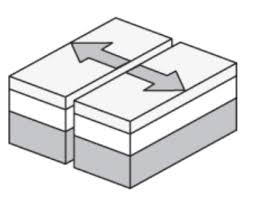
Name the boundary
a)
convergent boundary
b)
divergent boundary
c)
transform boundary
d)
sergent boundary
12.

Name the boundary
a)
convergent boundary
b)
divergent boundary
c)
transform boundary
d)
sergent boundary
13.
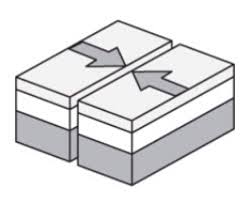
Name the boundary
a)
convergent boundary
b)
divergent boundary
c)
transform boundary
d)
sergent boundary
14.
This layer of Earth is the thickest part
a)
crust
b)
outer core
c)
mantle
d)
inner core
15.
Which ocean is expanding due to a mid-ocean ridge (divergent boundary)?
a)
Indian
b)
Dead Sea
c)
Atlantic
d)
Artic
16.
Is a layer of week of soft mantle that is made of rock that flows slowly. Tectonic plates move on top of this layer.
a)
Inner Core
b)
Asthensophere
c)
Lithosphere
d)
Outer Core
17.
This is the outermost, rigid layer of the Earth, made up of two parts, is divided into pieces call tectonic plates.
a)
Inner Core
b)
Asthensophere
c)
Lithosphere
d)
Outer Core
18.
The solid, dense center of our planet that extends from the bottom of the outer core to the center of the Earth..
a)
mantle
b)
outer core
c)
inner core
d)
crust
19.

Identify the letter in the diagram. Identify letter A
a)
Lithosphere
b)
Asthenosphere
c)
Mantle
d)
Outer Core
20.
Identify the letter in the diagram. Identify letter F
a)
Lithosphere
b)
Asthenosphere
c)
Mantle
d)
Outer Core
21.
Identify the letter in the diagram. Identify letter G
a)
Crust
b)
Convection Current
c)
Inner Core
d)
Outer Core
22.
Identify the letter in the diagram. Identify letter D
a)
Lithosphere
b)
Asthenosphere
c)
Mantle
d)
Outer Core
23.
Identify the letter in the diagram. Identify letter C
a)
Lithosphere
b)
Asthenosphere
c)
Mantle
d)
Inner Core
24.
The driving force of the tectonic plates are convection currents, where can these be found?
a)
inner core
inner core
inner core
b)
crust
c)
mantle
d)
outer core
25.
Which type of rock results from melting and cooling of magma?
a)
Igneous
b)
Metamorphic
c)
Sedimentary
d)
Extrusive
26.
Which type of rock forms from extreme heat and pressure?
a)
Igneous
b)
Sedimentary
c)
Organic
d)
Metamorphic
27.
What is the MAIN way rocks are classified?
a)
Their color and shapes
b)
How they form
c)
Mineral bands
d)
Where they form
28.
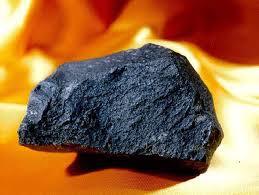
This rock was found near the mouth of a volcano. What type of rock is this?
a)
Sedimentary
b)
Igneous
c)
Metamorphic
29.
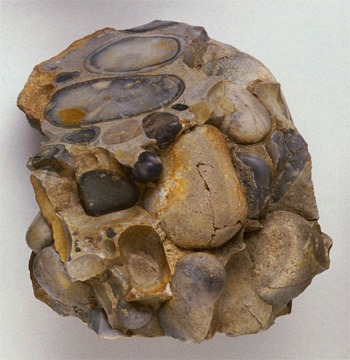
This rock was formed by smaller pieces of rock that settled at the bottom of a lake millions of years ago. What type of rock is this?
a)
Sedimentary
b)
Igneous
c)
Metamorphic
30.

This rock started as molten magma. What type of rock is this?
a)
Sedimentary
b)
Igneous
c)
Metamorphic
31.
Which type of rock forms from extreme heat and pressure?
a)
Igneous
b)
Sedimentary
c)
Organic
d)
Metamorphic
32.

What are the 3 main types of rocks?
a)
metamorphic, sedimentary, lava
b)
metamorphic, igneous, sedimentary
c)
metamorphic, magma, sedimentary
33.
Which of the following types of soil has the largest particles?
a)
sand
b)
silt
c)
humus
d)
clay
34.
Which type of soil is best for growing plants?
a)
sand
b)
clay
c)
gravel
d)
humus
35.

Are there minerals in soil?
a)
Yes
b)
No
36.
The color of a mineral in powder form is called the mineral's
a)
hardness
b)
specific gravity
c)
luster
d)
streak
37.
How light reflects off of a mineral is called the mineral's
a)
luster
b)
streak
c)
cleavage
d)
fracture
38.
Diamond has a hardness of ___ on Mohs Hardness Scale.
a)
1
b)
5
c)
8
d)
10
39.

The following image shows what mineral property?
a)
Hardness
b)
Streak
c)
Cleavage
d)
Density
40.
Dull, silky, waxy, pearly, and earthy are terms that best describe which property of minerals?
a)
luster
b)
color
c)
streak
d)
cleavage
41.

By definition, a mineral has which of the following characteristic(s)?
a)
definite chemical composition
b)
crystal structure
c)
naturally occuring
d)
all of the above
42.
How do you test the hardness of a mineral?
a)
Throw it against a wall
b)
Step on it
c)
Scratch Test
d)
Kick it until it breaks
43.

What mineral is used for pencils?
a)
Graphite
b)
Galena
c)
Magnetite
d)
Quartz
100 %

