wayground logo

Free Printable Worksheets

Font size

S
M
L
XL
Worksheets

US History Mid Term Review

Total questions: 135

Worksheet time: 2hrs 5mins

Name
Class
Date
1.
As Americans took over more and more land, what happened to Native Americans?
a)
They agreed to give up their land.
b)
They were given their choice of where to live.
c)
They were forced to live in reservations.
d)
They voluntarily moved to Canada and Mexico.
2.
What states were part of the Mexican Cession?
a)
Massachusetts, Rhode Island, Pennsylvania
b)
Louisiana, Arkansas, Alabama, Mississippi
c)
Oregon, Washington, Idaho
d)
California, New Mexico, Utah, Nevada
3.
Which part of the country was the Mexican Cession in?
a)
Northeastern U.S.
b)
Southeastern U.S.
c)
Northwestern U.S.
d)
Southwestern U.S.
4.
The war with Mexico BEGAN with
a)
California's rebellion
b)
a border dispute in Texas
c)
the Battle of Buena Vista
d)
a US invasion of Mexico City
5.
Which of the following presidents purchased Louisiana?
a)
Washington
b)
Adams
c)
Jefferson
d)
Jackson
6.
The purchase of Louisiana
a)
was a costly mistake
b)
was opposed by western farmers
c)
doubled the size of the United States
d)
led to war with Great Britain 
7.
What is the name of the piece of land the U.S. gained after the Mexican-American War?
a)
Oregon Country
b)
Given Mexican Land
c)
Louisiana Purchase
d)
Mexican Cession
8.
How did the U.S. acquire Oregon? 
a)
treaty with the British
b)
war with England
c)
purchased from the British
d)
war with Mexico
9.
Why was the Gadsden Purchase added to the U.S. in 1853?
a)
it was needed for the building of a railroad
b)
it was a gift from Mexico
c)
it was part of the treaty with Mexico
d)
gold was discovered in that area
10.
The discovery of gold led to
a)
California statehood
b)
Polk becoming president
c)
a war with Mexico
d)
Texas statehood
11.
During which time period did most territorial expansion of the United States take place?
a)
Early 1700s
b)
Early 1800s
c)
Late 1700s
12.
How did the Northwest Ordinance of 1787 provide for the orderly expansion of the United States?
a)
It provided the president with the power to sign treaties with foreign powers to buy additional territory
b)
It provided a review process for laws in new territories and states.
c)
It provided procedures for establishing territories and creating states.
13.
Where was most of the territory the United States acquired during the era of Westward Expansion?
a)
West of the Appalachian Mountains and east of the Mississippi River
b)
West of the Mississippi River
c)
Along the Canadian border with the United States
14.
Which of the following contributed to the westward expansion of the United States?
a)
European warships attacked the eastern seaboard, forcing citizens to move westward for safety.
b)
Most of the land east of the Mississippi River was not suitable for farming.
c)
Many Americans felt it was their right and duty to move westward.
d)
The standard of living on the Pacific Coast was very high, so many people wanted to move there.
15.
The philosophy of "Manifest Destiny" stated that American should expand from the Atlantic Ocean to the __________
a)
Mississippi River
b)
Pacific Ocean
c)
Rocky Mountains
d)
Great Lakes
16.
Belief that the U.S. would control North America?
a)
Manifest Destiny
b)
Manifest Determination
c)
Mandate of Heaven
d)
Imperialism
17.
Which area on the map was acquired by the United States as a result of the Mexican War?
a)
Texas Annexation
b)
Gadsden Purchase 
c)
Mexican Cession
d)
Oregon Territory
18.
Name the piece of Land.
a)
Texas Annexation
b)
Mexican Cession 
c)
Louisiana Purchase 
d)
Florida Cession
19.
Name the piece of land.
a)
Mexican Cession
b)
Northwest Territory 
c)
Trans-Appalachian West 
d)
Oregon Country 
20.
What was the name of the treaty where Mexico ceded half of its land to the United States?
a)
Treaty of Guadalupe Hidalgo
b)
Treaty of San Jacinto
c)
Treaty of Mesa Verde
d)
Treaty of Alama Gordo
21.
Which of these would be the best title for the illustration above?
a)
Divine Nature
b)
Survival of the Fittest
c)
Universal Expansion
d)
Manifest Destiny
22.
What did the Louisiana Purchase of 1803, the annexation of Texas in 1845, and the Mexican War of 1846 have in common?
a)
They brought about a war with Spain.
b)
They increased the territory of the United States.
c)
Each resulted in territory annexed by the United States.
d)
Each involved land forcibly taken from Mexico.
23.
Why was slavery generally supported by southerners?
a)
All southerners owned slaves
b)
They knew someday they would be slaveowners
c)
Slavery was an important part of their economy
d)
They would be executed for disagreeing
24.
Former slave, travels the country arguing for women's rights and abolition
a)
William Lloyd Garrison
b)
Sojourner Truth
c)
Harriet Beecher Stowe
d)
Harriet Tubman
25.
Uncle Tom's Cabin intensified Northern dislike of slavery.
a)
True
b)
False
26.
Who was the author of the book written to depict the evils of slavery?
a)
Henry David Thoreau
b)
Catherine Beecher
c)
Harriet Beecher Stowe
d)
Harriet Tubman
27.
Harriet Beecher Stowe wrote this influential book that caused many in the North to become anti-slavery after reading it.
a)
Nat Turner's Revolt
b)
The Liberator
c)
The Bugler
d)
Uncle Tom's Cabin
28.
Most famous conductor of the Undergroud Railroad.
a)
Harriet Beecher Stowe
b)
Harriet Tubman
c)
Harriet Stanton
d)
Harriet Marshall
29.
Abolition is a movement to end...
a)
the consumption of alcohol
b)
slavery
c)
women's rights
d)
trade
30.
Shared his personal testimony of being a slave himself, he made listeners realize the brutality and horrors of slavery
a)
William Lloyd Garrison
b)
John Brown
c)
Frederick Douglass
d)
Benjamin Rush
31.
Was published by William Lloyd Garrison
a)
The Liberator
b)
The North Star
c)
Harper's Weekly
d)
Uncle Tom's Cabin
32.
Southerners felt as though they needed stricter rules to be able to control African-Americans after this event...
a)
Nat Turner's rebellion
b)
publication of The North Star
c)
publication of Uncle Tom's Cabin
d)
13h Amendment
33.
This was the network that helped runaway slaves reach the north?
a)
Underground Railroad
b)
Ocean Ships
c)
Transcontinental Railroad
d)
Freedom Train
34.
What compromise was created by Henry Clay during the 1820s?
a)
Kansas Nebraska Act
b)
Comrpomise of 1850
c)
Tariff Compromise
d)
Missouri Compromise
35.
The Fugitive Slave was a part of what Compromise?
a)
The Missouri Compromise
b)
Kansas-Nebraska Act
c)
Compromise of 1850
d)
Tariff Compromise
36.
This was created in part because of the devotion to different regions of the United States?
a)
Sectionalism
b)
Division
c)
Slavery
d)
Agriculture
37.
This man was an escaped slave who taught himself to read and write.  He became an influential player in the abolitionist movement?
a)
Stephen Douglass
b)
Solomon Northup
c)
Frederick Douglass
d)
Harry Tubman
38.
She was known as the Moses of her People?
a)
Harriet Tubman
b)
Cloteet
c)
Sojourner Truth
d)
Harriet Beecher Stowe
39.
This slave sued for his freedom.  What was the court case called?
a)
Scott v Sanford
b)
Brown v Board of Education
c)
Plessy v Ferguson
d)
Roe v Wade
40.
Factories like this were commonly found in what region of the United States during the early half of the 19th century?
a)
West
b)
North
c)
South
d)
East
41.
What event was the event held to promote women’s rights in 1848?
a)
The March on Washington
b)
The Sarah Childress Polk Meeting
c)
The Rally in Hyde Park
d)
The Seneca Falls Concention
42.
What invention instigated slavery greatly expanding across the south?
a)
The telegraph
b)
The lawn mower
c)
The cotton gin
d)
The light bulb
43.
This law allowed Missouri to become a slave state at the same time Maine became a free state.  It prohibited slavery in the Louisiana Territory.
a)
Missouri Compromise
b)
Compromise of 1850
c)
Kansas Nebraska Act
d)
Fugitive Slave Laws
44.
This law allowed California to become a free state and gave southerners a law that return escaped slaves back to the south.   
a)
Kansas Nebraska Act
b)
Missouri Compromise
c)
Dred Scott Decision 
d)
Compromise of 1850
45.
Under the Kansas-Nebraska Act of 1854, how would Kansas and Nebraska decide if they were a free or slave state?
a)
lottery
b)
President would decide
c)
Governors would decide
d)
popular sovereignty
46.
Popular sovereignty means
a)
let the people vote on the decision
b)
pro slavery
c)
fight for a cause
d)
to die for a cause
47.
What compromise abandons the Missouri Compromise?
a)
The belief that you're part of the country is the BEST.  You put your part of the country's needs in front of what is best for the WHOLE nation.
b)
Compromise of 1850
c)
Kansas-Nebraska Act
48.
What controversial Law required U.S citizens to return runaway slaves back to their owner?
a)
Slave codes 
b)
Fugitive Slave Act
c)
Underground railroad 
d)
Slaves Law of 1852
49.

Antebellum in American history was

a)

time period before the Civil War

b)

time period before the American Revolution

c)

time period before WW 1

d)

time period before WW2

50.

The main economy of the North during Antebellum was

a)

farming

b)

mining

c)

factories/manufacturing

d)

cash crops

51.

The main economy of the South during Antebellum was

a)

farming

b)

mining

c)

factories/manufacturing

d)

railroad

52.
Angelina and Sarah Grimke were sister from SC and are most notable as being 19th century?
a)
Abolitionists
b)
Anarchists
c)
Politicians
d)
Suffragettes
53.
Describe the slave population in the south by the 1820's
a)
slavery was just beginning in America
b)
Slaves were only in the Northern states
c)
There was an African American majority in most Southern states.
d)
There were only slaves coming from Barbados at that time
54.
What was the reason for the English wanting a permanent settlement at Jamestown?
a)
They were looking to escape religious persecution.
b)
They wanted a permanent vacation spot.
c)
It was an economic venture.
d)
It was an exploration venture.
55.
Why did groups like the Pilgrims and the Puritans come to America?
a)
To Make More Money
b)
To Expand Land for the King of England
c)
To Build a New Government
d)
To Practice Their Religion Freely
56.
This company was responsible for writing the charter to settle Jamestown.
a)
The Jamestown Company
b)
The England Company
c)
The New England Company
d)
The Virginia Company
57.
Which social group's members could vote?
a)
Male landowners
b)
Free African American 
c)
Women
d)
Artisans
58.

The agreement Pilgrims made to govern themselves and make fair laws is called the........

a)

Declaration of Independence

b)

Mayflower Compact

59.
Which of the colonial regions had mild winters and long, hot summers?
a)
New England colonies
b)
Middle colonies
c)
Southern colonies
d)
Western colonies
60.
Small farms, rocky soil, cold winters, short growing season describes
a)
New England colonies
b)
Middle colonies
c)
Southern colonies
d)
Western colonies
61.
All of the following are characteristics of the Middle colonies EXCEPT:
a)
market towns
b)
wide-spread use of slavery
c)
different religions
d)
villages and cities
62.
To run large plantations, planters relied mostly on the work of _________________.
a)
apprentices
b)
free African-Americans
c)
enslaved African-Americans
d)
artisans
63.

This colonial region specialized in shipbuilding and fishing

a)

Mid-Atlantic

b)

New England

c)

Southern

d)

North

64.
This colonial region specialized in cotton, tobacco, indigo, rice, and forest products
a)
Mid-Atlantic
b)
New England
c)
Southern
65.
Where were the first armed conflicts of the American Revolution?
a)
Yorktown
b)
Saratoga
c)
Lexington and Concord
d)
Bunker Hill
66.
What was the name of the British king during the American Revolution?
a)
Charles III
b)
George III
c)
William III
d)
James III
67.
This American victory was the turning point in the war.
a)
Saratoga
b)
Yorktown
c)
Bunker Hill
d)
Lexington and Concord
68.
Who was the major author of the Declaration of Independence?
a)
Benjamin Franklin
b)
John Adams
c)
Thomas Jefferson
d)
Patrick Henry
69.
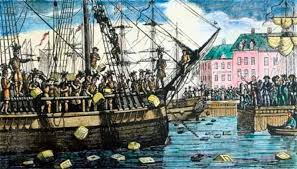
What event is depicted in this image?
a)
Boston Massacre
b)
Boston Tea Party
c)
Battle of Bunker Hill
d)
Lexington and Concord
70.
Samuel Adams and Paul Revere led members of the Sons of Liberty in this protest against taxes.
a)
First Continental Congress
b)
Boston Massacre
c)
Boston Tea Party
d)
Stamp Act Congress
71.
Of the following events, which happened first? 
a)
Saratoga
b)
Yorktown
c)
Declaration of Independence
d)
Treaty of Paris of 1783
72.
The U.S. was founded on July 4, 1776, by the approval of this document.
a)
the Treaty of Paris
b)
the Constitution
c)
the Declaration of Independence
d)
the Virginia Charter
73.
This was a tax on molasses and sugar to reduce smuggling.
a)
Stamp Act
b)
Sugar Act
c)
Townshend Act
d)
Tea Act
74.
This was a tax on all printed materials in the 13 Colonies.
a)
Stamp Act
b)
Sugar Act
c)
Tea Act
d)
Townshend Act
75.
Finish this American Colonist Motto, "No Taxation without..."
a)
Transportation
b)
Relaxation
c)
Representation
d)
Sensation
76.
Why were the American Colonist taxed after the French and Indian War?
a)
Britain was in debt and needed money
b)
That was the agreement with the Native Americans
c)
They made too much money
d)
Townshend Acts
77.
Which was the punishment for the Boston Tea Party?
a)
Intolerable Acts
b)
Sugar Acts
c)
Quartering Acts
d)
Stamp Acts
78.
Which compromise is made up of ideas from the Virginia Plan and the New Jersey plan?
a)
The Great Compromise
b)
The three-fifths compromise
c)
The constitutional compromise
d)
The big compromise
79.
Which group of people wanted the Constitution to include a Bill of Rights?
a)
Federalists
b)
Anti-federalists
c)
Democrats
d)
Northerners
80.
Anti-federalists wanted a Bill of Rights added to the constitution to help protect...
a)
Individual Rights
b)
State Rights
c)
Slavery
d)
The Articles of Confederation
81.
Which of the following is NOT a branch of the government?
a)
Legislative
b)
Judicial
c)
Executive
d)
Constitutional
82.
The Federalists papers were written to persuade people to support the new constitution.
a)
True
b)
False
83.
______ is the belief that the government gets its power from the people.
a)
Rule of Law
b)
Popular Sovereignity
c)
Checks and balances
d)
Federalism
84.
The Constitution replaced the ______ as the governing document of the country.
a)
Declaration of Independence
b)
Bill of Rights
c)
Emancipation Proclamation
d)
Articles of Confederation
85.
Which branch executes the laws?
a)
Executive
b)
Judicial
c)
Appellate
d)
Legislative
86.
Which branch interprets the laws?
a)
Executive
b)
Judicial
c)
Appellate
d)
Legislative
87.
Which branch makes the laws?
a)
Executive
b)
Judicial
c)
Appellate
d)
Legislative
88.
What is the name for a change or addition to the Constitution?
a)
Federalism
b)
Amendment
c)
Ratification
d)
Veto
89.
What plan had 2 houses, favored the larger states, and was based on population?
a)
Virginia Plan
b)
New Jersey Plan
c)
Great Compromise
d)
3/5 Compromise
90.
What plan had 1 house, favored the smaller states, and was based on equal representation?
a)
Virginia Plan
b)
New Jersey Plan
c)
Great Compromise
d)
3/5 Compromise
91.
What plan had 2 houses, one house that favored the larger states (population) and one house that favored the smaller states (equal representation)?
a)
Virginia Plan
b)
New Jersey Plan
c)
Great Compromise
d)
3/5 Compromise
92.

Constitutional legislative power that allows Congress to stretch its powers to get things done.

a)

Necessary & Proper Clause

b)

Elastic Clause

c)

Both

93.

Method for counting of slaves towards the state population.

a)

Connecticut Compromise

b)

New Jersey Plan

c)

Articles of Confederation

d)

3/5th Compromise

94.
Which court case establishes Judicial Review?
a)
Mculloh V Maryland
b)
Marbury V Madison
c)
Plessy V Ferguson
d)
Hamilton V Jefferson
95.
What is the name of the two political parties in 1800?
a)
There were no political parties
b)
Anti-federalists and Adams Democrats
c)
Federalists and Jeffersonian Republicans
d)
Democrats and Republicans
96.
The railroad boom began in 1862 when President Abraham Lincoln signed the ______________
a)
Time zone legislation
b)
Gettysburg Address
c)
Land Grant Law
d)
Pacific Railway Act
97.
The government offered each railroad company land along its right of way to
a)
Give railroad workers a place to live
b)
Encourage rapid construction of the tracks
c)
Allow the companies to build stations along the way
d)
Keep anyone else from building there
98.
Railroad companies raised most of the money that they needed to build their railroads from
a)
Private investors
b)
Selling government land grants
c)
subsidies from tax revenues
d)
Hauling freight to market
99.
To make rail service more reliable, in 1883 the American Railway Association
a)
Set standards for materials used in the construction of railroads
b)
Set a maximum number of cars that a train could pull
c)
Drew latitude and longitude lines for the country
d)
Divided the country into standardized time zones
100.
What industries were given a big boost by the railroads
a)
Coal, lumber, and steel
b)
farming and ranching
c)
Fake plastic vomit
d)
Aviation
101.
Where did the two parts of the TRR meet?
a)
Promontory, UT
b)
New York, NY
c)
San Francisco, CA
d)
Omaha, NE
102.
Why was the transcontinental railroad beneficial to America?
a)
The railroad was built over mountains that were impassable in stagecoach.
b)
Railroads provided a faster, safer, and cheaper transportation.
c)
Railroads allowed People to bring their furniture to the Great Plains.
d)
Railroads crossed rivers which were difficult to cross earlier.
103.
How were the Chinese discriminated against?
a)
They were denied water and supplies
b)
Black Codes prevented their freedoms
c)
they were objected to Jim Crow Laws
d)
they were paid less than other workers
104.

Why were the Chinese immigrants important in helping complete the railroad?

a)

They didn't have to be paid as much as the other workers.

b)

They knew how to work with the gunpowder that was used to blast holes in the mountains for tunnels.

c)

They were the hardest workers of all.

d)

They were very fast workers.

105.

How did the railroad system change life across America?

a)

Made traveling easier, faster, and safer.

b)

Now that things could be shipped all over the country by train, many industries grew.

c)

The west became more populated because it was easier to get there.

d)

All of the above

106.

Why was the railroad called transcontinental?

a)

The word transcontinental means "across the continent" which is what this railroad did.

b)

The word transcontinental mean "around the continent" which is what this railroad did.

c)

Trans means away, so it mean away from the country. It was called this because things on the train went away from where they were originally.

107.
This period during the 1870s to 1900 is known for it's rise of railroads, big business, industrialization and social problems in the United States.
a)
World War I
b)
Progressive Era
c)
Gilded age
d)
Roaring Twenties
108.
in 1882, the Government passed this legislation that restricted immigration for 10 years from a certain group into the United States.
a)
Nativist Act
b)
Mexican Reparition Act
c)
Dawes Act
d)
Chinese Exclusion Act
109.
During the Gilded age, workers came together to work for better pay, working conditions, and less hours. Leaders such as Samuel Gompers help led many of this workers in....
a)
Philanthropy
b)
Labor Unions
c)
Political Bosses
d)
Credit Unions
110.
Under this policy in 1887, the Government gave Native Americans land in order to farm land, just like European farmers. 
a)
Dawes Act
b)
Ghost Dance
c)
Trail of Tears
d)
Laws Act
111.
The innovation of this transportation help open up the national market? 
a)
boats
b)
railroads
c)
autombils 
d)
horse drawn carriages 
112.
Men such as Andrew Carnegie believed in giving money to libraries, musuems and schools to help benefit people who wanted to move up in the social ladder. 
a)
geopolitical
b)
political bosses
c)
anthropolgy
d)
philanthropy
113.
Because of the rapid growth of Industrilization in the North people moved out of rural towns to?
a)
Rural farms
b)
Urbanzied cities
c)
Subrebs cities
d)
El rancho
114.
Many Immigrants faced issues once they arrived such as language barriers, but these group of people mostly restricted new immigrants from emtering the country.
a)
Democrats
b)
Republicans
c)
Donald Trump
d)
Nativists
115.
A group of companies in the same industry giving day-to-day operation of their companies over to a single board of directors.
a)
monopoly
b)
corporation
c)
trust
d)
horizontal Integration
116.
Between 1860 and 1910, the U.S. population tripled due to:
a)
The Baby Boom
b)
Immigration
c)
The Homestead Act
d)
Better Healthcare
117.
What is it called when one company controls an entire industry?
a)
monopoly
b)
oligarchy
c)
trust
d)
robber baron
118.
He created the company known as Standard Oil
a)
Andrew Carnegie
b)
Cornelius Vanderbilt
c)
John D. Rockefeller
d)
Thomas Edison
119.
Which of these is NOT a reason why people viewed industrial leaders as robber barons?
a)
wealthy manipulators of government
b)
unfairly squeezed out competietion
c)
exploited the working class
d)
provided progress, jobs, technolgy
120.
Which of these is NOT a reason why industrial leaders were considered captains of industry?
a)
They formed monopolies
b)
They helped the country
c)
They deserved the riches they create
d)
They provide progress, jobs, technology
121.
 Images such as this illustrate the position that many US companies were — 
a)
requiring vocational training programs for children
b)
employing children as a source of cheap labor
c)
seeking government regulation of child labor
d)
providing safe working conditions for child laborers
122.
An organization of workers formed to improve working conditions is called what?
a)
Philanthropy
b)
Labor Unions
c)
Political Bosses
d)
Credit Unions
123.
When one company controls one entire step in a production process they have a . . .
a)
Horizontal Monopoly
b)
Vertical Monopoly
124.
What is a refusal to work as a form of protest?
a)
Strike
b)
Union
c)
Muckraker
d)
Suffrage
125.
This man was the founder of U.S. Steel and also one of history's greatest philanthropists
a)
John Rockefeller
b)
J.P. Morgan
c)
Andrew Carnegie
d)
Cornelius Vanderbilt
126.
The technological development most revolutionized US steel industry.
a)
Electrification
b)
Vulcanization
c)
Steam power
d)
Bessemer Process
127.
What is a monopoly?
a)
A company that has complete control of an industry and does not allow competition.
b)
A game that old people love to play.
c)
A business that is controlled by the government.
d)
none of the above
128.
Which law granted 160 acres of land to any male head of household willing to move West?
a)
The Interstate Commerce Act
b)
The Pendleton Act
c)
The Homestead Act 
d)
none of the above
129.
The transformation from rural to city is called
a)
urbanization
b)
industrialization
c)
Manifest Destiny
d)
factory system
130.
What processing station did Immigrants go through on the WEST coast?
a)
Ellis Island
b)
Angel Island
c)
Devil Island
d)
Alcatraz
131.
Most immigrants came through this port in New York City...
a)
Ellis Island
b)
Roanoke Island
c)
Angel Island
d)
Liberty Island
132.
Which group believed in survival of the fittest and people were naturally selected to succeed?
a)
social darwinist
b)
political bosses
c)
nativist
d)
political machines
133.
Which law expanded competition and eliminated trusts and monopolies?
a)
Interstate Commerce Act 
b)
Homestead Act
c)
Sherman AntiTrust Act
d)
Dawes Act
134.
Which of the following was the Captain of Industry for the steel industry? 
a)
John D. Rockefeller
b)
Alexander Graham Bell
c)
Cornelius Vanderbilt
d)
Andrew Carnegie
135.
He made his fortune in the oil industry and began an oil company known as the Standard Oil Company. 
a)
John D. Rockefeller
b)
Thomas Edison
c)
Cornelius Vanderbilt
d)
Andrew Carnegie