
 Worksheets
Bonding
Total questions: 32
Worksheet time: 40mins
Name
Class
Date
1.
Covalent compounds
a)
Share electrons
b)
transfer electrons
c)
contain a sea of electrons
d)
conduct electricity
2.
What two types of atoms make a covalent bond?
a)
2 Nonmetals
b)
1 Nonmetal and 1 Metal
c)
2 Metals
d)
2 Noble Gases
3.

What elements generally make an ionic bond?
a)
metal and nonmetal
b)
2 or more nonmetals
c)
metal
d)
none of the above
4.
What is a valence electron?
a)
an electron that is found in the outermost shell of an atom.
b)
an electron found in the innermost shell of an atom.
c)
an electron found in the middle shell.
5.
What is the number of valence electrons for Oxygen?
a)
8
b)
6
c)
2
d)
1
6.
What is the number of valence electrons for Neon?
a)
6
b)
7
c)
8
d)
9
7.
Is Hydrogen considered a metal or a non-metal?
a)
Metal
b)
Non-metal
8.
Ionic Bonding involves...
a)
The transfer of protons
b)
The transfer of nuetrons
c)
The transfer of electrons
d)
None Of the above
9.
What happens when the sodium atom loses an electron?
a)
It become negatively charged
b)
It become positively charged
c)
none
10.
The number of dots in a Lewis electron dot structure is equal to the number of
a)
valence electrons
b)
core electrons
c)
protons
d)
neutrons
11.
When an atom loses an electron, it becomes a:
a)
Positive ion
b)
Negative ion
c)
Neutral ion
d)
Neutral atom
12.
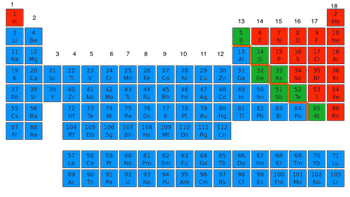
Where are metals located on the periodic table?
a)
Blue
b)
Green
c)
Red
13.
Which of the following has covalent bonding?
a)
CH4
b)
CaO
c)
CuCl2
d)
Li2O
14.

What is an ion?
a)
A Charged Atom
b)
A Large Atom
c)
A Small Atom
d)
A Cute Atom
15.

Cations are...
a)
Positive
b)
Negative
c)
Neutral
d)
Purring
16.

Anions are...
a)
Positive
b)
Negative
c)
Neutral
d)
Crying
17.
An octet of electrons contains...
a)
18 electrons
b)
8 electrons
c)
10 electrons
d)
0 electrons
18.
When an atom loses an electron, it becomes a:
a)
positive ion
b)
negative ion
c)
neutral ion
d)
neutral atom
19.
An electron has what kind of charge?
a)
no charge
b)
positive
c)
negative
d)
it depends
20.
Elements in the same _________ have the same number of valence electrons
a)
Row
b)
Group
c)
Metals
d)
Nonmetals
21.
What are ionic bonds?
a)
valence electrons transferred between atoms
b)
Inner most electrons transferred between atoms
22.
What elements generally make an ionic bond?
a)
metal and nonmetal
b)
2 or more nonmetals
c)
metal
d)
none of the above
23.
Predict the bond that will form between Be and F.
a)
Ionic
b)
Covalent
24.
How many valence electrons are elements trying to reach in their outer shells?
a)
1
b)
2
c)
5
d)
8
25.

Which of these is covalent?
a)
NaCl
b)
Pb(NO3)2
c)
CO2
d)
AlCl3
26.
Which of the following has a full valence shell?
a)
Oxygen
b)
Neon
c)
Barium
d)
Carbon
27.
Ionic bonds can be formed between two nonmetals.
a)
True
b)
False
28.

How many valence electrons in this structure?
a)
6
b)
5
c)
4
d)
7
29.
Is the following compound ionic or covalent:
AlCl3
AlCl3
a)
ionic
b)
covalent
30.
Predict the bond that will form between Sr and S.
a)
Ionic
b)
Covalent
31.
What is the number of valence electrons for Silicon?
a)
1
b)
2
c)
6
d)
4
32.
Predict the bond that will form between Se and Cl.
a)
Ionic
b)
Covalent
100 %

