wayground logo

Free Printable Worksheets

Font size

S
M
L
XL
Worksheets

Quizziz #10 (Due Sunday, 12/16 @ 11pm)

Total questions: 43

Worksheet time: 33mins

Name
Class
Date
1.
These hormones are synthesized from cholesterol.
a)
peptide
b)
steroid 
c)
amine
2.
Organ that secretes epinephrine
a)
thyroid
b)
pancreas
c)
adrenal gland
d)
anterior pituitary
3.
Insulin is this type of hormone
a)
peptide
b)
steroid
c)
amine
4.
Produces insulin
a)
pancreas
b)
adrenal gland
c)
liver
d)
anterior pituitary
5.

Specialized group of cells and tissues that work together to produce and secrete substances such as hormones, enzymes or other bodily components

a)

Hormone

b)

Gland

c)

Thymus

6.
Which is true for insulin?
a)
created in the beta cells of the islets of Langerhans
b)
increases blood sugar
c)
controlled by a positive feedback loop
d)
needed for adult onset diabetes
7.
The term for "steady state" that the body tries to maintain is
a)
homeostasis
b)
dialysis
c)
equilibrium
d)
diuresis
8.

What two hormones pancreas produced

a)

glucagon and cortisol

b)

glucose and insulin

c)

glucagon and insulin

d)

glucose and aldosterone

9.

what does glucagon and insulin do

a)

clean your blood

b)

control blood sugar concentration

c)

help you digest faster

d)

make you high

10.
The term for maintaining internal temperature is: 
a)
Thermoregulation
b)
Thermometer
c)
Homeothermal
d)
Homeostasis
11.

Vasodilation means

a)

blood vessels allow more blood to flow through them

b)

blood vessels allow less blood to flow through them

c)

blood vessels swell up

d)

there is a blood clot

12.

Three ways you body can lose heat

a)

Evaporation of sweat

b)

Warm air exhaled out

c)

Hairs becoming erect

d)

Vasodilation

13.

Why is the bodies core temperature 37oC?

a)

Optimum temperature for enzymes

b)

No specific reason

c)

To limit the enzymes rate of reaction

d)

Its not 37oC

14.

What is osmoregulation?

a)

maintaining blood pressure and volume

b)

maintaining salt and water balance in cells

c)

controlling the functions of the kidney

15.
When the temperature is too hot, what occurs?
a)
vasodilation - more blood near the surface of the skin
b)
vasoconstriction - less heat near the surface of the skin
16.
When the temperature is too cold, what occurs?
a)
vasodilation - more blood near the surface of the skin
b)
vasoconstriction - less heat near the surface of the skin
17.
Osmosis is the movement of _____ across a membrane.
a)
food
b)
energy
c)
oxygen
d)
water
18.
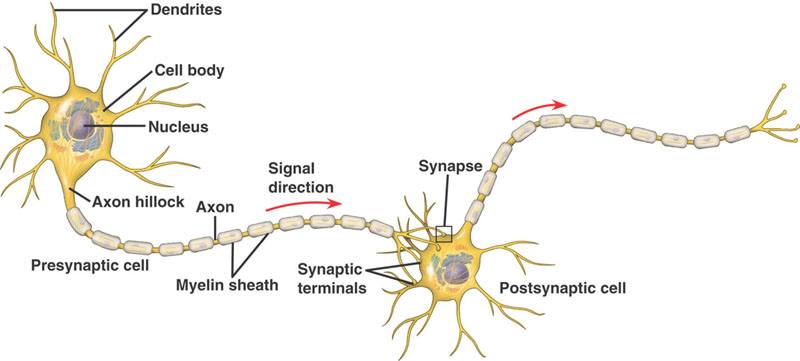
What is Dendrite
a)
nerve fibers that carry message to cell body
b)
allow nerve impulses to pass from one neuron to next neuron
c)
nerve fibers that carry message from the cell body
d)
fat covering of the neuron
19.

What makes up the central nervous system?

a)

heart, lungs, brain

b)

cerebrum, cerebellum, medulla

c)

brain, spinal cord, and nerves

20.
Anything that causes you to respond is ....
a)
a response.
b)
a stimuli.
c)
a reaction.
d)
an interpretation.
21.
a signal molecule that transmits nerve impulses across synapses
a)
neuron
b)
neurotransmitter
c)
nerve
d)
action potential
22.
What number(s) on the graph represents the Resting Potential?
a)
1 and 2
b)
1 and 5
c)
2 and 3
d)
3 and 4
23.
Which ions are involved in the electrical nerve impulse?
a)
Iodine and Sodium
b)
Potassium and Sodium
c)
Iron and Sodium
d)
Calcium and Iodine
24.
-70 mV is the measure of a
a)
Threshold Potential
b)
Action Potential
c)
Resting Potential
d)
End Point Potential
25.
A membrane potential becoming less negative is called
a)
hyperpolarization
b)
depolarization
c)
repolarization
d)
polarization
26.
What number on the graph represents the Depolarization phase?
a)
1
b)
2
c)
3
d)
4
27.
What number on the graph represents the Hyperpolarization phase?
a)
1
b)
2
c)
3
d)
4
28.
What is the insulating membrane that surrounds parts of the axon that helps to protect & propagate action potential?
a)
Axon
b)
Dendrites
c)
Node of Ranvier
d)
Myelin Sheath
29.

What contains the nucleus of the neuron?

a)

Terminal Bouton

b)

Cell Body

c)

Axon Hillock

d)

Myelin Sheath

30.

The space between a presynaptic and post synaptic neuron

a)

Nodes of Ranvier

b)

Axon Hillock

c)

synaptic cleft

d)

terninal bouton

31.
What number(s) on the graph represents the Resting Potential?
a)
1 and 2
b)
1 and 5
c)
2 and 3
d)
3 and 4
32.
When a neuron is depolarized, what are the first channels to open?
a)
Sodium
b)
Potassium
c)
Calcium
d)
ACTH
33.
When a neuron is resting, the inside of the axon has a ____________ charge.
a)
positive
b)
negative
34.
When a membrane potential reaches +30mV, ________ channels open, ________ occurs, and ________ channels close.
a)
Sodium, depolarization, potassium
b)
Potassium, depoloarization, sodium
c)
sodium, repolarization, potassium
d)
postassium, repolarization, sodium
35.
A signal molecule that binds to a plasma-membrane protein is a
a)
ligand
b)
second messenger
c)
protein kinase
d)
receptor protein
36.
What is an organic compound that is made by glands in the body (pituitary, thyroid, etc) that is used in long distance communication between cells?
a)
Hormones
b)
Neurotransmitters
c)
Synapse
d)
Carbohydrates
37.
Signal amplification is most often achieved by
a)
an enzyme cascade
b)
binding of multiple signals
c)
branching pathways
d)
action of adenylyl cyclase
38.
Which of the following correctly describes the reception stage of the signal transduction pathway for insulin?
a)
insulin binds to a protein receptor that is present in the cell membrane of the target cell
b)
ATP is synthesized by mitochondria 
c)
The transport protein for glucose is inserted into the cell membrane to allow glucose to passively enter the cell
d)
tyrosine kinases phosphorylate enzymes and activate them
39.
What is the name of the pathway that occurs when a signal is received and then converted into a cellular response?
a)
signal transduction
b)
biochemical
c)
catabolic
d)
anabolic
40.
This junction allows communication between two animal cells with adjoining plasma membrane channels.
a)
Desmosomes
b)
TIght Junctions
c)
Gap Junctions
d)
Plasmodesmata
41.
Allows for communication between plant cells
a)
Desmosomes
b)
Tight Junction
c)
Gap Junction
d)
plasmodesmata
42.
Heartbeat, digestion, and other self-regulating bodily functions are governed by the:
a)
Voluntary Nervous System
b)
Autonomic Nervous System
c)
Sympathetic Nervous System
d)
Somatic Nervous System
43.
Voluntary movements, such as writing with a pencil, are directed by the:
a)
Sympathetic Nervous System
b)
Somatic Nervous System
c)
Parasympathetic Nervous System
d)
Autonomic Nervous System