Wayground logo

Free Printable Worksheets

Font size

S
M
L
XL
Worksheets

AP Biology Photosynthesis Review

Total questions: 36

Worksheet time: 37mins

Name
Class
Date
1.
Which of the following are products of the light reactions of photosynthesis that are utilized in the Calvin Cycle?
a)
CO2 and glucose
b)
ATP and NADPH
c)
ADP, P and NADP+
d)
H2Oand O2
2.
Where does the Calvin cycle take place?
a)
Stroma
b)
thylakoid
c)
thylakoid space
d)
matrix
3.
When oxygen is released as a result of photosynthesis, it is a direct by-product of____
a)
reducing NADP+
b)
splitting water molecules
c)
chemiosmosis
d)
electron transfer in photosystem 1
4.
What is the main role of the pigment molecules in a light-harvesting complex in the thylakoid membranes?
a)
split water and release oxygen to te reaction-center chloropyll
b)
transfer light energy to the reaction-center chlorophyll
c)
synthesize ATP
d)
transfer electrons to NADPH
5.
In what respect are the photosynthetic adaptations of C4 plants and CAM plants similar?
a)
an enzyme other than Rubisco carries out the first step in carbon fixation 
b)
both types of plants make most of their sugar in the dark
c)
both types of plants make their sugar without the Calvin cycle
d)
Stomata normally close during the day
6.
T or F: The light reactions of photosynthesis suppley the calvin cyucle with ATP and NADPH
a)
True
b)
False
7.
T or F: In photosynthetic cells, the electron transport chains are located in the thylakoid membranes and mitochondrial inener membranes.
a)
True
b)
False
8.
In chemiosimosis in mitochondria, protons flow from the intermembrane space into the matrix, whearas in chemiosimosis in chloroplast, protons flow from __________
a)
the thylakoid space to the stoma
b)
the stoma to the thylakoid space
c)
the matrix into the stoma
d)
the stoma into the cytosol
9.
Which of the following events occurs in the light reactions of photosynthesis?
a)
NADP+ is produced
b)
ATP is consumed to yield ADP
c)
light is absorbed and funneled to  chlorophyll a
d)
carbon dioxide is fixed in organic molecules
10.
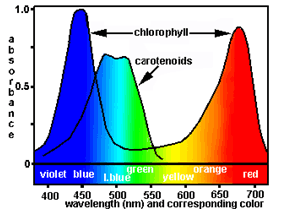
The color of light least effective in driving photosynthesis is _________
a)
blue
b)
red
c)
orange
d)
green
11.
2 energy rich molecules created by Light Dependent Reactions of Photosynthesis are:
a)
ATP and ADP
b)
ATP and NADPH
c)
ADP and FADH
d)
ADP and NADP
12.
What is the name of a pigment-containing complex found in a thylakoid?
a)
chlorophyll a
b)
photosystem
c)
grana
d)
stroma
13.
When carbon first enters the Calvin cycle, what molecule does it combine with? 
a)
PGA
b)
G3P
c)
RuBP
d)
ATP
14.
What is the function of NADP+?
a)
It absorbs light
b)
It is an electron carrier
c)
It is a light-reflecting pigment
d)
It acts as long-term energy storage
15.

What is one function of the other pigments besides chlorophyll, in the chloroplast?

a)

to block damaging wavelengths of light

b)

to absorb different wavelengths than the chlorophyll

c)

to provide different colors to the leaves

d)

to transfer energy to a separate photosystem beside the one using chlorophyll a and b.

16.

Which of the following statements best represents the relationships between the light reactions and the Calvin cycle?

a)

The light reactions provide ATP and NADPH to the Calvin cycle, and the Calvin cycle returns ADP, ℗i, and NADP+ to the light reactions.

b)

The light reactions provide ATP and NADPH to the carbon fixation step of the Calvin cycle, and the Calvin cycle provides water and electrons to the light reactions.

c)

The light reactions supply the Calvin cycle with CO2 to produce sugars, and the Calvin cycle supplies the light reactions with sugars to produce ATP.

d)

The light reactions provide the Calvin cycle with oxygen for carbon fixation, and the Calvin cycle provides the light reactions with sugars to produce ATP.

17.

Rubisco is important in which step of photosynthesis

a)

energizing the electrons in chlorophyll

b)

carbon fixation when CO2 is connected to RUBP during calvin cycle

c)

regeneration phase as RUBP is made during calvin cycle

d)

reduction of the carbon chain during the calvin cycle

18.

Why does photorespiration occur?

a)

stomata are closed and CO2 levels are too low.

b)

stomata are closed and O2 levels are too low.

c)

stomata are open and too much water is leaving the plant

d)

stomata are open and the plant receives too much CO2

19.
Photosynthesis
a)
Endergonic
b)
Exergonic
20.
Which of the following molecules is not needed for the Calvin Cycle?
a)
CO2
b)
ATP
c)
NADPH
d)
H2O
21.
Green plants reflect ________ light.
a)
Red
b)
Green
c)
All
d)
Red and Violet
22.
The light reactions occur in the ________ and the dark reactions take place in the ________.
a)
Chloroplast / thylakoid membrane
b)
stroma / thylakoid
c)
mesophyl / stomata
d)
thylakoid membrane / stroma
23.
Where does the carbon come from that is used to form glucose?
a)
The soil
b)
CO2 in the air
c)
From other carbohydrates
d)
Calvin Cycle
24.
When oxygen is released as a result of photosynthesis, it is a direct by-product of
a)
reducing NADP+
b)
splitting water molecules
c)
chemiosmosis
d)
electron transfer in photosystem II and I
25.
What is the primary function of the Calvin cycle?
a)
regenerate ATP for use in the light reactions of photosynthesis
b)
produce carbon dioxide for use in the light reactions of photosynthesis
c)
produce oxygen by oxidizing water
d)
produce simple sugars from carbon dioxide
26.
The H+ concentration gradient is used to 
a)
make NADPH
b)
split a water molecule
c)
generate ATP
d)
form water
27.
The main source of energy for all life comes from ____.
a)
the Earth
b)
the moon
c)
the sun
d)
the food we eat/make
28.
Which of the following is the correct equation for PHOTOSYNTHESIS?
a)
6CO2 + 6H2O --> 6O2 + C6H12O6
b)
6CO2 + C6H12O6 + 6H2O --> O2 
c)
6O2 + 6H2O --> 6CO2 + C6H12O6
d)
C6H12O6 + 6O2 ---> 6H2O + 6CO2 
29.

Where does carbon dioxide enter plants?

a)

The leaves

b)

Stomata

c)

Roots

d)

Stem

30.
Where does a plant absorb the water that it uses during photosynthesis?
a)
Leaves
b)
Stem
c)
Roots
d)
Petals
31.
Which of the following is directly associated with Photosystem I?
a)
harvesting light energy to make ATP
b)
receiving electrons from the thylakoid membrane ETC
c)
generation of molecular oxygen
d)
extraction of hydrogen electrons from the splitting of water
32.
Which of the following is NOT a product of the light reactions?
a)
ATP
b)
NADPH
c)
Oxygen
d)
Glucose
33.
What does ATP synthase do?
a)
Create ATP in chemiosmosis.
b)
Break down ATP in chemiosmosis.
c)
Break down NADPH. 
d)
Create NADPH.
34.

Electrons become energized during photosynthesis when

a)

they are absorbed by water

b)

they undergo carbon fixation

c)

they are struck with light energy

d)

they are incorporated into oxygen

35.
Since we're building a carbohydrate in the Calvin Cycle, is the process endergonic or exergonic and why?
a)
Endergonic because carbohydrate production is catabolic
b)
Exergonic because carbohydrate production is anabolic
c)
Endergonic because carbohydrate production is anabolic.
d)
Exergonic because carbohydrate production is catabolic
36.

The molecule that comes out of the Calvin Cycle to produce glucose, and polymers like cellulose is:

a)

RuBP

b)

Rubisco

c)

acetyl CoA

d)

G3P