
 Worksheets
1st Semester Review (8th Grade)
Total questions: 91
Worksheet time: 2hrs 18mins
Where did the Quakers decide to go?
They went to the colony of Pennsylvania.
They traveled to Roanoke.
They went to Plymouth.
They traveled to Canada.
From the list below, select ALL of the examples of New England's economical sources:
Merchants
Fishing
Shipbuilding
Skilled Craftspeople
The geography of Southern Colonies included:
Uncleared Forests, Moderate Growing Season and Winters
Fertile Soil, Warm Climate, Long Growing Season
Harsh Winters, Rocky Soil, Jagged Coast
What did the Mayflower Compact establish?
a dinner menu
a travel pattern
a form of self-government
a confirmed religion
What cash crops did slaves produce on plantations in the Caribbean?
Wheat, barley, and rye
Pineapples, coconuts, and oranges
Tobacco, sugar, and cotton
Corn, squash, and beans

What was the main purpose of the Proclamation of 1763?
To prevent colonist from talking about the King
To help colonist trap fur in the Ohio River Valley
To forbid colonist from moving across the Appalachian Mountains
To give all colonist born in 1763 a free birthday dessert at their favorite restaurant

which Country had to give up most of their land after losing the French and Indian War?
Britain
France
America
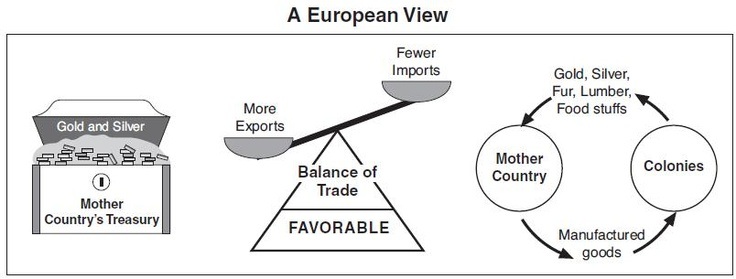
What is mercantilism?
A system where a mother countries gains money and power from natural resources that come from its colonies.
where colonies trade gold and silver with each other.
Wars that start over money.
Plantation colonies trading slaves for money.
Boston Massacre
Boston Tea Party
Lexington and Concord
Surrender at Yorktown
????????

_____________________________________-members of the colonial army who were ready to fight at a minute's notice
delegate
casualties
minutemen
militia


Which group wanted to ensure protection of individual rights and was therefore scared to ratify the Constitution?
Anti-Federalists
Federalists
Which party supported the elites and a strong national government to control trade and support the economy?
Democratic-Republicans
Federalists
Who is the official leader of the Senate, but is rarely there.
President Pro-Tempore
President of the United States
Speaker of the House
Vice-President of the United States
Rebels were angry in the Whiskey Rebellion because the Government...
taxed only the selling of whiskey
taxed whiskey really high to make revenue in order to pay off debt
taxed the selling and making of whiskey
taxed whiskey really high just show the farmers who's boss out of boredom
How did the Shay Rebellion demonstrate the weakness of the Articles of Confederation?
It revealed that the nation needed a stronger federal govt
Proved that states needed more power
Reaffirmed that when there is a conflict between the state's law and a federal statute, "the act of Congress . . . is supreme; and the law of the state...must yield to it."
Marbury v. Madison (1803)
Gibbons v. Ogden (1824)
McCulloch v. Maryland (1819)
Led to federal government regulation of activities regulating anything that involves commerce between states such as railroads, pipelines, minimum wage regulation, and prohibition of child labor.
McCulloch v. Maryland (1819)
Marbury v. Madison (1803)
Gibbons v. Ogden (1824)
Roger Williams discovered what colony?
Pennsylvania
Rhode Island
Virginia
What was the name of the TRAIL that Daniel Boone blazed from Virginia to Kentucky?
Winding Path
Wilderness Road
Forest Road
In his pamphlet Common Sense, Thomas Paine urged American colonists to
establish their own nation
pay their colonial taxes
obey the laws of Parliament
form an alliance with France
Why did Marquis de Lafayette join the Continental Army?
He wanted to help the Americans gain freedom.
He wanted to oppose the intolerable acts.
He was sent by the king.
How did Baron von Steuben help the Continental Army?
He gave them supplies.
He allowed them to use cannons.
He organized them, created drills, and a manual for them to use.


Define CABINET
a forced journey of Native American groups to Indian Territory
a group of advisors to the president
the goal of the movement that fought to end slavery
someone who settles a new place before others
pride in one's nation
Define NATIONALISM
the forced journey of Native American groups to Indian Territory
a group of advisors to the president
the goal of the movement that fought to end slavery
someone who settles a new place before others
pride in one's nation
How did the new capital of Washington, D. C. symbolize the new nation?
It was built in a large commercial city.
It was located between the first two British colonies.
It was a new city.
It was named after its military leader.
Why was Jefferson able to make the Louisiana Purchase?
Congress had given him permission.
The United States had captured the port of New Orleans.
Napoleon wanted to sell the Louisiana territory to pay for a war with Britain.
James Monroe was wealthy and could buy the land.
Which of the following was one of the major outcomes of the Lewis and Clark Expedition?
The explorers discovered a water route across the continent.
The journey paved the way for settlers from the eastern United States.
The expedition caused the Native Americans to rise up in rebellion.
The explorers found no unique animals or plants.
Why was it difficult for the United States to remain neutral in the war between Great Britain and France?
Both Great Britain and France were threatening American shipping.
Great Britain and France wanted to take back the Northwest Territory.
The United States wanted to take over Canada, and knew it would have to fight for it.
French and British soldiers had remained in the frontier after the Revolution.
What event inspired Francis Scott Key to write the "Star-Spangled Banner"?
the end of the War of 1812
seeing the American flag flying above Fort McHenry
the surrender of the British fleet
the American victory at the Battle of New Orleans
How did the War of 1812 change the way Americans viewed their nation?
It showed that the United States was stronger than Great Britain.
The victory over Great Britain doubled the United States' territory.
The loss of the port of New Orleans was a major blow to American trade.
It showed that the United States could stand up to the most powerful nation on Earth.
What was the main message of the Monroe Doctrine?
The United States would not wage war on Europe.
North and South America were U. S. Territory.
It warned European nations not to colonize in the Americas.
It declared independence for all colonies in Latin America.
Why did James Monroe order Andrew Jackson into Florida?
to stop the Seminoles from attacking settlers in Georgia
to recapture escaped African slaves
to purchase Florida from the Spanish
to meet with the ordinary people
Why was there a crisis in the Electoral College in the election of 1800?
The Electoral College voted separately for president and vice president, and they elected a Federalists for president and a Democratic-Republican for vice president.
Two Democratic-Republican candidates got the same amount of votes in the Electoral College, so the House of Representatives had to vote to break the tie.
The Electoral College voted separately for president and vice president, and they elected a Democratic-Republican for president and a Federalists for vice president.
Two Federalists candidates got the same amount of votes in the Electoral College, so the Senate had to break the tie.
What was significant change occurred in 1804 as a result of the issues in the election of 1800?
Congress passed the 12th Amendment, which required the Electoral College to vote for only one candidate from a political party.
The political parties signed an agreement about how to resolve disputed elections in the future.
The political parties signed an agreement to unify, which led to President Jefferson to say: "We are all Republicans. We are all Federalists."
Congress passed the 12th Amendment, which required the Electoral College to vote for president and vice president separately.

Chief Justice of the Supreme Court appointed by John Adams
John Marshall
Thomas Jefferson
William Clark
Meritwether Lewis

3rd President of the United States; author of the Declaration of Independence
John Marshall
Thomas Jefferson
William Clark
Meritwether Lewis

When the territory in western United States purchased from France in 1803 for $15 million
Election of 1800
Louisiana Purchase
Barbary War
Embargo Act

Conflict in which Jefferson follows the Adams's precedent of undeclared war by fighting the Barbary pirates.
Election of 1800
Louisiana Purchase
Barbary War
Embargo Act
An act passed by Congress to stop all foreign trade with the United States (1807)
Election of 1800
Louisiana Purchase
Barbary War
Embargo Act

A Shoshone woman whose language skills and knowledge of geography helped Lewis and Clark
John Marshall
Sacagawea
Lewis and Clark
Barbary Pirates
The ______________________________ was an address to Congress on December 1823 that outlined a comprehensive foreign policy to protect U.S. independence by limiting European influences on North and South America.
Monroe Doctrine
Adams-Onis Treaty
War of 1812
Convention of 1818
The ________________________________________ was a treaty between the United States and Britain that set the 49th parallel of latitude as the boundary between Canada (British) and the United States across the West.
Treaty of Ghent
Adams-Onis Treaty
Embargo Act
Convention of 1818
______________________________________ was the Governor of the Indiana Territory who gained national fame following his defeat of Tenskwatawa and a Native American confederation at the Battle of Tippecanoe. Later became the 9th president of the United States.
Andrew Jackson
William Henry Harrison
Marbury v. Madison
Monroe Doctrine
The ________________________ was between Britain and the United States, fought between 1812 and 1815. It began over alleged British violations of American shipping rights, such as the impressment of seamen. There was no clear winner in the war.
Louisiana Purchase
Embargo Act
War of 1812
Barbary Pirates
The ___________________________ passed by Thomas Jefferson in 1807 forbid American ships from trading with Europe because of this act the American economy began to collapse.
Marbury v. Madison
Embargo Act
Treaty of Ghent
Monroe Doctrine

