
 Worksheets
Benchmark I Review (Exploration through T. Jefferson
Total questions: 87
Worksheet time: 1hrs 25mins
Why were French explorers interested in claiming the
Mississippi River and having access to the Great
Lakes?
They believed that gold was located there.
They were mainly fur trappers and traders.
They found no eastern coast land available.
They were farmers who wanted the rich lands.
The transatlantic slave trade began when —
sugar plantations in the West Indies needed labor
cotton became a cash crop in the southern colonies
American Indians refused to work on southern
plantations
indentured servants went on strike in the southern
colonies
Which colonial region developed a fishing industry?
New England
Middle Colonies
Which colonial region produced agricultural products, including
wheat and other grains?
New Enland Colonies
Middle Colonies
Which colonial region developed a shipbuilding industry?
New England colonies
Middle Colonies
Which colonial region had rich, fertile soil?
New England Colonies
Middle Colonies
Representative government and institutions developed
during the colonial period because—
most colonists did not feel loyalty to the English
king
each colony was working to protect its own interests
rulers in England tended to leave the colonists to
themselves
mercantilism meant the colonists relied on
England for goods
The English Parliament responded to the Boston Tea
Party by issuing which of the following?
The Intolerable Acts
The Olive Branch Petition
The Stamp Act
The Treaty of Paris
Which of the following are considered unalienable
rights according to the authors of the Declaration of
Independence?
Peace, land, bread
Liberty, equality, fraternity
Justice, tranquility, common defense
Life, liberty, pursuit of happiness
Where did General Washington have the Continental
Army camp for training over the bitter winter of 1777–1778?
Delaware
Gettysburg
New York City
Valley Forge

The excerpt above describes the provision that allowed
the United States to—
Fish off Canadian waters
Pay off loyalist debts
Establish an independent country
Remove all British forts west of the Appalachian Mountains
Which of the following agreements resulted in the
modern bicameral structure of the U.S. Congress?
Missouri Compromise
Compromise of 1850
Three-Fifth Compromise
Great Compromise
The Anti-Federalists argued against ratification of the
U.S. Constitution because they —
disagreed with the Great Compromise
hoped to keep the Articles of Confederation
wanted a parliamentary system of government
believed that states’ rights were not
protected
Which of the following was a power given to the national
government under the Articles of Confederation?
Levy and collect taxes
Draft soldiers after a declaration of war
Establish a national currency
Establish post offices

In what way has the excerpt most influenced the lives
of Americans?
Americans are assured that they may worship as
they please.
Religious private schools are popular institutions
in America.
Businesses in America generally close to observe
Sabbath days.
Respecting religious holidays are a part of
American cultural practices.

Which U.S. constitutional principle was influenced by the
excerpt?
Due process
Popular sovereignty
Separation of powers
States rights

These articles found in the U.S. Constitution illustrate
the constitutional principle of—
Federalism
Separation of powers
Popular sovereignty
Individual rights
Which of the following is addressed in the Eighth
Amendment of the Constitution?
Being forced to support a certain religion
The right to peacefully assemble
Refusing to pay federal taxes
Excessive punishment for convicted felons
How did the Northwest Ordinance of 1787 provide for
the orderly expansion of the United States?
It provided a review process for laws in new
territories and states.
It provided policies for acquiring territory from
American Indian tribes.
It provided procedures for establishing territories
and creating new states.
It provided the president with the power to sign
treaties with foreign powers to buy additional
territory.
In the first half of the 1800s, many wealthy New England
manufacturers supported the (a)
because their economy was connected with trade with
Great Britain. They believed a strong national government
would create a stable economy.
The common man such as farmers and artisans
supported the (a) because it supported
states’ rights.
In George Washington’s Farewell Address, he warned
the nation about foreign dangers of—
Economic cooperation with Europe
Colonization of the Americas by Europeans
Being dragged into a European war
Forming political parities
Which issue accounts for the development of political
parties in the early U.S. republic?
An argument about the peace treaty ending the
War of 1812
A disagreement about the creation of a national
bank
A disagreement about the purchase of Louisiana
from the French
An argument about adding the Bill of Rights to the
Constitution
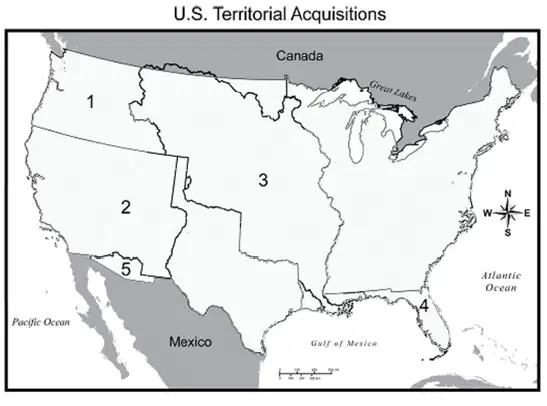
Which number on the map represents the Louisiana
Purchase of 1803?
1
2
3
4

Which constitutional principle is addressed in the excerpt above?
Federalism
Separation of church and state
Judicial Review
Popular Sovereignty
Which of the following were precedents established by George Washington as President?
Appointed cabinet members as advisors to the President
Preserved the union after a deadly and bloody civil war
Purchased land that doubled the size of the United States
Served for two terms
Asked Congress to declare war on Great Britain
The Magna Carta influenced the the U.S. form of government by -
creating a Bill of Rights
guaranteeing due process (trial by jury...)
promoting a strong federal government
self-government
The Federalist Papers influenced the U.S. government by
establishing due process
U.S. Bill of Rights
promoting a strong federal government
self-government
The Mayflower Compact influenced the U.S. government by
promoting a strong federal government
U.S. Bill of Rights
self-government
guaranteeing due process
What was the primary economic activity in the Southern Colonies during the colonial period?
Shipbuilding and fishing
Manufacturing and trade
Tobacco and cotton plantations
Fur trading
Which founding document was primarily authored by Thomas Jefferson and served as a formal declaration of independence from British rule?
The Constitution of the United States
The Articles of Confederation
The Declaration of Independence
The Federalist Papers
What was the main purpose of the Federalist Papers?
To oppose the ratification of the Constitution
To outline the weaknesses of the Articles of Confederation
To convince New Yorkers to support the new Constitution
To propose amendments to the Constitution
What port city was acquired with the Louisiana Purchase?
Charleston
New York
New Orleans
Boston
What constitutional principal was established in Marbury v. Madison?
republicanism
judicial review
federalism
separation of powers
Which colony was founded by Catholics fleeing religious persecution in England?
Maryland
Georgia
Virginia
Massachusetts
Which colony was founded by Roger Williams after being vanished from Massachusetts for disagreeing with Puritan leaders?
Maryland
Virginia
Georgia
Rhode Island
Which colony was founded by Thomas Hooker who disagreed with religious leaders in Massachusetts and extended voting rights to non-church members in his colony?
Georgia
Connecticut
Maryland
Virginia
Because of the cold winters and thin, rocky soil found in the New England region, their economic activities consisted of -
agriculture
lumber
shipbuilding
growing grain
fishing
The Southern colonies' economy was based on agriculture because of -
long winters
long growing season
warm climate
fertile soil
mild winters
Which colony was founded as a barrier between Spanish Florida and the Carolinas as well as a place where DEBTORS could start over?
Georgia
Virginia
Massachusetts
Maryland
Which is true about the colony of Jamestown?
Founded in 1620 for religious reasons
Founded in 1620 for economic reasons
Founded in 1607 for economic reasons
Founded in 1607 for political reasons
Friendly French ___ _______
(a)
Which colonial government established a tradition of SELF-GOVERNMENT in the colonies?
House of Burgesses
Mayflower Compact
Fundamental Orders of Connecticut
U.S. Congress
Which colonial government EXTENDED VOTING RIGHTS to non-church members and was the FIRST WRITTEN CONSTITUTION in the colonies?
House of Burgesses
Mayflower Compact
Fundamental Orders of Connecticut
U.S. Congress
Which colonial government was the FIRST ELECTED REPRESENTATIVE ASSEMBLY in the colonies and served as a MODEL OF A LEGISLATURE for other colonies?
House of Burgesses
Mayflower
Compact
Fundamental Orders of Connecticut
U.S. Congress
Which physical feature did the British government use to prevent westward expansion after the French and Indian War?
Atlantic Ocean
Appalachian Mountains
Rocky Mountains
Mississippi River
The Sugar Act, Stamp Act, Quartering Act and Townshend Acts were ___________ that were passed in Parliament and resented by the colonists.
shipping laws
acts of God
British economic policies
unalienable rights
Colonists protested the Tea Act by dumping 342 chests of tea in Boston Harbor in an event known as the -
Intolerable Acts
Winter at Valley Forge
Boston Tea Party
First Continental Congress
Who authored the Declaration of Independence and defined unalienable rights as life, liberty, and the pursuit of happiness?
John Hancock
Thomas Jefferson
George Washington
John Paul Jones
This person was appointed as Commander-In-Chief of the Continental Army.
George Wasshington
John Paul Jones
John Hancock
Thomas Jefferson
Which event is considered the TURNING POINT of the American Revolution?
Valley Forge
Yorktown
Saratoga
Lexington and Concord
Which event of the American Revolution involved General Cornwallis surrendering to General George Washington and is considered the last major battle?
Lexington and Concord
Saratoga
Valley Forge
Yorktown
Which battles initiated the Revolutionary War?
Saratoga
Yorktown
Lexington and Concord
Valley Forge
What was the meeting held in Philadelphia by colonial delegates to respond to the Intolerable Acts (British punishments)?
First Continental Congress
Second Continental Congress
House of Burgesses
Parliament
Which of the following were different ways that colonists protested British economic policies? Choose all that apply
Applied for citizenship
smuggling
boycotts
praying
feeling resentment
The _______ was passed to establish the procedures for the orderly expansion of the United States.
U.S. Constitution
Proclamation of 1763
Bill of Rights
Northwest Ordinance
A Congress made up of two houses is a ___.
Unicameral
Bicameral
Senate
House of Representatives
Power was with the states, Amendments requiring the approval of all 13 states, and having a unicameral legislature that lacked a president to enforce laws were _______ of the Articles of Confederation
STRENGTHS
WEAKNESSES
Having the power to establish post offices, make peace treaties such as the Treaty of Paris, and declare war were ________ of the Articles of Confederation.
STRENGTHS
WEAKNESSES
Under the Northwest Ordinance, the right to __________ was gained when a population of 5,000 of free adult males was reached in a territory.
apply for statehood
self-government
bear arms
freedom of speech
The _______________ Compromise was used to settle the argument over whether the enslaved population would count towards a state's population.
Three-Fifths
Missouri
California
Great
The Great Compromise settled the argument over representation in Congress by establishing a BICAMERAL legislature that includes a _(1)____________ that satisfies the Virginia Plan and a _(2)__________ that satisfies the New Jersey Plan.
(1) Senate, (2) House of Representatives
(1) House of Burgesses, (2) Mayflower Compact
(1) House of Representatives, (2) Senate
(1) Parliament, (2) Fundamental Orders of Connecticut
Things that _________ would say to SUPPORT RATIFICATION of the Constitution would be that a strong federal government is needed and that a Bill of Rights is not necessary because of the principles of checks and balance, limited government, federalism, and separation of powers that are included in the Constitution.
a Federalist
an Anti-Federalist
Things that _________ would say to OPPOSE RATIFICATION would be that the Constitution would take the power away from the states and demanded a Bill of Rights is necessary to protect the people from governmental abuse.
a Federalist
an Anti-Federalist
Alexander Hamilton and Thomas Jefferson disgreed on the creation of -
a compromise
political parties
a National Bank
the location of the White House

Select 2 things the British were doing to anger America
Helping Native Americans
Having the policy of impressments
Refusing to sell tea to America
Helping Napoleon buy back Louisiana
Select the image that represents the policy of impressments


Select 3 outcomes from the War of 1812
The US economy grew
Americans gained more pride
The USA showed the world it was strong
America took over Canada from the British

What song was inspired by the attack of Fort McHenry?
"Yankee Doodle"
"This land is your land"
"Star Spangled Banner"
"America the Beautiful"
Which state was added as a free state to balance out Missouri joining the Union as a slave state?
Maine
Illinois
Indiana
Vermont

Close reading the map, with the Missouri Compromise, what state was allowed to enter as a slave state?
Missouri
Maine
Kentucky
Ohio

What was the “Middle Passage?
The second leg of a triangular trade route on which slaves were transported across the Atlantic Ocean
The selling of enslaved people in the slave markets of America
The process of branding enslaved Africans
The forced march of enslaved Africans to a European fort

What group of colonies had a plantation system and relied on slaves to grow crops?
New England
Middle
Southern
Western

Under the British system of mercantilism, the American colonies served primarily as a
self-sufficient trading partner for other European nations
market for British manufactured goods and a source of raw materials
source of manpower for the British army and navy
buffer to the expansion of French and Spanish colonies

Which physical characteristics made these economic activities possible?
Tall mountains, a long shoreline, and fertile soil
A temperate climate, vast grasslands, and plentiful lakes
Dense forests, natural harbors, and swift rivers
Natural harbors, an arid climate, and rocky soil

The ? ? ? ? ? ? ? ? ? ? was an important agreement that combined the Virginia Plan with the New Jersey Plan. It created a BICAMERAL legislature with 2 parts [Senate - with equal representation; House of Representatives - based on population]
Great Compromise
Awesome Agreement
Legislative Bicameralism
NJ-V Cooperative

STRENGTHS: could declare war, make treaties, and operate post offices
WEAKNESSES: needed 9 out of 13 states approval for congressional decisions, no executive branch, no power to tax
What document is being described here?
the Articles of Confederation
the Declaration of Independence
the Magna Carta
the Treaty of Paris 1783

I - "I don't think we should ratify this constitution."
II - "The revolution was fought to END tyranny, not start a new one."
III - "I'm against this constitution because our individual rights aren't being protected."
Which of these quotes would be said by a an ANTI-FEDERALIST?
I
II
III
ALL of these are correct

The Three-Fifths Compromise centered around the counting of ______ to determine a state's population. Southern states agreed to count 3 out of every 5 in order to increase their political influence.
slaves
houses
roads
cities
What is the Highest Court in the United States?
The Municipal Court
The Supreme Court
The Superior Court
The Felony Court
What does the Judicial Branch do?
Resolves disputes (disagreements)
reviews laws
decides if a law goes against the Constitution
All of the above

What was the name of the group that met to discuss what the colonists should do about unfair laws like the Intolerable Acts?
The First Continental Congress
The House of Burgesses
The Sons of Liberty
The Boston Tea Party

How did the colonists resist British laws an taxes?
Boycotts
Protests
Tarring and feathering tax collectors
All of the above
This was a common complaint among the colonist.
Persecution
Proclamation line of 1763
No taxation without representation
Colonists were used to having this type of government that was influenced by the Mayflower compact and Fundamental Orders Of Connecticut?
Communism
Self-Government
Monarchy
What is the name of the act that closed Boston Harbor and served as a punishment for the Boston Tea Party?
Townshend Act
Quartering Act
Intolerable Acts

