wayground logo

Free Printable Worksheets

NEW

Font size

S
M
L
XL
Worksheets

Classification/virus/bacteria/protist/fungus 2023

Total questions: 70

Worksheet time: 1hrs 22mins

Name
Class
Date
1.

A whip-like structure that helps a bacterial cell to move

a)

Flagellum

b)

Conjugation

c)

Endospore

d)

Pasteurization

2.
There are bacteria all over my body
a)
false
b)
true
3.
Bacteria are prokaryotes which means they
a)
have a nucleus in their capsule
b)
do not contain a nucleus
c)
can live in environments with and without oxygen
4.
Name this bacteria shape
a)
coccus
b)
spirillum
c)
bacillus
5.
Name this bacteria shape
a)
bacillus
b)
coccus
c)
spirillum
6.
Name this bacteria shape
a)
coccus
b)
bacillus
c)
spirillum
7.
Bacteria are both harmful and beneficial.
a)
True
b)
False
8.
How many cells does one bacteria have?
a)
Two
b)
One
c)
Three
d)
Multi-celled
9.
Bacteria are unicellular
a)
True
b)
False
10.
Bacteria reproduce asexually by 
a)
spores
b)
conjugation
c)
fixation
d)
binary fission
11.

Bacteria can be used to make foods such as yogurt & cheese.

a)

true

b)

false

12.
True or False: Some types of bacteria eat and clean up oil spills
a)
True
b)
False
13.
 Bacteria that help break down dead material in the environment are called 
a)
vaccines
b)
decomposers
c)
oats
14.
The process in which a unicellular organism transfers some of its genetic material to another unicellular organism
a)
Budding
b)
Conjugation
c)
Binary fission
15.
What do viruses need to reproduce?
a)
they need genetic material
b)
They need a host cell
c)
They need  bacteria
d)
They need insulin
16.
A(n) _____ is a virus that enters a bacterial cell.
a)
endospore
b)
decomposer
c)
plasmid
d)
bacteriophage
17.
When a virus invades a living cell, its _______
takes over the cell's functions.
a)
outer coat
b)
genetic material
c)
core
d)
cytoplasm
18.
True or False
The flu is caused by a virus.
a)
true
b)
false
19.
Antibiotics kill viruses
a)
True
b)
False
20.
________ is used to prevent viral diseases while _______ are used to kill bacteria
a)
vaccine; antibiotics
b)
antibiotics; vaccine
c)
antibiotics; antibiotics
21.
What provides direct energy for the virus?
a)
food
b)
its host
c)
the sun
d)
a parasite
22.
How could you describe the size of a virus?
a)
Smaller than bacteria
b)
Larger than a parasite
c)
About the size of a dime
d)
Smaller than a proton
23.
A tiny non-living particle that invades and then multiplies inside of a living cell is called a:
a)
vaccine
b)
virus
c)
bacteriophage
24.
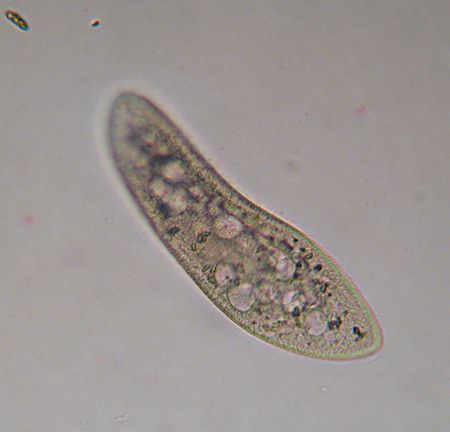
Name this protist?
a)
Euglena 
b)
Amoeba 
c)
Paramecium 
d)
Volvox
25.
Name this protist?
a)
Paramecium 
b)
Amoeba 
c)
Volvox
d)
Euglena 
26.
Name this protist?
a)
Amoeba
b)
Euglena
c)
Paramecium 
d)
Volvox
27.
Conjugation is what type of reproduction?  
a)
Sexual Reproduction 
b)
Asexual Reproduction 
28.
A protist that can not make its own food is called what? 
a)
Autotroph
b)
Heterotroph 
29.
A protist that can make its own food is called what? 
a)
Heterotroph
b)
Autotroph
30.
Which protist has an eyespot?
a)
Amoeba
b)
Volvox
c)
Euglena 
d)
Paramecium 
31.
Which protist has an oral groove and a gullet? 
a)
Paramecium 
b)
Volvox
c)
Amoeba 
d)
Euglena 
32.
Fine hairs that allow protist to move is called what? 
a)
Pseudopods 
b)
Euglena 
c)
Flagella 
d)
Cilia 
33.
What are the finger like projections called? 
a)
Flagella 
b)
Cilia 
c)
Pseudopods
d)
Veela 
34.
What type of cells are protists?
a)
Prokaryotic 
b)
Eukaryoitc 
35.

Which of the following tiny hair-like structures help protists move?

a)

Cilia

b)

Pili

c)

Pseudopodia

d)

Flagella

36.

What is another term for animal-like protists?

a)

Protozoa

b)

Algae

c)

Bacteria

d)

Slime molds

37.
The image shows a paramecium. What structure is utilized by the paramecium for movement?
a)
Cilia
b)
Flagella
c)
Pseudopods
d)
Pili
38.
"Algae" is a general term used to describe _____________ - like protists.
a)
Plant
b)
Fungi
c)
Animal
d)
Bacteria
39.

Which of following structures help euglena detect light?

a)

Eyespots

b)

Flagella

c)

Cilia

d)

Pseudopods

40.
The scientific name for an organism is made from the:
a)
class and family name
b)
genus and species name
c)
domain and kingdom name
d)
kingdom and phylum name
41.
The 8 levels of classification, most broad to most specific.
a)
Domain, Genus, Family, Order, Class, Phylum, Kingdom, Species
b)
Domain, Species, Kingdom, Genus, Phylum, Family, Class, Order
c)
Domain, Kingdom, Phylum, Class, Order, Family, Genus, Species
d)
Domain, Kingdom, Species, Phylum, Family, Order, Class, Genus
42.
Who first proposed binomial nomenclature as a way of classifying organisms?
a)
Carolus Linnaeus
b)
Thomas Jefferson
c)
Charles Darwin
d)
Albert Einstein 
43.
What is the genus name here:
Canis lupus
a)
Canis
b)
lupus
44.
Which Domain/Kingdom is capable of living in extreme environments like hot springs, geysers, or very salty waters?
a)
Bacteria
b)
Archaea
c)
Eukarya
45.
Which of the following does not belong in the Fungi Kingdom? 
a)
Yeast
b)
Ameoba
c)
Mold
d)
Mushroom
46.
What is a species?
a)
A group of organisms that can mate with each other and produce fertile offspring. 
b)
A group of organisms that genetically are very different from each other. 
c)
A group of organisms that can mate, but do not produce offspring.
d)
Indivual organisms that live in the same environment. 
47.

1st taxonomist/Greek

a)

Aristotle

b)

John Ray

c)

Carl Linneaus

d)

Charles Darwin

48.

scientist that classifies and names organisms

a)

taxonomist

b)

zoologist

c)

ornithologist

d)

cardiologist

49.

What is the species name of the animal Pan troglodyte.

a)

troglodyte

b)

Pan

c)

chimp

d)

Animalia

50.

the largest taxonomic group

a)

kingdom

b)

phylum

c)

genus

d)

species

51.

the smallest/most specific taxonomic group

a)

species

b)

genus

c)

kingdom

d)

phylum

52.

Prokaryotes do not have a nucleus or membrane bound organelles.

a)

True

b)

False

53.
An organism made up of more than one cell would be called:
a)
multicellular
b)
unicellular
c)
heterotroph
d)
autotroph
54.
An example of an unicellular organism would be:
a)
monkey
b)
bacteria
c)
spider
d)
human
55.

The scientific name for a raccoon is written below in several different ways. Which one is written in the correct form?

a)

Procyon lotor

b)

Procyon lotor

c)

Procyon Lotor

d)

PROCYON LOTOR

56.
Why do scientists classify living things?
a)
It helps scientists trap species to study
b)
It is easier to study organisms when grouped 
c)
It is a good way to keep organisms calm
d)
It is helpful when dissecting an organism
57.
An early classification system had two groups: Plants and Animals. What is wrong with that system?
a)
It is too specific
b)
It is too narrow minded
c)
It is too broad
d)
It is too fancy 
58.
An organism that gets its food by consuming other organisms is known as a:
a)
heterotroph
b)
autotroph
c)
prokaryote
d)
eukaryote
59.
Which characteristics best describes the Plant Kingdom?
a)
unicellular; eukaryote; autotroph
b)
multicellular, prokaryote, autotroph
c)
multicellular, eukaryote, autotroph
d)
unicellular, prokaryote, heterotroph
60.
Which characteristics best describes the Animal Kingdom?
a)
unicellular, eukaryote, autotroph
b)
multicellular, prokaryote, heterotroph
c)
multicellular, eukaryote, autotroph
d)
multicellular, eukaryote, heterotroph
61.
Which characteristics best describe the Kingdom Protista?
a)
multicellular, eukaryote, heterotroph and autotroph
b)
multicellular and unicellular, heterotoph and autotroph, eukaryote
c)
unicellular, autotroph, prokaryote
d)
multicellular and unicellular, prokaryote, heterotroph
62.
Which characteristics best describe the Kingdom Fungi?
a)
multicellular and unicellular, eukaryote, autotroph
b)
multicellular and unicellular, prokaryote, heterotroph
c)
multicellular, eukaryote, heterotoph
d)
multicellular and unicellular, eukaryote, heterotroph
63.
Which characteristics best describes the Kingdoms Eubacteria and Archaebacteria?
a)
unicellular, prokaryote, heterotroph
b)
unicellular, prokaryote, heterotroph and autotroph
c)
multicellular, eukaryote, autotroph
d)
multicellular, prokaryote, heterotroph and autotroph
64.
The reproductive cells of fungi are called:
a)
pollen
b)
seeds
c)
spores
d)
mold
65.
Mold is classified into which of the following kingdoms?
a)
plantae
b)
fungi
c)
protista
d)
bacteria
66.
Fungi were originally classified as plants but later they were classified separately.  Which of the following characteristics of fungi separates them from plants?
a)
They reproduce asexually.
b)
They are able to grow in dry conditions.
c)
They are unable to make their own food.
d)
They can move from one place to another.
67.
Fungi break down dead organisms, or waste products of living organisms, returning nutrients to the soil.  What role do fungi play in food webs?
a)
primary consumer
b)
producer
c)
secondary consumer
d)
decomposer
68.
__________ are fungi that that produce the gas that makes bread rise.
a)
Mushrooms
b)
Athletes' foot
c)
Blue Cheese
d)
Yeast
69.
An antibiotic made from a species of thread-like fungus.
a)
lichen
b)
mold
c)
penicillin
d)
asprin
70.
Which is an example of a disease caused by fungi
a)
Diphtheria
b)
The Common Cold
c)
Strep Throat
d)
Athlete's Foot