
 Worksheets
Unit 3 Test review
Total questions: 72
Worksheet time: 42mins
How many Domains are there
10
2
3
6
I have cell walls
I am an autotroph
I am multicellular
What am I?
Plant
Animal
Eubacteria
Protist
I have no cell walls
I am eukaryotic
I reproduce sexually
I am multicellular
What kingdom do I belong to?
Plant
Animal
Protist
Fungi
I am unicellular
I am prokaryotic
I am found in extreme ecosystems
What kingdom do I belong to?
Protist
Plant
Animal
Archaebacteria
What is the main difference between prokaryotes and eukaryotes?
Prokaryotes have a cell wall, eukaryotes do not
Prokayotes have a nucleus, eukaryotes do not
Eukaryotes have a nucleus, prokaryotes do not
Eukaryotes have a cell wall, prokaryotes do not
A scientific name consist of which two categories
Class and Family
Family and Genus
Genus and Species
Species and Class
Which domain includes organisms that can survive in extreme environments?
Archaea
Bacteria
Eukarya
The science of describing, classifying and naming living things is known as _______.
Biology
Taxonomy
Sortology
Phylogeny
Biologist group living things based on ____.
Habitat
Size
Colors
Shared Characteristics
(Taxonomy) Which level is the most specific?
Domain
Family
Species
Genus
(Domain) Which domain(s) include only prokaryotic cells? (without nucleus)
Eukarya & Bacteria
Archaeabacteria
Bacteria & Archeabacteria
Bacteria
(Domain) Which domain(s) include organisms that have eukaryotic cells? (has nucleus)
Eukarya
Eukarya & Bacteria
Bacteria
Archaeabacteria
(Domain) Organisms in ______________ domain live in extreme environments like volcanic thermal vents.
Eukarya
Bacteria
Archaea
(Kingdoms) Moss is multicellular, autotrophic (photosynthetic), and has cell walls. Which kingdom does moss belong to?
Protista
Fungi
Plantae
Animalia
(Kingdoms) Organisms in ____________ kingdom are unicellular, heterotrophs or autotrophs, most are aquatic and can be animal-like, plant-like, or fungus-like.
Fungi
Animalia
Protista
Plantae
(Kingdoms) Which kingdom contains organisms that are mostly multicellular, have cell walls, and can be decomposers or heterotrophs?
Fungi
Plantae
Animalia
Protista
(Taxonomy) How many kingdoms are there?
2
4
6
8
To put similar organisms into groups
taxonomy
classification
dichotomous key
phylum
the broadest classification category
Kindgom
Domain
Order
Species
What are the six kingdoms of life?
Animals, Plants, Vertebrates, Invertebrates, Viruses, Fungi
Bacteria, Amoeba, Algae, Archaea, Protists, Nuclei
Archaebacteria, Euacteria, Protista, Animalia, Plantae Fungi
Archaea, Bacteria, Animals, Plants, Proteins, Fungi

What are the names of the three domains of life?
Bacteria, Archaea, Eukarya
Bacteria, Archaea, Animalia
Archaea, Plantista, Animalia
Life, Animals, Plants
True or False: Bacteria can live in soil, water and in/on human bodies.
TRUE
FALSE
Which of the following attributes is NOT accurate for members of the Animalia Kingdom?
multi-cellular
has a nervous system
uses photosynthesis to produce food
can move from place to place
What are three major traits that are used to classify organisms?
Cell type, how they get energy, number of cells they are made of
Cell type, if they're living or dead, the number of organs they have
How they create energy, how many years they live, how big they are
The number of cells they have, the number of years they live, the number of offspring they produce
The members of the ________ Kingdom use photosynthesis to create energy.
Fungi
Plants
Animals
Archaebacteria...
are eukaryotic
live in extreme environments
are non-living
live in the soil

Multicellular
Eukaryotic
Prokaryotic
Consumers
plant and animal
protist and fungus
archaebacteria and eubacteria
archaebacteria and protist
Which animal is a mammal?


Whip Scorpion
Wind Scorpion
Daddy long legs
Scorpion

Organisms with cells that lack a nucleus are called:
Eukaryotes
Heterotrophs
Prokaryotes
Autotrophs
Which of the following organisms is a vertebrate?
insect
sponge
monkey
earthworm
Which term describes an animal without a
backbone?
chordate
invertebrate
protozoan
vertebrate

What can an autotrophic organism do that a heterotrophic organism can NOT?
Make their own food
Have a nucleus
Reproduce through binary fission
They're the same
They are the same
One has a nucleus and one doesn't
Unicellular organisms are made of one cell and multicellular are made of many
One is bacteria and the is archaebacteria

I cause dead animals to really stink when I slowly digest their tissues. I am a single celled organism with no nucleus in my cell.
Fungi
Plantae
Anamalia
Bacteria
Which two kingdoms contain ONLY multicellular organisms? (Pick 2)
Plants
Animals
Fungi
Protists
Bacteria
Multicellular, no cell wall, moves and is heterotroph; which kingdom does it belong to?
Animalia
Eubacteria
Fungi
Plantae
Autotrophs
Make their own food
Get their food from others
are Fungi
are none of the above
Heterotrophs
make their own food
get their food from others
are fungi
none of the above
Multicellular organisms belong in which kingdom?
Archaebacteria
Fungi
Protist
Eubacteria
Which kingdom has the organisms that most commonly make you sick?
e-coli
eubacteria
archaebacteria
staph
Which Kingdom is the virus in?
Protists
Animalia
Fungi
It is not in a kingdom because it isn't living.
Mulitcellular organism have
one cell
many cells
no cells
both one cell and many cells
Protists have mostly
are nonmoving
single celled but don't move
single cell and move with a cilia or flagella
many celled with a cilia or flagella
Which Kingdom has organisms that help humans digest their food?
Protist
Eubacteria
Fungi
I have no nucleus and live in very hot liquids. Which Kingdom am I in?
Fungi
Protist
Eubacteria
Archaebacteria
Which of the following characteristics is the most important in classifying an organism into a kingdom?
red in color
photosynthesis
reproduces asexually and sexually
height
Which domain has organisms that live in extreme environments (vocanoes, Yellowstone hot pools, deep under water with no light)
Eubacteria
Archae
Eukarya
No organism can live in those conditions
I am multicellular and autotrophic which kingdom would I be in?
Plantae
Animalia
Fungi
Protists
I am Eukaryotic, mainly multicellular, heterotrophic and reproduce with spores (asexual) and sexually.
Plantae
Animalia
Fungi
Protist
I am:
single celled (mostly), Eukaryotic, heterotroph, reproduce sexual and asexual. What Kingdom am I in?
Fungi
Archaebacteria
Eubacteria
Protists

A cell with nucleus is
Autotrophic
Prokaryotic
Eukaryotic
Heterotrophic

AMOEBA-PARAMECIUM-EUGLENA-DINOFLAGELLATES BELONG TO WHAT KINGDOM
PLANT
PROTIST
FUNGI
ANIMAL
ARCHAEBACTERIA

APES BELONG TO WHAT KINGDOM
PLANT
ANIMAL
FUNGI
PROTIST

11. Plant-like protists are considered to be _____________________ because they use the Sun’s energy to obtain energy.
Heterotrophic
Unicellular
Eukaryotic
Autotrophic

In order to conduct photosynthesis, plant-like protists must contain a _______________.
Chloroplast
Mitochondria
Nucleus
None of the above
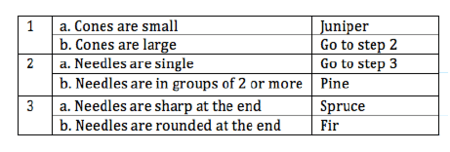
Juniper
Pine
Spruce
Fir
1
2
3
4
physical features
weather patterns
environment
diet
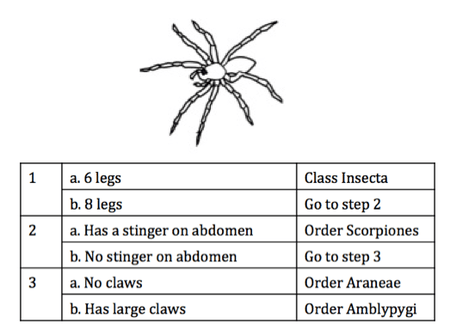
Class Insecta
Order Amblygygi
Order Araneae
Order Scorpiones

Which leaf is shown in the drawing?
Magnolia
Redbud
Sweetgum
None of the above

Which of the paired statements could be used to tell the difference between the two insects using a dichotomous key?
Has 6 legs
Has 8 legs
Large hind legs
Small hind legs
2 pairs of spots on wing cover
3 pairs of spots on wing cover
Antennae absent
Antennae present

Which shark is the picture of?
Cow Shark
Great White Shark
Hammerhead Shark
Saw Shark

