
 Worksheets
Practice for Chapter 1 Quiz Ecology
Total questions: 75
Worksheet time: 46mins
What organism is the main focus of our Amplify unit story?
Marine biologists
Moon Jellies
Orca Whales
Giant Kelp
An ecosystem is made up of ______ .
living things and their offspring
nonliving things such as rocks and soil
living things and nonliving things
many types of animals
What is the best definition of an organism?
Many individuals of the same species living in the same area.
All of the living and nonliving things in a particular area.
An individual plant, animal, fungus, or single-celled life form.
A creature that is large enough to see without using a microscope.
Which picture accurately shows a "population"?


What causes a population size to increase?
The number of births is greater than the number of deaths.
The number of deaths is greater than the number of births.
The number of births and the number of deaths is equal.
What causes a population size to decrease?
The number of births is greater than the number of deaths.
The number of deaths is greater than the number of births.
The number of births and the number of deaths is equal.
If the population size stays stable, does this mean that no organisms have been born or died?
Yes, because if organisms were born or died that would change the number of organisms in the population.
No, because if some organisms are born and the same number of organisms die, then the total population size can stay constant.
Yes, because some organisms never die, so they don't need to reproduce.
No, because all organisms will give birth and then die.

Based on this graph, what must be true about the US honeybee population?
There are more births than deaths occurring.
There are more deaths than births occurring.
There is an equal number of deaths and births occurring.
People don't like honeybees.
A large population of squirrels lives in a forest. In the last 50 years, the size of the squirrel population has stayed the same. What must be true about the squirrel population during the last 50 years?
No squirrels were born and no squirrels died.
Humans started protecting the squirrel population so they stopped dying.
The squirrels did not have any baby squirrels during these years.
The number of squirrels that were born was the same as the number of squirrels that died.

A population of tigers lives in Bangladesh. Over 50 years, the size of the tiger population increased. What best explains the increase in the size of the tiger population?
A lot of tigers were born and none of them died.
The tiger population is always increasing because no animal eats tigers.
Fewer tigers were born than died.
More tigers were born than died.

A population of bluefish lives in the Gulf of Mexico. Over the last 50 years, the size of the bluefish population has decreased. What best explains the decrease in the size of the bluefish population?
A lot of bluefish died and no new bluefish were born.
More bluefish were born than died.
Fewer bluefish were born than died.
The bluefish population is always decreasing because bluefish are always being eaten.

A large population of ducks lives in an area with a lake. In the last 40 years, the size of the duck population has stayed the same. What must be true about the duck population during the last 40 years?
The number of ducks that were born was the same as the number of ducks that died.
No ducks were born and no ducks died.
Humans started protecting the duck population so they stopped dying.
The ducks did not have any baby ducks during these years.

A population of mice lives in the northeastern United States. Over the last 50 years, the size of the mouse population decreased. What best explains the decrease in the size of the mouse population?
Fewer mice were born than died.
A lot of mice died and no new mice were born.
More mice were born than died.
The mouse population is always decreasing because mice are always being eaten.
A population of deer lives in Canada. Over 50 years, the size of the deer population decreased. What best explains the decrease in the size of the deer population?
A lot of deer died and no deer were born.
Fewer deer were born than died.
The deer population is always decreasing because deer are always being eaten.
More deer were born than died.
When a populations is known to be STABLE, it:
there are more deaths
there are more births
stays mostly the same, over time
horses live there
True or False: Nonliving and dead mean the same thing.
True
False

Which of the following is an abiotic part of an ecosystem?
Pebbles
Sea Turtle
Jellyfish
Plankton
Which of the following would cause a population to increase? (Two answers are correct)
birth
death
emigration
immigration

When the number of deaths in a population is equal to the number of births in a population, the population is considered to be __________________________.
increasing
decreasing
stable
fluctuating

A population will increase when the number of births is (a) than the number of deaths.




Fill in the blanks with appropriate words. ________ is the study of organisms and their interaction with the surrounding environment.
Ecology
Biology
Geology
Astronomy
Fill in the blanks with appropriate words. An ________ studies the relationship between living organisms and their habitats.
ecologist
biologist
geologist
chemist
How many levels of organization are there in an ecosystem?
Five: organism, population, community, ecosystem, and biosphere
Four: organism, community, ecosystem, and biosphere
Six: cell, organism, population, community, ecosystem, and biosphere
Three: population, community, and ecosystem
Fill in the blanks with appropriate words. A ________ is a group of similar individuals, usually of a given species occupying a particular habitat at a particular time.
population
community
ecosystem
biome
Fill in the blanks with appropriate words. An ________ is a single organism, plant, animal, or microorganism, such as bacteria and fungi, capable of independent existence.
individual
ecosystem
community
population
Fill in the blanks with appropriate words. An ________ is a functional unit of nature consisting of more than a community of living organisms and their abiotic factors.
ecosystem
organism
population
biome
Fill in the blanks with appropriate words. A ________ includes populations of different species living together and sharing the same habitat in a given area.
community
ecosystem
biome
population
Fill in the blanks with appropriate words. A ________ is the total of all the ecosystems on the planet Earth.
biosphere
atmosphere
hydrosphere
lithosphere
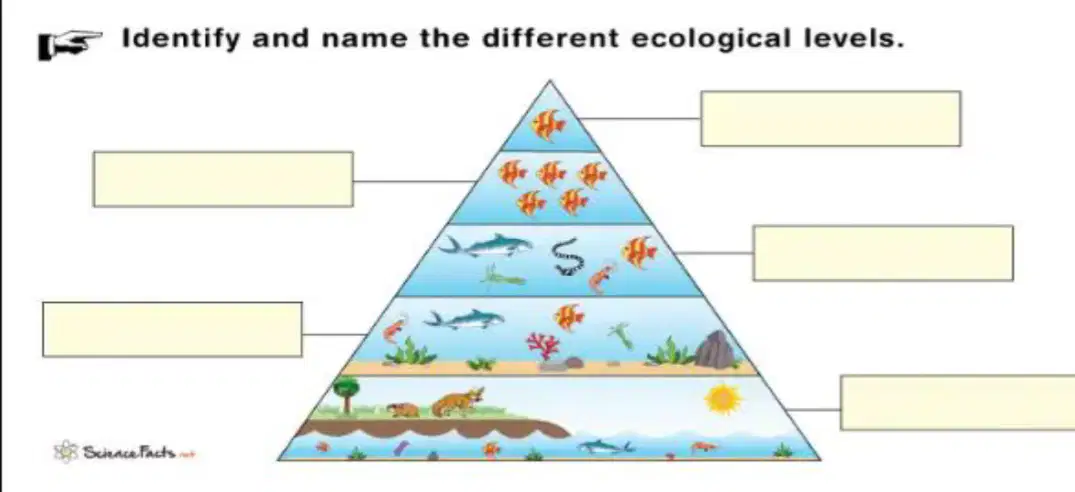
Identify and name the different ecological levels in the diagram.
Organism, Population, Community, Ecosystem, Biosphere
Cell, Tissue, Organ, Organ System, Organism
Producer, Consumer, Decomposer
Individual, Group, Society, Culture

Identify the different ecological organization levels. Fill in the blanks with the correct levels of ecological organization. Also draw the different organisms in each level.
The different levels of ecological organization are: individual, population, community, ecosystem, biome, and biosphere.
The different levels of ecological organization are: cell, tissue, organ, organ system, organism.
The different levels of ecological organization are: atom, molecule, cell, tissue, organ.
The different levels of ecological organization are: species, genus, family, order, class.
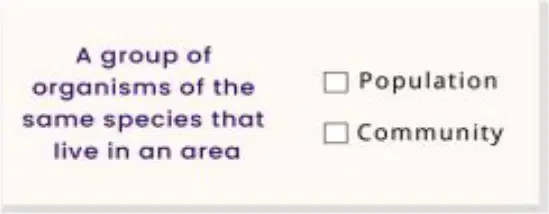
Determine which level of ecological organization the information refers to. A group of organisms of the same species that live in an area.
Population
Community
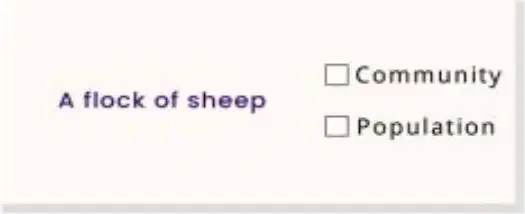
Determine which level of ecological organization the information refers to. A flock of sheep.
Community
Population

Determine which level of ecological organization the information refers to. An interacting group of various species in a common location.
Community
Ecosystem
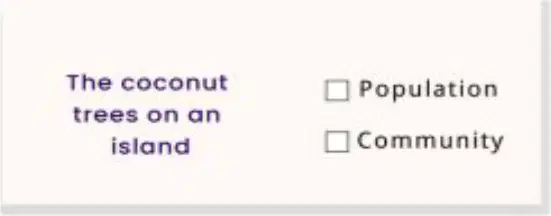
Determine which level of ecological organization the information refers to. The coconut trees on an island.
Population
Community
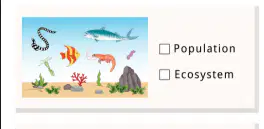
Determine which level of ecological organization the information refers to.
Biosphere
Ecosystem
Population
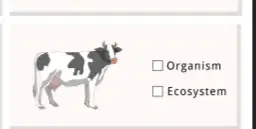
Determine which level of ecological organization the information refers to.
Organism
Ecosystem

1 individual
Organism
a group of the SAME organisms
Population
groups of DIFFERENT organisms
Community
All of the living and non-living things in an area
Ecosystem
a ball of life =
the earth
Biosphere
Label the levels of organization:
Match the following

population

community

organism
Match the following
Biosphere
Where organisms live ocean-to sky
Organism
One living thing
Poplation
2 or more organisms of the same species
Community
Multiple populations
Ecosystem
community & abiotic factors
Which of the following is an example of an abiotic factor in an ecosystem?
Sunlight
Tree
Deer
Fungi
Fill in the blanks with appropriate words. A ________ is a living component that affects the population of another organism, or the environment.
abiotic factor
biotic factor
biosphere
ecosystem
Which of the following best describes the relationship between abiotic and biotic factors in an ecosystem?
Abiotic factors are less important than biotic factors.
Biotic factors control abiotic factors.
Biotic factors depend on abiotic factors for survival.
Abiotic factors are independent of biotic factors.
Fill in the blanks with appropriate words. ________ is the study of organisms and their interaction with the surrounding environment.
Ecology
Biology
Geology
Astronomy
Fill in the blanks with appropriate words. An ________ studies the relationship between living organisms and their habitats.
ecologist
biologist
geologist
chemist
How many levels of organization are there in an ecosystem?
Five: organism, population, community, ecosystem, and biosphere
Four: organism, community, ecosystem, and biosphere
Six: cell, organism, population, community, ecosystem, and biosphere
Three: population, community, and ecosystem
Fill in the blanks with appropriate words. A ________ is a group of similar individuals, usually of a given species occupying a particular habitat at a particular time.
population
community
ecosystem
biome
Fill in the blanks with appropriate words. An ________ is a single organism, plant, animal, or microorganism, such as bacteria and fungi, capable of independent existence.
individual
ecosystem
community
population
Fill in the blanks with appropriate words. An ________ is a functional unit of nature consisting of more than a community of living organisms and their abiotic factors.
ecosystem
organism
population
biome
Fill in the blanks with appropriate words. A ________ includes populations of different species living together and sharing the same habitat in a given area.
community
ecosystem
biome
population
Fill in the blanks with appropriate words. A ________ is the total of all the ecosystems on the planet Earth.
biosphere
atmosphere
hydrosphere
lithosphere
Identify and name the different ecological levels in the diagram.
Organism, Population, Community, Ecosystem, Biome, Biosphere
Cell, Tissue, Organ, Organ System, Organism
Producer, Consumer, Decomposer
Individual, Group, Society, Culture
Identify the different ecological organization levels. Fill in the blanks with the correct levels of ecological organization. Also draw the different organisms in each level.
The different levels of ecological organization are: individual, population, community, ecosystem, biome, and biosphere.
The different levels of ecological organization are: cell, tissue, organ, organ system, organism.
The different levels of ecological organization are: atom, molecule, cell, tissue, organ.
The different levels of ecological organization are: species, genus, family, order, class.
Determine which level of ecological organization the information refers to. A group of organisms of the same species that live in an area.
Population
Community
Determine which level of ecological organization the information refers to. A flock of sheep.
Community
Population
Determine which level of ecological organization the information refers to. An interacting group of various species in a common location.
Community
Ecosystem
Determine which level of ecological organization the information refers to. The coconut trees on an island.
Population
Community
Determine which level of ecological organization the information refers to.
Biosphere
Ecosystem
Population
Determine which level of ecological organization the information refers to.
Organism
Ecosystem
1 individual
Organism
a group of the SAME organisms
Population
groups of DIFFERENT organisms
Community
All of the living and non-living things in an area
Ecosystem
a ball of life =
the earth
Biosphere
Label the levels of organization:
Match the following
population
community
organism
Match the following
Biosphere
Where organisms live ocean-to sky
Organism
One living thing
Poplation
2 or more organisms of the same species
Community
Multiple populations
Ecosystem
community & abiotic factors
Which of the following is an example of an abiotic factor in an ecosystem?
Sunlight
Tree
Deer
Fungi
Fill in the blanks with appropriate words. A ________ is a living component that affects the population of another organism, or the environment.
abiotic factor
biotic factor
biosphere
ecosystem
Which of the following best describes the relationship between abiotic and biotic factors in an ecosystem?
Abiotic factors are less important than biotic factors.
Biotic factors control abiotic factors.
Biotic factors depend on abiotic factors for survival.
Abiotic factors are independent of biotic factors.

