wayground logo

Free Printable Worksheets

Font size

S
M
L
XL
Worksheets

Review for Semester Test Part 3

Total questions: 119

Worksheet time: 2hrs 7mins

Name
Class
Date
1.
Which body system consists of the heart, veins, and arteries?
a)
Circulatory
b)
Respiratory
c)
Excretory
d)
Digestive
2.

During digestion, nutrients from food are absorbed through the walls of the small intestine and are transported to the rest of the body to be used for movement. In this process-

a)

Thermal energy is transformed into chemical energy

b)

Chemical energy is transformed into thermal energy

c)

Mechanical energy is transformed into mechanical energy

d)

Chemical energy is transformed into mechanical energy

3.
Which human body systems work together to allow the body to move?
a)
Circulatory and muscular
b)
Muscular and skeletal
c)
Respiratory and skeletal
d)
Respiratory and digestive
4.
Which body system allows our body to break down food and deliver nutrients to other parts of the body?
a)
Digestive
b)
Circulatory
c)
Respiratory
d)
Excretory
5.
Which human body system is composed of bones?
a)
Muscular
b)
Circulatory
c)
Skeletal
d)
Digestive
6.
Which human body system consists of the mouth, stomach, and intestines?
a)
Skeletal
b)
Digestive
c)
Circulatory
d)
Respiratory
7.
Which body systems work together to allow humans to breath and transfer oxygen to the rest of our body?
a)
Circulatory and skeletal
b)
Circulatory and respiratory
c)
Respiratory and muscular
d)
Muscular and digestive
8.

This system carries food, gases and wastes throughout the body

a)

cardiovascular system

b)

respiratory system

c)

nervous system

9.
This system allows the body to take in oxygen and excrete, or get rid of waste gases.
a)
Nervous System
b)
Muscular System
c)
Respiratory System
10.
This system protects the body's organs, provides support for the body.
a)
Nervous System
b)
Skeletal System
c)
Respiratory System
11.
What happens during inhalation?
a)
The diaphram contracts and moves down, enlarging enlarging the space around the lungs
b)
The diaphragm relaxes and moves up reducing the space around the lungs
12.

Which of following processes best describes a physical change that occurs during digestion?

a)

stomach acid breaks down proteins

b)

bile breaks down fat

c)

saliva breaking down large molecules into smaller molecules

d)

chewing food to break down large pieces so they can be swallowed

13.

Which statements best describe how force affects the flow of blood in circulation? Select all that apply.

a)

Blood pressure is the pressure exerted by circulating blood on the walls of blood vessels, due to the pumping action of the heart

b)

heart muscle contracts causing the heart to pump, which forces blood to move throughout the body

c)

the constant pumping of the heart maintains blood pressure and supply throughout the body

d)

heart muscle relaxes causing the heart to pump, which forces blood to flow faster, with high pressure throughout the body

14.

Which 2 body systems help the body to break down molecules and absorb nutrients and exchange oxygen and carbon dioxide?

a)

respiratory and reproductive

b)

muscular and skeletal

c)

digestive and respiratory

d)

circulatory and endocrine

15.

Main function of the excretory system is to--

a)

produce enzymes to help digest food

b)

collect and remove waste products from the body

c)

prevent diseases and fight infections

d)

carry oxygen and nutrients to the body's cells

16.

The largest human body organ, which regulates temperature and serves as a barrier against harmful microorganisms, belongs to the---

a)

circulatory system

b)

nervous system

c)

digestive system

d)

integumentary system

17.

Main function of the muscular system is to---

a)

support the body

b)

break down food

c)

movement of body

d)

removal of waste

18.

The function of the digestive system is most like which cell organelle?

a)

cell membrane

b)

mitochondria

c)

nucleus

d)

cytoplasm

19.

The cell wall is most like which organ system?

a)

nervous

b)

excretory

c)

respiratory

d)

integumentary

20.
Organisms that reproduce asexually generally have offspring that are 
a)
unicellular. 
b)
multicellular. 
c)
genetically varied. 
d)
genetically identical. 
21.
A plant that has traits identical to the parent plant provides evidence that the plant 
a)
resulted from sexual reproduction. 
b)
resulted from asexual reproduction. 
c)
will develop many seeds. 
d)
will have large leaves. 
22.
Where the better adapted organisms survive to pass traits along to offspring.
a)
Evolution
b)
Natural Selection
c)
Extinction
d)
Artifical Selection
23.
Which organisms are most likely to survive?
a)
the best adapted
b)
the fastest
c)
the strongest
d)
the most domesticated (tamed)
24.
An organism that has evolved adaptations that make it very good at getting 1 or few foods has a....
a)
Behavioral adaptation 
b)
Specialized adaptation
c)
Physical adaptation
d)
General adaptation
25.
The differences among a species, like different bird beaks, are called
a)
genes.
b)
variations.
c)
traits.
d)
theories.
26.
Why are advantageous traits more likely to be passed onto offspring?
a)
Because they are more likely to survive and reproduce.
b)
Because they come from dominant alleles.
c)
Because they come from recessive alleles.
d)
Because the trait is an acquired phenotype.
27.
Charles Darwin’s observation that finches of different species on the Galápagos Islands have many similar physical characteristics supports the hypothesis that these finches 
 
a)
have the ability to interbreed.
b)
acquired traits through use and disuse.
c)
all eat the same type of food.
d)
descended from a common ancestor.
28.
A species lives in a particular environment.  What is TRUE about the environment that the species lives in and about how the species will look over thousands of years?
a)
The environment will stay the same, and the traits of the species will stay the same.
b)
There will be changes to the environment, but the traits of the species will stay the same.
c)
There will be changes to the environment that could lead to changes in the traits of the species.
d)
There will be changes to the environment, and the traits of the species will change, but the changes in the environment could never lead to changes in the traits of species.
29.
The difference in the physical traits of an individual from those of other individuals in a group is called a(n)
a)
change
b)
adaption
c)
species
d)
variation
30.
Why did the population of peppered moths in England change from light to dark after the Industrial Revolution?
a)
Light moths were easy to see against sooty trees and were eaten, they did not reproduce and pass on their traits.
b)
Light moths were easily seen against sooty trees and birds ate them.
c)
The birds that ate the dark moths were killed by soot
d)
Dark moths were produced by industrial processes
31.
Which statement is true about variations in a population?
a)
A population with fewer variations that is adapted to its environment is likely to survive changes in the environment.
b)
A population with many variations will not change when there are changes in its environment.
c)
A population with many variations will survive changes in its environment.
d)
A population with fewer variations will have a stable population despite changes in the environment.
32.
Which organism would be more likely to survive changes in the availability of different food sources?
a)
An organism with a generalized adaptation
b)
An organism with a specialized adaptation.
c)
Both organisms.
d)
Neither organism.
33.
What is the advantage of having different shaped beaks?
a)
To look different from other species.
b)
To be able to eat the food readily available in the environment.
c)
To protect itself against predators.
d)
To protect itself against prey.
34.
What is the advantage of having different shaped beaks?
a)
To look different from other species.
b)
To be able to eat the food readily available in the environment.
c)
To protect itself against predators.
d)
To protect itself against prey.
35.

What word describes a trait that helps an organism survive in its environment?

a)

natural selection

b)

mutation

c)

camouflage

d)

adaptation

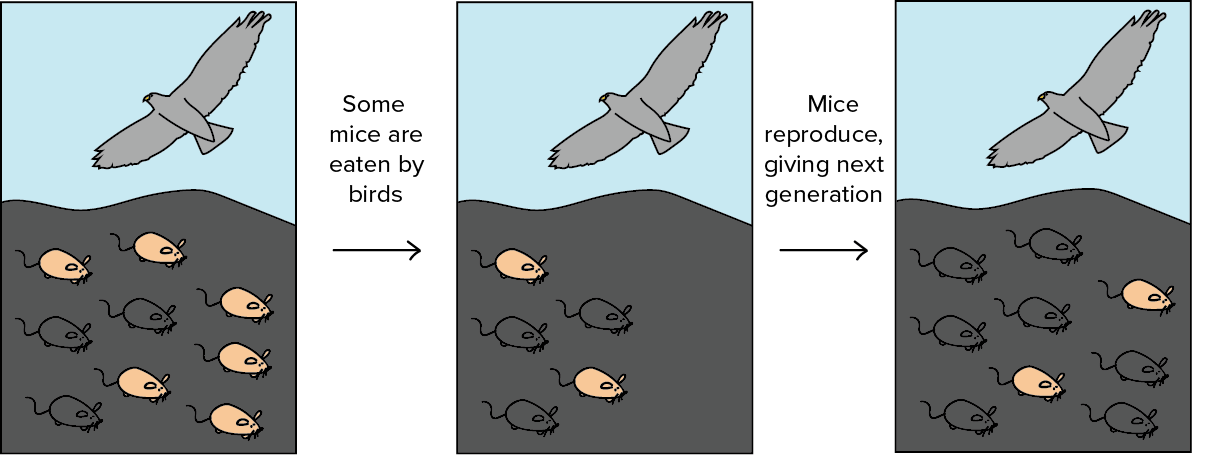
36.
What process is being shown in this image?
a)
Variation
b)
Natural Selection
c)
Selective Breeding
d)
Homeostasis
37.
Why is the mouse population changing over time?
a)
The light mice can reproduce more successfully than the dark mice
b)
The hawks eat more dark mice than light mice because the dark mice taste better
c)
The hawks eat more light mice than dark mice because they can see the light mice more easily
d)
The hawks eat more dark mice than light mice because they can see the dark mice more easily
38.
Organisms that are better adapted to the environment survive to pass traits to their offspring
a)
Natural Selection
b)
Homeostasis
c)
Selective Breeding
d)
Extinction
39.
According to the theory of natural selection, some individuals more likely than others to survive and reproduce because they:
a)
pass on to their offspring their newly acquired traits.
b)
are better adapted to their environment than others and will pass on those adaptations to future offspring.
c)
do not pass on newly acquired traits.
d)
produce fewer offspring than others in the same environment.
40.
What is the advantage of having different shaped beaks?
a)
To look different from other species.
b)
To be able to eat the food readily available in the environment.
c)
To protect itself against predators.
d)
To protect itself against prey.
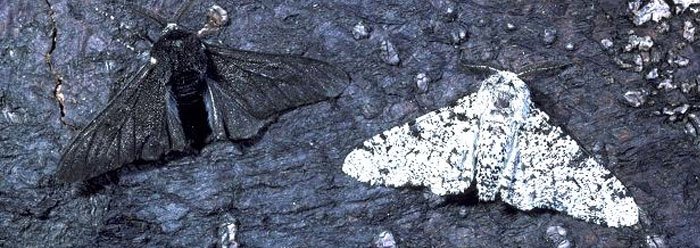
41.
The trees these moths used to live on were white, but have been covered in soot from coal factories. Which moth will be more successful in this environment?
a)
Dark moth
b)
Light moth
c)
Both will be equally successful
d)
Neither will be successful
42.
Since the 1800s humans have stopped burning coal, and the trees have returned to their original color. Which moth will be more successful in this environment?
a)
Dark moth
b)
Light moth
c)
Both will be equally successful
d)
Neither will be successful
43.
Selective breeding is where ___________ decides which traits should be passed on
a)
Nature
b)
 A human
c)
Mr. Holt
d)
The illuminati
44.
Domesticated dogs are an example of:
a)
Natural Selection
b)
Selective Breeding
45.
The long and sharp beak of a woodpecker is an example of:
a)
Natural Selection
b)
Selective Breeding
46.
Which is not an example of an adaptation?
a)
A bird's beak allows it to crack open hard nuts.
b)
A zebra's stripes allow it to confuse its predators.
c)
A frog's large hind legs allow it to jump from danger.
d)
A cat sleeps on the sofa to avoid the vacuum cleaner.
47.
Why do peppered moths tend to be the same color as the trees on which they live?
a)
The coloring goes along with tasting like the tree. 
b)
It keeps the moth the same temperature as the tree. 
c)
It makes the moths faster than the birds
d)
It makes the moths harder to see.
48.
Which of these is an example of natural selection?
a)
The largest animal in a population will have more opportunities for reproduction.
b)
Several species of organisms work together so that they all succeed.
c)
One species takes all the resources in an environment leaving none for others.
d)
Organism that are best suited to an environment tend to survive and reproduce more often.
49.
Breed an organism for a desired trait is the definition of
a)
selective breeding
b)
natural selection
c)
natural breeding
d)
biological evolution
50.
Among organism that live in the desert, the most common adaptation is 
a)
water conservation
b)
large ears
c)
broad leaves
d)
deep roots
51.
Selective breeding is when
a)
animals change because of their environment
b)
humans choose the desired traits and breed animals
c)
when animals fight each other to survive
d)
when humans go to the pet store
52.
Anything that helps an animal survive in its environment.
a)
counter-shading
b)
mimicry
c)
adaptation
d)
camouflage
53.
_______________ is when an animal blends into its environment.
a)
camouflage
b)
mimicry
c)
warning coloration
54.
How do adaptations help animals?
a)
To hide from predators
b)
to hunt for food
c)
to survive in their habitats
d)
All of these are correct
55.
The ears of this fox are an example of...
a)
A behavioral adaptation
b)
Poor breeding
c)
A physical adaptation
d)
Plastic surgery gone horribly wrong
56.
Giraffes have long necks. This allows them to eat from the tops of trees where other animals cannot reach. This is a result of...
a)
Natural Selection 
b)
Adaptation 
c)
Variation
d)
Stretching
57.
Most adaptations that help an organism survive are passed on from parent to child as ___traits?
a)
adaptable
b)
physical
c)
more
d)
inherited
58.
Which is an example of a trait that is an adaptation for cold climate but not for warm climate?
a)
thick fur and fat
b)
long claws
c)
camoflauge
d)
poisonous chemicals
59.
Which word means:
things that are taught rather than inherited
a)
mimicry
b)
learned behaviors
c)
habitat
d)
predator
60.
A trait that helps an organism survive and reproduce.
a)
adaptation
b)
competition
c)
environmental factor
d)
mutation
61.
The purpose of selective breeding is to 
a)
Get bigger animals
b)
get smaller animals
c)
create animals with desirable traits
d)
create animals with bad traits
62.
The purpose of selective breeding is to 
a)
Get bigger animals
b)
get smaller animals
c)
create animals with desirable traits
d)
create animals with bad traits
63.
A group of birds in an area eats many kinds of seeds. A disease kills all the plants in an area except for tall trees that produce hard seeds. Which of these traits will future generations of the birds most likely have?
a)
Webbed feet and strong wings
b)
Strong wings and strong beaks
c)
Strong beaks and webbed feet
d)
Showy feathers and Small beaks
64.
Which feature of a rose helps it grow without being eaten by large animals?
a)
flowers with bright colors
b)
sharp thorns
c)
small seeds
d)
deep roots
65.
The seasonal movement of an organism from one place to another
a)
camouflage
b)
migration
c)
hibernation
d)
function
66.
1.  Study the picture to the left. A population of insects is sprayed with a new insecticide. Most of the insects are killed but a few survive. In the next generation, spraying continues, but many more of the insects are unaffected by the insecticide than the first spraying. Which of the following BEST explains these results?
a)
The insecticide caused a mutation in the species
b)
A few insects in the first population were immune and passed this trait to their offspring
c)
a.  The insecticide caused a side effect of immunity that was passed on to the next generation of insects. The insects learned to fight off the insecticide.
67.
Evidence shows that the wolf is the ancestor to all of the breeds of dogs shown below. How did this variation arise in a relatively short period of time?
a)
A.  Genetic manipulation
b)
Natural selection
c)
Random chance
d)
Selective breeding
68.

This allows materials to be transported quickly between structures in the cell.

a)

Nucleus

b)

Vacuole

c)

Cytoplasm

d)

Chromosomes

69.

This is the control center of a cell.

a)

Vacuole

b)

Chromosomes

c)

Nucleus

d)

Cytoplasm

70.

This is the purpose of a vacuole.

a)

To contain the genetic information of a cell.

b)

To store water and nutrients in a cell.

c)

To protect the cell.

d)

To move the cell.

71.

This structure is found in a plant cell but not an animal cell.

a)

Cell Membrane

b)

Cell Wall

c)

Vacuole

d)

Nucleus

72.

This is where the Chlorophyll can be found.

a)

Vacuole

b)

Cytoplasm

c)

Flagellum

d)

Chloroplast

73.

This is what makes a plant cell look different than an animal cell.

a)

Nucleus

b)

Cell Membrane

c)

Cell Wall

d)

Cilia

74.

This contains the genetic information of a cell.

a)

Cytoplasm

b)

Vacuole

c)

Chromosomes

d)

Chloroplasts

75.

This gives the cell its energy using respiration.

a)

Mitochondria

b)

Ribosomes

c)

Endoplasmic Reticulum

d)

Lysosomes

76.
What is the cell organelle that forms the outer boundary of a cell and allows certain materials to move into and out of a cell?
a)
nucleus
b)
cell membrane
c)
cell wall
d)
cell barrier
77.
What is the cell organelle that is a gel-like material inside the cell that contains water and nutrients?
a)
rough ER
b)
smooth ER
c)
ribosomes
d)
cytoplasm
78.
What is the cell organelle that directs the activity of a cell that contains chromosomes with DNA?
a)
nucleolus
b)
nucleus
c)
ribosomes
d)
golgi body
79.
What is the cell organelle that separates the nucleus from the cytoplasm?
a)
nuclear membrane
b)
cell membrane
c)
nucleus
d)
nucleolus
80.
What is the cell organelle that breaks down food and releases energy to the cell?
a)
nucleus
b)
mitochondria
c)
chloroplast
d)
ribosome
81.
Letter C represents what cell part?
a)
nucleus
b)
nucleolus
c)
nuclear membrane
d)
cytoplasm
82.
What is the cell organelle that contains chlorophyll and makes food for a PLANT cell?
a)
chlorophyll
b)
chloroplast
c)
vacuole
d)
mitochondria
83.
Letter D represents which cell organelle?
a)
smooth ER
b)
rough ER
c)
golgi body
d)
vacuole
84.
Letter A represents what cell part?
a)
nucleus
b)
nucleolus
c)
nuclear membrane
d)
cytoplasm
85.
Letter E represents which cell organelle?
a)
smooth ER
b)
rough ER
c)
golgi body
d)
vacuole
86.
The way an animal behaves in a group in order to survive is called...?
a)
hibernation
b)
social interaction
c)
herding
d)
population
87.
This adaptation helps animals hide for either predators or prey. What is it?
a)
warning coloration
b)
camouflage
c)
instinct
d)
migration
88.
When an organism copies a characteristic of something else in order to better its chances for survival and reproduction
a)
hibernation
b)
camouflage
c)
mimicry
d)
migration
89.
When an organism copies a characteristic of something else in order to better its chances for survival and reproduction
a)
hibernation
b)
camouflage
c)
mimicry
d)
migration
90.
An example of a physical adaptation is...
a)
a turtle hiding inside its shell
b)
The spikes on a porcupine fish
c)
a rabbit burrowing underground
d)
a viper biting when threatened
91.
A monkey has a long tail to help it swing from branch to branch.
a)
Behavioral Adaptation
b)
Structural Adaptation
92.
An owl is mostly nocturnal meaning it hunts and is active at night.
a)
Behavioral Adaptation
b)
Structural Adaptation
93.
An example of a physical adaptation is...
a)
a turtle hiding inside its shell
b)
The spikes on a porcupine fish
c)
a rabbit burrowing underground
d)
a viper biting when threatened
94.
This is a period of deep sleep that occurs in some animals when outside temperatures are cold: ______
a)
hibernation
b)
migration
95.
1. What is an adaptation?
a)
A feature or behavior that helps an animal survie.
b)
The food that an animal eats.
c)
How energy moves in a food web.
96.
Why do some animals hibernate?
a)
The cold weather makes them sleepy.
b)
Their food supply is smaller in the winter.
c)
They have no one to play with.
97.
An animal's color or pattern that helps it blend into its surroundings
a)
Environment 
b)
Mimicry
c)
Camouflage
98.
 Which of these BEST describes how some birds survive when the weather gets cold? 

     
a)
 a.   They store twigs and sticks in their nest 
b)
 b. They migrate to a warmer climate 
c)
 c. They grow more feathers to stay warm in the winter 
d)
 d. They hide in bushes and wait for warm weather 
99.
Some animals move great distances as the seasons change.  What is this called?
a)
hibernation
b)
migration
c)
habitat
d)
coloration
100.
Which of the following is a physical adaptation for the underlined animal?
a)
A snake unhinges its jaw to eat a rabbit it just caught.
b)
A hognose snake rolls over, slows its breathing, and hangs its tongue out to pretend to be dead.
c)
A herd of buffalo encircle their young to protect them from a pack of wolves.
d)
A dung beetle rolls a piece of dung across the desert.
101.
A thick layer of ____________ keeps polar bears warm during the cold winter.
a)
Nails
b)
Mimicry
c)
Blubber
d)
Camouflage
102.
Explain how colouration helps an organism survive.
a)
The organism is able to hide against its environment, protecting it from predators.
b)
The organism is able to stay warm in the winter by moving to a warmer climate.
c)
The organism looks like another organism to help it survive.
d)
The organism stores food in the spring so that it can survive a long winter.
103.
When an organism slows its life functions for a period of time to better its chances for survival during harsh conditions
a)
camouflage
b)
migration
c)
mimicry
d)
hibernation
104.
Which of the following is a physical adaptation for the underlined animal?
a)
A butterfly has bright colors to warn predators that it is poisonous.
b)
A hognose snake rolls over, slows its breathing, and hangs its tongue out to play dead.
c)
A herd of buffalo encircle their young to protect them from a pack of wolves.
d)
A dung beetle rolls a piece of dung across the desert.
105.
Traveling done by an animal to find food and water. 
Adaption: birds flying south for the winter
a)
Camouflage
b)
Migration
c)
Hibernation
d)
Locomotion
106.
What adaptation does this squirrel have that allows it to glide through the air?
a)
Extra skin under the arms and legs to capture air as it falls.
b)
Big ears to capture are as it falls
c)
Small eyes to see where it will land
d)
A short thin tail
107.
The polar bear's white fur allows it to hide in the cold arctic. This adaptation is called________________.
a)
White on white
b)
Camouflage
c)
Color matching
d)
behavioral adaptation 
108.
Polar bears have an adaptation that allows them to swim. What is most likely this adaptation?
a)
White coat
b)
Fat belly
c)
Small eyes
d)
Webbed Feet
109.

Which organ stores and breaks down food?

a)

pancreas

b)

liver

c)

stomach

d)

large intestine

110.
Which digestive organ makes digestive juices to help the small intestine absorb nutrients?
a)
Liver
b)
Gallbladder
c)
Pancreas
d)
Esophagus
111.
Nutrients from digested food are absorbed in which digestive organ?
a)
Small Intestine
b)
Stomach
c)
Large Intestine
d)
Gallbladder
112.

What is # 4 ?

a)

urethra

b)

ureter

c)

urinary bladder

d)

kidney

113.
Which system absorbs oxygen and releases carbon dioxide?
a)
respiratory
b)
excretory
c)
endocrine
d)
immune
114.
Which system acts as a barrier from the sun and helps regulate body temperature?
a)
integumentary
b)
muscular
c)
digestive
d)
circulatory
115.
Which system controls voluntary and involuntary movement?
a)
muscular
b)
skeletal
c)
immune
d)
excretory
116.
This system transports oxygen and nutrients around the body.
a)
circulatory
b)
respiratory
c)
skeletal
d)
digestive
117.
This system breaks down food into nutrients that the body can absorb.
a)
digestive
b)
excretory
c)
reproductive
d)
immune
118.
This system fights pathogens (germs) and produces and stores white blood cells.
a)
immune
b)
muscular
c)
endocrine
d)
integumentary
119.
This system supports the body and protects vital organs.
a)
skeletal
b)
muscular
c)
circulatory
d)
nervous