
NEW
Font size
S
M
L
XL
 Worksheets
Chemistry Midterm Study Guide 2018
Total questions: 54
Worksheet time: 46mins
Name
Class
Date
1.
The one factor that is changed in an experiment. You should have only one. It's what you change as the scientist.
a)
Independent Variable
b)
Dependent Variable
c)
Control
2.
The change that is the result of the independent variable. The factor that responds or is measured in an experiment.
a)
Dependent Variable
b)
Independent Variable
c)
Controll
3.
This variable in an experiment is the one being changed by the scientist.
a)
dependent variable
b)
independent variable
c)
data
d)
control group
4.
Parts of the investigation that remain the same throughout to prevent affecting the outcome
a)
Independent Variable
b)
Constant
c)
Controlled Variable
5.
Testing a hypothesis often involves a(n):
a)
answer
b)
experiment
c)
problem
d)
safety check
6.
Lauren is convinced that book/movie combinations are better if you have read the book before watching the movie. Lauren's friend, Alyssa, thinks that movies are just as good even if you don't read the book. They got 40 of their classmates to help them solve their debate. 20 classmates read the book Divergent and 20 more classmates viewed the movie without reading the book. All participants went to see the movie on Friday at 6 p.m. They had their classmates do a survey (1-4 stars). Then, Alyssa and Lauren averaged the number of stars for both groups.
What is the dependent variable?
What is the dependent variable?
a)
The length of the movie
b)
The time the movie starts
c)
The # of stars the movie gets
7.
How many significant figures does the following number have: 0.002040
a)
6
b)
4
c)
3
d)
2
8.
How many significant figures does the following number have: 0.998005
a)
9
b)
10
c)
6
d)
5
9.
How many significant figures does the following number have: 0.002040
a)
6
b)
4
c)
3
d)
2
10.
How many significant figures does the following number have: 0.998005
a)
9
b)
10
c)
6
d)
5
11.
How many significant figures does the following number have: 100.00210
a)
7
b)
5
c)
10
d)
8
12.
What is the measurement 1042 Liters rounded to 2 significant figures?
a)
1040 L
b)
1.1 x 10³ L
c)
1.0 x 10³ L
d)
1050 L
13.
Determine the number of Significant Figures in 10-L.
a)
4
b)
3
c)
2
d)
1
14.
How many Significant Figures in the number below?
4.56 x 10³
4.56 x 10³
a)
5
b)
4
c)
6
d)
3
15.
What is the first significant figure in 0.0457?
a)
4
b)
5
c)
0
d)
7
16.
What is 78.5 rounded to one significant figure?
a)
79
b)
78.5
c)
70
d)
80
17.
What is 0.658 rounded to 1 significant figure?
a)
0
b)
0.66
c)
0.7
d)
0.658
18.
round to 2 decimal places 22.484
a)
22.49
b)
22.48
c)
22.40
d)
22.00
19.
Round off 509.96 to 4 significant figures.
a)
509.9
b)
509.0
c)
510.0
d)
510
20.
67 seconds + 10.1 seconds = ?
a)
77.1
b)
77
c)
70
d)
80
21.
0.0005 meters + 0.029 meters = ?
a)
0.0295 meters
b)
0.300 meters
c)
0.030 meters
d)
0.029 meters
22.
9544 lbs - 321 lbs = ?
a)
9000 lbs
b)
10,000 lbs
c)
9223 lbs
d)
9862 lbs
23.
1.0 kg - 0.001 kg = ?
a)
0.999 kg
b)
0.99 kg
c)
0.9 kg
d)
1.0 kg
24.
100 + 30.6
a)
130.6
b)
131
c)
130
d)
100
25.
5.9 x 6.01
a)
35.459
b)
35.46
c)
35.5
d)
35
26.
7.8 x 5.501
a)
42.9078
b)
42.908
c)
42.91
d)
42.9
e)
42
27.
0.9/2.3
a)
0.391
b)
0.39
c)
0.40
d)
0.4
28.
7.15/0.10
a)
71.5
b)
72
c)
70
d)
71.50
29.
Calculate 923 g ÷ 20312 cm3 and give your answer with the correct number of significant figures.
a)
0.04 g/cm3
b)
0.045 g/cm3
c)
0.0454 g/cm3
d)
0.05 g/cm3
30.
When a measurement is repeatable and consistent it is said to have...
a)
High precision
b)
Low precision
c)
High accuracy
d)
Low accuracy
31.
How close a measurement is to the accepted value is called..
a)
Accuracy
b)
Precision
c)
Significant
d)
Estimate
32.
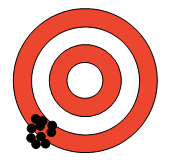
This bullseye demonstrates...
a)
High Accuracy & High Precision
b)
High Accuracy & Low Precision
c)
Low Accuracy & High Precision
d)
Low Accuracy & Low Precision
33.
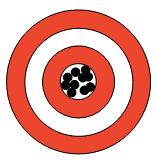
?
a)
High Accuracy & High Precision
b)
High Accuracy & Low Precision
c)
Low Accuracy & High Precision
d)
Low Accuracy & Low Precision
34.
The students measured length during a science experiement, they got 12 cm. But the actual measurement was 14.25 cm. What was the percent error?
a)
15.79%
b)
18.75%
c)
2.25%
d)
18%
35.
The deer population is estimated to be 17,600 in northern Illinois, but an actual count was 21,300. What is the percent error?
a)
21%
b)
17.37%
c)
17.4%
d)
21.02%
36.
Jessie estimates the weight of her cat to be 8 pounds. The actual weight of the cat was 10 pounds. Find the percent error.
a)
15%
b)
20%
c)
25%
d)
30%
37.

What is measured with a graduated cylinder?
a)
Passage of time
b)
Distance from one thing to another
c)
Weight of an object
d)
Volume of liquid
38.

What is this?
a)
Measuring tube
b)
Test tube
c)
Graduated Cylinder
d)
Pipette
39.

What is used to protect your eyes from chemicals, broken glass, and fire?
a)
Fire blanket
b)
Eye wash
c)
Goggles
d)
Flask
40.
What instrument should be used if the lab directions ask you to measure to the nearest milliliter?
a)
graduated cylinder
b)
triple beam balance
c)
Erlenmeyer flask
d)
meter stick
41.

Name the tool pictured
a)
scalpel
b)
Eye dropper
c)
Tweezer
d)
Forceps
42.

Name the tool
a)
crucible tongs
b)
metal tongs
c)
forceps
d)
tweezers
43.
The _________________ is used to simply hold or approximately measure a liquid.
a)
scale
b)
test tube
c)
beaker
d)
thermometer
44.
If a beaker is hot what should be used to hold it?
a)
test tube holder
b)
metal tongs
c)
forceps
d)
test tube rack
45.

Identify this piece of lab equipment?
a)
Balance
b)
Graduated cylinder
c)
Hot plate
d)
Beaker tongs
46.
Convert from meters to cm: 9 meters
a)
900 cm
b)
90 cm
c)
0.9 cm
d)
0.09 cm
47.
Convert 17 m to cm:
a)
0.17 cm
b)
0.017 cm
c)
1,700 cm
d)
170 cm
48.
Convert 300 meters to centimeters:
a)
3000 cm
b)
0.3 cm
c)
30,000 cm
d)
3 cn
49.
490,000 g =____ kg
a)
490
b)
49
c)
4,900
d)
0.49
50.
The tool used to measure the mass of a substance or object is a ______________.
a)
balance
b)
graduated cylinder
c)
ruler
d)
thermometer
51.
What is the unit for weight?
a)
Hertz
b)
m/s
c)
Kilograms
d)
Newtons
52.
The amount of space occupied by an object is also known as ____.
a)
volume
b)
time
c)
length
d)
speed of light
53.
Metric (SI) Unit for liquid volume
a)
millimeters, meters, centimeters
b)
grams, kilograms, milligrams
c)
milliliters, liters
d)
Newtons
54.
What is the correct SI unit for mass?
a)
Kilograms
b)
newtons
c)
pounds
d)
grams
Reset

