Wayground logo

Free Printable Worksheets

Font size

S
M
L
XL
Worksheets

Law of Conservation of Matter

Total questions: 50

Worksheet time: 51mins

Name
Class
Date
1.
In a reaction A + B ----> C,  reactant A has 5g and product  C has 9g. How many grams does reactant B should have? 
a)
4g
b)
5g
c)
9g
d)
14g
2.
Bob puts 200 grams of ice into a pitcher with 900 grams of water. He gets distracted and comes back later to find that the ice has melted in the water. How many grams of water does Bob now have in the pitcher?
a)
200 g
b)
700 g
c)
1,100 g
3.
24 g of magnesium reacts with 38 g of fluorine to produce _____ g magnesium fluoride
a)
62 
b)
38
c)
24
d)
14
4.
What is the law of conservation of mass?
a)
The amount of matter changes when reacted or changed.
b)
The mass of all reactants are changed during a physical or chemical change
c)
The mass of the reactants equals the mass of the products
d)
The mass of the products is different than the mass of the reactants.
5.
Students react baking soda & vinegar.
Which of the following would provide the evidence that the number of atoms present before a chemical reaction is equal to the number of atoms present after the chemical reaction?
a)
The mass of the plastic bag, baking soda, and vinegar before the reaction was equal to the mass after the reaction.
b)
Bubbles were produced during the reaction, which meant that a gas was being produced.
c)
The plastic bag did not change in any way, indicating that it was not involved in the reaction.
d)
The mass of the baking soda was exactly equal to the mass of the vinegar used to create the chemical reaction.
6.
The Law of Conservation of matter states that the total amount of matter ______________ after it undergoes change.
a)
disappears
b)
stays the same
c)
weighs less
d)
explodes
7.

What is the part of the chemical equation in green called?

Fe + S → FeS

a)

products

b)

reactants

c)

yield

d)

input

8.

What is the right part of a chemical equation called...

2H2 + O2 --> 2H2O

a)

Reactants

b)

Products

c)

Yields

d)

Output

9.

This type of system allows matter to flow freely in and out...

a)

Closed System

b)

Open System

10.
A boiling pot with a lid on it to keep in the energy is what type of system?
a)
Closed System
b)
Open System
11.
Use this equation: 
4H + O2 --> 2H2O
How many atoms of oxygen are on the reactant side of the arrow?
a)
4
b)
8
c)
1
d)
2
12.
Use this equation: 
4H + O2 --> 2H2O
How many atoms of hydrogen are on each side of the arrow?
a)
4
b)
2
c)
8
d)
1
13.

The Law of Conservation of Mass States

a)

Energy cannot be created nor destroyed, it can only change form.

b)

Mass cannot be created nor destroyed, it can only change form.

c)

Matter cannot be created nor destroyed, it can only change form.

d)

Mass can be created or destroyed, it cannot change form.

14.

In this chemical equation , the 2 in front of the 2O2 and the 2 in front of the 2H2O are called the...

a)

Products

b)

Reactants

c)

Coefficient

d)

Subscript

15.

In this chemical equation ,the small numbers dropped down below the letters like the 4 in CH4 are known as the

a)

Products

b)

Reactants

c)

Coefficient

d)

Subscript

16.

If you have 15 grams of Baking Soda and 20 grams of Vinegar as products, what would you expect the mass of your reactants to be?

a)

15 grams

b)

20 grams

c)

5 grams

d)

35 grams

17.
Fill in the blank:
A __________________ chemical equation shows that the same number of atoms in the reactants are also in the product.
a)
balanced
b)
transferred
c)
rearranged
d)
beautiful
18.
In a chemical reaction, the mass of the reactants was 15g.  The mass of the products was 12g.  Did this chemical reaction follow the law of conservation of mass?
a)
Yes 
b)
No
c)
You can't tell with the given infomation 
19.
The following chemical reaction occurs:
2S + 3O2 -> 2SO3
How many atoms of oxygen are there in the reactant?
a)
2 atoms of oxygen
b)
3 atoms of oxygen
c)
6 atoms of oxygen
d)
1 atom of oxygen
20.
The following chemical reaction occurs:
N2 + 3 H2 -> 2 NH3
How many atoms of hydrogen are there in the product?
a)
3 atoms of hydrogen
b)
2 atoms of hydrogen
c)
6 atoms of hydrogen
d)
1 atom of hydrogen
21.
Is this equation balanced?
a)
yes
b)
no
c)
Not enough information
22.
Is the equation balanced?: 2H2O + O2 --> 4MgO + 3Fe
a)
Yes
b)
No
23.
Balance this equation
_Al +_HCl --> _H2 +_AlCl3
a)
2, 6, 3, 2
b)
it is already balanced
c)
4, 12, 3, 4
d)
2, 1, 4, 5
24.
Balance this equation-
__P4 + __O2 --> __P2O3
a)
it is already balanced
b)
2, 1, 3
c)
1, 2, 3
d)
1, 3, 2
25.
Balance this equation
_N2 + _H2 --> _NH3
a)
1,2,3
b)
1,3,2
c)
1,1,2
d)
2,1,1
26.
Balance this equation.
_Mg + _Cl2 --> _MgCl2
a)
1, 2,1
b)
already balanced
c)
2,1,1
d)
1,1,2
27.
Balance this equation
_Zn+_HCl-->_ZnCl2 +_H2
a)
1,1,2,1
b)
1,1,1,2
c)
1,2,1,1
d)
2,1,1,1
28.
How many atoms of aluminum are on each side of the following equation: 4Al + 3O2 --> 2Al2 O3
a)
2
b)
6
c)
1
d)
4
29.
When balancing equations a ____ can be placed to the left of a formula of a substance to make the equations balanced
a)
charge
b)
subscript
c)
random number
d)
coefficient
30.
What is a coefficient?
a)
The small number on the right of the chemical symbol.
b)
The large number to the left of a formula.
31.
What is the arrow in a chemical equation...
H2 + O --> H2O
a)
Reactants
b)
Products 
c)
Yields 
d)
Chemical Equation 
32.
What is the little number after an element in a chemical equation called.
Example: H2
a)
Coefficient 
b)
Subscript
c)
Atom
d)
Equation
33.
Balance this equation.
_N2+_O2->_H2O+_HNO3
a)
not possible
b)
2,2,1,2
c)
2,1,1,4
d)
2,2,1,4
34.
Balance this equation-
_SeCl6+_O2>_SeO2+_Cl2
a)
1,2,1,2
b)
1,1,1,3
c)
1,2,1,1
d)
2,1,1,1
35.
4Si + S8 --> 2Si2S4
a)
Synthesis
b)
Decomposition
c)
Single displacement
d)
Double displacement
36.
3Ca + 2AlCl3 --> 3CaCl2 + 2Al
a)
Synthesis
b)
Decomposition
c)
Single diplacement
d)
Double displacement
37.
3KOH + H3PO4 --> K3PO4 + 3H2O
a)
Synthesis 
b)
Decomposition
c)
Single displacement
d)
Double displacement
38.
2Pb(NO3)2 --> 2PbO + 4NO2 + O2
a)
Synthesis 
b)
Decomposition
c)
Single displacement
d)
Combustion
39.
Which chemical reaction breaks down into 2 substances?
a)
Double Replacement
b)
Single Replacement
c)
Synthesis
d)
Decomposition
40.
Which chemical reaction switches 2 elements?
a)
Double Replacement
b)
Single Replacement
c)
Combustion
d)
Decomposition
41.
A + B = AB
a)
Double Replacement
b)
Synthesis
c)
Combustion
d)
Decomposition
42.
AB + CD = AD + CB
a)
Double Replacement
b)
Single Replacement
c)
Combustion
d)
Decomposition
43.
A + BC = B + AC
a)
Single Replacement
b)
Combustion
c)
Double Replacement
d)
Synthesis
44.
Which chemical reaction takes place when 2 substances react to form a single product?
a)
Decomposition
b)
Double Replacement
c)
Single Replacement
d)
Synthesis
45.
AB = A + B
a)
Decomposition
b)
Single Replacement
c)
Combustion
d)
Synthesis
46.

When balancing equations, the rule is that you can only add, change, and remove ____________

a)

Coefficients

b)

Mass

c)

Subscripts

d)

Elements

47.
Which coefficients balance this equation:
NH3  +  O2 ---->   NO  + H2O
a)
2,3,5,6
b)
5,5,4,6
c)
4,6,4,5
d)
4,5,4,6
48.
How many TOTAL atoms are in 2CaO2
a)
2
b)
3
c)
5
d)
6
49.
How many ATOMS of Oxygen are in 3Fe2O3
a)
2
b)
3
c)
6
d)
9
50.
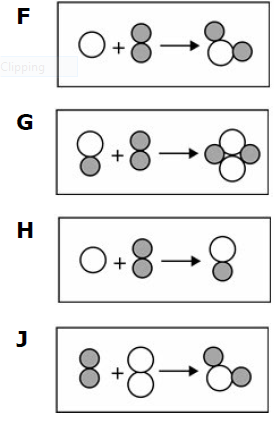
Which of the following models best demonstrates a balanced chemical equation?
a)
F
b)
G
c)
H
d)
J