Wayground logo

Free Printable Worksheets

Font size

S
M
L
XL
Worksheets

1st Semester Chemistry exam

Total questions: 63

Worksheet time: 1hrs 19mins
Name
Class
Date
1.
Freezing
a)
Solid to gas
b)
Liquid to solid
c)
Gas to solid
d)
Liquid to gas
2.
What are the states of matter?
a)
solid, liquid, and juice
b)
solid and liquid
c)
solid and gas
d)
solid, liquid, and gas
3.
Which state of matter has tightly packed molecules?
a)
solid
b)
liquid
c)
gas
4.

Boiling water

a)

Chemical Change

b)

Physical Change

5.

Is a a rusting bicycle a chemical or physical change?

a)

chemcial

b)

physical

6.

Is bleaching your hair a physical or chemical change?

a)

physical

b)

chemical

7.

In the modern periodic table elements are arranged by:

a)

atomic mass

b)

atomic number

c)

valence electrons

d)

number of isotopes

8.
The atomic number tells you what?
a)
number of electrons
b)
number of protons
c)
number of neutrons
d)
both electrons and protons in an atom.
9.

The atoms along the jagged line are called

a)

metals

b)

nonmetals

c)

metalloids

d)

noble gases

10.

Which element serves as the electronegativity anchor?

a)

He

b)

Cs

c)

F

d)

Au

11.

If Na+1 and F-1 combine what is the resulting formula?

a)

NaF

b)

NaF2

c)

Na2F

d)

Na

12.

If Mg+2 and F-1 combine what is the resulting formula?

a)

MgF2

b)

MgF

c)

Mg2F

d)

Mg

13.
Which of the following is an ionic compound:
a)
CH4
b)
I2
c)
LiBr2
d)
CO
14.
Name the following ionic compound: BeCl2
a)
beryllium chlorine
b)
beryllium II chloride
c)
beryllium chloride
d)
beryllium dichloride
15.
What is the name of N2O3
a)
Nitrogen trioxide
b)
Dinitrogen oxide
c)
Dinitrogen trioxide
d)
Nitrogen oxide
16.
What is the chemical formula for Tetrasulfur pentoxide?
a)
SO
b)
S4O
c)
S4O5
d)
S5O4
17.
Which of the following half reactions correctly represents a reduction half reaction?
a)
Fe →Fe2+ + 2e-
b)
Pb4+ + 2e- →Pb2+
c)
2O-2 →O2 + 4e-
d)
Fe + 3e- →Fe3+
18.
     In the reaction Zn + H2O --> ZnO2 + H2
 which element, if any, is oxidized? 
a)
Zinc
b)
Hydrogen
c)
Oxygen
d)
None
19.
Which of the following metals is the most reactive according to the reactivity series of metals.
a)
Copper
b)
Zinc
c)
Magnesium 
d)
Lithium
20.
Based on the activity series, which metal could X represent in the reaction below?
X + Ca (NO3)2 -->  Ca + X (NO3)2
a)
Ba
b)
Fe
c)
Mg
d)
Zn
21.
What type of reaction occurs between an element and a compound?
Zn + 2HCl --> ZnCl2 + H2
a)
Synthesis
b)
Decomposition
c)
Single Replacement
d)
Double Replacement
22.

What kind of reaction is this:

4Fe + 3O2 → 2Fe2O3

a)

Synthesis

b)

Decomposition

c)

Single Replacement

d)

Double Replacement

23.
What kind of reaction is this:
 CaCO3 + Ag2SO4 → CaSO4 + Ag2CO3 
a)
Decomposition
b)
Single Replacement
c)
Double Replacement
d)
Combustion
24.

In a chemical reaction, the _________ are on the right of the →

a)

reactants

b)

products

c)

catalyst

d)

yield

25.

In a chemical reaction, the _________ (original substances) are on the left of the →

a)

reactants

b)

products

c)

catalyst

d)

yield

26.
2Pb(NO3)2   -->   2PbO +  4NO2  +  O2
a)
Synthesis
b)
Decomposition
c)
Single Displacement
d)
Combustion
27.

a reaction where an acid (H+) reacts with a base (OH-) to produce water and a salt

a)

single replacement

b)

double replacement

c)

combustion

d)

acid-base

28.

CH4 + O2 --> CO2 + H2O

a)

Single Replacement

b)

Double Replacement

c)

Combustion

d)

Acid-Base

29.
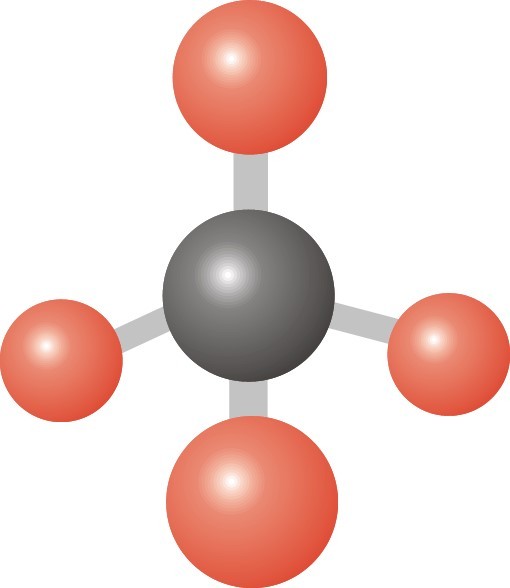
What VSEPR shape is this
a)
Linear
b)
Line
c)
Tetrahedral
d)
Bent
30.
What VSEPR structure is this?
a)
Trigonal Pyrimidal
b)
Trigonal Planar
c)
Tetrahedral
d)
Non-existant
31.
What VSEPR structure is this?
a)
Trigonal Pyrimidal
b)
Trigonal Planar
c)
Tetrahedral
32.
What VSEPR structure would O2 form?
a)
Linear
b)
H-7
c)
Gas
d)
Bent
33.

What shape would PH3 have?

a)

Trigonal Planar

b)

Trigonal pyramidal

c)

Bent

d)

Linear

34.
What is the percent by mass of magnesium in MgO?
a)
20%
b)
40%
c)
50%
d)
60%
35.

An empirical formula:

a)

is a formula that calculates the coefficients of a compound in a balanced equation.

b)

is the simplest whole-number ratio of elements in the compound.

36.
What is the empirical formula of the following molecular formula:  C3H6
a)
C3H6
b)
CH2
c)
C2H4
d)
CH3
37.
Which pair has the same empirical formula?
a)
NaCrO4 and Na2Cr2O7
b)
C2H4O2 and C6H12O6
c)
C3H6O3 and C2H6O2
d)
CH4 and C2H6
38.
You are given the following percentages: 40.05% S and 59.95% O. Find the empirical formula for these elements. (keep two decimal places throughout calculations)
a)
SO
b)
SO2
c)
SO3
d)
SO4
39.
What is the molecular formula if the empirical formula is C2H5 and the molecular molar mass is 58.14 g/mol?
a)
C2H5
b)
C4H10
c)
C1H2.5
d)
C4H8
40.
What is the molecular formula if the empirical formula is CH2O and the molecular molar mass is 180.18?
a)
CH2O
b)
C2H4O2
c)
C4H8O4
d)
C6H12O6
41.
A mixture of two or more metals is called:
a)
mixture
b)
solution
c)
compound
d)
alloy
42.

Electrons that are free to move in metals

a)

delocalized electrons

b)

oxidation number

c)

chemical bond

d)

salts

43.
What is the ability of a substance to be pulled into a thin strand?
a)
Malleability
b)
Ductility 
c)
Conductivity
d)
Solubility
44.
What is the ability of a substance to allow heat, sound, or electricity to flow through it?
a)
Malleability
b)
Ductility
c)
Solubility
d)
Conductivity
45.
How many valence electrons does chlorine (Cl) have?
a)
2
b)
5
c)
6
d)
7
46.
Which of these elements has 8 valence electrons?
a)
P
b)
Be
c)
O
d)
Ar
47.
This is a correct dot diagram for fluorine (F)
a)
true
b)
false
48.
A covalent bond involves a __________ of electrons.
a)
sharing
b)
borrowing
c)
exchanging
d)
switching
49.
A __________ is a number written to the right of a chemical symbol and slightly below it.
a)
subscript
b)
coefficient
c)
chemical formula
d)
compound
50.
When chlorine reacts it wants to ______________ electron.
a)
gain 1
b)
lose 1
c)
gain 2
d)
lose 2
51.
When Aluminum forms an ionic compound then it will ________________ electron(s).
a)
gain 1
b)
gain 2 
c)
gain 3
d)
lose 3 
52.
Three pairs of electrons are shared in a
a)
Single bond
b)
Double bond
c)
Triple bond
53.

How many lone pairs of electrons are in a molecule of isocyanic acid; pictured above?

a)

2

b)

3

c)

6

d)

8

54.
Which of the following is the correct Lewis structure for the compound PBr3?
a)
structure A
b)
structure B
c)
structure C
d)
structure D
55.
The element oxygen has _____ valence electrons and needs to add _____ electrons to complete its octet.
a)
2, 6
b)
6, 2
c)
8, 2
d)
2, 8
56.
What is the proper name for S2O2?
a)
Sulfur oxide
b)
Sulfur dioxide
c)
sulfur (II) oxide
d)
disulfur dioxide
57.
Who could this molecule be?
a)
CH4
b)
CO2
c)
PCl5
d)
BF3
58.
What happens in ALL chemical changes?
a)
Change in state of matter
b)
A new substance is formed
c)
Bubbles are produced
d)
An explosion
59.
Which of the following tells you that a chemical change may have occurred?
a)
Change Shape
b)
Melting
c)
Vaporizing
d)
Change in color
60.
Is copper tarnishing a physical or chemical change?
a)
Physical 
b)
Chemical
61.

Which of the following is not a clue that a chemical reaction has taken place?

a)

Changing size

b)

Changing color

c)

A gas being formed

d)

Formation of a precipitate

62.

Identify the Extensive Properties

a)

color

b)

mass

c)

volume

d)

Density

e)

length

63.

What is the ability of a substance to be pulled into a thin strand?

a)

Malleability

b)

Ductility

c)

Conductivity

d)

Solubility