
 Worksheets
Electrochemistry
Total questions: 60
Worksheet time: 40mins
1) What two metals are often used in electrochemical cells?
Carbon and copper
Zinc and sulfur
Zinc and carbon
Zinc and copper

An electrolytic cell uses electrical energy to drive
chemical reaction
physical reaction
no reaction
none of above

Galvanic cells convert
mechanical energy in to electrical energy
potential energy in to electrical energy
electrical energy in to chemical energy
chemical energy in to electrical energy

When water is electrolyzed, gas collected at cathode, is
sulphur
oxygen
hydrogen
sulphur dioxide
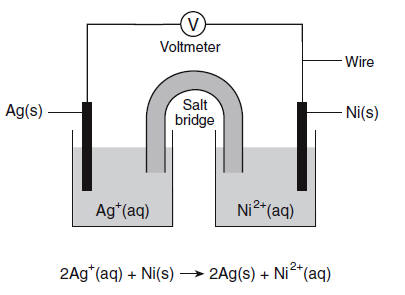
What reaction occurs at the anode?
Ag+/Ag = 0.80V
Ni2+/Ni = -0.25V
Ag+ + e- →Ag
Ag → Ag+ + e-
Ni2+ + 2e- → Ni
Ni → Ni2+ + 2e-
Which is correct to write cell notation
Anode: Zn
Cathode: Ni
Zn2+ (aq,1M) / Zn (s) // Ni (s) / Ni2+ (aq,1M)
Zn (s) /Zn2+ (aq,1M) // Ni2+ (aq,1M) / Ni (s)
Zn2+ (s,1M) / Zn (aq) // Ni (aq) / Ni2+ (s,1M)
Zn (aq) /Zn2+ (s,1M) // Ni2+ (s,1M) / Ni (aq)
Calculate standard cell potential for this equation:
Zn2+(aq) + 2e → Zn(s) Eº = – 0.76 V
Cd2+(aq) + 2e → Cd(s) Eº = – 0.40 V
Eocell = -0.36 V
Eocell = -1.16 V
Eocell = +1.16 V
Eocell = +0.36 V
State one functions of salt bridge
to maintain the movement of electron
to allowing electron to flow and complete the circuit
to separate two electrolyte
to maintain the electrical neutrality of the cell
Standard electrode potential of a half-cell is measured with reference to
a) standard hydrogen electrode with 0.500M [HCl] solution
b) standard oxygen electrode with 1.00M [HCl] solution
c) standard chlorine electrode with 1.00M [HCl] solution
d) standard hydrogen electrode with 1.00 M [HCl] solution
cathode is the electrode where
reduction takes place
oxidation takes place
either reduction or oxidation
none of these
in electrochemical cell anode is
positive
negative
neutral
none
Zn/Zn+2 // Ag+1 / Ag

Which direction will the potassium ions (K+1) from the salt bridge flow?
Towards the copper sulfate solution
Towards the nickel sulfate solution
Towards the copper metal
Towards the nickel metal
Zn/Zn+2 // Cu+2/Cu
Mn/Mn(NO3)2 // PBSO4/Pb
Al(s) + Zn(NO3)2(aq) → Al(NO3)3(aq) + Zn(s)
How many moles of aluminum metal can be deposited when 0.600 moles of electrons are passed through 4.00 moles of molten Al2O3?
0.100
0.200
1.33
1.80
Which of the following statements concerning galvanic cells is/are true?
The two half-cells are connected by a salt bridge.
Electrons flow from the anode to the cathode.
Reduction occurs at the cathode.
All of the above are true.
Assume that the following reaction proceeds in an electrolytic cell. If 1.5A of current are used for 2.0 hours, what will plate and how many grams are expected?
Fe+2 (aq) + Ni (s) --> Fe (s) + Ni+2 (aq)
Iron plates; 3.1 grams
Iron plates; 8.7 x 10⁻⁴ grams
Nickel plates; 3.3 grams
Nickel plates; 9.1 x 10⁻⁴grams
Assume that the following reaction proceeds in an voltaic cell. If the concentration of Ag+1 (aq) is 0.10M and the concentration of Au+3 (aq) is 1.0M, what is the expected voltage from this reaction?
Ag(s) + Au+3 (aq) --> Ag+1 (aq) + Au(s)
Ag+1 + e- = Ag E° = +0.799V
Au+3 + 3e- = Au E° = +1.50V
less than 0.70 V
more than 0.70 V
exactly 0.70 V
with decrease in concentration , molar conductivity
decreases
increases
remains constant
none
specific conductance decreases with
decrese in concentration
increse in concentration
remains constant
none
What is a redox reaction?
A reaction where both reactants get reduced.
A reaction where both reactants get oxidized.
A reaction that involves a transfer of electrons between reactants.
A reaction that involves the combustion of at least one reactant.
What is a half-reaction?
It is a reaction at equilibrium where half of the substances are reactants and half of the substances are products.
It is the reaction that occurs when the switch of a galvanic cell is open.
It shows EITHER the reduction component or the oxidation component of a redox reaction.
It shows BOTH the reduction and oxidation components of a redox reaction.
Zn/Zn+2 // Ag+1 / Ag
Al3+(aq) + 3e-→Al(s) E° = -1.66 V
Ag+(aq) + e-→Ag(s) E° = +0.80 V
According to the standard reduction potentials given above, what is the standard cell potential for the reaction represented below?
3Ag+(aq) + Al(s) →3Ag(s) + Al3+(aq)
-1.74 V
-0.86 V
+1.74 V
+2.46 V
An electric current of 1.00 ampere is passed through an aqueous solution of Ni(NO3)2. How long will it take to plate out exactly 1.00 mol of nickel metal, assuming 100 percent current efficiency?
(1 Faraday = 96,500 coulombs)
386,000 sec
193,000 sec
96,500 sec
48,200 sec
Cu(s) + 2Ag+ →Cu2+ + 2Ag(s)
If the equilibrium constant for the reaction above is 3.7 x 10¹⁵, which of the following correctly describes the standard voltage, E°, and the standard free energy change, ΔG°, for this reaction?
E° is positive and ΔG° is negative.
E° is negative and ΔG° is positive.
E° and ΔG° are both positive.
E° and ΔG° are both negative.
Cu2+(aq) + 2e-→Cu(s) E° = 0.34 V
Cr3+(aq) + e-→Cr2+(aq) E° = -0.41 V
Cu2+(aq) + Cr3+(aq) → Cu(s) + Cr2+(aq)
Cu2+(aq) + 2Cr2+(aq) → Cu(s) + 2Cr3+(aq)
Cu(s) + 2Cr3+(aq) → Cu2+(aq) + 2Cr2+(aq)
Cu(s) + Cr3+(aq) → Cu2+(aq) + Cr2+(aq)

For the construction of a second galvanic cell (not shown), only one modification was made to the galvanic cell illustrated above: the Cu electrode has double the mass of the Cu electrode. Which of the following correctly compares the initial E° for the second cell to that of first cell at 298K, and why?
The initial E° for the second cell is twice that of the first cell because a larger amount of Cu(s) can be oxidized to Cu2+.
The initial E° for the second cell is twice that of the first cell because more Cu2+ ions can be deposited on the solid Cu electrode.
The initial E° for the second cell is half that of the first cell because the greater amount of Cu(s) in the half-cell inhibits the formation of more Cu(s).
The initial E° for the second cell is same as for the first cell because the overall chemical reaction that occurs in the cell does not change.
M(s) + 3Ag+(aq) →3Ag(s) + M3+(aq) E° = +2.46 V
Ag+(aq) + e-→Ag(s) E° = +0.80 V
According to the information above, what is the standard reduction potential for the half-reaction M3+(aq) + 3e-→M(s)?
-1.66 V
-0.06 V
0.06 V
1.66 V

To construct the galvanic cell illustrated above, the salt bridge was prepared by soaking a piece of cotton in 5.0 M NaNO3(aq) before placing it inside the U-shaped tube filled with distilled water. If the cotton was soaked in distilled water by mistake, which of the following best explains how the operation of the cell would be affected?
The operation of the cell is not affected because neither Na+(aq) nor NO3-(aq) is involved with redox reaction that takes place.
The operation of the cell generates a higher potential because there are fewer ions in the solution, making the reaction more thermodynamically favored.
The cell will operate for a much longer time because the flow of the electrons through the circuit will eventually be reversed.
The cell would not operate because a current could not be conducted between the half-cells.
Mg2+(aq) + 2e-→Mg(s) E° = -2.37 V
Cr3+(aq) + 3e-→Cr(s) E° = -0.74 V
Based on the information above, which of the following shows the cell potential and the Gibbs free energy change for the overall reaction that occurs in a standard galvanic cell?
E° = +1.63 V, ΔG° = -157 KJ/molrxn
E° = +1.63 V, ΔG° = -944 KJ/molrxn
E° = +5.63 V, ΔG° = -543 KJ/molrxn
E° = +5.63 V, ΔG° = -3262 KJ/molrxn
When a magnesium wire is dipped into a solution of lead(II) nitrate, a black deposit forms on the wire. Which of the following can be concluded from this observation?
The standard reduction potential, E° for Pb2+(aq) is greater than that for Mg2+(aq).
Mg(s) is less easily oxidized than Pb(s).
An external source of potential must have been supplied.
The magnesium wire will be the cathode of a Mg/Pb cell.
Zn(s) + Cu2+ → Zn2+ + Cu(s)
An electrolytic cell based on the reaction represented above was constructed from zinc and copper half-cells. The observed voltage was found to be 1.00 V instead of the standard cel potential, E° of 1.10 V. Which of the following could correctly account for this observation?
The copper electrode was larger than the zinc electrode.
The Zn2+ electrolyte was Zn(NO3)2, while the Cu2+ electrolyte was CuSO4.
The Zn2+ solution more concentrated than the Cu2+ solution.
The solutions in the half-cells had different volumes.
Given the standard electrode potentials,
K+/K = −2.93V, Ag+/Ag = 0.80V,
Hg2+/Hg = 0.79V
Mg2+/Mg = −2.37 V, Cr3+/Cr = − 0.74V
their increasing order of reducing power.
K<Mg<Cr<Hg<Ag
Ag >Hg > Cr > Mg > K
Ag < Hg < Cr < Mg < K
K>Mg>Cr>Hg>Ag
Nernst equation FOR (i) Mg(s) | Mg2+(0.001M) || Al3+(0.0001 M) | Al(s)
ECELL=E0CELL-0.0591/6 log[Mg2+]3/[Al3+]2
ECELL=E0CELL-0.0591/6 log[Al3+]2/[Mg2+]3
ECELL=E0CELL+0.0591/3 log[Mg2+]3/[Al3+]2
ECELL=E0CELL-0.0591/3 log[Mg2+] /[Al3+]
How much charge in Faraday is required for the following reductions:
1 mol of Al3+ to Al.
1F
2F
3F
4F
molar conductivity of NH4OH increases sharply at infinite dilution due to
decrease in dissociation
increase in dissociation
increase in association
decrease in association
Which of the following is the SI unit of molar conductivity.
S m-1 mol-1
S m mol-1
S m2 mol-1
S m2 mol-2
which of the following is not correct
G* = Rk
G* = l/A
G* = Gk
k = GG*
The value of Λm0 of CaCl2 is ------------. given: λm0(Ca2+=119.0) and λm0(Cl−=76.3)
271.6
195.3
314,3
390.6
If a conductivity and conductance of a solution is same then it's cell constant
A) 1
B) 0
C) 10
D) 1000
The difference between the electrode potentials of two electrodes when no current is drawn through the cell is called -----------------
cell potential
potential difference
cell voltage
cell emf

