wayground logo

Free Printable Worksheets

Font size

S
M
L
XL
Worksheets

Unit 3 Exam Review Periodic Table

Total questions: 59

Worksheet time: 2hrs 40mins

Name
Class
Date
1.
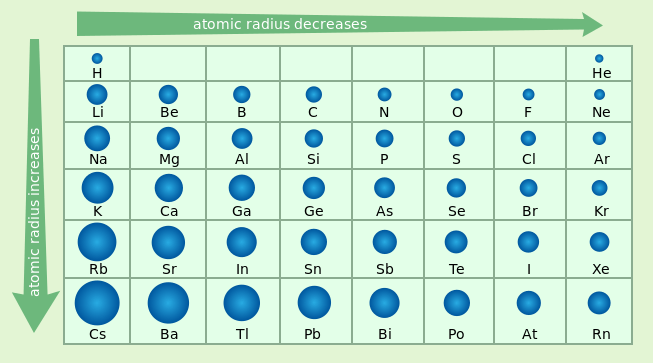
As you move down a group, atomic radius increases because - 
a)
you add more and more neutrons
b)
you add more and more protons
c)
you add more and more shells (energy levels)
d)
you add more atomic mass
2.
The atom with the largest atomic radius in Group 18 is - 
a)
Ar
b)
He
c)
Kr
d)
Rn
3.
The element with the smallest ionization energy in Period 6 is - 
a)
Rn
b)
Cs
c)
Os
d)
Tm
4.
As you move across the periodic table atoms tend to get smaller because, ______________.
a)
the atoms have more mass.
b)
the atoms have less mass
c)
the atoms have more protons.
d)
the atoms have less electrons.
5.
The energy required to remove electrons is the definition of: 
a)
Electronegativity
b)
Atomic Number
c)
Atomic Radius
d)
Ionization
6.
What is the name of family I
a)
Alkaline Earth Metals
b)
Boron Family
c)
Alkali Metals
d)
Halogen Family
7.
Families all have similar 
a)
Names
b)
atomic numbers
c)
atomic masses
d)
properties
8.
Electronegativity is...
a)
the ability of an atom to attract/ accept electrons
b)
the ability of an atom to lose electrons
c)
the energy required to remove an electron from a specific atom
d)
how easy it is to make friends. 
9.
Electronegativity __________ from left to right within a period and __________ from top to bottom within a group.
a)
decreases, increases 
b)
increases, increases
c)
increases, decreases 
d)
stays the same, increases
10.
Which has the greater EN: 
Cl or Al?
a)
Cl
b)
Al
11.
Which has the greater EN: 
H or F?
a)
H
b)
F
12.
Which of the following will have a larger radius than Zinc?
a)
Gallium
b)
Aluminum
c)
Magnesium
d)
Strontium
13.
Which of the following will have a higher electronegativity than arsenic (As)?
a)
Carbon (C)
b)
Neon (Ne)
c)
Antimony (Sb)
d)
Germanium (Ge)
14.
Which of the following will have a lower ionization energy than Scandium (Sc)?
a)
Helium (He)
b)
Titanium (Ti)
c)
Calcium (Ca)
d)
Magnesium (Mg)
15.
As atoms of elements in group 16 are considered in order from top to bottom, the electronegativity of each successive element....
a)
decreases
b)
increases
c)
remains the same
d)
none of the above
16.
Which atom has the largest atomic radius?
a)
potassium
b)
rubidium 
c)
francium
d)
cesium
17.
As you move down the periodic table atoms get bigger.  This is because ____________.
a)
The atoms have more mass.
b)
The atoms have more protons.
c)
The atoms have more energy levels
d)
The atoms have more nuetrons
18.
As you move across the periodic table atoms tend to get smaller because, ______________.
a)
the atoms have more mass.
b)
the atoms have less mass
c)
the atoms have more protons.
d)
the atoms have less electrons.
19.
Atoms that have a high electronegativity, _______________.
a)
give up their electrons more easily.
b)
hold on to their electrons more tightly.
c)
have more electron shells.
20.
Electronegativity is...
a)
how good an atom is at attracting electrons
b)
the ability of an atom to lose electrons
c)
the energy required to remove an electron from a specific atom
d)
how easy it is to make friends. 
21.
Ionization energy is...
a)
the energy required to add an electron to a specific atom
b)
how much energy it takes to remove an electron from an atom
c)
the energy required to shield the outer electrons from the nucleus
d)
a measure of the ability of an atom to attract electrons
22.
The atom with the largest atomic radius in Group 18 is - 
a)
Ar
b)
He
c)
Kr
d)
Rn
23.
Which statement correctly and completely identifies a trend?
a)
Atomic radius decreases across a period and increases down a group.
b)
Electronegativity decreases across a period and decreases down a group.
c)
Ionization energy increases across a period and increases down a group.
d)
Ionic radius increases across a period and increases down a group.
24.
The element with the largest electronegativity in the halogens is - 
a)
At
b)
F
c)
Cl
d)
Br
25.
Which of the following is true about a sulfur atom and a chlorine atom?
a)
Sulfur is larger and has higher ionization energy.
b)
Sulfur is larger and has lower ionization energy.
c)
Sulfur is smaller and has higher ionization energy.
d)
Sulfur is smaller and has lower ionization energy.
26.
As you move down the periodic table atoms get bigger.  This is because ____________.
a)
The atoms have more mass.
b)
The atoms have more protons.
c)
The atoms have more energy levels
d)
The atoms have more nuetrons
27.
As you move across the periodic table atoms tend to get smaller because, ______________.
a)
the atoms have more mass.
b)
the atoms have less mass
c)
the atoms have more protons.
d)
the atoms have less electrons.
28.

Sulfur is a...

a)

metal

b)

nonmetal

c)

metalloid

29.
Which is an alkaline earth metal?
a)
Calcium
b)
Rubidium
c)
Carbon
d)
Iodine
30.
Which is a metal?
a)
Rhodium (Rh)
b)
Arsenic (As)
c)
Hydrogen
d)
Argon (Ar)
31.
Radium (Ra)
a)
alkali metal
b)
alkaline earth metal
c)
halogen
d)
noble gas
32.

Which of the following element is an example of Halogen

a)

Sodium

b)

Magnesium

c)

Fluorine

d)

Carbon

33.

Highly reactive

a)

Alkali metal

b)

Noble gases

c)

Rare earth metals

d)

Neon

34.
What group on the Periodic Table contains the elements of the alkaline earth family?
a)
1
b)
2
c)
17
d)
18
35.

What group is the family found? These halides are very reactive and almost have full outer energy level/shell.

a)

1

b)

2

c)

16

d)

17

36.
Which of the following is the atomic number of an alkali metal?
a)
31
b)
20
c)
18
d)
19
37.
What is the total number of electrons found in the valence shell of a halogen in the ground state?
a)
1
b)
7
c)
2
d)
8
38.
Which properties are characteristic of the Group 1 metals?
a)
high reactivity and the formation of unstable compounds
b)
low reactivity and the formation of unstable compounds
c)
high reactivity and the formation of stable compounds
d)
low reactivity and the formation of stable compounds
39.
Which group contains elements that are inert?
a)
1
b)
2
c)
17
d)
18
40.
Which of the following is an Alkaline Earth Metal? 
a)
Calcium
b)
Lithium
c)
Phosphorus
d)
Copper 
41.
Which of the following is a transition metal? 
a)
Iron
b)
Oxygen
c)
Neon
d)
Barium
42.
Which of the following is a Halogen? 
a)
Bromine
b)
Rubidium
c)
Argon
d)
Beryllium
43.
Which of the following is a Noble Gas? 
a)
Krypton
b)
Chlorine
c)
Radium
d)
Gallium
44.

Vertical columns on the periodic table are called ___?

a)

groups

b)

periods

c)

rows

d)

families

45.

Which color on the image of the periodic table corresponds with the halogens.

a)

red

b)

black

c)

blue

d)

orange

46.

Which color on the image of the periodic table corresponds with the noble gases.

a)

red

b)

black

c)

blue

d)

orange

47.

The periodic table is organized in horizontal rows called...

a)

Groups

b)

Periods

c)

Families

d)

Chemical Symbols

48.

Which of the following are properties of transition metals?

a)

They are excellent conductors of electricity and heat

b)

They are malleable and ductile.

c)

They have high boiling points.

d)

All of the above.

49.

Transition metals include the only elements that can produce a

a)

transition

b)

compound

c)

ion

d)

magnetic field

50.

Which of the following is NOT a property of most transition metals?

a)

Ability to conduct electricity

b)

malleability

c)

ability to conduct heat

d)

low melting point

51.

In which group of the periodic table is this element located

a)

1

b)

8

c)

3

d)

Not enough information

52.

Which group of the periodic table is this element located

a)

1

b)

2

c)

7

d)

8

53.

What group of the periodic table is this element located

a)

1

b)

3

c)

6

d)

8

54.

How many valence electrons does this element have?

a)

2

b)

5

c)

8

d)

Not enough information

55.

Which peak (or peaks) correspond to valence electrons?

a)

The peak at 0.8

b)

The peaks at 0.8 and 1.36

c)

The peak at 19.3

d)

The peaks at 19.3 and 1.36

56.

How many valence electrons does the element pictured in the PES spectrum below have?

a)

1

b)

2

c)

3

d)

4

57.

What does the 4th peak from the left represent?

a)

The 2s electrons

b)

The 3d electrons

c)

The 2p electrons

d)

The 3s electrons

58.

The PES spectrum below is for the element _______________.

a)

O

b)

Ne

c)

N

d)

F

59.

What is the electron configuration for this PES graph?

a)

1s22s22p63s23p2

b)

1s22s22p63s23p1

c)

1s22s22p63s23p3

d)

1s22s22p63s2