wayground logo

Free Printable Worksheets

Font size

S
M
L
XL
Worksheets

Supper Biology First Semester Review

Total questions: 194

Worksheet time: 3hrs 31mins

Name
Class
Date
1.
surrounds the cell; regulates what enters/leaves cell; maintains homeostasis
a)
vacuole
b)
cell wall
c)
cell membrane
d)
lysosome
2.
control the cell's activities; contains the cell's DNA
a)
mitochondria
b)
cell membrane
c)
nucleus
d)
golgi body
3.
breaks down glucose to release energy for the cell
a)
nucleus
b)
lysosomes
c)
mitochondria
d)
vacuole
4.
What is the cell organelle that stores water, food and waste called?
a)
The cytoplasm
b)
The lysosomes
c)
The vacuole
d)
The mitochondria
5.
What is the main difference between prokaryotic and eukaryotic cells?
a)
Prokaryotic cells have a nucleus and Eukaryotic cells do not
b)
Prokaryotic cells are unicellular and Eukaryotic cells are multicellular.
c)
Prokaryotic cells do not have a nucleus, Eukaryotic cells do have a nucleus.
d)
Prokaryotic cells are plant cells and Eukaryotic cells are animal cells.
6.
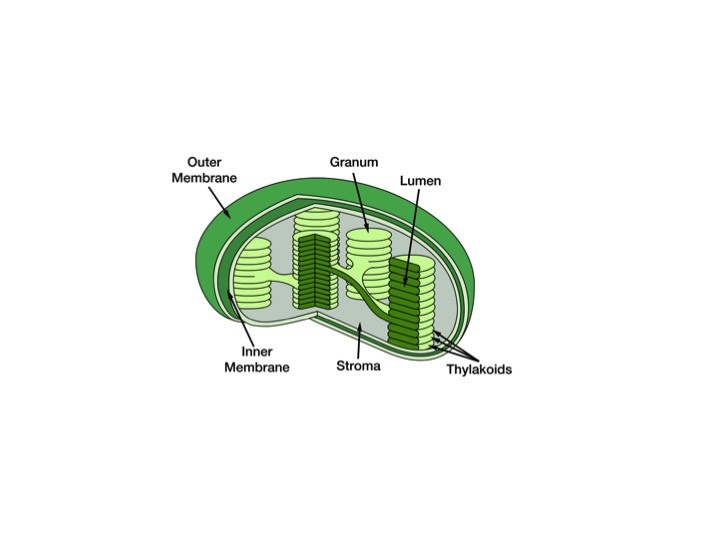
The main function of chloroplasts is:
a)
To control what enters and leaves the cell.
b)
To break down food to release energy for the cell.
c)
To control all activities of the cell.
d)
To produce food for the cell using the sun's energy.
7.
The cytoplasm
a)
Is  the gel-like fluid that holds other organelles in place.
b)
Breaks down food to produce energy for the cell.
c)
Is known as the "brain" of the cell.
d)
Is where photosynthesis takes place.
8.
Which statement is NOT part of the Cell Theory?
a)
Only animals are made of cells.
b)
Cells are the basic unit of structure and function in all living things.
c)
All living things are made of cells.
d)
New cells come from existing cells.
9.
Ribosomes are the cell organelle that
a)
Break down food to produce energy for the cell.
b)
Produce proteins for the cell.
c)
Break down broken cell parts.
d)
Make food for the cell using the sun's energy.
10.
Identify which of these is NOT a major difference between plant and animal cells.
a)
Only plant cells have a cell wall.
b)
Only animal cells have mitochondria.
c)
Animal cells do NOT contain chloroplasts.
d)
Plant cells have a large central vacuole.
11.
Organisms composed of many cells are called
a)
Prokaryotic
b)
Eukaryotic
c)
Unicellular
d)
Multicellular
12.
Which types of organisms are Prokaryotes?
a)
Animals
b)
Plants
c)
Fungi
d)
Bacteria
13.
Unicellular organisms are
a)
Prokaryotic
b)
Eukaryotic
c)
Made of many cells
d)
Made of one cell
14.
Plant and animal cells are identical. 
a)
True
b)
False
15.
This organelle helps plants keep their rigid structure. 
a)
Cell wall
b)
Cell membrane
c)
Chloroplast
d)
Nucleus
16.
Using this image, what organelle is D?
a)
Endoplasmic Reticulum
b)
Flagella
c)
Rough ER
d)
Smooth ER
17.
Using this image, what organelle is G?
a)
Vacuole
b)
Flagella
c)
Rough ER
d)
Nucleus
18.
Using this image, what organelle is N?
a)
Centrioles
b)
Cell Membrane
c)
Golgi Apparatus
d)
Ribosome
19.
What is the difference between rough and smooth ER?
a)
There is no difference.
b)
Plants have rough ER, animals have smooth ER.
c)
What type of injuries the Doctors treat.
d)
Rough has ribosomes, smooth does not.
20.
Contains a phosphate, sugar and nitrogen base
a)
nucleic acid
b)
lipid
c)
carbohydrate
d)
protein
21.
Contains DNA and RNA
a)
lipids
b)
carbohydrates
c)
proteins
d)
nucleic acids
22.
Provides long term energy and insulation,
a)
lipids
b)
carbohydrates
c)
nucleic acids
d)
proteins
23.
Used for short term (quick) energy.
a)
carbohydrates
b)
lipids
c)
proteins
d)
nucleic acids
24.
Building blocks of the body, hair , muscles etc.
a)
protein
b)
nucleic acid
c)
lipids
d)
carbohydrates
25.
Is found in the cell membrane as a bilayer. 
a)
lipids
b)
protein
c)
nucleic acid
d)
carbohydrate
26.
Identify the macromolecule in the picture
*GLUCOSE
a)
lipid
b)
protein
c)
nucleic acid
d)
carbohydrate
27.
Identify the macromolecule in the picture.
* look at the R.....
a)
carbohydrates
b)
lipids
c)
proteins 
d)
nucleic acids
28.
Identify the macromolecule in the picture
* cholesterol and triglycerides
a)
carbohydrate
b)
protein
c)
lipid
d)
nucleic acid
29.
Identify the macromolecule in the picture
a)
carbohydrate
b)
lipid
c)
protein
d)
nucleic acid
30.
What is the function of nucleic acids?
a)
Stores energy
b)
Stores genetic information
c)
Movement
d)
Physical structure
31.
What is the monomer of proteins?
a)
amino acids
b)
polypeptides
c)
nucleotides
d)
monosaccharides
32.
What is the monomer of nucleic acids?
a)
Glycerol
b)
Monosaccharides
c)
Amino Acids
d)
Nucleotides
33.
What are the four macromolecules?
a)
proteins, nucleic acids, carbohydrates, and lipids
b)
monosaccharides, lipids, polysaccaharides, and proteins
c)
RNA, DNA, proteins, and carbohydrates
d)
proteins, DNA, RNA, and steroids
34.
Which of the following is a lipid?
a)
cholesterol
b)
cellulose
c)
glucose
d)
protein
35.
All of the following are examples of lipids except:
a)
oil
b)
wax
c)
fatty acid
d)
cellulose
36.
A monosaccharide is a subunit of a:
a)
nucleic acid
b)
lipid
c)
carbohydrate
d)
protein
37.
Most enzymes:
a)
speed up the chemical reaction
b)
have no effect on the rate of the chemical reaction
c)
slow the rate of the chemical reaction
d)
keep the rate of the chemical reaction the same
38.
What suffix (word ending) is used in the names of most carbohydrates?
a)
-ase
b)
-nic
c)
-ose
d)
-yme
39.
All organic compounds contain the element
a)
carbon
b)
nitrogen
c)
phosphorus
d)
sulfur
40.
Which is the monomer (building block) for lipids?
a)
fatty acids & glycerol
b)
nucleotide
c)
amino acids
d)
monosaccharide
41.
What molecule is used for LONG term energy storage?
a)
carbohydrates
b)
lipids
c)
protiens
d)
nucleic acid
42.
Which of the following elements make up nucleic acids?
a)
C, H, O
b)
C, H, O, N
c)
C, H, O, N, P
d)
C, H, O, Ca, S
43.
Carbohydrates are made of... 
a)
C H O
b)
C H O N
c)
C H O N P
d)
C H O N S
44.
Also known as simple sugars, these carbohydrate monomers.
a)
lipids
b)
nucleotide
c)
monosaccharide
d)
monomer
45.
Enzymes are considered to be 
a)
Lipids
b)
Carbohydrate
c)
Protein
d)
Nucleic Acid
46.
Which macromolecule is shown?
a)
lipid
b)
protein
c)
nucleic acid
d)
carbohydrate
47.
Which macromolecule is shown?
a)
lipid
b)
protein
c)
nucleic acid
d)
carbohydrate
48.
Which macromolecule is shown?
a)
lipid
b)
protein
c)
nucleic acid
d)
carbohydrate
49.
Which macromolecule is shown?
a)
lipid
b)
protein
c)
nucleic acid
d)
carbohydrate
50.
The cell below is in a _________ solution.
a)
Hypotonic
b)
Hypertonic
c)
Isotonic
51.
The cell below is in a _____________ solution.
a)
Hypertonic
b)
Hypotonic
c)
Isotonic
52.

This egg has shrunk, what type of solution was it placed in?

a)

hypotonic solution

b)

hypertonic solution

c)

isotonic solution

53.
What type of solution is this cell in?
a)
Isotonic
b)
Hypertonic
c)
Hypotonic
d)
diffused
54.

If the dots represent sugar what direction will the water flow?

a)

Into the cell

b)

Out of the cell

c)

Both equally (equilibrium)

55.
What type of solution is this cell in?
a)
Isotonic
b)
Hypertonic
c)
Hypotonic
d)
diffused
56.
The cells seem to be swelling and about to burst what type of solution are they most likely in?
a)
Hypertonic
b)
Isotonic
c)
Hypotonic
57.
The cells seem to be shriveled and dehydrated what type of solution are they most likely in?
a)
Hypertonic
b)
Isotonic
c)
Hypotonic
58.
The cells seem to be of normal size in what type of solution are the cells most likely in?
a)
Hypertonic
b)
Isotonic
c)
Hypotonic
59.
The image indicates what type of solution the cell is in?
a)
Isotonic
b)
Hypertonic
c)
Hypotonic
60.
The image indicates what type of solution the cell is in?
a)
Isotonic
b)
Hypertonic
c)
Hypotonic
61.
What type of transport does not require energy? 
a)
Active Transport
b)
Passive Transport
62.
What type of transport requires energy? 
a)
Active Transport
b)
Facilitated Diffusion
c)
Simple Diffusion
d)
Passive Transport
63.
Molecules diffuse from a high concentration, to a low concentration 
a)
True
b)
False
64.
The movement of molecules against a concentration gradient
a)
simple diffusion
b)
facilitated diffusion
c)
active transport
d)
osmosis
65.
Movement of solute through the cell membrane from high to low concentration using a channel protein.
a)
diffusion
b)
active transport
c)
facilitated diffusion
d)
osmosis 
66.
Which is NOT a form of active transport?
a)
Endocytosis
b)
Osmosis
c)
Exocytosis
d)
Pinocytosis
67.
This diagram is showing...
a)
endocytosis
b)
exocytosis
c)
osmosis
d)
diffusion
68.
Passive transport is called "passive" because it occurs WITHOUT
a)
cause.
b)
energy.
c)
a concentration gradient.
d)
a cell wall.
69.
When molecules are spread evenly across the cell membrane, ______________________ is reached.
a)
difference
b)
transportation
c)
equilibrium
d)
solution
70.
Osmosis is the diffusion of _____ across a membrane
a)
glucose
b)
NaCl
c)
proteins
d)
water
71.
Active Transport moves molecules from ________ to _________ concentration; it ___________ energy.
a)
high, low; does not require
b)
low, high; does not require
c)
high, low; requires
d)
low, high; requires
72.
Which of the following is the correct equation for PHOTOSYNTHESIS?
a)
CO+ light + H2O --> O+ Sugar
b)
CO+ sugar + H2O --> O+ light
c)
O2 + light + H2O --> CO+ Sugar
d)
CO+ O2 + H2O --> Light+ Sugar
73.
Which organelle performs PHOTOSYNTHESIS?
a)
Chloroplast
b)
Mitochondria
74.
What process occurs when light energy is captured in autotrophs and converted into sugar?
a)
Photosynthesis
b)
Cellular Respiration
75.
What is the ultimate ORIGINAL source of energy for living things
a)
Sugar
b)
Sun
c)
Moon
d)
Carbon Dioxide
76.
Which organisms perform Photosynthesis?
a)
Only Autotrophs
b)
Only Heterotrophs
c)
Autotrophs and Heterotrophs
77.
Which of the following is an example of an AUTOTROPH?
a)
Appletree
b)
Dog
c)
Mushroom
d)
Human
78.
Which of the following is an example of a HETEROTROPH?
a)
Grass
b)
Algae
c)
Lemon Tree
d)
Bear
79.
What is the pigment in chloroplasts that performs photosynthesis?
a)
Chlorosynthesis
b)
Chlorophyll
c)
ADP
d)
Electron Transport
80.
What are the products of photosynthesis?
a)
water and carbon dioxide
b)
oxygen and glucose
c)
oxygen and carbon dioxide
d)
oxygen and water
81.
Plants need ________ for photosynthesis
a)
oxygen
b)
soil
c)
carbon dioxide
d)
sugar
82.
Chloroplasts are...
a)
Structures of animal cells to produce ATP
b)
Organelles where lipids are elaborated
c)
Specialized structures of plants where food is made
d)
Waste organelle of plants
83.
What is the pigment in chloroplasts that performs photosynthesis?
a)
Chlorosynthesis
b)
Chlorophyll
c)
ADP
d)
Electron Transport
84.
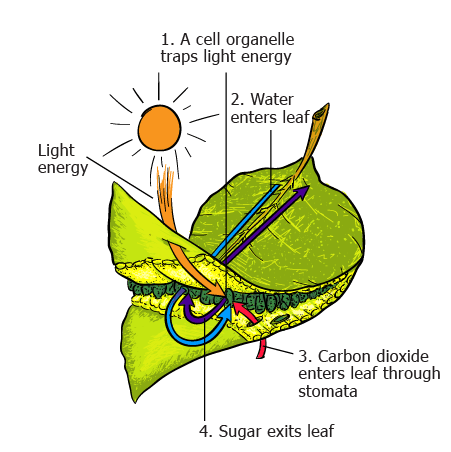
Look at the image
What substances and organelle work together to absorb sunlight to perform photosynthesis in this example?
a)
cell wall and chloroplast
b)
mitochondria and water
c)
vacuole and carbon dioxide
d)
chloroplast and chlorophyll
85.

ADP can be recharged to ATP by

a)

Breaking off a phosphate

b)

Adding a phosphate

c)

Making glucose

86.

The reactants or raw materials needed for cell respiration are

a)

water and carbon dioxide

b)

sunlight and water

c)

sugar (glucose) and oxygen

d)

oxygen and ATP

87.

The pigment in the chloroplast that plants use for photosythesis to gather light energy

a)

Chlorophyll

b)

Chloroplast

c)

Mitochondria

88.

Which organelle does cell respiration take place in?

a)

Chloroplast

b)

Cytoplasm

c)

Mitochondria

d)

Ribosome

89.

Alcoholic fermentation and lactic acid fermentation are processes that don't require oxygen, so they are

a)

Aerobic

b)

Anaerobic

90.

Which organisms can perform cellular respiration?

a)

Plants and animals

b)

Only animals

c)

Only plants

d)

Only bacteria

91.
B=brown eyes
b= blue eyes
What is true about two brothers that have brown eyes?
One has genotype BB the other Bb.
a)
they have same phenotype and genotype
b)
they have different genotypes and phenotypes
c)
they have same phenotype but different genotypes
d)
they have same genotype but different phenotypes
92.
A dog gives birth to 5 puppies. What percentage of the chromosomes does each puppy share with the mother?
a)
25%
b)
50%
c)
75%
d)
100%
93.
What does heterozygous mean?
a)
An organism that has the same genes for a trait (TT or tt)
b)
An organism that has different genes for a trait (Tt)
c)
When neither gene is fully dominant; offspring is a mixture of both
d)
the different forms of a trait (hair color--> brown, blonde, red
94.
If a heterozygous tall pea plant is crossed with a short pea plant, what are the possible genotypes of the future offspring?
a)
100% Tt
b)
50% Tt, 50% tt
c)
75%Tt, 25%tt
d)
25%TT, 50%Tt, 25%tt
95.
This is an example of what?
a)
Complete dominance
b)
Incomplete dominance
c)
Codominance
d)
None of the above
96.
If T=Tall & t=short, what is the genotypic ratio?
a)
1:3
b)
3:1
c)
1:2:1
d)
2:2
97.
Two brown eyed parents (Bb) have a baby. What is the chance the baby is blue eyed?
a)
0 %
b)
25%
c)
50%
d)
75%
98.
Snapdragon flowers come in red, pink and white.  What type of inheritance is this?
a)
Complete Dominance
b)
Incomplete Dominance
c)
Codominance
d)
Polygenic Inheritance
99.
A heterozygous yellow pea plant's genotype would be:
a)
YY
b)
yy
c)
Yy
d)
Yg
100.
Which process and type of resulting cells are represented?
a)
mitosis, gametes
b)
mitosis, body cells
c)
meiosis, gametes
d)
meiosis, body cells
101.
Which of the following cell types is formed by meiosis?
a)
muscle cells
b)
skin cells
c)
sperm cells
d)
blood cells
102.
Which best describes the process shown?
a)
mutation in which the DNA content of the gene is ltered
b)
segregation of sister chromatids
c)
condensation and segregation of the alleles
d)
crossing-over which alleles are exchanged
103.
How many times in meiosis does the cell divided?
a)
2
b)
4
c)
3
d)
1
104.
What phase is  shown in the picture?
a)
anaphase 1
b)
anaphase 2
c)
metaphase 1
d)
telophase 1
105.
Incomplete dominance means that the traits are
a)
expressed equally
b)
dominant
c)
recessive
d)
blended
106.
Term for homozygous organisms that display two dominant phenotypes at the same time
a)
codominance
b)
incomplete dominance
c)
multiple alleles
d)
linked genes
107.
The inherited combination of alleles is known as the offspring's
a)
heredity
b)
phenotype
c)
genotype
d)
redigree
108.
An organism's appearance is known as its
a)
heredity
b)
phenotype
c)
genotype
d)
pedigree
109.
Sex cells are produced through the process of
a)
mitosis
b)
cytokinesis
c)
binary fission
d)
meiosis
110.
G = green, g = yellow
The genotype for a yellow plant is...
a)
GG
b)
Gg
c)
gg
d)
all of the choices result in yellow
111.
An allele whose trait only shows up when no dominant allele is present.
a)
hidden allele
b)
dominant allele
c)
recessive allele
d)
present allele
112.
Two brown eyed parents (Bb) have a baby. What is the chance the baby is blue eyed?
a)
0 %
b)
25%
c)
50%
d)
75%
113.
Magda is a tall, 11 year old drummer. She has a scar on her right cheek. She is good at swimming. Which of her traits did Magda most likely inherit?
a)
height
b)
the scar
c)
ability to swim
d)
ability to play drums
114.
having two different genes for a trait (sometimes called hybrid).
a)
protein
b)
homozygous
c)
heterozygous
d)
genotype
115.
having two of the same genes for the trait (sometimes called purebred).
a)
homozygous
b)
hetrozygous
c)
protein
d)
chromosome
116.
the passing of genetic traits from parent to offspring.
a)
heredity
b)
trait
c)
gene
d)
allele
117.
What is a phenotype
a)
The genetic make up (code)
b)
The physical trait
118.
Which of the following is a phenotype?
a)
BB
b)
Bb
c)
bb
d)
Blue eyes
119.
What gamete possibilities could come from this parent's genotype?
a)
AB, AB, aB, aB
b)
Ab, AB, Ab, ab
c)
Ab, Ab, Ab, Ab
d)
AB, aB, ab, aB
120.
What is a dihybrid cross?
a)
A dihybrid cross studies two traits at a time
b)
A cross that studies a single trait
c)
A cross that studies a three traits
121.
Which of the following is homozygous dominant?
a)
Yy
b)
Y
c)
yy
d)
YY
122.
Which of the following genotypes is heterozygous?
a)
Bb
b)
BB
c)
bb
d)
B
123.
Which of the following is homozygous recessive?
a)
Tt
b)
tt
c)
TT
d)
T
124.
How many alleles (letters) do each person carry for a trait?
a)
1
b)
2
c)
3
d)
4
125.
What is another way of saying "purebred"?
a)
homozygous
b)
dominant
c)
recessive
d)
heterozygous
126.
A human usually has xx amount of chromosomes.
a)
6
b)
22
c)
4
d)
46
127.
The cells produced via meiosis are called:
a)
sex cells
b)
somatic cells
c)
body cells
d)
skin cells
128.
This produces 2 identical cells.
a)
mitosis
b)
meiosis
129.
What causes genetic variation in meiosis?
a)
chromosomes lining up
b)
crossing over of chromosomes
c)
separation of chromosomes
d)
chromosomes pulling apart
130.

How many chromosomes do sex cells have?

a)

23

b)

46

c)

12

d)

74

131.
If the Diploid number of Carrots is 18, the haploid number is
a)
18
b)
9
c)
27
d)
36
132.
Asexual reproduction produces ___________________.
a)
two genetically identical offspring
b)
one genetically identical offspring
c)
two genetically different offspring 
d)
one genetically different offspring
133.
What type of cell division is responsible for growth and development?
a)
Meiosis
b)
Mitosis
c)
DNA Replication
d)
Natural Vegatative Propagation
134.
What is something that occurs in meiosis that increases genetic diversity?
a)
Crossing over
b)
Mutation
c)
They are genetically identical 
d)
One parent gives more genetic information than the other
135.
How many daughter cells are created by the process of meiosis? 
a)
2
b)
1
c)
4
d)
3
136.
What kind of cells are produced by mitosis?
a)
gametes
b)
body (Somatic)
c)
sperm cells
d)
jail cells
137.
What process is being shown in the diagram?
a)
Meiosis
b)
Mitosis
c)
Sexual reproduction
d)
Asexual reproduction
138.
Does DNA have to replicate before both mitosis and meiosis?
a)
Yes
b)
No
c)
Only Mitosis
d)
Only Meiosis
139.
How many times does DNA replication occur in mitosis and meiosis?
a)
Once
b)
Twice
c)
Never
d)
Three
140.
If a cell with 12 chromosomes goes through mitosis, how many chromosomes will be in the daughter cell.
a)
12
b)
24
c)
6
d)
48
141.
Why is the process of meiosis so important?
a)
Repairing injury
b)
Ensure that all daughter cells are diploid
c)
Fighting infections
d)
Ensure that offspring receive the correct number of chromosomes.
142.
If the diploid number of a cell is 30, what is the haploid number?
a)
15
b)
60
c)
30
d)
0
143.

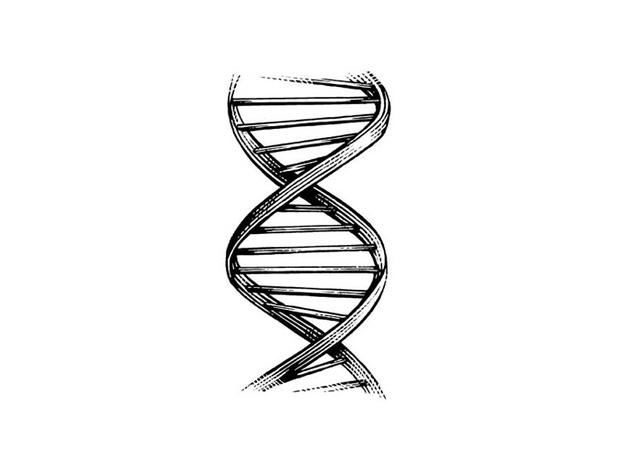
What type of bond holds together the two strands of the DNA double helix?

a)

covalent

b)

ionic

c)

hydrogen

d)

metallic

144.

What is the name of the sugar molecule found in DNA?

a)

ribose

b)

deoxyribose

c)

glucose

d)

sucrose

145.

What type of bond holds the monomers together in each strand of DNA?

a)

ionic

b)

covalent

c)

peptide

d)

hydrogen

146.

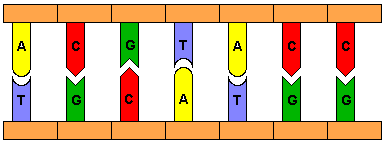
How do the two strands of a DNA molecule compare to each other?

a)

identical

b)

opposite

c)

the same

d)

complementary

147.

The monomers that make up DNA and RNA are called?

a)

amino acids

b)

monosaccharides

c)

nucleotides

d)

fatty acids

148.

The backbone/sides of the DNA molecule are

a)

sugar and phosphate

b)

sugar and base

c)

base and phosphate

d)

alternating bases

149.

The steps or rungs of the DNA ladder consist of?

a)

sugar and phosphate

b)

sugar and base

c)

paired nitrogen bases

d)

phosphate and base

150.

The process of DNA copying itself is called?

a)

duplication

b)

synthesis

c)

replication

d)

transcription

151.

The process of DNA copying itself is

a)

conservative - one original and one new DNA molecule

b)

semi-conservative - 2 DNA molecules with one new and one original strand

c)

dispersive - 2 DNA molecules with each strand consisting of alternating segments of new and original DNA parts

d)

partial - one complete DNA molecule and one partial DNA molecule

152.

If one strand of DNA has the following base sequence, what will the other strand's base sequence be? AATGGC

a)

AATGGC

b)

TTACCG

c)

UUACCG

d)

GGCAAT

153.

In DNA, the code or directions for making a protein is

a)

the order of nitrogen containing bases in DNA

b)

the order of phosphates and sugars in DNA

c)

the type of sugar in each nucleotide

d)

the number of phosphate groups

154.

How would you be able to distinguish RNA from DNA?

a)

RNA is single stranded

b)

RNA has Uracil

c)

RNA has Ribose

d)

All of these are ways that RNA differs from DNA!

155.

What is a single-stranded nucleic acid that contains the sugar ribose and nitrogen bases A U C G?

a)

Uracil

b)

DNA

c)

RNA

d)

mRNA

156.

RNA molecule that carries copies of instructions for the assembly of amino acids into proteins from DNA to the rest of the cell.

a)

mRNA

b)

tRNA

c)

rRNA

d)

DNA

157.

Type of RNA molecule that transfers amino acids to ribosomes during protein synthesis

a)

rRNA

b)

tRNA

c)

mRNA

d)

Thymine

158.

Type of RNA that makes up the major part of ribosomes.

a)

tRNA

b)

rRNA

c)

mRNA

d)

DNA

159.

Which Science rule is: DNA can form only between the nitrogen bases adenine and thymine and between the nitrogen bases guanine and cytosine?

a)

Nucleus

b)

Ribosome

c)

Crossing over

d)

Base Pairing

160.

Three-nucleotide sequence on messenger RNA that codes for a single amino acid.

a)

Anti-Codon

b)

RNA

c)

Condon

d)

DNA

161.

Decoding of a mRNA message into an amino acid chain to form a protein.

a)

Making of Ribisome

b)

Transcription

c)

Translation

d)

Crossing over

162.

Process in which part of the nucleotide sequence of DNA is copied into a complementary sequence in RNA.

a)

Inter Phase

b)

Making of codons

c)

Translation

d)

Transcription

163.

A small organelle in the cell on which proteins are assembled, It is a type of protein.

a)

Mitochondria

b)

Ribosome

c)

Nucleus

d)

Lysosome

164.

Structure that contains the cell's genetic material (DNA) and controls the cell's activities.

a)

Nucleus

b)

Nucleolus

c)

Ribosome

d)

Golgi Body

165.

A sequence of three nucleotides in a region of transfer RNA that recognizes a complementary coding triplet of nucleotides in messenger RNA during translation by the ribosomes in protein biosynthesis.

a)

Anti Codon

b)

Codon

c)

tRNA

d)

Protein

166.

The basic concept that, in nature, genetic information generally can flow only from DNA to RNA to protein.

a)

Transcription

b)

Translation

c)

Central Dogma

d)

Natural Selection

167.
In RNA, Uracil pairs with ______. 
a)
cytosine
b)
adenine
c)
guanine
d)
thymine
168.
The process to go from DNA to mRNA is _______
a)
translation
b)
transcription
c)
replication
169.
The process to go from mRNA to a protein is called ____
a)
transcription
b)
rRNA
c)
replication
d)
translation
170.
DNA holds the code for
a)
lipids
b)
carbohydrates
c)
protein
d)
sugar
171.
Choose the nucleotide sequence of the RNA strand that would be complementary to the following strand: 
GTAGTCA
a)
UATUAGA
b)
ACGACTG
c)
CAUCAGU
d)
CATCAGT
172.
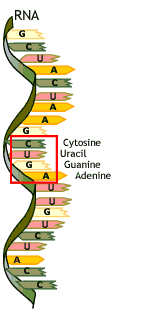
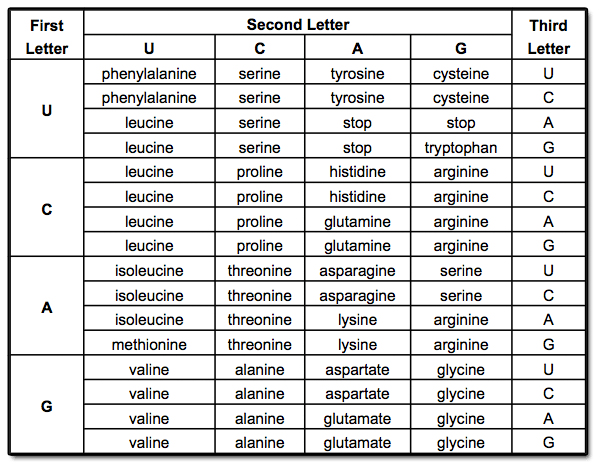
What amino acid is represented by the codon UUA?
a)
Phenylalanine
b)
Tyrosine
c)
Leucine
d)
Stop codon
173.
What is the three base sequence of mRNA that codes for a single amino acid?
a)
Anticodon
b)
Codon
c)
Protein
174.
DNA has a _____________ structure. 
a)
double helix
b)
single strand
c)
ring 
d)
chain
175.
In DNA, Adenine pairs with ___________. 
a)
Guanine
b)
Cytosine
c)
Thymine
d)
Uracil
176.
Translation is the process where
a)
mRNA is created in the Nucleus
b)
mRNA is decoded to form a protein 
c)
glucose molecules are made
d)
is where lipids are synthesised
177.
Does the order of amino acids in a protein matter?
a)
YES!
b)
NO!
178.
How many amino acids are coded for by this sequence of nucleotides:
ATG GGA ACT CCA
a)
4
b)
2
c)
6
d)
12
179.
What is a substance called if it speeds up a chemical reaction?
a)
reusable
b)
catalyst
c)
specific
d)
fragile
180.
With what 3 letters do enzymes typically end?
a)
-ose
b)
-ase
c)
-ese
d)
-tic
181.
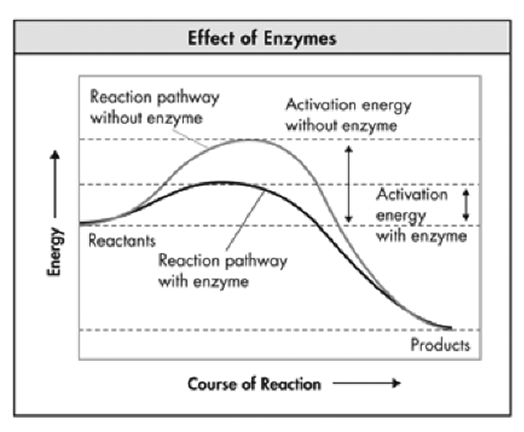
The graph shows how enzymes affect reactions in cells. Which statement best summarizes the information shown in the graph?
a)
Enzymes increase the energy of the reactants.
b)
Enzymes decrease the energy level of the products.
c)
Enzyme decrease the activation energy of the reaction.
d)
Enzymes reverse the direction of the reaction.
182.
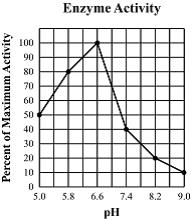
Which of the following conclusions can be drawn from this graph?
a)
The optimum pH of the enzyme is 6.6.
b)
The optimum pH of the enzyme is 5.8
c)
The enzyme’s activity increases as pH increases 5.0 to 9.0
d)
The enzyme’s activity is greater around pH of 8.0 .
183.
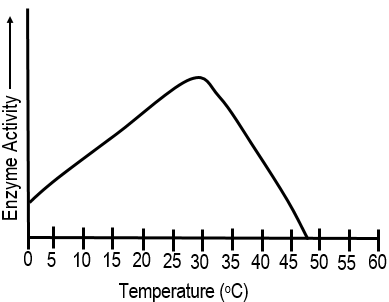
Based on the graph, what is the optimal temperature for this enzyme? 
a)
15oC
b)
40oC
c)
30oC
d)
35oC
184.
Which of the following conclusions can be drawn from this graph?
a)
The optimum pH of the enzyme is 6.6.
b)
The optimum pH of the enzyme is 5.8
c)
The enzyme’s activity increases as pH increases 5.0 to 9.0
d)
The enzyme’s activity is greater around pH of 8.0 .
185.
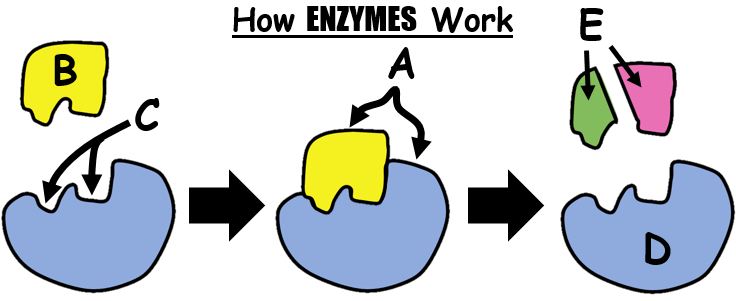
In the diagram, what is letter A? 
a)
product
b)
substrate
c)
enzyme-substrate complex
d)
active site
186.
Enzymes are...
a)
nucleic acids
b)
proteins
c)
lipids
d)
carbohydrates
187.
An enzyme speeds up a chemical reaction in the cell but can only be used once.  True or False? 
a)
true
b)
false
188.
What is the function of an enzyme?
a)
enzymes break themselves into small pieces
b)
enzymes slow down chemical reactions
c)
enzymes speed up chemical reactions
d)
enzymes combine products to form reactants 
189.
What happens when enzymes are heated to a high temperature?
a)
The enzymes die.
b)
The shapes of the enzyme are altered denature
c)
The enzymes' amino acid sequence changes.
d)
The enzymes remain the same
190.
Which of these is NOT true?
a)
Enzymes can denature (change shape) when the temperature gets too high.
b)
Enzymes can only be used once in a chemical reaction. 
c)
Extreme pH can denature enzymes.
d)
Enzymes speed up chemical reactions. 
191.
Which of these is most likely an enzyme?  
a)
Sucrose
b)
Galactose
c)
Fructose
d)
Amylase
192.
The pH at which an enzyme is most efficient is called the _________ pH of an enzyme.
a)
neutral
b)
optimum
c)
minimum
d)
experimental 
193.
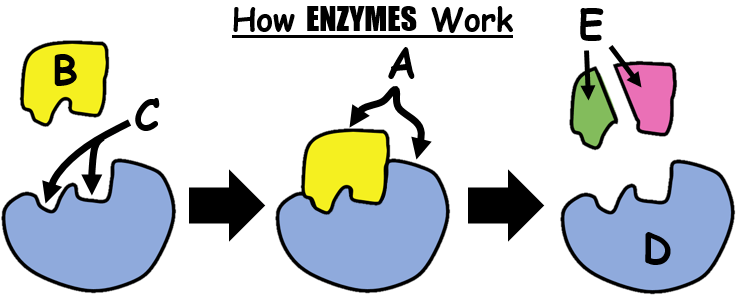
Letter D...
a)
active site
b)
enzyme
c)
substrate
d)
products
194.
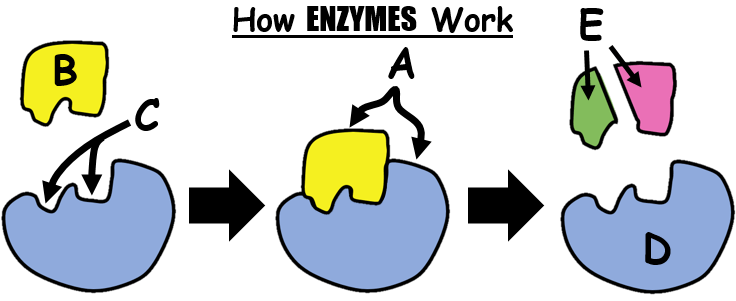
Letter C...
a)
active site
b)
enzymes
c)
substrate
d)
products