
 Worksheets
Physical Science Review
Total questions: 144
Worksheet time: 2hrs 45mins
Name
Class
Date
1.
A series of steps used by scientists to solve a problem or answer a question.
a)
scientific method
b)
recipe
c)
data collection
d)
metric system
2.
Which is NOT a step in the scientific method?
a)
Make observation
b)
Form a theory
c)
Collect data
d)
Form a hypothesis
3.
A testable explanation to a problem that has not yet been tested.
a)
data
b)
theory
c)
hypothesis
d)
fact
4.
This variable in an experiment is the one being changed by the scientist.
a)
dependent variable
b)
independent variable
c)
data
d)
control group
5.
Testing a hypothesis often involves a(n):
a)
answer
b)
experiment
c)
problem
d)
safety check
6.
What is a hypothesis?
a)
A hypothesis is the right answer to an experiment.
b)
A hypothesis is the wrong answer to an experiment.
c)
A hypothesis is an educated guess.
d)
I don't know.
7.
The summary at the end of an experiment that explains the results.
a)
conclusion
b)
procedures
c)
materials
d)
responding variable
8.
The name of the information that you get from your experiment (you organize it into charts and graphs).
a)
observations
conclusion
conclusion
b)
data
c)
variables
d)
hypothesis
9.
Dependent variable means
a)
the scientist controls what to test
b)
educated guess
c)
ask a question
d)
what is being measured
10.
If you increase the amount of spinach you eat, then you will increase the iron in your blood.
What's the dependent variable?
What's the dependent variable?
a)
increase the amount of iron in your blood
b)
spinach you eat
11.
Will a construction paper air plane fly faster than an airplane made from notebook paper? Choose the best hypothesis.
a)
If I make a paper airplane from notebook paper, then it will fly faster than construction paper.
b)
Yes.
c)
No.
d)
I think the construction paper air plane will fly faster.
12.
The statement that best summarizes scientific knowledge is...
a)
Scientific knowledge is based on absolute truths.
b)
Scientific knowledge is based on contemporary theories only and totally disregards theories of the past.
c)
Scientific knowledge is tentative (subject to change) in light of new evidence and news ways of thinking and as new observations challenge prevailing theories.
d)
Scientific knowledge makes no distinction between pseudoscientific ideas, such as astrology.
13.
Tyrone would like to determine the density of three irregularly shaped rocks. Which of the following tools could he use to accurately perform his measurements?
a)
ruler and triple-beam balance
b)
graduated cylinder and ruler
c)
electronic balance and a beaker
d)
triple-beam balance and a graduated cylinder
14.
The base unit for length in SI units is the
a)
gram
b)
liter
c)
meter
d)
milliliter
15.
The statement that best summarizes scientific knowledge is...
a)
Scientific knowledge is based on absolute truths.
b)
Scientific knowledge is based on contemporary theories only and totally disregards theories of the past.
c)
Scientific knowledge is tentative (subject to change) in light of new evidence and news ways of thinking and as new observations challenge prevailing theories.
d)
Scientific knowledge makes no distinction between pseudoscientific ideas, such as astrology.
16.
What's the difference between a hypothesis and a theory?
a)
"Theory is another word for "fact"; hypothesis is another word for "guess".
b)
Hypothesis can't be proven; theories can.
c)
Theories have been confirmed through tests; hypotheses haven't.
d)
Theories contain many hypothesis; a hypothesis only contains one theory.
17.
What is qualitative?
a)
Using your 5 senses
b)
Using dice
c)
A store
d)
A place
18.
What is quantitative?
a)
Using numbers and measurements
b)
A cookie
c)
A plane
d)
A fictional story
19.
The SI unit for mass is the
a)
ounce
b)
pound
c)
gram
d)
kilogram
20.
Scientist who studies Animals is a?
a)
Geologist
b)
Zoologist
c)
Biologist
d)
Botanist
21.
Study of Living Things is what?
a)
Physical Science
b)
Earth Science
c)
Life Science
d)
Forensic Science
22.
What is the driving force behind science?
a)
Question
b)
Curosity
c)
Hypothesis
d)
Idea
23.
Generally accepted to be true and is universal
a)
Law
b)
Theory
c)
Both
24.
Describes a phenomena
a)
Law
b)
Theory
c)
Both
25.
Can be disproven
a)
Law
b)
Theory
c)
Both
26.
This particle is found in the nucleus and has no charge
a)
Neutron
b)
Proton
c)
Electron
27.
This particle is found in the nucleus and has a positive charge
a)
Electron
b)
Proton
c)
Neutron
28.
This is a negatively charged particle found outside the nucleus
a)
Electron
b)
Proton
c)
Neutron
29.
All matter is made of what?
a)
energy
b)
atoms
c)
electrons
d)
compounds
30.
How did Rutherford discover the proton?
a)
Cathode tube ray experiment
b)
Gold Foil Experiment
c)
Planetary Model
d)
Plum Pudding Model
31.

What scientist is best known for his "Plum Pudding" model of the atom?
a)
J.J. Tomson
b)
Ernest Rutherford
c)
John Dalton
d)
Democritus
32.
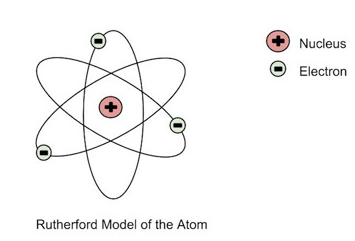
Rutherford's gold foil experiment provided evidence that...
a)
negative and positive charges are spread evenly throughout the atom.
b)
alpha particles have a positive charge.
c)
gold is not a dense as previously thought.
d)
there is a dense positively charged nucleus at the center of an atom.
33.

What are electrons?
a)
Negatively charged particles
b)
Neutrally charged particles
c)
Positively charged particles
d)
Uncharged particles
34.
Which word would closely define the term "atomos"?
a)
Incredible
b)
Indivisible
c)
Indelible
d)
Independent
35.

He proposed the atomic theory of the atom.
a)
John Dalton
b)
JJ Thomson
c)
Niels Bohr
d)
Ernest Rutherford
36.

Which is the correct sequence of the scientists who made major changes in the model of the atom?
1-JJ Thomson
2-Erwin Schrodinger
3-John Dalton
4-Niels Bohr
5-Ernest Rutherford
1-JJ Thomson
2-Erwin Schrodinger
3-John Dalton
4-Niels Bohr
5-Ernest Rutherford
a)
2, 1, 4, 3, 5
b)
3, 1, 5, 4, 2
c)
5, 3, 2, 1, 4
d)
4, 3, 2, 1, 5
37.

Which of the following is proposed by Erwin Schrodinger?
a)
Solar system model of the atom
b)
Plum pudding model of the atom
c)
Billiard ball model of the atom
d)
Electron cloud model of the atom
38.
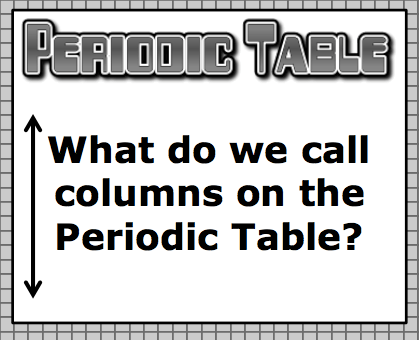
a)
Periods
b)
Groups
39.
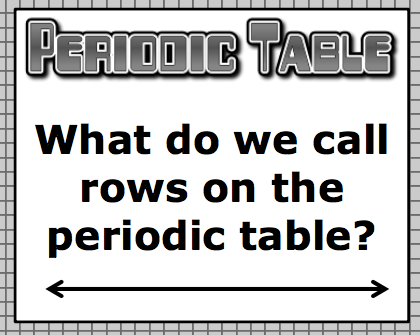
a)
Periods
b)
Groups
40.
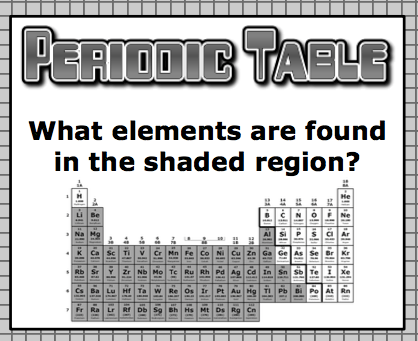
a)
Metals
b)
Nonmetals
c)
Metalloids
41.
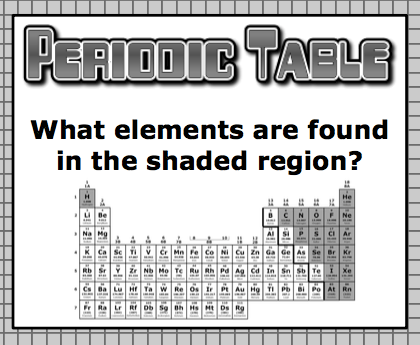
a)
Metals
b)
Nonmetals
c)
Metalloids
42.
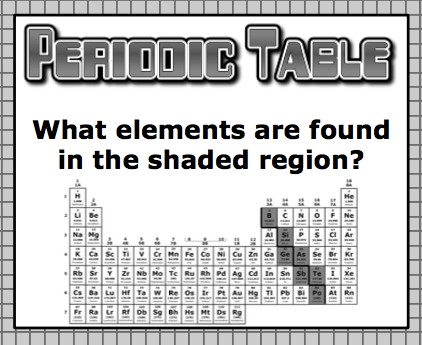
a)
Metals
b)
Nonmetals
c)
Metalloids
43.
In the modern periodic table elements are arranged by:
a)
atomic mass
b)
atomic number
c)
valence electrons
d)
number of isotopes
44.
The atomic number tells you what?
a)
number of electrons
b)
number of protons
c)
number of neutrons
d)
both electrons and protons in an atom.
45.

How did Mendeleev arrange the elements?
a)
alphabetical
b)
density
c)
melting point
d)
atomic mass
46.
What is a pure substance that cannot be broken down?
a)
matter
b)
atom
c)
molecule
d)
element
47.
What do the following properties describe? : shiny, ductile, good conductor, high melting point
a)
metal
b)
nonmetal
c)
metalloid
48.
Which of the following statements are FALSE?
a)
metals are located to the LEFT of the zig-zag line
b)
metals are less reactive than nonmetals
c)
nonmetals are located to the RIGHT of the zig-zag line
d)
metalloids have properties of both metals and nonmetals
49.
Ice melting
a)
Chemical Change
b)
Physical Change
50.
Wood burned in a fireplace
a)
Chemical Change
b)
Physical Change
51.
Cake batter baked in an oven
a)
Chemical Change
b)
Physical Change
52.
Blue liquid and yellow liquid mixed to make a green liquid
a)
Chemical Change
b)
Physical Change
53.
Rust on an iron fence
a)
Chemical Change
b)
Physical Change
54.
what is the definition of chemical change?
a)
any change that results in the formation of new chemical substances.
b)
changing clothes
c)
matter cannot be created or destroyed, only change form
d)
changes affecting the form of a chemical substance, but not its chemical composition.
55.
what is the definition of physical change?
a)
any change that results in the formation of new chemical substances.
b)
rusting
c)
changes affecting the form of a chemical substance, but not its chemical composition.
d)
any property that is measurable, whose value describes a state of a physical system
56.
what is condensing?
a)
physical property
b)
chemical property
c)
chemical change
d)
physical change
57.
what is solubility?
a)
chemical property
b)
physical property
c)
george
d)
chemical change
58.
what is digestion?
a)
body function
b)
chemical change
c)
physical change
59.
One cup of water is left outside for two days when it was checked there was only half a cup left. What happened?
a)
evaporation; chemical change
b)
condensation; physical change
c)
evaporation; physical change
d)
condensation; chemical change
60.
what happens when water freezes?
a)
ice is formed; chemical property
b)
cold water is formed; physical change
c)
ice is formed; physical change
d)
cold water is formed; chemical change
61.
what stays the same when there is a physical change?
a)
density
b)
volume
c)
neither
62.
what stays the same when there is a physical change?
a)
density
b)
volume
c)
neither
63.
Which of the following is a sign that a chemical reaction has occurred?
a)
change in shape
b)
melting
c)
formation of a gas
d)
dissolving
64.
Which of the following is NOT an example of a physical change?
a)
crumpled paper
b)
pencil sharpening
c)
shrunken clothing
d)
rust
65.
What is the best example of a machine that converts electrical energy into kinetic energy and sound energy?
a)
an electric toothbrush
b)
a toaster
c)
a flashlight
d)
an iron
66.
What best describes the energy conversion that occurs when you turn on a hair dryer?
a)
electric to kinetic to thermal and sound
b)
chemical to thermal to light and sound
c)
nuclear to electrical to thermal and sound
d)
kinetic to light to thermal and sound
67.
What best describes the energy conversion that takes place in a microwave oven?
a)
electrical to light to thermal
b)
chemical to thermal to light
c)
electrical to thermal to sound
d)
nuclear to thermal to chemical
68.
Turning on a lamp is an example of energy transformation from electrical to 3 forms of energy. Which of these is NOT created by the lamp?
a)
radiant
b)
light
c)
heat
d)
chemical
69.
Which of the following energy transfers occurs when food is digested?
a)
chemical to mechanical
b)
radiant to nuclear
c)
mechanical to potential
d)
thermal to chemical
70.
In energy transformations, "wasted energy" usually takes what form?
a)
heat
b)
chemical energy
c)
light
d)
sound waves
71.

What kind of energy transformation takes place in this system?
a)
chemical to electrical to light
b)
electrical to chemical to light
c)
electrical to light to chemical
d)
light to chemical to electrical
72.
Which is an example of radiant energy to thermal energy transformation?
a)
a greenhouse
b)
an electric stovetop
c)
an electric stove
d)
a car's brakes
73.
During most energy transformations and transfers, wasted energy takes the form of __.
a)
electromagnetic radiation
b)
sound waves
c)
random mechanical movements
d)
heat
74.
What is the best example of a device that converts electrical energy to thermal energy?
a)
a toaster
b)
a clock radio
c)
a flashlight
d)
an electric toothbrush
75.
What is the best example of a device that converts electrical energy to thermal energy?
a)
a toaster
b)
a clock radio
c)
a flashlight
d)
an electric toothbrush
76.
What two forms of energy are given off by a burning candle?
a)
heat and light
b)
mechanical and electrical
c)
nuclear and light
d)
potential and heat
77.
Which of the following radiant energy to electrical energy?
a)
solar calculator
b)
windmill
c)
glow stick
d)
firecracker
78.
Which of the following mechanical energy to electrical energy?
a)
solar calculator
b)
windmill
c)
glow stick
d)
firecracker
79.
Which of the following chemical energy to radiant energy?
a)
solar calculator
b)
windmill
c)
glow stick
d)
firecracker
80.
Which of the following chemical energy to sound and radiant energy?
a)
solar calculator
b)
windmill
c)
glow stick
d)
firecracker
81.
Which of the following converts chemical energy to radiant energy?
a)
candle
b)
light bulb
c)
coal power plant
d)
nuclear power plant
82.
Which of the following converts electrical energy to radiant energy?
a)
candle
b)
light bulb
c)
coal power plant
d)
nuclear power plant
83.
Which of the following converts chemical energy to electrical energy?
a)
candle
b)
light bulb
c)
coal power plant
d)
nuclear power plant
84.
Which of the following converts nuclear energy to electrical energy?
a)
candle
b)
light bulb
c)
coal power plant
d)
nuclear power plant
85.
Which of the following converts chemical energy to electrical energy?
a)
Battery
b)
Person eating food
c)
Automobile
d)
Camp Fire
86.
Which of the following converts mechanical energy to a different type of mechanical energy?
a)
Battery
b)
Person riding a bike
c)
Automobile
d)
Camp Fire
87.
Which of the following converts chemical energy to mechanical energy?
a)
Battery
b)
Person riding a bike
c)
Automobile
d)
Camp Fire
88.
Which of the following converts chemical energy to thermal energy?
a)
Battery
b)
Person riding a bike
c)
Automobile
d)
Camp Fire
89.

__________ is an energy resource that WILL NOT run out in the next several hundred years.
a)
Renewable Energy Resource
b)
Nonrenewable Energy Resource
c)
Fossil Fuel
d)
Forever Fuel
90.

__________ is an energy resource that WILL run out in the next several hundred years.
a)
Renewable Energy Resource
b)
Nonrenewable Energy Resource
c)
Fossil Fuels
d)
Forever Fuels
91.

Coal is a __________ energy resource.
a)
Renewable
b)
Nonrenewable
92.

Solar Power is a __________ energy resource.
a)
Renewable
b)
Nonrenewable
93.
Solar Power is a __________ energy resource.
a)
Renewable
b)
Nonrenewable
94.

Natural Gas is a __________ energy resource.
a)
Renewable
b)
Nonrenewable
95.

Oil is a __________ energy resource.
a)
Renewable
b)
Nonrenewable
96.

Wind is a __________ energy resource.
a)
Renewable
b)
Nonrenewable
97.

Geothermal Power is a __________ energy resource.
a)
Renewable
b)
Nonrenewable
98.
Non-renewable or Renewable: Coal
a)
Renewable
b)
Non-Renewable
99.
Non-renewable or Renewable: Wood
a)
Non-renewable
b)
Renewable
100.
Non-renewable or Renewable: Water
a)
Renewable
b)
Non-Renewable
101.
Non-renewable or Renewable: Animals
a)
Renewable
b)
Non-Renewable
102.
Non-renewable or Renewable: Sunlight
a)
Renewable
b)
Non-Renewable
103.
Non-renewable or Renewable: Wind
a)
Renewable
b)
Non-Renewable
104.
compounds are chemically bounded together
a)
False
b)
true
c)
I don't know?
105.
Can an element be broken down into a simpler substance
a)
yes
b)
No
106.
Which of the following an element?
a)
Carbonic Acid
b)
Copper
c)
Iron and Copper
d)
Water
107.
Which of the following is not a compound?
a)
HCl
b)
Cl
c)
NaCl
d)
CO2
108.
Salt water boils and the water completely evaporates, salt (NaCl) is left in the bottom of the beaker. Which of the following is left in the beaker?
a)
Compound
b)
Element
c)
Mixture
d)
None of the Above
109.
A combination of substances that are not chemically combined is called a(n)____________.
a)
mixture
b)
compound
c)
physical
110.
Mixtures are separated through ___________changes.
a)
mixture
b)
compound
c)
physical
111.

This picture represents which of the following?
a)
element
b)
compound
c)
mixture
112.

This picture represents which of the following?
a)
element
b)
compound
c)
mixture
113.

This picture represents which of the following?
a)
element
b)
compound
c)
mixture
114.
In a mixture, substances
a)
keep their properties
b)
have a definite chemical composition
c)
lose their properties
d)
combine chemically
115.
Which of these is not a pure substance.
a)
Gold
b)
NaCl
c)
Hydrogen
d)
Kool aide
116.

What type of mixture?
a)
Homogeneous
b)
Hetrogenous
117.

What type of mixture is this?
a)
heterogeneous
b)
homogeneous
118.

What does it mean if a mixture is homogeneous?
a)
you can see the different parts
b)
cannot tell one part from another
c)
chunks of particles
d)
made of elements
119.
Which of the following IS a mixture?
a)
air
b)
hydrogen
c)
water
d)
sugar
120.
What is the only type of mixture that has particles that dissolve and are transparent.
a)
Solutions
b)
Suspensions
c)
Colloids
121.
What is a solvent?
a)
The substance that does the dissolving in a solution.
b)
The substance that is being dissolved in a solution.
c)
The mixing of different substances.
d)
The process in which neutral molecules lose or gain electrons
122.
Muddy water is an example of what type of mixture?
a)
colloid
b)
solution
c)
suspension
d)
homogeneous
123.
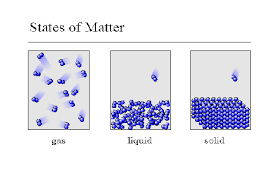
At higher temperatures
a)
particles in an object have less energy
b)
particles in an object move faster
c)
a gas contracts
124.
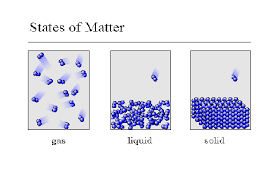
A gas
a)
has a definite shape but no definite volume
b)
has a definite volume but no definite shape
c)
has fast-moving particles
125.
Freezing
a)
Solid to gas
b)
Liquid to solid
c)
Gas to solid
d)
Liquid to gas
126.
Boiling
a)
liquid to gas
b)
gas to solid
c)
gas to liquid
d)
solid to liquid
127.
Boiling
a)
liquid to gas
b)
gas to solid
c)
gas to liquid
d)
solid to liquid
128.
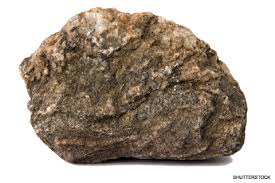
Which state of matter has tightly packed molecules?
a)
solid
b)
liquid
c)
gas
129.
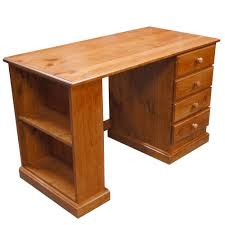
Which state of matter has a definite shape?
a)
solid
b)
liquid
c)
gas
130.
What is happening when my ice cream changes from a solid to a liquid?
a)
freezing
b)
melting
c)
burning
d)
evaporation
131.
Define a liquid.
a)
Indefinite shape, indefinite volume
b)
Definite shape, definite volume
c)
Found in stars
d)
Definite volume, indefinite shape
132.
The state of matter that has no definite size or shape is
a)
Solid
b)
Liquid
c)
Gas
133.
Particles (molecules) in a ______________________ have more energy than the other states of matter.
a)
gas
b)
solid
c)
liquid
134.
Particles of a liquid
a)
are tightly packed together and stay in a fixed position.
b)
have no viscosity.
c)
decrease in volume with increasing temperature.
d)
are free to move around one another but still touch.
135.
What term describes a solid changing to a gas?
a)
Deposition
b)
Sublimation
c)
Evaporation
d)
Freezing
136.
Particles (molecules) in a ______________________ have more energy than the other states of matter.
a)
gas
b)
solid
c)
liquid
137.
What is condensation?
a)
gas to solid
b)
gas to liquid
c)
liquid to solid
d)
solid to liquid
138.
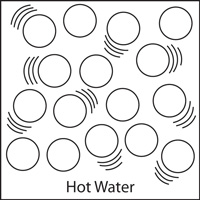
The speed of the molecules determines the _____.
a)
volume
b)
density
c)
pressure
d)
temperature
139.
Which has a greater distance between particles?
a)
Solid
b)
Liquid
140.
The slower the particles in a substance move,
a)
the colder it is.
b)
the warmer it is.
c)
the more energy it has.
d)
the less energy it has.
141.
Thermal energy is...
a)
heat energy.
b)
the energy of motion
c)
energy of nuclear processes.
d)
an indication of physical change.
142.
A chemical change
a)
doesn't really change much.
b)
creates a new substance
c)
is a change in the state of matter
143.
A chemical change
a)
doesn't really change much.
b)
creates a new substance
c)
is a change in the state of matter
144.
A physical change is...
a)
a change that doesn't change the identity
b)
a change that makes something new.
c)
a chemical reaction
100 %

