
NEW
Font size
S
M
L
XL
 Worksheets
DCA #2 Review
Total questions: 59
Worksheet time: 2hrs 37mins
Name
Class
Date
1.
Which of the following produces identical nuclei in cells?
a)
fertilization
b)
osmosis
c)
mitosis
d)
pollution
2.
Which statement best describes the importance of sexual reproduction?
a)
sexual reproduction produces variation in offspring
b)
sexual reprosuction provides regeneration of body parts
c)
sexual reproduction occurs between individuals of the same species
d)
sexual reproduction produces offspring that are identical
3.
Which of the following cell types is formed by meiosis?
a)
skin cells
b)
sperm cells
c)
blood cells
d)
muscle cells
4.
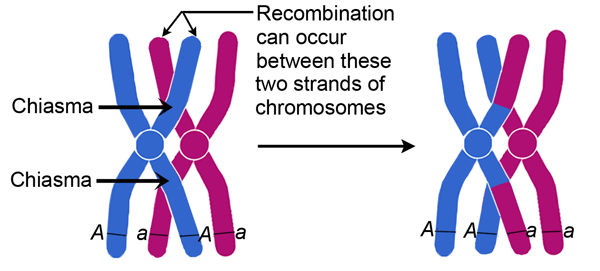
This image shows chromosomes during Prophase 1. Which of the following correctly describes the process shown?
a)
segregation of sister chromatids
b)
condensation and segregation of alleles
c)
mutationin which the DNA content of the gene is altered
d)
crossing - over in which alleles are exchanged
5.
Which of the following statements correctly describes meiosis?
a)
Meiosis does not occur in reproductive cells.
b)
The cells produced at the end are identical
c)
the cells produced at the end contain half the # of chromosomes
d)
cells divide only once during meiosis
6.
What process is necessary for the inherited traits of an organism to be passed along by sexual reproduction?
a)
meiosis
b)
mutation
c)
mitosis
d)
fission
7.
What is one advantage of sexual reproduction?
a)
The offspring are identical to the parents
b)
the offspring are resistant to viruses
c)
the offspring are born live, instead of from eggs
d)
The offspring inherit a wider variety of genetic information
8.
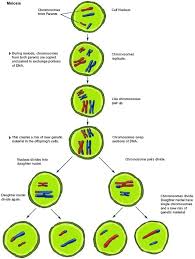
This diagram shows which cellular process that occurs in organisms?
a)
endocytosis
b)
mitosis
c)
meiosis
d)
phagocytosis
9.
If an intestinal cell in a butterfly contains 24 chromosomes, a butterfly egg cell would contain___________.
a)
12 chromosomes
b)
6 chromosomes
c)
3 chromosomes
d)
24 chromosomes
10.
Meiosis is the key process in the production of_________.
a)
body cells
b)
RNA
c)
white blood cells
d)
gametes
11.
Which of the following best describes meiosis?
a)
It happens in all tissues except the brain and spinal cord
b)
It is the 1st stage of mitosis
c)
It occurs only in cells in the reproductive structures of the organism
d)
it is carried out in all tissues that require cell replacement
12.
Cells of organism must replicate for ?
a)
growth
b)
repair of damaged cells
c)
replacement of dying cells.
d)
All of the above
13.
Before cells can divide, what must be copied?
a)
mitochondria
b)
cytoplasm
c)
DNA
d)
Cell Wall
14.
The division of the nucleus is known as:
a)
Synthesis
b)
Mitosis
c)
G1
d)
G2
15.
Humans have ________ pairs of chromosomes.
a)
21
b)
23
c)
46
d)
None of the above
16.
Eukaryotic cells store their genetic information(DNA) in __________.
a)
Chromosomes
b)
Centromeres
c)
karyotypes
d)
Proteins
17.
Uncontrollable cell growth is known as _____
a)
obesity
b)
cancer
c)
diabetes
d)
hepatitis
18.
The ___________ holds the replicated sister chromatids together.
a)
centriole
b)
chromosomes
c)
centromere
d)
cycles
19.
The cell spends most of it's life in ________________.
a)
mitosis
b)
cytokinesis
c)
Interphase
d)
None of the above
20.
In the G1 stage of the cell cycle, the cell
a)
Grows
b)
Matures
c)
Carries on normal activities
d)
All of the above
21.
In the S stage of interphase_______________
a)
the cell grows
b)
the nucleus divides
c)
the cell membrane divides
d)
the DNA is replicated
22.
In the G2 stage of cell division, ______________ are made.
a)
organelles
b)
structures for cell division
c)
proteins
d)
all of the above
23.
When a plant cell goes through cell division, _____________.
a)
the 2 new nuclei are separated by the cell membrane pinching off.
b)
4 new cells are formed
c)
a cell plate forms, dividing the 2 new nuclei
d)
None of the above
24.

The chromosome in the diagram
a)
has been replilcated
b)
consists of 2 copies of 1 chromosome
c)
is about to go through cell division
d)
all of the above.
25.
A human cell has 46 chromosomes before mitotic division. How many chromosomes will the daughter cells after mitosis.
a)
12
b)
23
c)
46
d)
92
26.
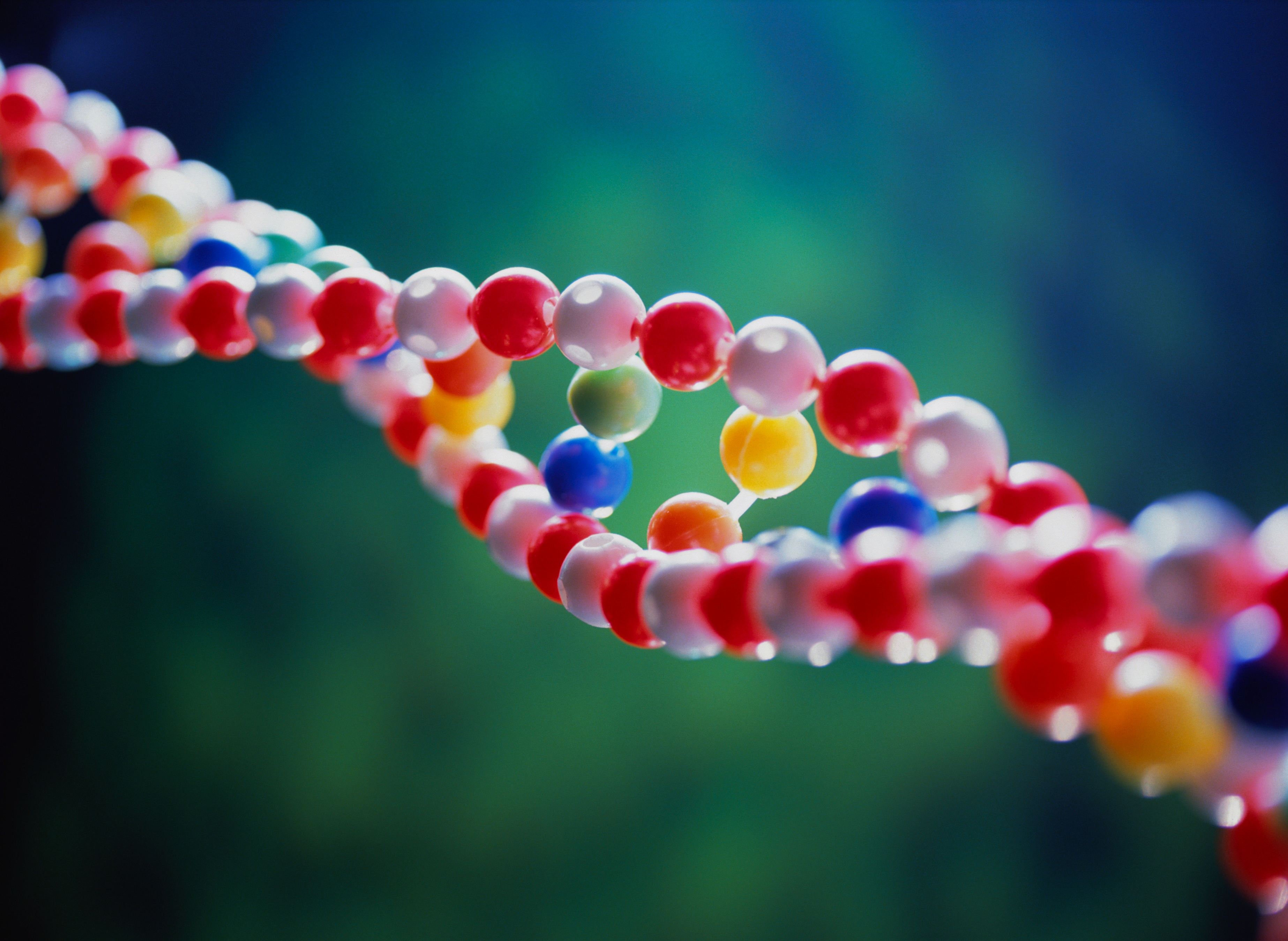
Why is DNA important?
a)
it is very small and very complicated
b)
it's in everything
c)
it serves as the blueprint for traits of all living things
d)
because we eat it every day for energy
27.
What are the 4 nitrogen bases?
a)
adenine, thymine, cytoplasm, and guanine
b)
adenine, thymine cytosine, and guanine
c)
adenine, thymine, cytosine, and gylcerol
d)
adenine, thymine, cytosine, and glucose
28.
Which 2 molecules forms the sides (backbone) of the DNA ladder?
a)
deoxyribose and adenine
b)
deoxyribose and a hydrogen bond
c)
sugar and the nucleus
d)
deoxyribose (sugar) and phosphate
29.
Which sequence of DNA bases would pair with this partial strand
ATG TGA CAG
ATG TGA CAG
a)
ATG TGA CAG
b)
TAC ACT GTC
c)
GTA AGT GAC
d)
CAT TCA CTG
30.

Which of the following best describes a DNA molecule?
a)
double helix
b)
contains ribose
c)
made of amino acids
d)
contains Uracil
31.
Adenine bonds with ______________.
a)
Guanine
b)
Thymine
c)
Cytosine
d)
Adenine
32.
Guanine bonds with ______________.
a)
Adenine
b)
Guanine
c)
Cytosine
d)
Thymine
33.
A process in which DNA has the unique ability to make an exact copy of itself.
a)
Replication
b)
Translation
c)
Transcription
34.
Which 2 molecules form the sides (backbone) of the DNA ladder?
a)
deoxyribose sugar and adenine
b)
deoxyribose sugar and a hydrogen bond
c)
deoxyribose sugar and the nucleus
d)
deoxyribose sugar and phosphate
35.
Which organelle is DNA usually found in?
a)
cell membrane
b)
vacuole
c)
chloroplast
d)
nucleus
36.
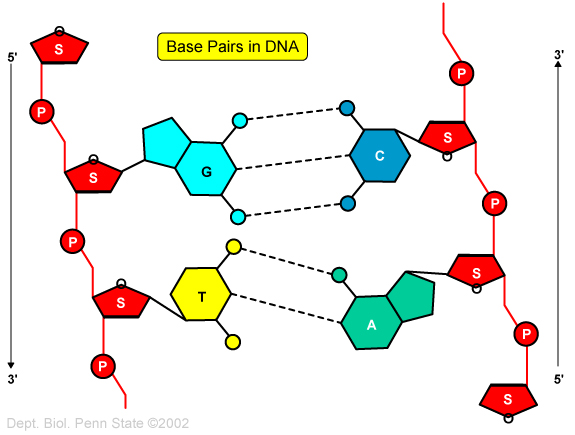
Nitrogenous bases are joined by which type of bond?
a)
polar bonds
b)
ionic bonds
c)
covalent bonds
d)
hydrogen bonds
37.
In what phase of the cell cycle does DNA replication take place?
a)
G1
b)
S
c)
G2
d)
M
38.

The drawing shows the structure of what molecule?
a)
A DNA molecule
b)
A lipid molecule
c)
A carbohydrate molecule
d)
A protein molecule
39.

Name this structure
a)
double helix
b)
nucelotide
c)
twisted ladder
d)
hydrogen bond
40.
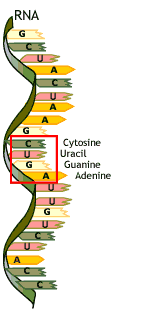
In RNA, Uracil pairs with ______.
a)
cytosine
b)
adenine
c)
guanine
d)
thymine
41.
The process to go from DNA to mRNA is _______
a)
translation
b)
transcription
c)
replication
42.
The process to go from mRNA to a protein is called ____
a)
transcription
b)
rRNA
c)
replication
d)
translation
43.
DNA holds the code for
a)
lipids
b)
carbohydrates
c)
protein
d)
sugar
44.
Choose the nucleotide sequence of the RNA strand that would be complementary to the following strand:
GTAGTCA
GTAGTCA
a)
UATUAGA
b)
ACGACTG
c)
CAUCAGU
d)
CATCAGT
45.
The main function of tRNA is to...
a)
carry a message that, when translated, forms proteins
b)
form a portion of ribosomes
c)
string together complementary RNA and DNA strands
d)
bring amino acids from the cytoplasm to the ribosomes
46.
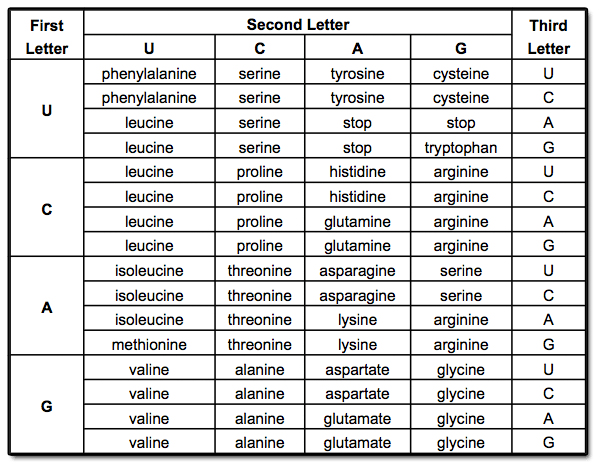
What amino acid is represented by the codon UUA?
a)
Phenylalanine
b)
Tyrosine
c)
Leucine
d)
Stop codon
47.
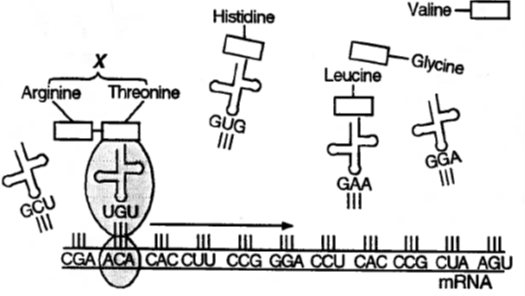
What process is going on in this photo?
a)
Transcription
b)
Translation
c)
Replication
d)
All the above
48.
Which component of DNA determines the traits of an organism?
a)
Nitrogen Bases
b)
Sugar-Phosphate Backbone
c)
Hydrogen bonds
49.
What is the location in the cell for translation?
a)
nucleus
b)
mitochondria
c)
ribosome
d)
chloroplast
50.
What is the three base sequence of mRNA that codes for a single amino acid?
a)
Anticodon
b)
Codon
c)
Protein
51.
What is the location in the cell for transcription?
a)
nucleus
b)
cytoplasm
c)
ribosome
d)
mitochondria
52.
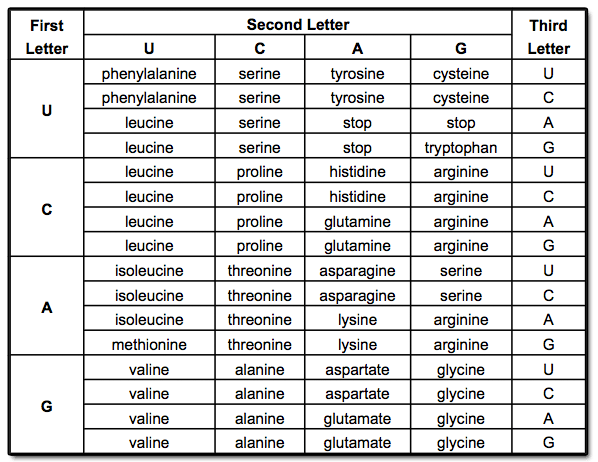
What is the correct amino acid sequence for the mRNA code AUGCCAGUAUGA
a)
Met-Pro-Ala-Val
b)
Met-Pro-Val
c)
Tyr-Gly-His
d)
Tyr-Gly-Arg-His
53.
How many amino acids are coded for by this sequence of nucleotides:
ATG GGA ACT CCA
ATG GGA ACT CCA
a)
4
b)
2
c)
6
d)
12
54.
Contains the bases adenine, uracil, cytosine and guanine
a)
DNA
b)
RNA
c)
Both
55.
What type of mutation occurs, when a base is subtracted from the sequence?
a)
Deletion
b)
Insertion
c)
Substitution
56.
What mutation has occurred here?
T-G-A-C-C-A
T-G-A-G-C-A
T-G-A-C-C-A
T-G-A-G-C-A
a)
Substitution
b)
Deletion
c)
Insertion
d)
Frameshift
57.
Any change in the sequence of DNA is...
a)
transgenic shift
b)
Single Genotype
c)
Monohybrid Trait
d)
Mutation
58.
Why are insertion and deletion (frameshift) mutations so harmful?
a)
They change all of the codons from the mutation on down the line, which changes the amino acid sequence
b)
They insert things that an organism doesn't need.
c)
They often delete things that organisms need.
d)
Insertion and deletions are not any more harmful than substitution mutations.
59.
Why is the order of amino acids so important?
a)
The order of amino acids dictates what shape the protein will fold into.
b)
It is not important. The protein folding chamber will force the protein to fold into the correct shape.
Reset

