wayground logo

Free Printable Worksheets

Font size

S
M
L
XL
Worksheets

Light and Optics 2.0-3

Total questions: 108

Worksheet time: 2hrs 49mins

Name
Class
Date
1.
Which explains why the fork looks different under water?
a)
light can't pass through the glass
b)
the wavelength of light lengthens
c)
the amount of light increases when going through water
d)
light is refracted at an angle
2.
Why do we see objects as white?
a)
They absorb all light
b)
They reflect all light
c)
They absorb some light and reflect some light
3.
Another name for light bending is ....
a)
Reflaction
b)
Absorbing
c)
Refraction
d)
mirror
4.
The Law of Reflection:
The angle of incidence is _________ the angle of reflection
a)
bigger than
b)
the same as
c)
smaller than
5.
Luminous means...
a)
Gives out its own light
b)
Reflects light from other things
6.
_____ is a lens that is thicker in the middle and makes an object appear bigger.
a)
prism
b)
convex lens
c)
concave lens
d)
mirror
7.
______ is a lens that is thicker on its edges and makes an object appear smaller?
a)
mirror
b)
convex lens
c)
concave lens
d)
prism
8.
What Does a Concave Lens Do?
a)
Make things bigger
b)
Make things smaller
c)
Make things closer
d)
Make things happy
9.
What Does a Convex Lens Do?
a)
Make things bigger
b)
Make things smaller
c)
Make things closer
d)
Make things sader
10.
Fill in the blank with the best answer: After light passes through a convex lens the light comes together at a __________. 
a)
Spot
b)
Focal point
c)
point
d)
Local Point
11.
When light shines through a prism it creates a ________________
a)
colors
b)
ROY G. BIV
c)
spectrum
d)
electromagnetic wave
12.

What are the 3 primary colors of light?

a)

red, green, blue

b)

yellow, orange, violet

c)

red, black, green

d)

magenta, cyan, indigo

13.
What shape does light travel in?
a)
Waves
b)
Circles
c)
Squares
d)
Diamonds
14.
Light is predictable because it will always travel in a _________ line.
a)
Curvy
b)
Straight
c)
Backwards
d)
Crazy
15.
If someone is wearing a black shirt in the sunshine, what will the black do to the light?
a)
Reflect it
b)
Absorb it
c)
Refract it
d)
Diffuse it
16.
If light strikes a mirror at a 50⁰ angle, what angle will it come off of the mirror?
a)
50⁰
b)
70⁰
c)
45⁰
d)
30⁰
17.
Light produced by humans is called 
a)
Shadows
b)
Natural Light
c)
Artificial Light
d)
Color
18.

concave mirror focal point is

a)

behind mirror

b)

infront of mirror

19.

an object will appear ____________________ when it is far away from a concave mirror

a)

small and upside down

b)

small and upright

c)

big and upside down

d)

big and upright

20.

an object will appear ____________________ when it is in front of a focal point from a concave mirror

a)

small and upside down

b)

small and upright

c)

big and upside down

d)

big and upright

21.

the focal point of a convex mirror is

a)

in front of the mirror

b)

behind the mirror

22.

objects will appear _______________ when in a convex mirror

a)

small and upright

b)

small and upside down

c)

big and upright

d)

big and upside down

23.

An example of a real life convex mirror is

a)

telescope

b)

car head light

c)

flashlight

d)

car mirror

24.

An example of a real life concave mirror is

a)

car mirror

b)

flashlight

25.
The bending of a wave as it passes at an angle from one medium to another is called?
a)
Convex Lens
b)
Refraction
c)
Concave Lens
26.
The point where the rays meet is known as....
a)
Fire
b)
the focal point
c)
refraction
d)
Plane of the lens
27.
When light passes at an angle to the normal from one material into another material in which its speed is higher 
a)
it is bent toward the normal.
b)
it always lies along the normal.
c)
it is unaffected.
d)
it is bent away from the normal.
28.
When light passes at an angle to the normal from one material into another material in which its speed is lower
a)
it is bent towards the normal.
b)
it always lies along the normal.
c)
it is unaffected.
d)
it is bent away from the normal.
29.
Is a convex lens thicker or thinner in the middle?
a)
Thicker 
b)
Thinner 
30.

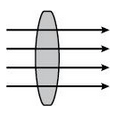
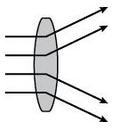
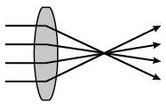
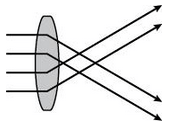
Which lens represents the path light takes through a concave lens?

a)
b)
c)
d)
31.

Which figure represents the path light takes through a convex lens?

a)
b)
c)
d)
32.
A magnifying glass is an example of what type of lens?
a)
convex
b)
concave
c)
mirror
d)
Cylinder
33.
This type of Electromagnetic wave shows a break in bones.
a)
gamma ray
b)
x-ray
c)
brokenometer
d)
radio wave
34.
Which has the LONGEST wavelength and, therefore, the lowest frequency/energy
a)
Gamma Rays
b)
Radio Waves
c)
Visible Light
d)
Infrared rays
35.
Which part of the electromagnetic spectrum has high enough energy to cause damage to eyes and skin, and sometimes even cancer? 
a)
infrared light
b)
visible light
c)
ultraviolet light
d)
microwaves
36.
Cancer can be treated with_______________waves.
a)
Penicillin
b)
Radio
c)
Infrared
d)
Gamma
37.
You have cool glow-in-the-dark stickers of Mickey Mouse. This is an example of 
a)
fluorescence
b)
chemiluminescence
c)
phosphorescence 
d)
incandescence
38.
What is an example of artificial light?
a)
the sun 
b)
the stars 
c)
bioluminescence 
d)
neon light 
39.
the ability to emit light
a)
phosphorescence
b)
magnetic resonance images (MRI)
c)
gamma rays 
40.
uses a filament to produce light 
a)
incandescent bulb
b)
fluorescent bulb
c)
phosphorescence 
41.
when living organisms produce their own light 
a)
luminescence
b)
bioluminescence
c)
phosphorescence
d)
photophore
42.
light producing organ on a firefly
a)
photophore
b)
phosphor
c)
phosphorescence
43.
_____ is a lens that is thicker in the middle and makes an object appear bigger.
a)
prism
b)
convex lens
c)
concave lens
d)
mirror
44.

The law of ___________ states that when a ray of light reflects off a surface, the angle of incidence is equal the angle of reflection.

a)

refraction

b)

reflection

c)

magnification

d)

diffraction

45.

Why does light refract when it encounters the glass in a lens?

a)

because it speeds up, which causes it to bend

b)

because it slows down, which causes it to bend

c)

because it hits a dense medium, which causes it to bounce off

d)

because it gets absorbed, which causes it to lessen in intensity

46.

Sara is using a magnifying glass to closely examine her stamp collection. Which type of lens is found in a magnifying glass.

a)

bifocal

b)

concave

c)

convex

d)

prismatic

47.

How does a concave lens differ from a convex lens?

a)

A convex lens is another way to describe a plane mirror; a concave lens is curved

b)

A concave lens is curved inward on both sides; a convex lens is on only one side

c)

A convex lens has a thick center and thin edges, a concave lens has a thin center and thicker edges

d)

A convex lens has a thin center and thick edges. a concave lens has a thick center and thinner edges

48.

Which image CORRECTLY shows how light behaves when it travels from air through glass?

a)
b)
c)
d)
49.
Which light source is not an example of Bioluminescent ?
a)
Candles
b)
Fireflies
c)
Lantern fish 
50.
Mirrors that bulge out are called:
a)
Concave mirrors
b)
Convex mirrors
51.

How do phosphorescent light sources work?

a)

It requires electricity to work

b)

It absorbs light energy from another source and then slowly releases it after the source is removed

c)

It heats to such a high temperature creating a flame which emits a glow

d)

It is the result of a chemical reaction between two different substances

52.

_______________ light is when energy heats up to such a high temperature it emits a glow

a)

bioluminescent

b)

incandescent

c)

phosphorescent

d)

fluorescent

53.

Which of these light sources is an example of bioluminescent light source?

a)

CFL light bulb

b)

glow stick

c)

firefly

d)

glow in the dark watch

54.

Fluorescent light sources emit light when

a)

electrical energy is supplied

b)

a biochemical reaction occurs in a living organism

c)

the light source heats up to such a high temperature it emits a glow

d)

two substances mix together to create a chemical reaction

55.

Which one of these light sources is phosphorescent?

a)

candle

b)

glow stick

c)

glow in the dark stickers

d)

flash light

56.

A mirror reflection that appears to be farther away and smaller than the actual object would be the reflection of a _____________ mirror.

a)

convex

b)

concave

c)

plane

57.

A mirror that shows us a magnified reflection is called a _____________ mirror.

a)

concave

b)

plane

c)

convex

58.

A cosmetics mirror would be what type of mirror?

a)

concave

b)

convex

c)

plane

59.

A convex lens make objects look

a)

the same size as the actual object

b)

bigger, magnified

c)

smaller

60.

A concave lens makes objects look

a)

bigger, magnified

b)

smaller

c)

the same size as the actual object

61.

A magnifying glass is an example of a ___________ lens.

a)

conduct

b)

concave

c)

convex

62.

The law of reflection states that

a)

When light enters a mirror on an angle, it will reflect off at a different angle

b)

When light enters a mirror at a certain angle, it will reflect off at the same angle

c)

When light enters a mirror on an angle it stays inside the mirror

d)

When light enters a mirror on an angle it will reflect off in many different directions

63.

The light beam that enters a mirror is called the

a)

reflected ray

b)

incident ray

c)

accident ray

d)

refracted ray

64.

Which has the highest frequency and energy?

a)

radiowaves

b)

infrared

c)

visible light

d)

Gamma rays

65.

Which has a longer wavelength and lower energy?

a)

gamma rays

b)

x-rays

c)

visible light

d)

microwaves

66.

Which has a higher energy and shorter wavelength?

a)

radiowaves

b)

visible light

c)

microwaves

d)

Infrared

67.

Which has the highest energy?

a)

radiowaves

b)

Ultraviolet

c)

infrared

d)

visible light

68.

Which type of light on the Electromagnetic spectrum can humans see without technology?

a)

Infrared

b)

x-rays

c)

visible light

d)

gamma rays

69.

A convex lense _____________ objects

a)

minifies

b)

magnifies

70.

A concave lense ________________ objects

a)

minifies

b)

magnifies

71.
__________ objects reflect all colors; __________ object absorb all colors
a)
white ; black
b)
black ; white
c)
red ; violet
d)
violet ; red
72.
A red banner will reflect  ________ and will ________ all other colors of light
a)
only red light ; absorb
b)
all colors of light ; absorb
c)
all colors but red ; transmit
d)
only red light ; transmit
73.
The top of a spoon acts as a __________ mirror; the bottom of a spoon acts as a __________ mirror
a)
concave ; convex
b)
convex ; concave
c)
both sides are concave
d)
both sides are convex
74.

If you see a green leaf on a tree, that means...

a)

Green is the color being reflected off the leaf.

b)

Green is the color being absorbed by the leaf.

c)

All the colors are being reflected off the leaf.

d)

All the colors are being absorbed by the leaf.

75.

Sunlight is special because it...

a)

contains all the colors of the rainbow.

b)

contains most of the colors of the rainbow.

c)

contains white light and black light.

d)

contains black light.

76.
Which best explains what happens to light when it shines on a green snake?
a)
Red and Green are absorbed
b)
Red and green are reflected
c)
Green is absorbed, Red is reflected
d)
Green is reflected, Red is absorbed
77.
Which best explains why a white paper looks white?
a)
It absorbs all colors
b)
It reflects red and green
c)
It reflects red and blue
d)
It reflects all colors
78.
Which color of light has the longest wavelength?
a)
Red
b)
Orange
c)
Green
d)
Violet
79.
The Law of Reflection:
The angle of incidence is _________ the angle of reflection
a)
bigger than
b)
the same as
c)
smaller than
80.
What are the three primary colours of light?
a)
Red,Yellow,Blue
b)
Red,Green,Yellow
c)
Red,Green,Blue
d)
Yellow,Blue,Green
81.
Red plus Green equal what subtractive color?
a)
Magenta
b)
Cyan
c)
Yellow
d)
Black
82.
The color you see is the color that is ___.
a)
reflected
b)
absorbed
83.
If all light waves are absorbed by a medium, then what color will be perceived?
a)
White
b)
Black
c)
Red
d)
Green
84.
What part of the visible spectrum has the highest energy? 
a)
Red
b)
Orange
c)
Green
d)
Violet
85.
R + B  =
a)
Red
b)
Cyan
c)
Magenta
d)
Yellow
86.
Which color is a primary color of light?
a)
Yellow
b)
Green
c)
Cyan
d)
Magenta
87.
The point where the rays meet is known as....
a)
Fire
b)
the focal point
c)
refraction
d)
Plane of the lens
88.
What does the word "diverging" mean?
a)
to spread apart
b)
to come together
c)
parallel
d)
perpendicular
89.
What does the word "converging" mean?
a)
to separate
b)
to come together
c)
parallel 
d)
perpendicular
90.
Light is a part of what spectrum?
a)
hydroelectric
b)
Solarpower
c)
electromagnetic
d)
Censa
91.
All of the following are sources of light except ______________
a)
the sun
b)
a light bulb
c)
fire
d)
the moon
92.
Light that bounces back has been _______________
a)
transferred
b)
heated up
c)
absorbed
d)
reflected
93.
Light that bends has been ____________________
a)
teleported
b)
reflected
c)
charged
d)
refracted
94.
Select the correct order of waves on the EM Spectrum. 
a)
Radio, Micro, Infra, Visible, Ultra, X-ray, Gamma
b)
Gamma, X-ray, Ultra, Vis, Infra, Micro, Radio
c)
Vis, Micro, Infra, Ultra, X-ray, Gamma, Radio
d)
Micro, Radio, Vis, Infra, Ultra, X-ray, Gamma
95.
A mirror with a surface that curves inward like the inside of a bowl
a)
concave mirror
b)
convex mirror
c)
plane mirror
d)
flat mirror
96.

Where might you find a concave lens?

a)

car headlights

b)

the corner of a convenience store

c)

the peephole in your front door

d)

in your eyeball

97.
Where might you find a convex mirror?
a)
car headlights
b)
the corner of a convenience store
c)
inside a microscope
d)
in your eyeball
98.
This type of wave can go through soft tissue, but they don't go through dense muscle, teeth, or bones.
a)
Microwaves
b)
Ultraviolet Waves
c)
X-rays
d)
Gamma Rays
99.

The primary colors of light are

a)

red, green, indigo

b)

red, green, blue

c)

black, white, yellow

d)

magenta, cyan, yellow

100.

The primary colors of pigment in printing are

a)

red, green, indigo

b)

red, green, blue

c)

black, white, yellow

d)

magenta, cyan, yellow

101.

Mixing all the primary colors of light in equal amounts results in _________ light.

a)

Black

b)

White

c)

Yellow

d)

Indigo

102.

Which light produces a lot of unnecessary heat?

a)

incandescent

b)

florescent

103.

Which light works by warming up a filament?

a)

incandescent

b)

florescent

104.

Which light works by a chemical reaction with a phosphor?

a)

incandescent

b)

florescent

105.

Which light is more expensive to buy?

a)

incandescent

b)

florescent

106.

Which light can last for over 10 years?

a)

incandescent

b)

florescent

107.

Which light bulb makes a company more money?

a)

incandescent

b)

florescent

108.

Which light bulb is worst for the environment?

a)

incandescent

b)

florescent