wayground logo

Free Printable Worksheets

Font size

S
M
L
XL
Worksheets

8th Grade Midterm Review

Total questions: 111

Worksheet time: 1hrs 21mins

Name
Class
Date
1.
The charge of an atom is determined by the number of- 
a)
protons and electrons
b)
protons and neutrons
c)
electrons and neutrons
d)
all of the above
2.
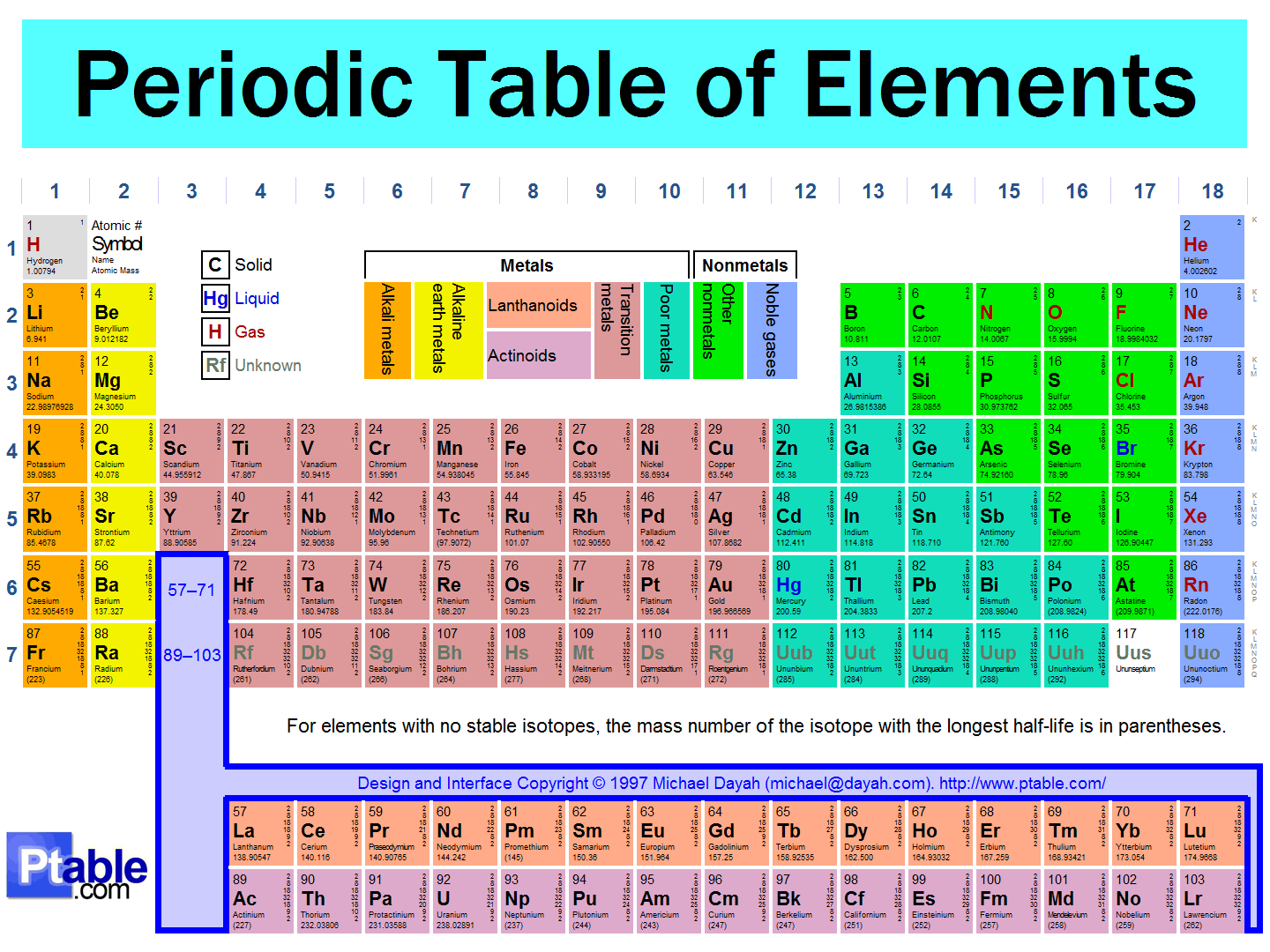
On a periodic table groups are- 
a)
the vertical columns
b)
the horizontal rows
c)
all of the above
d)
none of the above
3.
On a chemical label the yellow section represents-
a)
reactivity
b)
health
c)
special info
d)
flammability
4.
If an atom is neutral, what must be in balance?
a)
protons and neutrons
b)
protons and electrons
c)
neutrons and electrons
d)
all of the above
5.
Which of the following have a negative charge and the smallest mass?
a)
proton
b)
neutron
c)
electron
d)
newton
6.
The following atom has:
8 protons
10 neutrons 
10 electrons
It will have a charge of-
a)
+2
b)
-2
c)
+1
d)
none of the above
7.
The particles found in the nucleus are-
a)
protons and electrons
b)
electrons only
c)
protons and neutrons
d)
all of the above
8.
An atom of a certain element has 17 protons, 17 electrons, and a mass number of 35.  How many neutrons are in this atom?
a)
17
b)
18
c)
34
d)
35
9.
An atom has 11 protons, 11 neutrons, and 11 electrons.  What is the charge of the atom's nucleus?
a)
-11
b)
+11
c)
none of the above
10.
Elements can be identified by their unique number of 
a)
protons
b)
electrons
c)
neutrons
d)
none of the above
11.
What type of particles are found in the cloud surrounding the nucleus?
a)
electrons
b)
protons
c)
neutrons
d)
all of the above
12.
A atom contains 3 protons and 4 neutrons. The atom is electrically neutral.  How many electrons does this atom have?
a)
3
b)
4
c)
7
d)
-1
13.
The reactivity of an atom is determined by the number of-
a)
neutrons
b)
isotopes
c)
ions
d)
valence electrons
14.
An element is always identified by- 
a)
number of protons
b)
number of electrons
c)
number of ions
d)
number of neutrons
15.
When moving down a column on the periodic table, what do you notice stays the same-
a)
mass number
b)
number of valence electrons
c)
atomic number
d)
energy levels
16.
Groups can be identified on a periodic table-
a)
horizontally
b)
vertically
c)
both horizontally and periodically 
d)
they are not on the periodic table
17.
Periods can be identified on a periodic table-
a)
horizontally
b)
vertically
c)
both horizontally and vertically
d)
they are not on a periodic table. 
18.
The 4 indicators of a chemical change/reaction include-
a)
production of gas
b)
change in temperature and color
c)
production of a solid
d)
all of the above
19.
Ca(H2PO4)2
How many atoms of oxygen are present in the formula?
a)
2
b)
4
c)
6
d)
8
20.
Ca(H2PO4)2
How many atoms of Phosphorus are present?
a)
1
b)
2
c)
4
d)
8
21.
2H2 + 2Cl2 --->  4HCl
Is this equation balanced?
a)
yes
b)
no
c)
not sure
22.
Elements that are in the same group, have the same number of-
a)
protons
b)
electrons
c)
neutrons
d)
valence electrons
23.
Which of the following indicates the number of atoms for each element?
a)
coefficient
b)
subscript
c)
product
d)
reactant
24.
The number of molecules of a certain substance is represented by a number placed in front of the chemical formula-
a)
coefficient
b)
subscript
c)
product
d)
reactant
25.
How many elements are in C6H12O6?
a)
1
b)
2
c)
3
d)
4
26.
How many atoms of carbon (C) are in  C6H12O6?
a)
3
b)
6
c)
12
d)
24
27.
Element or compound?
H2O
a)
element
b)
compound
28.
Element or compound?
O2
a)
Element
b)
Compound
29.
Which of the following is a compound?
a)
Co
b)
O2
c)
C
d)
CO2
30.
Which is the correct formula for:
 three hydrogen (H)
one sulfur (S)
four oxygen (O)
a)
H3SO4
b)
HSO4
c)
H4S3O
d)
H2O
31.
Which is the correct formula for:
one carbon (C)
two oxygen (O)
a)
CO2
b)
CO
c)
C2O
d)
2CO
32.
Which of the following is NOT an element?
a)
H2O
b)
H2
c)
O2
d)
Au
33.
How many elements are in H2O?
a)
1
b)
2
c)
3
d)
4
34.
How many atoms are there TOTAL in:
H2SO4
a)
6
b)
5
c)
7
d)
3
35.
How many Valance electrons does Iodine Have?
a)
6
b)
16
c)
7
d)
17
36.
Beryllium is in group number______.
a)
Group 2
b)
Group 3
c)
Group 4
d)
Group 7
37.
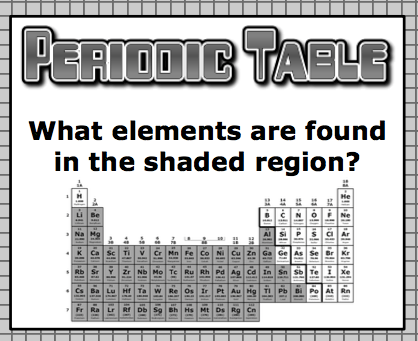
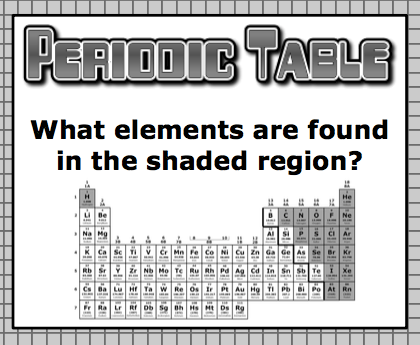
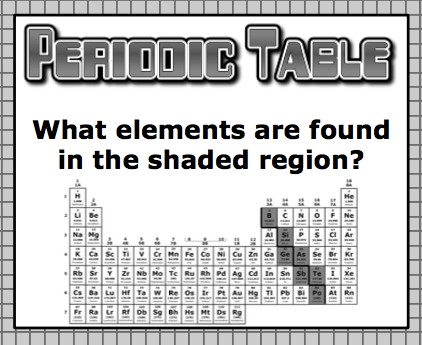
The atoms along the staircase are called 
a)
metals
b)
nonmetals
c)
metalloids
d)
noble gases
38.
The blue atoms are called 
a)
metals
b)
nonmetals
c)
metalloids
d)
noble gases
39.
Elements which are considered semiconductors are 
a)
metal
b)
nonmetal
c)
metalloid
d)
nonexistent
40.
An atom has 5 protons and 7 neutrons. What is the mass number of the atom?
a)
5
b)
7
c)
2
d)
12
41.
What is the name of the group that never reacts--ever ever they are stable with a full outermost ring!!!
a)
noble gases
b)
transition
c)
halogens
d)
borons
42.
How many O's are in Al₂(SO₄)₃
a)
4
b)
12
c)
7
d)
24
43.
How many Sodium (Na) are in 6NaCl?
a)
1
b)
12
c)
6
44.
How many atoms are there TOTAL in:
H2SO4
a)
6
b)
5
c)
7
d)
3
45.
If there is no subscript, there is ______ atom(s) of that element.
a)
0
b)
2
c)
only 1
d)
1 million
46.
How many elements are present in this compound?
Mg2As3COHNi2
a)
2
b)
4
c)
6
d)
10
47.
How many molecules are in 10MgCl2?
a)
10
b)
2
c)
30
d)
13
48.
Na + MgF2 -->  NaF + Mg
What are the reactants?
a)
Na + MgF2
b)
Na
c)
NaF + Mg
d)
NaF
49.
NH3 ---> N2 + H2
What are the products?
a)
N2 + H2
b)
N2
c)
H2
d)
NH3
50.
A chemical change is?
a)
a shoe lace cut in half
b)
doesn't change anything
c)
changes the look of an object
d)
change that results in the formation of new chemical substances
51.
A way to show the number and type of elements (atoms) in a molecule or compound with a combination of symbols and numbers.
a)
Molecule
b)
Chemical formula
c)
Physical change
d)
Coefficient
52.
In chemical reactions, what does the principle of conservation of mass mean?
a)
Matter is not created or destroyed.
b)
The total mass of the reactants is greater than the total mass of the products.
c)
The total mass of the reactants is less than the total mass of the products.
d)
Matter is not changed.
53.
Is the following equation balanced?...
Al + O2 --> 2Al2O3
a)
Yes!
b)
No!
54.
For an investigation a student poured a blue solution of CuSO4 into a beaker. The student placed a shiny, silver-colored strip of zinc metal in the solution and observed the changes.
The student inferred that a chemical reaction occurred. What evidence supports this inference?
a)
A dark solid formed on the zinc metal.
b)

The zinc metal remained silver-colored and shiny
c)
The CuSO4 solution turned blue when the zinc metal was added.
d)
None of these
55.
If 15mg of A react with 10mg of B, how much of product C will be produced?
a)
10mg
b)
15mg
c)
20mg
d)
25mg
56.
Number of N in (NH₄)₂CrO₄
a)
1
b)
2
c)
8
d)
16
57.

What is the independent variable in the following hypothesis?

HYPOTHESIS: If I get more sleep at night, I will be more attentive in science class.

a)

attentiveness in science class

b)

amount of sleep

c)

seat location in class

d)

what the teacher is teaching that day

58.

What is a constant variable?

a)

factors you keep the same in the experiment

b)

the group that receives the normal treatment

c)

scientific idea with a lot of evidence

d)

educated prediction of what the results will look like

59.

Which of these describes the control group? (Select two)

a)

The group that receives no independent variable or the normal version of the independent variable.

b)

The group that receives no dependent variable or the normal version of the dependent variable.

c)

The purpose is to provide a group to compare to the experimental groups.

d)

The purpose is to collect more data about the independent variable to increase validity.

60.
This variable in an experiment is the one being deliberately changed by the scientist. 
a)
dependent variable
b)
independent variable
c)
data
d)
control group
61.
A student wants to test the effects of type of exercise on heart rate.  What is the dependent variable?
a)
heart rate
b)
type of exercise
c)
amount of exercise
d)
time of day exercise occurs
62.

Shannon is wondering why her skin is red and itchy after taking her bubble bath. Which stage of the scientific method is she in?

a)

Question or Problem

b)

Forming a Hypothesis

c)

Drawing a Conclusion

d)

Analyzing Data

63.
The atoms along the staircase are called 
a)
metals
b)
nonmetals
c)
metalloids
d)
noble gases
64.
Elements which are shiny, conduct electricity and heat are called
a)
metal
b)
nonmetal
c)
metalloid
d)
nonexistent
65.
How many neutrons are in a Gold atom?
a)
79
b)
196
c)
118
d)
275
66.
What's a valence electron?
a)
electrons in the second energy level
b)
electrons in the outermost energy level
c)
the atomic number
d)
electrons in the first level
67.
Day and night is caused by the _____________ of earth on its axis.
a)
revolution
b)
orbit
c)
rotation
68.

What season is letter C?

a)

Winter, night

b)

Winter, day

c)

Summer, night

d)

Summer, day

69.
When the Northern Hemisphere of Earth is Leaning away from the Sun, What season is the Southern Hemisphere experiencing?
a)
Summer
b)
Winter
c)
Spring
d)
Fall
70.
The horizontal row on the periodic table is called a
a)
group
b)
family
c)
period
d)
atomic number
71.
A vertical column is called...
a)
group
b)
tower
c)
period
d)
crew
72.
The number at the bottom of each square on the periodic table is the ...
a)
atomic number
b)
atomic mass
c)
chemical symbol
d)
element name
73.
The number at the top of each square on the periodic table is the ...
a)
atomic number
b)
atomic mass
c)
Chemical Symbol
d)
Element Name
74.
a)
energy levels
b)
valence electrons
c)
protons
d)
neutrons
75.
a)
energy levels
b)
valence electrons
c)
protons
d)
neutrons
76.
a)
Group 1
b)
Group 17
c)
Group 2
d)
Group 18
77.
a)
Group 1
b)
Group 17
c)
Group 18
d)
Group 2
78.
a)
Metals
b)
Nonmetals
c)
Metalloids
79.
a)
Metals
b)
Nonmetals
c)
Metalloids
80.
a)
Metals
b)
Nonmetals
c)
Metalloids
81.
a)
Metals
b)
Nonmetals
c)
Metalloids
82.
a)
Metals
b)
Nonmetals
c)
Metalloids
83.
a)
Metals
b)
Nonmetals
c)
Metalloids
84.
Sodium (Na) is found in period 
a)
3
b)
2
c)
4
d)
1
85.

What does the atomic mass tell you?

a)

Basically,the number of electrons and protons

b)

The number of neutrons

c)

Basically, the number of protons and neutrons

d)

The number of protons.

86.
The atomic number of this pictured element is
a)
28
b)
58.6934
c)
Ni
d)
Nickel
87.

What are valence electrons?

a)

Any of an atom's electrons

b)

Electrons located on the first energy level

c)

Electrons not attached to any atom

d)

electrons located on the outer energy level

88.

a unique number for each element that equals the number of protons in an atom of that element

a)

element name

b)

element symbol

c)

atomic number

d)

atomic mass

89.

the mass of an atom, calculated by adding the number of protons and neutrons in the nucleus of the atom

a)

element name

b)

element symbol

c)

atomic number

d)

atomic mass

90.

one of several forms of a single element, which contains the same number of protons, but different numbers of neutrons

a)

isotope

b)

ion

c)

orbital

d)

nucleus

91.

an atom or group of atoms that has gained or lost one or more electrons and is now either positively or negatively charged

a)

isotope

b)

ion

c)

orbital

d)

nucleus

92.
In the modern periodic table elements are arranged by:
a)
atomic mass
b)
atomic number
c)
valence electrons
d)
number of isotopes
93.
Calcium is most like which of the following?
a)
Barium
b)
Potassium
c)
Cesium
d)
Nitrogen
94.
Beryllium is in group number______.
a)
Group 2
b)
Group 3
c)
Group 4
d)
Group 7
95.
The period for Bromine is ___________.
a)
3
b)
2
c)
4
96.

The Earth completes one of these every 365.25 days

a)

rotation

b)

revolution

97.
This is the reason we experience day and night
a)
rotation
b)
revolution
98.
Takes about 24 hours to complete one
a)
rotation
b)
revolution
99.
When one side of the Earth is having daytime, the other side is having nighttime
a)
rotation
b)
revolution
100.
The seasons change as the Earth orbits around the sun
a)
rotation
b)
revolution
101.
The sun appears to rise in the east and set in the west
a)
rotation
b)
revolution
102.
As the Earth orbits, the part of the Earth tilted toward the sun is having spring and summer
a)
rotation
b)
revolution
103.
Places near the equator don't have much change in season because those places are always close to the sun
a)
rotation
b)
revolution
104.
What are the reasons for the season?
a)
Earth's tilt & rotation
b)
Earth's tilt & revolution
c)
Earth's rotation & rovolution
d)
Earth's tilt & resolution
105.

Which diagram BEST models how the day/night cycle occurs on Earth?

a)
b)
c)
d)
106.

Which hemisphere is tilting towards the sun in this diagram?

a)

Northern

b)

Southern

107.

When the Northern Hemisphere is tilted towards the Sun, which season are we experiencing?

a)

winter

b)

spring

c)

summer

d)

fall

108.

Which hemisphere is having winter?

a)

Northern

b)

Southern

109.
When the part of the world that you're living in is leaning towards the Sun, its _____
a)
winter
b)
spring
c)
summer
d)
fall
110.
Why is it warmer in the summer?
a)
Closer to the sun
b)
More direct light from Earth's tilt
c)
Stronger light from the sun
d)
Earth spins slower
111.
In the summer many people enjoy going to the beach. There is a beautiful beach in Argentina, which is located in the Southern Hemisphere. Which diagram shows the position of Earth when it is summer in Argentina?
a)
A
b)
B
c)
C
d)
D