wayground logo

Free Printable Worksheets

Font size

S
M
L
XL
Worksheets

Chem Chap 5: Periodic Table

Total questions: 54

Worksheet time: 1hrs 1mins

Name
Class
Date
1.

Which scientist organized the periodic table by atomic number?

a)

Mendeleev

b)

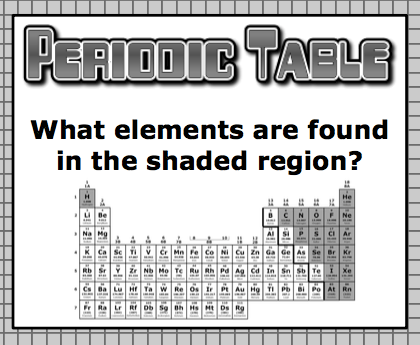
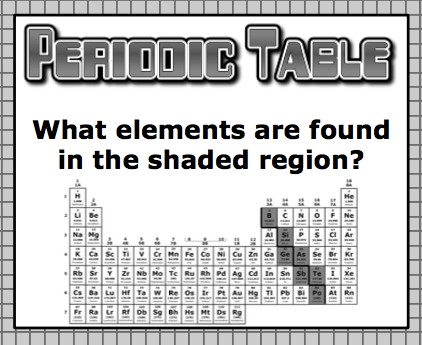
Moseley

c)

Dobereiner

d)

Seaborg

2.

Which scientist is known for the Law of Triads?

a)

Mendeleev

b)

Moseley

c)

Dobereiner

d)

Seaborg

3.
Who developed the law of octaves?
a)
Newlands
b)
Moseley
c)
Lavoisier
d)
Dobereiner
4.
Who identified triads of elements with similar properties?
a)
Mendeleev
b)
Dobereiner
c)
Moseley
d)
Newlands
5.
Which groups are part of the periodic table?
a)
metals, acids, ores
b)
flammable gases, ores, acids
c)
metals, nonmetals, conductors
d)
metals, nonmetals, semimetals
6.
What is the noble gas configuration for beryllium?
a)
[He]1s2
b)
[He]2s2
c)
[Li]2s1
d)
[Li]2s2
7.
What is the noble gas configuration for boron?
a)
[He]1s22s2
b)
[He]2s22p2
c)
[He]2s22p1
d)
[Li]2s22p1
8.
What is the noble gas configuration for Sulfur?
a)
[Ar] 3p4
b)
[He] 3s2 3p4
c)
[Ne] 3s2 3p4
d)
[Na] 3s2 3p4
9.
What is the noble gas configuration for Neon?
a)
[Ne]
b)
[He]2s22p6
c)
[F]2p1
d)
[Ne]2s21p6
10.
[Ne]3s1 is the noble gas configuration for which element?
a)
sodium
b)
lithium
c)
fluorine
d)
aluminum
11.
[Ne]3s23p1 is the noble gas configuration for which element?
a)
scandium
b)
boron
c)
nitrogen
d)
aluminum
12.
[Ne]3s23p5 is the noble gas configuration for which element?
a)
chlorine
b)
fluorine
c)
sulfur
d)
aluminum
13.
What is the noble gas configuration for Argon?
a)
[Ne]2s22p6
b)
[He]2s22p6
c)
[He]3s23p6
d)
[Ne]3s23p6
14.
_______________ developed the first periodic table and arranged the elements in order of increasing atomic mass.
a)
Stevie Wonder
b)
Sasha Vujacic
c)
Dmitri Mendeleev
d)
James Mosely
15.
Which property did Mendeleev use to order his periodic table?
a)
Shielding effect
b)
Eletronegitivity
c)
Atomic Weight
d)
Metallic Character
16.
In the modern periodic table elements are arranged by:
a)
atomic mass
b)
atomic number
c)
valence electrons
d)
number of isotopes
17.
a)
Periods
b)
Groups
18.
a)
Periods
b)
Groups
19.
a)
energy levels
b)
valence electrons
c)
protons
d)
neutrons
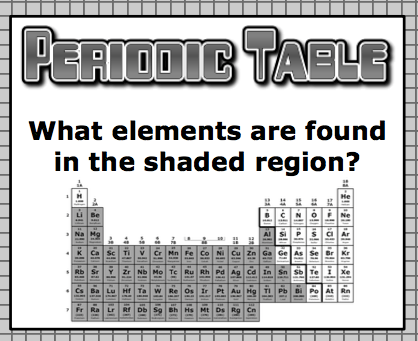
20.
a)
Metals
b)
Nonmetals
c)
Metalloids
21.
a)
Metals
b)
Nonmetals
c)
Metalloids
22.
a)
Metals
b)
Nonmetals
c)
Metalloids
23.
The months of the year are __________ because they repeat in the same order every 12 months.
a)
periodic
b)
group
c)
period
d)
halogens
24.
Pure forms of these elements are stored in oil so they won't react with oxygen and water in the air.
a)
Alkali Metals
b)
Alkaline-earth metals
c)
Halogens
d)
Noble Gases
25.
Each column in the periodic table is called a 
a)
period
b)
group
c)
cluster
d)
unit
26.
Which group of the periodic table is composed of inert (not reactive)  gases?
a)
alkali metals
b)
alkaline earth metals
c)
halogens
d)
noble gases
27.
The atomic number tells you what?
a)
number of electrons
b)
number of protons
c)
number of neutrons
d)
both electrons and protons in an atom.
28.
Group 18 elements are known as the _____ _____ and have full valence shells.
a)
royal gases.
b)
supreme solids.
c)
noble gases.
d)
legit liquids.
29.

This scientist discovered Group 18, which we call Inert/Noble Gases.

a)

Moseley

b)

Mendeleev

c)

Ramsay

d)

Thomson

30.

What is the chemical symbol for the element with atomic number of 20?

a)

Sc

b)

La

c)

K

d)

Ca

31.

What is the element name for atomic number 79?

a)

mercury

b)

copper

c)

gold

d)

platinum

32.
The periodic table has __ periods.
a)
18
b)
8
c)
2
d)
7
33.
The periodic table has __ groups.
a)
8
b)
7
c)
18
d)
2
34.
The atomic number of this pictured element is
a)
28
b)
58.6934
c)
Ni
d)
Nickel
35.

How many valence electrons?


1s22s22p63s23p64s2

a)

20

b)

8

c)

2

d)

38

36.

How many valence electrons?


1s22s22p63s23p64s23d104p4

a)

2

b)

4

c)

6

d)

16

37.
Which has the greater EN: 
H or F?
a)
H
b)
F
38.

Which of these atoms has the largest atomic radius?

a)

lithium

b)

potassium

c)

rubidium

d)

cesium

39.
As you move down the periodic table atoms get bigger.  This is because ____________.
a)
The atoms have more mass.
b)
The atoms have more protons.
c)
The atoms have more energy levels
d)
The atoms have more nuetrons
40.

As you move across the periodic table atoms tend to get smaller because, ______________.

a)

the atoms have more mass.

b)

the atoms have less mass

c)

the atoms have more protons/electrons which attract

d)

the atoms have less electrons.

41.

Atoms that have a high ionization energy, _______________.

a)

give up their electrons more easily.

b)

hold on to their electrons more tightly.

c)

have more electron shells.

42.
Metals are good conductors of heat and electricity.
a)
true
b)
false
43.
Which statement correctly and completely identifies a trend?
a)
Atomic radius decreases across a period and increases down a group.
b)
Electronegativity decreases across a period and decreases down a group.
c)
Ionization energy increases across a period and increases down a group.
d)
Ionic radius increases across a period and increases down a group.
44.
Atomic radius generally increases as we move __________.  
a)
down a group and from right to left across a period 
b)
up a group and from left to right across a period 
c)
down a group and from left to right across a period 
d)
up a group and from right to left across a period 
45.
Electronegativity __________ from left to right within a period and __________ from top to bottom within a group.
a)
decreases, increases 
b)
increases, increases
c)
increases, decreases 
d)
stays the same, increases
46.
Desire to add electrons is the definition of:
a)
Electronegativity
b)
Atomic Number
c)
Atomic Radius
d)
Ionization
47.
Which of the following atoms would you expect  to have the largest atomic radius?
a)
Li
b)
K
c)
Ca
d)
Br
48.
How many valence electrons does chlorine (Cl) have?
a)
2
b)
5
c)
6
d)
7
49.
This is a correct dot diagram for neon (Ne)
a)
true
b)
false
50.
This is a correct dot diagram for fluorine (F)
a)
true
b)
false
51.
This could be the dot diagram of
a)
Be
b)
B
c)
C
d)
Ne
52.
How many electrons should Magnesium have around its Lewis dot model?
a)
1
b)
2
c)
3
d)
4
53.
A anion will be a ____ ion.
a)
negative
b)
positive
54.
A cation is a ____ ion.
a)
negative
b)
positive