wayground logo

Free Printable Worksheets

NEW

Font size

S
M
L
XL
Worksheets

Gas Laws

Total questions: 55

Worksheet time: 2hrs 53mins
Name
Class
Date
1.
What does Boyle's law relate to?
a)
Temperature and Volume
b)
Volume and Pressure
c)
Temperature and Pressure
2.
When the temperature of matter increases the particles...
a)
speed up and move closer
b)
speed up and move farther apart
c)
slow down and move closer together
d)
slow down and move farther apart
3.
How do gas molecules move? 
a)
in an orderly fashion 
b)
constantly and randomly
c)
in straight line paths
d)
in a circular motion
4.
In Charles' Law the pressure remains constant.
a)
True
b)
False
5.
What type of relationship is Charles' Law?
a)
Inverse
b)
Direct
c)
Not enough information
d)
#goals
6.
True or False: Gases can be compressed. 
a)
True
b)
False
7.
What is the formula for Boyle's Law?
a)
P1V1=P2V2
b)
P1V1/P2V2
c)
P1V2=P2V1
d)
P1/V1=P2/V2
8.
When Pressure increases then the Volume must...
a)
Increase
b)
decrease
9.
When Volume increases then Pressure must...
a)
Increase
b)
Decrease
10.
What type of relationship to pressure and volume have?
a)
direct
b)
inverse
c)
no relationship
d)
I don't know
11.
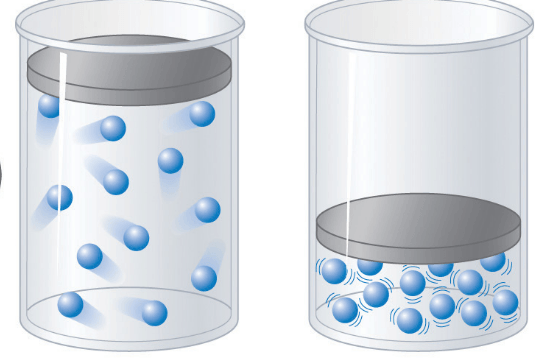
Which container will have a lower pressure?
a)
left
b)
right
c)
they both have the same pressure
d)
I don't know
12.
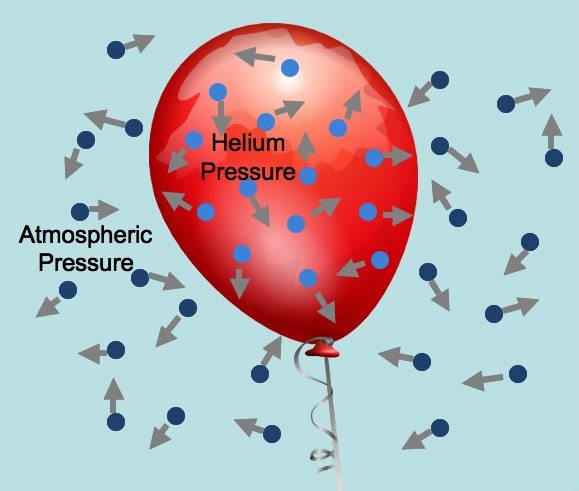
What causes pressure?
a)
The walls of the container
b)
The vacuum in the container
c)
The collisions of the particles
d)
Atmospheric pressure acting on the outside walls
13.
The relationship of which two variables are compared in Boyle's Law?
a)
pressure & volume
b)
volume & temperature
c)
temperature & pressure
d)
volume & moles (amount of gas)
14.
Boyle's law : When _______ is held constant, the pressure and volume of a gas are ________  proportional
a)
temperature,  equally
b)
mass, inversely
c)
temperature, inversely
d)
mass, equally
15.
What type of relationship is Charles' Law?
a)
Inverse
b)
Direct
c)
Not enough information
d)
#goals
16.
In order to convert to Kelvin, you add ______ to the Celsius measurement.
a)
372
b)
273
c)
237
d)
732
17.
What is 50 C in Kelvin?
a)
223
b)
323
c)
100
d)
50
18.
100 degrees Celsius is equal to _______ Kelvin. 
a)
0 K
b)
273 K
c)
173 K
d)
373 K
19.
If a balloon is cooled what will happen to the volume?
a)
Volume will increase
b)
Volume will decrease
c)
Volume will not change
20.
Which of the following would increase the (gas) pressure of a system?
a)
Increase the Temperature
b)
Pump in more gas
c)
Decrease the volume
d)
All of these
21.
The following graph shows ____ relationship. 
a)
Direct
b)
Inverse
22.
Boyle's law :  The pressure and volume of a gas show a _____ relationship. 
a)
Inverse 
b)
Direct 
23.
In the ideal gas law, which variable represents the gas constant?
a)
n
b)
R
c)
T
d)
V
24.
Calculate the volume that a 0.323-mol sample of a gas will occupy at 265 K and a pressure of 0.900 atm (make sure you use the correct R value).
a)
7.18 L 
b)
7.81 L
c)
4.63 L
d)
4.36 L
25.
You have a gas that has a pressure of 2 ATM and a volume of 10L.  What would be the new volume if the pressure was changed to 1 ATM?
a)
5 L
b)
20 L
c)
It would stay at 10L
d)
1 L
26.
A sample of oxygen gas has a volume of 150.0 mL when its pressure is .947 atm. What will the volume of the gas be if it is lowered to a pressure of 0.658 atm and the temperature remains constant?
a)
72 mL
b)
144 mL
c)
216 mL
d)
288 mL
27.
A sample of gas with a volume of 30.0 mL at 25.0oC is heated to 50.0oC.  What is the new volume of the gas?
a)
60.0 mL
b)
15.0 mL
c)
27.5 mL
d)
32.5 mL
28.
Determine the Kelvin temperature required for 0.0470 mol of gas to fill a balloon to 1.20 L under .998 atm pressure. 
a)
0 K 
b)
107 K 
c)
207 K 
d)
307 K 
29.
Determine the initial temperature of a random gas when the initial volume is 2.2 L and it is cooled to 88K with a volume of 0.85 L. 
a)
0.029 K
b)
0.021 K
c)
227.76 K
d)
34 K
30.

A hypothetical gas that perfectly fits all the assumptions of the kinetic molecular theory is known as

a)

real gas

b)

ideal gas

c)

imaginary gas

d)

perfect gas

31.

Which of the following is an assumption of the kinetic-molecular theory of gases?

a)

Collisions between gas particles are inelastic.

b)

Gases consist of closely spaced particles.

c)

Gas particles move around in an orderly manner.

d)

The temperature of a gas depends on the average kinetic energy of the gas particles.

32.

If a gas has the same temperature throughout, which gas molecule has the highest average velocity?

a)

O2

b)

H2O

c)

H2

d)

Xe

33.

Which condition is necessary for most gases to behave nearly ideally?

a)

high pressure

b)

high temperature

c)

low compressibility

d)

low expansion

34.

Which of the following is not a physical property of gases?

a)

absence of definite volume

b)

large density

c)

high compressibility

d)

fluidity

35.

Rates of effusion of different gases are proportional to their...

a)

polarity.

b)

particle charge.

c)

particle velocities.

d)

compressibility.

36.

Which of the following correctly describes the figure?

a)

Flask 1 contains the most molecules

b)

Flask 3 contains the most molecules

c)

Flask 2 contains the most molecules

d)

Flask 4 contains the most molecules

37.

Which of the following is true?

a)

Since all flask have same amount of gas, flask 1 has the least pressure

b)

Since all flask have same amount of gas, flask 3 has the least pressure

c)

Since all flask have same amount of gas, flask 2 has the least pressure

d)

Since all flask have same amount of gas, flask 4 has the least pressure

38.

Which among the following is true about Kinetic Molecular Theory?

a)

Gases do not move in straight line.

b)

Most of the volume of gas is empty space.

c)

Gas particles are not in constant random motion.

d)

Gas particles attract each other.

39.

Which of the following is true about KMT?

a)

Gas particles are elastic and do not attract each other.

b)

Energy is not lost when gas particles collide with each other or with the walls of the container.

c)

The kinetic energy of gas is dependent on temperature

d)

All of the above.

40.

Hydrogen gas exerts a pressure of 466 torr in a container. What is this pressure in atmospheres?

a)

0.217 atm

b)

0.466 atm

c)

0.613 atm

d)

1.63 atm

41.

"The volume of an ideal gas is directly proportional to the number of moles of the gas at constant temperature and pressure" is a statement of _____________ Law.

a)

Charles'

b)

Boyle's

c)

Amontons'

d)

Avogadro's

42.

The pressure of an ideal gas is inversely proportional to its volume at constant temperature and number of moles" is a statement of __________________ Law.

a)

Charles'

b)

Boyle's

c)

Amontons'

d)

Avogadro's

43.

"The volume of an ideal gas is directly proportional to its absolute temperature at constant pressure and number of moles" is a statement of ________________ Law.

a)

Charles'

b)

Boyle's

c)

Amontons'

d)

Dalton's

44.

"The total pressure in a mixture of unreacting gases is equal to the sum of the partial pressures of the individual gases" is a statement of __________________ Law.

a)

Graham's

b)

Boyle's

c)

Avogadro's

d)

Dalton's

45.
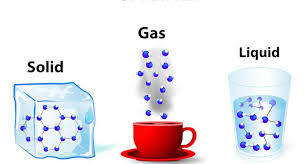
Of these three states of matter, which one has the most kinetic energy? 
a)
Solid 
b)
Liquid 
c)
Gas
46.
4 different flasks contain gas sample at 298 K, which of the following samples will the gas molecular be moving the slowest?  
a)
N2 
b)
O2 
c)
H2 
d)
CO2 
47.
What is Diffusion?
a)
The movement of a substance from higher concentration to a lower concentration
b)
The passage of a gas through a tiny hole into an evacuated chamber
48.
What is Effusion?
a)
The passage of a gas through a tiny hole into an evacuated chamber
b)
The movement of a substance from higher concentration to a lower concentration
49.

The stoppers are removed from each container, which are in the same room at the same temperature. Which gas diffuses through the room the most slowly.

a)

chlorine

b)

helium

c)

hydrogen

d)

nitrogen

50.

Which postulate of KMT explains why gases are so easily compressed?

a)

All particles are infinitely small and the size of a particle is negligible compared to the container that it holds.

b)

The particles of gas are in constant motion and move in straight lines.

c)

The particles of gas do not exert any force of attraction or repulsion on each other. There is no energy loss during a collision.

d)

The mean kinetic energy of the particles is directly proportional to their absolute temperature.

51.

Each of the containers is shown at the same temperature. In which container is the average speed of the particles the fastest?

a)

chlorine

b)

nitrogen

c)

hydrogen

d)

oxygen

52.

Gases found in the environment are most likely to exhibit properties similar to that of ideal gases under conditions of:

a)

High temperatures and high pressures

b)

Low temperatures and low pressures

c)

High temperatures and low pressures

d)

Low temperatures and high pressures

53.

Particles will experience large velocities at ...

a)

Low temperature

b)

Intermediate temperature

c)

High temperature

d)

All of the above

54.

According to kinetic theory of gases, the collisions between molecules of a gas:

a)

occur in a zig-zag path

b)

occur in a straight line

c)

change velocity and energy

d)

result in settling down of molecules

55.

Which one of the following is not a statement of kinetic theory of gases?

a)

The KE depends upon the temperature of the gas

b)

The KE depends upon the pressure of gas

c)

The collisions are elastic

d)

Pressure of gas is due to collisions of gas molecules on the walls of the container