wayground logo

Free Printable Worksheets

NEW

Font size

S
M
L
XL
Worksheets

PHASOR BRIDGE COURSE-SESSION-4 MATH & CHEM

Total questions: 58

Worksheet time: 56mins

Name
Class
Date
1.
Measure mainly of the nuclear particles: protons + neutrons
a)
Subatomic Particles
b)
Atomic Number
c)
Atomic Mass
d)
Gluons
2.
How many protons does an aluminium atom have? (Use the image to help you)
a)
27
b)
14
c)
40
d)
13
3.

Calculation used to find the number of neutrons in an atom

a)

Mass Number- Atomic Number

b)

Atomic Number - Mass Number

c)

Mass Number - Electrons

d)

protons = electrons = neutrons

4.
How many neutrons does a sodium atom have? (Use the image to help you)
a)
23
b)
11
c)
12
d)
34
5.
The _________ of an element equals the number of protons in an atom of that element
a)
mass number
b)
atomic weight
c)
atomic number
d)
isotopes
6.

Look at this picture of Argon off the periodic table. Which of the following is true for this element?

a)

18 protons

b)

40 protons

c)

22 protons

d)

21.9 protons

7.

Look at this picture of Argon off the periodic table. Which of the following is true for this element?

a)

18 neutrons

b)

40 neutrons

c)

22 neutrons

d)

21.9 neutrons

8.

Look at this picture of Argon off the periodic table. Which of the following is true for this element when it is neutral?

a)

18 electrons

b)

40 electrons

c)

22 electrons

d)

21.9 electrons

9.

Which part of an atom is used to identify it?

a)

number of protons

b)

number of neutrons

c)

number of electrons

10.

When you two isotopes of an atom, Carbon-12 and Carbon-13 for example, what has changed in the atomic structure?

a)

Number of protons

b)

Number of neutrons

c)

Number of electrons

11.

When you have an ion of an atom, O-2 for example, what has changed in the atomic structure?

a)

Number of protons

b)

Number of neutrons

c)

Number of electrons

12.

Name the element

a)

Boron

b)

Carbon

c)

Nitrogen

d)

Oxygen

13.

Name the element

a)

Aluminum

b)

Silicon

c)

Phosphorus

d)

Sulfur

14.

How many protons does indium have?

a)

49

b)

66

c)

114

d)

115

15.

What is the atomic mass of barium

a)

56

b)

82

c)

137

d)

138

16.

How many neutrons does platinum have?

a)

78

b)

117

c)

195

d)

196

17.

Identify #1

a)

proton

b)

neutron

c)

electron

d)

nucleus

18.

Identify #2

a)

proton

b)

neutron

c)

electron

d)

nucleus

19.

Identify #3

a)

proton

b)

neutron

c)

electron

d)

nucleus

20.

Identify #4

a)

proton

b)

neutron

c)

electron

d)

nucleus

21.
What is true about an atom?
a)
Most of the space in an atom is taken up by the nucleus
b)
Atoms are mostly empty space
c)
Atoms have no mass
d)
Electrons have much more mass that protons or neutrons.
22.
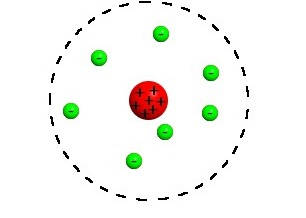
What part of the atom is indicated by the red sphere?
a)
nucleus
b)
electron cloud
c)
electrons
d)
neutrons
23.
Matter that is made up on only one type of atom is called
a)
a compound
b)
a subatomic particle
c)
an element
d)
water
24.

The number 16 for the atomic element sulfur is the

a)

ionic number

b)

isotope

c)

atomic mass

d)

atomic number

25.
Where is most of the mass in an atom located?
a)
in the nucleus
b)
in the protons
c)
in the neutrons
d)
in the electrons
26.
An atom has an atomic number of 15 and a mass number of 31. How many protons are there in the atom?
a)
15
b)
31
c)
16
d)
47
27.

What mass does a neutron have?

a)

1 amu

b)

0 amu

c)

-1 amu

d)

+2 amu

28.
What electrical charge does a proton have?
a)
+1
b)
0
c)
-1
d)
+2
29.

How many protons does an aluminum atom have?

a)

27

b)

14

c)

40

d)

13

30.
Complete the missing label on the diagram.
a)
Neutron
b)
Centre
c)
Nucleus
d)
Sub atomic particle
31.

What is the correct number of subatomic particles of a phosphorous atom with a mass of 31?

a)

p# - 15, n# = 15, e# = 15

b)

p# - 15, n# = 16, e# = 15

c)

p# - 15, n# = 15, e# = 16

d)

p# - 16, n# = 15, e# = 15

32.
Changing the number of neutrons in an atom changes its...
a)
element type.
b)
mass.
c)
charge.
d)
atom type.
33.

The following statements are true, EXCEPT

a)

The energy of a photon is proportional to its wavelength

b)

A line spectrum is produced when light is emitted from an excited atom

c)

The region in which an electron is most likely to be found is called an orbital

d)

Light is composed of photons of discrete energy

34.

Maximum number of electron that can occupy 3d orbital is

a)

2

b)

6

c)

8

d)

10

35.
J.J. Thompson discovered the ____________. His model is called the plum pudding model which we sometimes call the chocolate chip model. 
a)
proton
b)
electron
c)
neutron
d)
nucleus
36.
The experiment used by Ernest Rutherford to discover the nucleus of an atom. 
a)
Cathode Ray Experiment
b)
Gold Foil Experiment
c)
Reflector Experiment
d)
Plum Pudding Experiment
37.

Which scientist described a positively charged core (“nucleus”) in the middle of a lot of empty space?

a)

Chadwick

b)

Thomson

c)

Rutherford

d)

Bohr

38.
This model this model was the first to show a nucleus, consisting of protons and neutron.  Electrons surround the nucleus but are not shown in distinct energy levels. 
a)
The "Rutherford Model" of the atom
b)
The "Plum Pudding Model" of the atom
c)
The "Quantum Mechanical Modell" of the atom
d)
Democritus's model of the atom
39.
In the gold foil experiment, most of the positively charged alpha particles passed through the gold foil, but some were deflected or bounced back.  What did we conclude because of this?  
a)
Atoms are small indivisible spheres
b)
Atoms are mostly empty space with a small, dense, positive center
c)
Atoms have negatively charged particles which orbit the nucleus
d)
Light is a wave, not a particle
40.

Early ideas of matter being composed of earth, wind, water, and fire were proposed by

a)

Democritus

b)

Zeus

c)

Einstein

d)

Aristotle

41.
What inequality does the number line graph represent?
a)
x ≥ 3
b)
x > 3
c)
x < -3
d)
x ≤ -3
42.
Match the graph with its inequality.
a)
a > 11
b)
a < 11
c)
a ≥ 11
d)
a ≤ 11
43.
Which graph matches the inequality
r ≥ -6?
a)
A
b)
B
c)
C
d)
D
44.
Which graph matches the inequality
 ½ ≤ a?
a)
A
b)
B
c)
C
d)
D
45.
Solve:
x + 5 > 10
a)
x < 15
b)
x < 5
c)
x > 15
d)
x > 5
46.
Solve:
5 - 3x < -4
a)
x > 3
b)
x < 3
c)
x < -3
d)
x > -3
47.
Solve:
2x + 5 <  3x - 6
a)
x < 11
b)
x > 11
c)
x > -11
d)
x < -11
48.
Rewrite 34 = 81 in logarithmic form.
a)
log34 = 81
b)
log813 = 4
c)
log381 = 4
d)
log481 = 3
49.
Write 23= 8 in logarithmic form.
a)
log2 8 = 3
b)
log2 3 = 8
c)
log3 8 = 2
d)
log3 2 = 8
50.
Write 104= 10000 in logarithmic form.
a)
log10 4 = 10000
b)
log10000 4 = 10
c)
log10 10000 = 4
d)
log4 10000 = 10
51.
The common logarithm has what base?
a)
10
b)
0
c)
e
d)
-e
52.
Log with a base "e" (loge) is the same thing as...
a)
"e"
b)
Natural Logarithm (LN)
c)
Common Logarithm (Log)
d)
Natural Log, base "e"
LNe
53.
Rewrite log28 = 3 in exponential form.
a)
28 = 3
b)
23 = 8
c)
32 = 8
d)
83 = 2
54.
Rewrite logpt = m in exponential form.
a)
pt = m
b)
tm = p
c)
mt = p
d)
pm = t
55.
Write log3 81 = 4 in exponential form.
a)
814=3
b)
813=4
c)
43=81
d)
34=81
56.
Write log6 216 = 3 in exponential form.
a)
36=216
b)
63=216
c)
2166=3
d)
3216=6
57.
Evaluate log8 8
a)
8
b)
-1
c)
0
d)
1
58.
log525 = ?
a)
2
b)
5
c)
125
d)
10