
 Worksheets
alg 2 properties of logs
Total questions: 59
Worksheet time: 2hrs 44mins
The logarithmic equation Logba=x can be rewritten as....
b=ax
a=bx
x=ab
Log32x=5 can be rewritten as...
2x=35
5=32x
2x=53
Log6x4=−9 can be rewritten as...
4=6x−9
6x=4−9
4=−96x
Log4x=2 can be rewritten as...
4x=102
2=104x
10=46x
Log2(2x2−7)=(5x+1) can be rewritten as...
(2x2−7)=2(5x+1)
(5x+1)=2(2x2−7)
2=(5x+1)(2x2−7)
Log(4x2−3x+8)=(x−9) can be rewritten as...
(4x2−3x+8)=10(x−9)
(x−9)=10(4x2−3x+8)
10=(x−9)(2x2−3x+8)
Rewrite the logarithmic equation. log3p=4
4p=3
43=p
p=34
p4=3
Rewrite the logarithmic equation. logx23=2
x23=2
232=x
23=x2
23x =2
log(811)=−4 Rewrite the logarithmic equation.
811=10−4
81=1041
410=811
Log3x=2 can be rewritten as...
3x=102
2=103x
10=43x
Log12(x2−2x+1)=(x−5) can be rewritten as...
(x2−2x+1)=12(x−5)
(x2−2x+1)=(x−5)12
(x−5)=12(x2−2x+1)
Log(x+1)(2x+1)=7 can be rewritten as...
(2x+1)=(x+1)7
(x+1)=(2x+1)7
(2x+1)=7(x+1)
log(4x)
log4-logx
log4+logx
4logx
xlog4
log(xy2)
logx+2logy
logx+logy2
logx-2logy
logx+logy+log2
log(yx)
logx+logy
xlogy
log(x-y)
logx-logy
log(nm3)
logm-log3-logn
3logm+logn
3logm-logn
3log(m-n)
ln(4xy)
ln4+lnx+lny
4lnxy
4lnx+lny
4ln(x+y)
log(49)
log9+log4
log(9-4)
log9-log4
4log9
log(nm3)
logm-log3-logn
3logm+logn
3logm-logn
3log(m-n)
Expand: logb nm
logbm −logbn
logbm + logb n
mlogbn
nlogbn
Expand: log2 x5
log25 + log2x
log2x−log25
log25−log2x
5log2x
Expand: log dk
klogd
logk + log d
log k − logd
logd−logk
Expand: log7 y8
log7y + log78
log7y−log78
8log7y
log78+log7y
Expand: log923
21log923
log9(21)−log923
log92+log93
log9 (21)+log923
log(49)
log9+log4
log(9-4)
log9-log4
4log9
y = f(1/5x)

Describe the transformation
-f(x)
shift down
reflect over x-axis
reflect over y-axis
shift right
Which equation below is a quadratic function translated right 4 units?

Describe the transformations
g(−x)−4
Reflected across the x-axis
4 Units Left
Reflected across the x-axis
4 Units Down
Reflected across the y-axis
4 Units Left
Reflected across the y-axis
4 Units Down
Describe the transformation
h(31x)
Vertically Stretched by a factor of 31
Vertically Compressed by a factor of 31
Horizontally Stretched by a factor of 31
Horizontally Stretched by a factor of 31
Describe the transformation
3h(x)
Vertically Stretched by a factor of 3
Vertically Compressed by a factor of 3
Horizontally Stretched by a factor of 3
Horizontally Stretched by a factor of 3
Describe the transformations
−g(x)+2
Reflected across the x-axis
2 Units Up
Reflected across the x-axis
2 Units Down
Reflected across the y-axis
2 Units Up
Reflected across the y-axis
2 Units Down
Describe the transformation
f(x)−6
6 Units Up
6 Units Down
6 Units Left
6 Units Right
Describe the transformation
f(x+5)
5 Units Up
5 Units Down
5 Units Left
5 Units Right
Describe the transformation
f(x−2)
2 Units Up
2 Units Down
2 Units Left
2 Units Right
Describe the transformation
f(x)+3
3 Units Up
3 Units Down
3 Units Left
3 Units Right
The exponential function f(x)=2x and the logarithmic function g(x)=log2(x) are inverses. You know that because their graphs are reflected over what line?
the x-axis
the y-axis
y=x
y=-x
The inverse of an exponential function is its reflection across the x-axis.
True
False
A logarithmic function is the inverse of an exponential function.
True
False


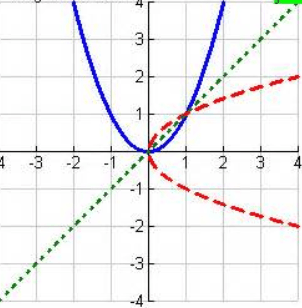
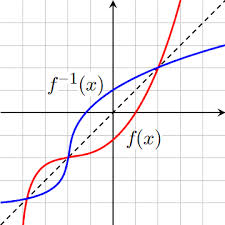

Are these equations inverses?
Yes
No

Is the inverse of the graph a function?
Yes
No

Is the inverse of the graph a function?
Yes
No

Which graph is the inverse of the graph shown?


Which graph is the inverse of the graph shown?


Which graph is the inverse of the graph shown?


Is the inverse of the table a function?
Yes
No

Which is the inverse of the table?


Which is the inverse of the table?


Which is the inverse of the table?



