wayground logo

Free Printable Worksheets

Font size

S
M
L
XL
Worksheets

Honors 1st Semester Final Practice

Total questions: 128

Worksheet time: 2hrs 23mins

Name
Class
Date
1.
How many significant figures does the following number have: 0.002040
a)
6
b)
4
c)
3
d)
2
2.
How many significant figures does the following number have: 0.998005
a)
9
b)
10
c)
6
d)
5
3.
How many significant figures does the following number have: 100.00210
a)
7
b)
5
c)
10
d)
8
4.
Round 0.010229 to four sig figs
a)
1022
b)
1023
c)
0.01023
d)
0.01022
5.
Round 1047.78 to three sig figs
a)
104
b)
105
c)
1050
d)
1050.00
6.
Round 1009 to three sig figs
a)
100
b)
101
c)
1010
d)
1000
7.
What is the measurement 1042 Liters rounded to 2 significant figures? 
a)
1040 L
b)
1.1 x 10³ L
c)
1.0 x 10L
d)
1050 L
8.
What is 78.5 rounded to one significant figure?
a)
79
b)
78.5
c)
70
d)
80
9.
What is 0.658 rounded to 1 significant figure?
a)
0
b)
0.66
c)
0.6
d)
0.658
10.
Determine the number of Significant Figures in 10.0-g
a)
5
b)
4
c)
3
d)
2
11.
Determine the number of Significant Figures in 10-L.
a)
4
b)
3
c)
2
d)
1
12.
How many Significant Figures in the number below?
4.56 x 10³
a)
5
b)
4
c)
6
d)
3
13.
Solve and round accordingly.
25.0 x 17 = ?
a)
430
b)
425
c)
425.0
d)
430.0
14.
Solve and round accordingly.
10 x .5540 = ?
a)
5.540
b)
5.54
c)
6
d)
6.0
15.
Solve and round accordingly.
230/13.3 = 
a)
17.3
b)
17
c)
17.2
d)
17.2932
16.
convert 93.2 cm to km
a)
0.00932
b)
0.0932
c)
0.932
d)
0.000 932
17.
convert 0.08 km to m
a)
80
b)
8
c)
0.8
d)
800
18.
convert 0.7 cm to m
a)
70
b)
0.07
c)
0.007
d)
7
19.
1234 Scientific Notation
a)
1.234 x 10^2
b)
1.243 x 10^3
c)
1.234 x 10^4
d)
1.234 x 10^3
20.
2.34 x 10^6 Standard Notation
a)
2340000
b)
234.0000
c)
234000
d)
2340
21.
5795 Scientific Notation
a)
5.795 x 10^4
b)
57.95 x 10^2
c)
5.795 x 10^3
d)
5.759 x 10^3
22.
5.89 x 10^-4 Standard Notation
a)
0.00589
b)
0.000589
c)
58900
d)
58.900
23.
Jack has a rock. The rock has a mass of 14g and a volume of 2cm3. What is the density of the rock?
a)
7 mL
b)
7 g/cm3
c)
28 g/cm3
d)
1/7 g/cm3
24.
What is the volume of Object X?
a)
10.0 cm3
b)
15.0 cm3
c)
20.0 cm3
d)
25.0 cm3
25.
I have two objects with the same volume but different masses.  Which object will be more dense?
a)
The object with less weight.
b)
The object with more weight.
c)
The object with more mass.
d)
The object with less mass.
26.
What is the formula for density?
a)
density = mass x volume
b)
density = mass / volume
c)
density = mass + volume
d)
density = mass - volume
27.
What is the volume of 150 grams of lead if it has a density of 11.3 g/cm3?
a)
13.3 g
b)
13.3 cm3
c)
.075 g
d)
1695 cm3
28.
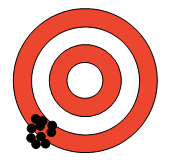
This bullseye demonstrates...
a)
High Accuracy & High Precision
b)
High Accuracy & Low Precision
c)
Low Accuracy & High Precision
d)
Low Accuracy & Low Precision
29.

How close a measurement is to the true value is called..

a)

Accuracy

b)

Precision

c)

Significant

d)

Estimate

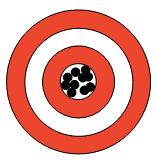
30.
?
a)
High Accuracy & High Precision
b)
High Accuracy & Low Precision
c)
Low Accuracy & High Precision
d)
Low Accuracy & Low Precision
31.
The students measured length during a science experiement, they got 12 cm. But the actual measurement was 14.25 cm. What was the percent error?
a)
15.79%
b)
18.75%
c)
2.25%
d)
18%
32.
The deer population is estimated to be 17,600 in northern Illinois, but an actual count was 21,300. What is the percent error?
a)
21%
b)
17.37%
c)
17.4%
d)
21.02%
33.
Convert 15.34 cm to nm.
a)
4351 nm
b)
1.534 nm
c)
1.534 x 10 ^8 nm
d)
15.34 x 10^5 nm
34.
What prefix represents 10^3?
a)
milli
b)
deca
c)
centi
d)
kilo
35.
A combination of base units is ____ unit. An example of this unit is density (g/cm^3).
a)
derived
b)
standard
c)
base
d)
prefix
36.
What unit should be in the denominator of the conversion factor?
a)
yards
b)
leagues
c)
feet
d)
fathoms
37.
What unit should be in the numerator of the conversion factor?
a)
yards
b)
leagues
c)
feet
d)
fathoms
38.
What are the three states of matter?
a)
solid, liquid, and gas
b)
solid, water, and gas
c)
wood, liquid, and gas
d)
solid, liquid, and helium
39.
What is one way matter change states?
a)
matter loses mass
b)
heat is added
c)
it doesn't change
d)
by doing nothing
40.
The amount of space that matter takes up is its _______.
a)
atom
b)
volume
c)
matter
d)
weight
41.
Water in the form of a gas is called _________.
a)
water vapor
b)
gasoline
c)
ice
d)
liquid
42.
Solids have a definite _______________.
a)
smell
b)
shape
c)
picture
d)
sound
43.
The measurement system used by scientist around the world.
a)
metric system
b)
customary systerm
c)
calorie system
d)
science system
44.
What is the measure of gravity on an object?
a)
matter
b)
mass
c)
weight
d)
volume
45.
Volume is ______________.
a)
length X width
b)
height X length
c)
length X width X height
d)
width X height
46.
________________ is anything that has mass and takes up space.
a)
volume
b)
matter
c)
mass
d)
weight
47.
The amount of matter in an object is its ________________.
a)
weight
b)
mass
c)
gram
d)
atom
48.
__________ has a definite shape and volume.
a)
liquid
b)
solid
c)
gas
49.
______________ does not have a definite shape or volume.
a)
liquid
b)
solid
c)
gas
50.
Which state of matter has particles that are tightly packed?
a)
liquid
b)
gas
c)
solid
51.
compounds are chemically bounded together 
a)
False
b)
true
c)
I don't know?
52.
Can an element be broken down into a simpler substance 
a)
yes 
b)
No
53.
Are there any compounds on the periodic table 
a)
yes there are many 
b)
no because only elements are on the periodic table
c)
I think they are?
54.
Which one has more than one type of atom in it
a)
Element
b)
Compound 
55.
which one only has one type of atom In it.
a)
Element
b)
compound
56.
Is salt (NaCI) a compound or a element
a)
Compound
b)
element
57.
How many elements are represented in the compound?
Na2CO3
a)
1
b)
2
c)
3
d)
4
58.
Which of the following represents an element?
a)
H2O
b)
H2
c)
NaCl
d)
CaCO3
59.
Salt water boils and the water completely evaporates, salt (NaCl) is left in the bottom of the beaker. Which of the following is left in the beaker?
a)
Compound
b)
Element
c)
Mixture
d)
None of the Above
60.
A combination of substances that are not chemically combined is called a(n)____________. 
a)
mixture
b)
compound
c)
physical
61.
Mixtures are separated through ___________changes.
a)
mixture
b)
compound
c)
physical
62.
This picture represents which of the following?
a)
element
b)
compound
c)
mixture
63.
The separation technique that involves heating a solution until the liquid changes into a gaseous state, leaving behind a solid is known as
a)
decanting
b)
 evaporation
c)
loading
d)
chromatography
64.
A combination of 2 or more substances that can be easily separated is called- 
a)
a mixture
b)
a solution 
c)
a solute 
d)
a solvent 
65.
If I added 27 grams of salt to water and separated the solution with a hot plate, what amount of salt would be left behind?
a)
20 grams
b)
0 grams
c)
27 grams
d)
10 grams
66.
To separate the sugar and lemonade, what method should you use?
a)
filtration 
b)
sorting
c)
magnet
d)
boiling
67.
To separate trail mix what method should you use?
a)
filtration 
b)
sorting
c)
magnet
d)
boiling
68.
 blue berry muffin
a)
heterogeneous mixture
b)
homogeneous mixture
69.
Italian Salad Dressing
a)
heterogeneous mixture
b)
homogeneous mixture
70.
Olive Oil
a)
Heterogeneous  mixture
b)
Homogeneous mixture
71.
Water and Kool-Aid are mixed together. Hot water, coffee and sugar are mixed together. Which substance is the solvent in both?
a)
Water
b)
Coffee
c)
Kool-aid
d)
Sugar
72.
What is a substance that is dissolved in another substance? 
a)
solution
b)
solute
c)
solvent
d)
compound
73.
A combination of two or more substances that cannot easily be separated--
a)
mixture
b)
solution
c)
solute
d)
solvent
74.
Referring to the table, what is the relative mass of a proton?
a)
10
b)
1
c)
0.1
d)
0.01
75.
The number in the upper corner of an element tile (7 for nitrogen) is called _____
a)
the proton number
b)
the atomic number
c)
the electron number
d)
the mass number
76.
For a given element, the atomic number indicates the number of _____
a)
protons in the nucleus
b)
neutron in the nucleus
c)
electrons in the atom
d)
nucleons in the atom
77.
If an atom contains exactly 79 protons, then it's an atom of _____
a)
lithium
b)
gold
c)
nitrogen
d)
carbon
78.
If you want to know which atom an element is, then count the _____
a)
protons
b)
neutrons
c)
electrons
d)
nucleons
79.
For an atom to be electrically neutral, it must contain the same number of _____
a)
protons and neutrons
b)
neutrons and electrons
c)
protons and electrons
d)
nucleons and electrons
80.
Different versions of an element, with differing numbers of neutrons, are called _____
a)
isosceles
b)
isomers
c)
isotopes
d)
isicless
81.
The sum of the number of protons and the number of neutrons is called the _____
a)
atomic number
b)
mass number
c)
isotope number
d)
average weight
82.

Has a mass of 4 and a charge of +2

a)

Alpha

b)

Beta

c)

Gamma

d)

Neutrino

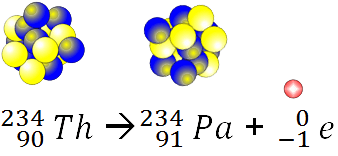
83.

Which type of nuclear radiation is being emitted here?

a)

Alpha

b)

beta

c)

gamma

d)

neutrino

84.
This is an example of...
a)
Fission  reaction
b)
Fusion reaction
c)
Decomposition reaction
d)
Combustion
85.
The process of changing one element to another through nuclear decay.
a)
Decomposition
b)
Radioactivity
c)
Transmutation
d)
Daughter nucleus
86.
The nucleus left after an isotope decays.
a)
Gamma ray
b)
alpha particle
c)
beta particle
d)
daughter nucleus
87.
Imagine you have 50,000 atoms of uranium-238. If U-238 has a half-life of 4.5 billion years, how many U-238 atoms will be left after 4.5 billion years? 
a)
25,000
b)
50,000
c)
12,500
d)
0
88.
In order of most to least penetrating radiation we have
a)
Alpha , Beta,  Gamma
b)
Beta , Gamma , Alpha
c)
Gamma, Beta, Alpha
d)
Gamma, Alpha, Beta
89.
Which type of nuclear radiation is being emitted here along with Rn
a)
alpha
b)
beta
c)
gamma
d)
none
90.
Nuclear power uses ____ for fuel.
a)
steel
b)
coal
c)
uranium
d)
hydrogen
91.
24.1% of all the isotopes of a an element have a mass of 75.23 amu, 48.7% have a mass of 74.61 amu, and 27.2% have a mass of 75.20 amu.
What is the average mass of this element?
a)
74.92 amu
b)
24.97 amu
c)
75.01 amu
d)
74.51 amu
92.
How many neutrons does this isotope of lithium have?
a)
8
b)
3
c)
4
d)
5
93.
What is the name of this element?
a)
Lithium
b)
Boron
c)
Carbon
d)
Neon
94.

What is the difference between iodine-131 and iodine-127?

a)

Iodine-131 has more protons than iodine-127

b)

Iodine-131 has more neutrons than iodine-127

c)

Iodine-131 has more electrons than iodine-127

d)

Iodine-131 has more atoms than iodine-127

95.
Which of the following is a negatively charged subatomic particle?
a)
Electron
b)
Proton
c)
Neutron
d)
Quark
96.
The particles that are found in the nucleus of an atom are
a)
neutrons and electrons
b)
electrons only
c)
protons and neutrons
d)
protons and electrons
97.
The atomic number of an elements is the total number of which particles in the nucleus?
a)
neutrons
b)
protons
c)
electrons
d)
protons and electrons
98.
The positive particles of an atom are 
a)
electrons 
b)
atoms
c)
neutrons 
d)
protons 
99.
Neutrons are
a)
negative
b)
positive
c)
neutral
d)
cows
100.
What do these isotopes of carbon all have in common?
a)
neutrons & mass number
b)
atomic number and neutrons
c)
atomic number and electrons
d)
protons, atomic number, and mass number
101.
In a correctly written symbol what would be located in the "A" position?
a)
number of neutrons
b)
atomic number
c)
number of electrons 
d)
mass number
102.
Calcium has three different isotopes. One has a mass of 35.00 amu; another has a mass of 41.00 amu; and another has a mass of 40.00 amu. Which isotope is the most abundant of the three?
a)
40.00 amu
b)
41.00 amu
c)
35.00 amu
d)
impossible to tell
103.

4.35% of all the isotopes of an element have a mass of 49.9461 amu, 83.79% have a mass of 51.9405 amu, 9.50% have a mass of 52.9407 amu, and 2.36% have a mass of 53.9389amu. What is the average mass of this element?

a)

51.99 amu

b)

52.19 amu

c)

53.45 amu

d)

17.33 amu

104.

Isotopes of each element differ in ______.

a)

the number of neutrons in the nucleus

b)

atomic number

c)

the number of electrons in the highest energy level

d)

the total number of electrons

105.
The lowest part of the wave is?
a)
crest
b)
trough
c)
rarefaction
d)
wavelength
106.
The highest point on a wave
a)
trough
b)
amplitude
c)
crest
d)
wavelength
107.

When light shines through a prism it creates ________________

a)

visible light

b)

infrared radiation

c)

ultraviolet rays

d)

electromagnetic wave

108.
Light is a form of 
a)
energy
b)
radiation
c)
reflection
109.

High frequency equals

a)

high energy

b)

low energy

c)

no change in energy

d)

none of the above

110.

The distance between 2 crests or troughs

a)

wavelength

b)

amplitude

c)

frequency

d)

wave speed

111.

The number of waves that pass in a given amount of time.

a)

wavelength

b)

wave speed

c)

amplitude

d)

frequency

112.
Which of the following regions of the electromagnetic spectrum has the longest wavelengths?
a)
microwave
b)
infrared
c)
x-ray
d)
gamma ray
113.
Look carefully at the waves.  Which carries the most energy?
a)
microwave
b)
infrared
c)
ultraviolet
d)
x-ray
114.
Which color has the least amount of energy?
a)
red
b)
orange
c)
green
d)
blue
115.
Which color has the highest frequency?
a)
red
b)
orange
c)
green
d)
blue
116.
A wave with a large wavelength will have a ______ frequency and _____ energy
a)
high, low
b)
high, high
c)
low, high
d)
low, low
117.
The unit of frequency is ___.
a)
meters
b)
nanometers (nm)
c)
m/s
d)
Hertz
118.

The frequency of violet light is 7.5x10¹⁴ Hz. What is its wavelength?

a)

4.0x10⁻⁷ m

b)

4.0x10⁷ m

c)

2.25x10²³m

d)

2.25x10²³ Hz

119.

Red light has a wavelength of 675 x 10-9 m. What is its frequency?

a)

2.03x10¹¹ m

b)

4.44x10¹⁴ Hz

c)

4.44x10¹⁴ nm

d)

2.03x10¹¹ Hz

120.
What is the speed of light?
a)
3.0x10⁸ ms
b)
3.0x10⁸ m/s
c)
6.626x10⁻³⁴ Js
d)
6.626x10⁻³⁴ J/s
121.

What is Planck's Constant?

a)

6.63x10⁻³⁴ Js

b)

6.63x10⁻³⁴ J/s

c)

3.0x10⁸ ms

d)

3.0x10⁸ m/s

122.
A common infrared laser operates at 1.06 x 10³ nm. What is the energy of a photon with this wavelength? (1 nm = 1x10⁻⁹m)
a)
7.02 x 10^-40 J
b)
6.25 x 10^-28 J
c)
3.54 x 10^-15 J
d)
1.87 x 10^-19 J
123.
What is the frequency of a photon whose energy is 3.4x10⁻¹⁹J?
a)
8.8x1026 Hz
b)
5.1x10¹⁴ Hz
c)
1.9x10⁻¹⁵ Hz
d)
2.3x10-52 Hz
124.
Put the visible light colors in order from longest wavelength to shortest wavelength
a)
Violet, Indigo, Blue, Green, Orange, Yellow, Red
b)
Red, Yellow, Green, Orange, Violet, Blue, Indigo
c)
Red, Orange, Yellow, Green, Blue, Indigo, Violet
125.
The type of spectrum generated here is called...
a)
absoption
b)
continuous
c)
constant
d)
emission
126.
The arrows pointing down represents...
a)
photon absorption
b)
proton emission
c)
electron absorption
d)
electron transition
127.
The parallel lines represents...
a)
energy levels of the atom
b)
energy levels of the electrons
c)
energy levels of the photons
d)
energy levels of the nucleus
128.
Light is emitted when electrons ...
a)
jump from high to low 
b)
jump from low to high 
c)
either of these
d)
none of these