Wayground logo

Free Printable Worksheets

Font size

S
M
L
XL
Worksheets

Anatomy and Physiology Science Olympiad 2019

Total questions: 36

Worksheet time: 27mins

Name
Class
Date
1.
How many chambers are there and what are they?
a)
venules, 4
b)
arterioles, 4
c)
ventricles and atriums, 4
d)
capillaries, 4
2.
Where does the blood enter?
a)
the vena cavas (superior and inferior)
b)
pulmonary valve
c)
tricuspid valve
d)
aorta
3.
What is an electrocardiogram?
a)
electrical activity of the brain
b)
electrical activity of the heart
4.
What is the SA node?
a)
pacemaker of the heart
b)
sends the excitation wave to a bundle of specialized fibers
5.
What's the difference between diastole and systole?
a)
closure of the tricuspid and mitral valves at the beginning
b)
closure of the aortic and pulmonary valves at the end
c)
relaxation and contraction
d)
an abnormal heart sound caused by improper valve closure
6.

What is the chamber of the heart that pumps deoxygenated blood t the lungs via the pulmonary artery

a)

Right atrium

b)

Left ventricle

c)

Left atrium

d)

Right ventricle

7.

What causes the narrowing of blood vessels due to fatty deposits on the inside of the blood vessel?

a)

artherosclerosis

b)

Artheritis

8.
The correct order of blood vessels from the heart to the right atrium is
a)
arteries, venules, capillaries, veins, arterioles
b)
veins, venules, arteries, arterioles, capillaries
c)
capillaries, arteries, arterioles, venules, veins
d)
arteries, arterioles, capillaries, venules, veins
9.
The largest artery of the body is the
a)
renal artery
b)
femoral artery
c)
carotid artery
d)
aorta
10.
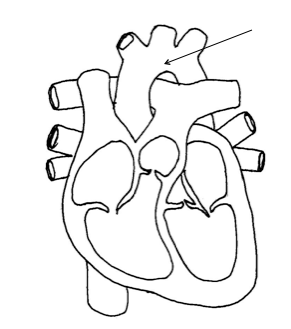
Name the part.
a)
Pulmonary vein
b)
Right atrium
c)
Aorta
d)
Pulmonary artery
11.
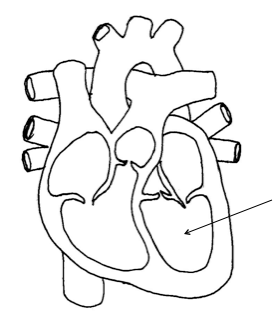
Name the part.
a)
Left ventricle
b)
Vena cava
c)
Right atrium
d)
Right ventricle
12.
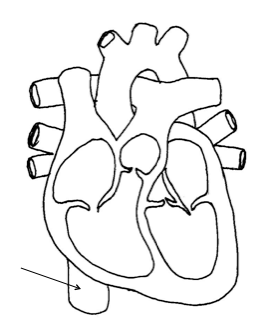
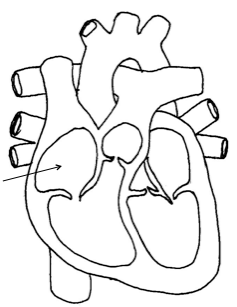
Name this part.
a)
Superior vena cava
b)
Right ventricle
c)
Inferior vena cava
d)
Pulmonary vein
13.
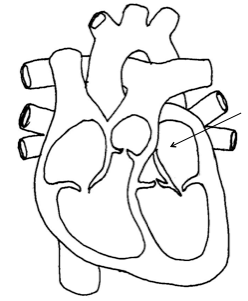
Name this part.
a)
Right atrium
b)
Left ventricle
c)
Right ventricle
d)
Left atrium
14.
Name this part.
a)
Left ventricle
b)
Pulmonary artery
c)
Right atrium
d)
Pulmonary veins
15.
Name this part.
a)
Right ventricle
b)
Aorta
c)
Right atrium
d)
Atrium
16.
Name this part.
a)
Right ventricle
b)
Pulmonary artery
c)
Left ventricle
d)
Right atrium
17.
Identify the circled valve
a)
Tricuspid
b)
Mitral
c)
Pulmonary
d)
Aortic
18.
Identify the circled valve
a)
Tricuspid
b)
Mitral
c)
Pulmonary
d)
Aortic
19.
Identify the circled valve
a)
Tricuspid
b)
Mitral
c)
Pulmonary
d)
Aortic
20.
These are responsible for clotting the blood:
a)
Erythrocytes
b)
Thrombocytes
c)
Leukocytes
d)
Erytropoietin
21.
These cells contain hemoglobin that carries oxygen:
a)
Erythropoietin
b)
Leukocytes
c)
Erythrocytes
d)
Thrombocytes
22.
The "pacemaker" which spontaneously generates a rhythmic impulse that spreads through the myocardium is known as the ___________.
a)
Atrioventricular Node
b)
Sinoatrial Node
c)
AV Bundle
d)
Junctional Fibers
23.
In an ECG pattern, the P wave is caused by
a)
polarization of the atrial muscle fibers
b)
polarization of the ventricular muscle fibers
c)
depolarization of atrial muscle fibers
d)
depolarization of ventricular muscle fibers
24.
The terms used to describe an abnormally slow heart rate is
a)
Tachycardia
b)
Bradycardia
c)
Fibrilation
d)
Cardioversion
25.
Thin-walled vessels that allow for the exchange of O2 , CO2, nutrients and wastes between blood cells or air sacs in the lungs
a)
Arteries
b)
Veins
c)
Capillaries
26.
Largest artery in the human body:
a)
Pulmonary artery
b)
femoral artery
c)
aorta
d)
carotid artery
27.
Blood circulation from the heart to the rest of the body is called
a)
Full body
b)
Systemic
c)
pulmonary
d)
heart to lung
28.
The inner layer (deepest) in the wall of the heart
a)
endocardium
b)
myocardium
c)
epicardium
d)
septum
29.

Name blood vessel A.

a)

Artery

b)

Vein

c)

Capillary

d)

Lymph vessel

30.

Click all of the structures which make up arteries.

a)

Lumen

b)

Endothelium

c)

Thin smooth muscle layer

d)

Elastic fibres

e)

Thick smooth muscule layer

31.

Which letter indicates the sino-atrial node (SAN)?

a)

X

b)

Y

32.

Select all of the options which are true of diastole

a)

Blood returns to the atria

b)

A decrease in atrial pressure pushes open the AV valves

c)

SL valves are open

d)

Blood enters the ventricles

33.

Select all of the options which are true of atrial systole.

a)

Atria contract

b)

Blood is pumped from ventricles into atria

c)

AV valve is open

d)

SL valve is open

34.

What would the heart rate of this individual be?

a)

75

b)

100

c)

60

d)

48

e)

120

35.

Which letter indicates the semilunar (SL) valves?

a)

X

b)

Y

36.

Select all of the vessels which travel to and from the lungs?

a)

7

b)

5

c)

6

d)

9