wayground logo

Free Printable Worksheets

Font size

S
M
L
XL
Worksheets

Sci 10 Unit 2 CHEM Review

Total questions: 169

Worksheet time: 3hrs 39mins

Name
Class
Date
1.
Carbon dioxide is abbreviated as CO2 because it is made up of 1 carbon atom and 2 oxygen atoms. Carbon dioxide is a/an...
a)
Colloid because it has carbon in it
b)
Compound because it is a molecule with more than one type of atom
c)
Atom because it is the smallest unit of carbon dioxide that exists
d)
Element because carbon and oxygen are both in the periodic table of elements
2.
Iron is a metal that is mined from the earth. Iron metal is used to make many different things, including buildings and soup cans. Iron is made of only 1 type of atom. Iron is a/an...
a)
Atomic number
b)
Compound
c)
Element
d)
Atomic weight
3.
Photosynthesis is the process whereby plants make glucose (C6H12O6) and oxygen (O2).  Glucose is a/an ____________ and oxygen is a/an _____________.
a)
compound; compound
b)
element; element
c)
element; compound
d)
compound; element
4.
Table salt, NaCl, is made of sodium and chlorine atoms.  Table salt is a/an:
a)
compound
b)
element
5.
A single molecule of water contains one oxygen atom and two hydrogen atoms.  Water is a/an:
a)
Element
b)
Compound
c)
Hydroid
d)
Solution
6.
Pure oxygen contains only one type of atom.  Oxygen is a/an:
a)
element
b)
compound
7.
What is the tiniest particle in the entire universe?
a)
cells
b)
gases
c)
atoms
d)
liquids
8.
Which part of an atom is POSITIVELY charged?
a)
protons
b)
neutrons
c)
electrons
d)
atoms
9.
What part of an atom is NEGATIVELY charged?
a)
protons
b)
neutrons
c)
electrons
d)
atoms
10.
Which part of an atom has no charge?
a)
protons
b)
neutrons
c)
electrons
d)
atoms
11.
What is the name of a single type of atom?
a)
cell
b)
proton
c)
element
d)
atom
12.
What is the term for combining 2 or more atoms together?
a)
atoms
b)
elements
c)
molecules
d)
compounds
13.
What is the term for combining 2 or more DIFFERENT atoms together?
a)
atoms
b)
elements
c)
molecules
d)
compounds
14.
TRUE OR FALSE:
Every compound is a molecule but not every molecule is a compound.
a)
TRUE
b)
FALSE
15.
What is the picture displayed?
a)
Atom
b)
Element
c)
Molecule
d)
Compound
16.
What is the picture displayed?
a)
atom
b)
element
c)
molecule
d)
compound
17.
What is the picture displayed?
a)
atom
b)
element
c)
molecule
d)
compound
18.
Are these molecules also compounds?
a)
YES
b)
NO
19.
Are these molecules also compounds?
a)
YES
b)
NO
20.
Name the following ionic compound: 
FeCl2
a)
Iron (II) Chloride
b)
Iron (I) Chloride
c)
Iron Chlorine
d)
Iron Chloride
21.
Name the following Ionic Compound: 
KCl
a)
Potassium Chlorine
b)
Potassium Chloride
c)
Potassium (I) Chlorine
d)
Potassium (II) Chloride
22.
Name the polyatomic ion in this compound: 
NaHCO3
a)
Sodium
b)
Carbonate
c)
Hydrogen Carbonate
d)
Sodium Carbonate
23.
Name the following Ionic Compound: 
FePO4
a)
Iron (III) Phosphate
b)
Iron (III) Phosphide
c)
Iron (II) Phosphate
d)
Iron (II) Phosphite
24.
How many elements are in the following compound: 
NaHSO4
a)
3
b)
4
c)
2
d)
5
25.
Write the formula from the following ionic compound: 
Calcium Nitrate
a)
CaN
b)
CaNO3
c)
Ca2NO3
d)
Ca(NO3)2
26.
Write the formula from the name of the following ionic compound: 
Sodium Carbonate
a)
NaCa
b)
Na2Ca
c)
NaCa2
d)
SCa
27.
Write the formula from the name: 
Iron (II) oxide
a)
Fe2O
b)
IO2
c)
FeO2
d)
FeO
28.
Covalent bonds are between...
a)
Metal and Non-metal
b)
Non-metal and Non-metal
c)
Metal and Metal
29.
Ionic bonds are between...
a)
Metal and Non-metal
b)
Non-metal and Non-metal
c)
Metal and Metal
30.
Atoms are most stable when their outer shell is complete.
a)
true
b)
false
31.
Covalent bonds actually "share" electrons?
a)
true
b)
false
32.
How are covalent bonds formed?
a)
Sharing of electrons
b)
Transfer of electrons
33.
How are ionic bonds formed?
a)
Transfer of electrons
b)
Sharing of electrons
34.
Is hydrogen considered a metal or a non-metal?
a)
A metal
b)
Nonmetal
c)
Metalloid
35.
Why do elements bond?
a)
To be friends
b)
To create a new element
c)
To become stable
36.
Is this ionic bond drawn correctly?
a)
Yes
b)
No
37.
Same repel, opposites
a)
avoid
b)
attract
c)
push
d)
pull
38.
What is a valence electron?
a)
The sum of neutrons and protons.
b)
The # of electrons in the last shell.
c)
A type of bond.
d)
A popular compound.
39.
Group numbers on the periodic table help us determine 
a)
The number of valence electrons
b)
Color of the elements
40.
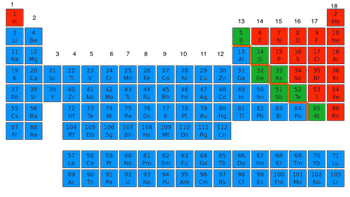
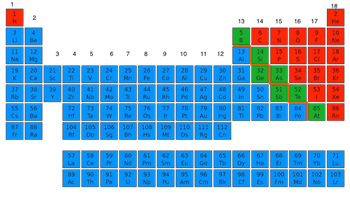
Where are metals located on the periodic table?
a)
Blue
b)
Green
c)
Red
41.
Where are the nonmetals located on the periodic table? 
a)
Blue
b)
Red
c)
Green
42.
Where are the metalloids located on the periodic table?
a)
Blue
b)
Red
c)
Green
43.
Two or more atoms held together by a chemical bond is called what?
a)
A molecule
b)
A molecure
44.
What is the formula for magnesium phosphide?
a)
Mg3P2
b)
Mg2P3
c)
Mg2(PO4)3
d)
Mg3(PO4)2
45.
The chemical formula of potassium iodide is
a)
KI
b)
PI
c)
KI₂
d)
K₂I
46.
What is the formula for lithium oxide?
a)
LiO
b)
LiO2
c)
Li2O
d)
Li2O3
47.
What is the formula for calcium chloride
a)
CaCl
b)
CaCl2
c)
Ca2Cl
d)
CaCl3
48.
Lithium and Arsenic form ?
a)
LiAs
b)
Li2As
c)
Li3As
d)
Li4As
49.
Write the correct chemical formula for Ag  and  Br -
a)
AgBr
b)
silver bromide
c)
Ag2Br2
d)
gold bromide
50.
Na +  and  S -2
a)
Na2S
b)
NaS2
c)
Na2S2
d)
NaS
51.
+  and  N-3
a)
KN
b)
KN3
c)
K3N3
d)
K3N
52.
Sliver Phosphide
a)
Ag3P
b)
Ag3PO4
c)
Ag3PO3
d)
AgP
53.
Na2S
a)
Sodium Sulfide
b)
Sodium Sulfate
c)
Sodium Sulfite
d)
Disodium Sulfide
54.
Manganese II Oxide
a)
MnO
b)
Mn2O
c)
Mn2O4
d)
MnO2
55.
Magnesium ion would take a charge of
a)
1+
b)
2+
c)
3+
d)
0
56.
The charge of V in V2O5 is?
a)
2+
b)
3+
c)
4+
d)
5+
57.
Which of the following elements would require Roman Numerals when it is named?
a)
Ga
b)
Ca
c)
B
d)
Au
58.
How many of the aluminum ion are needed to form an ionic compound with chlorine
a)
0
b)
1
c)
2
d)
3
59.
The formula for iron(III) oxide is
a)
FeO
b)
Fe3O
c)
Fe2O3
d)
Fe3O2
60.
What is the charge of Ni in NiBr3?
a)
+2
b)
+3
c)
-3
d)
+6
61.
Carbon dioxide
a)
C2O2
b)
C20
c)
CO
d)
CO2
62.
Phosphorous trichloride
a)
PCl3
b)
P3Cl
c)
P3Cl3
d)
PCL
63.
Bromine monoflouride
a)
Br1F1
b)
BrF
c)
Br2F
d)
BrF2
64.
Disulfur trioxide
a)
S3O2
b)
SO
c)
S2O3
d)
S2O
65.
P2O5
a)
Phosphorus Oxide
b)
Pentaphosphorus Dioxide
c)
Diphosphorous pentoxide
d)
Phosphoric Oxygen
66.
SeF4
a)
Tetraselenium fluoride
b)
Selenium Fluoride
c)
Selenium tetraflouride
d)
Selenium (IV) Fluoride
67.
CO
a)
Carbon Oxide
b)
Carbon Oxygen
c)
Dicarbon dioxide
d)
Carbon Monoxide
68.
PBr5
a)
Phosphorus Bromide
b)
Phosphorus Pentabromide
c)
Pentaphosphorus bromide
d)
Phosphorus Bromine
69.
Name the following compound:
  BF3
a)
boron fluoride
b)
boron difluoride
c)
monoboron trifluoride
d)
boron trifluoride
70.
carbon monoxide
a)
CO
b)
CO2
c)
C2O
d)
COH
71.
BrO3
a)
bromine oxide
b)
monobromine trioxide
c)
bromine trioxide
d)
bromine (III) oxide
72.
As4O10
a)
arsenic oxide
b)
quadarsenic decoxide
c)
tetraarsenic decoxide
d)
arsenic decoxide
73.
N2O
a)
ionic
b)
covalent
74.
CoCl
a)
ionic
b)
covalent
75.
FeO
a)
ionic
b)
covalent
76.
SF2
a)
ionic
b)
covalent
77.
SiH4
a)
ionic
b)
covalent
78.
What is the correct formula for dinitrogen pentoxide?
a)
N2O5
b)
N3O5
c)
N4O2
d)
N2O7
79.
What is the correct formula for sulfur hexachloride?
a)
SCl2
b)
S6Cl
c)
SCl6
d)
Scl8
80.
What is the correct formula for nitrogen monoxide?
a)
N2O3
b)
NO
c)
N2O7
d)
N3O10
81.
What is the correct formula for heptoxygen difluoride?
a)
O6F4
b)
O6F5
c)
O7F4
d)
O7F2
82.
What is the correct formula for carbon tetrachloride?
a)
CCl4
b)
CCl3
c)
CCl9
d)
C2Cl7
83.
What is the correct formula for trinitrogen decoxide?
a)
NO3
b)
N3O9
c)
N7O6
d)
N3O10
84.
What is the correct formula for pentaboron dihydride?
a)
B5H4
b)
B5H2
c)
B2H5
d)
BH6
85.
For a given element, the atomic number indicates the number of _____
a)
protons in the nucleus
b)
neutron in the nucleus
c)
electrons in the atom
d)
nucleons in the atom
86.
If an atom contains exactly 79 protons, then it's an atom of _____
a)
lithium
b)
gold
c)
nitrogen
d)
carbon
87.
For an atom to be electrically neutral, it must contain the same number of _____
a)
protons and neutrons
b)
neutrons and electrons
c)
protons and electrons
d)
nucleons and electrons
88.
Different versions of an element, with differing numbers of neutrons, are called _____
a)
isosceles
b)
isomers
c)
isotopes
d)
isicless
89.
The sum of the number of protons and the number of neutrons is called the _____
a)
atomic number
b)
mass number
c)
isotope number
d)
average weight
90.
In the Bohr model of the atom, what is the maximum number of electrons in the first shell?
a)
1
b)
2
c)
6
d)
8
91.
Which subatomic particle has no electric charge?
a)
the proton
b)
the neutron
c)
the electron
d)
the photon
92.
What is the mass number of this atom?
a)
1
b)
3
c)
4
d)
7
93.
What is the atomic number of this atom?
a)
2
b)
4
c)
6
d)
none of the above
94.
a)
2
b)
3
c)
5
95.
How many neutrons does the isotope of lithium have?
a)
8
b)
3
c)
4
d)
5
96.
A horizontal row of elements in the periodic table.
a)
column
b)
group
c)
period
97.
What element is this?
a)
Helium
b)
Hydrogen
c)
Argon
d)
Silver
98.
What element is represented in this Bohr Model? 
a)
Carbon
b)
Hydrogen
c)
Aluminum
d)
Lithium
99.
When electron changes its orbit from outer to inner energy is
a)
absorbed
b)
released
c)
no change 
d)
remains constant
100.
Three pairs of electrons are shared in a
a)
Single bond
b)
Double bond
c)
Triple bond
101.
A covalent bond is
a)
a bond that shares electrons metallicaly
b)
A bond that shares electrons with non metals
c)
Metalloids bonding
d)
metals and nonmetals bonding
102.

tetra

a)

six

b)

Four

c)

Five

d)

seven

103.
What is the correct formula for this molecule?
a)
NH
b)
N3H
c)
NH3
d)
NH4
104.

How many unpaired valence electrons does chlorine (Cl) have?

a)

1

b)

5

c)

6

d)

7

105.

This could be the dot diagram of

a)

Ne

b)

H

c)

C

d)

F

106.
This could be the dot diagram of
a)
Mg
b)
Cl
c)
C
d)
O
107.

This could be the dot diagram of an element with the atomic number

a)

8

b)

31

c)

19

d)

36

108.
This could be the dot diagram of
a)
Al
b)
Si
c)
Na
d)
Mg
109.
How many dots would a Lewis Dot structure of Helium have?
a)
1
b)
2
c)
8
d)
0
110.
How many electrons should Boron have around its Lewis dot model?
a)
1
b)
3
c)
5
d)
7
111.
What's a valence electron?
a)
electrons in the second energy level
b)
electrons in the outermost energy level
c)
the atomic number
d)
electrons in the first level
112.
In the equation,          2Mg + O2 ---> 2MgO, which are the reactants?
a)
Mg and O
b)
MgO
c)
Mg and MgO
d)
O and MgO
113.

Balance this equation, Ca + H2O --> CaO + H2

a)

Ca + 2H2O --> CaO + 2H2

b)

2Ca + H2O --> CaO + H2

c)

Its balanced as it is

d)

Cannot be balanced

114.
name this reaction,  Ca + O --> CaO
a)
Decomposition
b)
Synthesis
c)
Double Replacement
d)
Combustion
115.
Name this reaction, Cl2 + 2KI -->  I2 + 2KCl
a)
Synthesis
b)
Single Replacement
c)
Double Replacement
d)
Decomposition
116.
In chemical reactions, the law of conservation of mass is......
a)
disobeyed
b)
not true
c)
obeyed
d)
used sometimes
117.
The substances made during the chemical reaction are called ________
a)
reactants
b)
solution
c)
products
d)
problem
118.
Which chemical reaction breaks down into 2 substances?
a)
Double Replacement
b)
Single Replacement
c)
Synthesis
d)
Decomposition
119.
What is a coefficient?
a)
The small number on the right of the chemical symbol.
b)
The large number to the left of a formula.
120.
Classify
FeS + HCl → H
2S + FeCl2
a)
synthesis
b)
combustion
c)
single replacement
d)
double replacement
121.
Two Reactants and One Product
a)
Decomposition
b)
Synthesis
c)
Combustion
d)
Single Replacement
122.
Always starts with a Hydrocarbon that reacts with oxygen and produces carbon dioxide and water. 
a)
Decomposition
b)
Synthesis
c)
Combustion
d)
Single Replacement
123.
One reactant into several products.
a)
Decomposition
b)
Synthesis
c)
Combustion
d)
Single Replacement
124.
One element replaces another in a compound.
a)
Synthesis
b)
Combustion
c)
Single Replacement
d)
Double Replacement
125.
Ions in two compounds switch. 
a)
Synthesis
b)
Combustion
c)
Single Replacement
d)
Double Replacement
126.
What is the type of reaction shown at the top?
a)
Synthesis
b)
Decomposition
c)
Single Replacement
d)
Double Replacement
127.
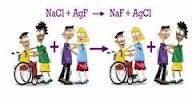
This pictures simulates what type of reaction?
a)
Synthesis
b)
Decomposition
c)
Single Replacement
d)
Double Replacement
128.
H2O + C yields H2 + CO2
1. Balance the equation,
2. what type reaction is this
a)
4:2:4:2
Decomposition
b)
1:1:1:2
Single Replacement
c)
2:1:2:1
Double Replacement
d)
2:1:2:1
Single Replacement
129.
What are the products of this reaction?
Cu+ AgNO3--> 
a)
Cu(NO3)2+Ag
b)
CuNO3 + Ag
c)
CuAg+NO3
d)
Cu+ AgNO3
130.
Write a balanced reaction for this reaction
Zn(s) + H2SO4(aq) -->
a)
Zn(SO4)2 + H
b)
ZnSO4 + H2
c)
ZnSO4 + H
d)
Zn2SO4 + H2
131.
Write a balanced equation for this DR reactions
NaOH + Fe(NO3)3 -->
a)
NaFe + OH(NO3)3
b)
2NaNO3 + 3Fe(OH)3
c)
NaNO3 + FeOH
d)
3NaNO3 + Fe(OH)3
132.
Write a Balanced Equation for this reaction:
C2H4 + 2 O2 -->
a)
C2O2 + H4
b)
CO2 + HOH
c)
CO + H
d)
2 CO2 + 2H2O
133.
Predict the products for the this reaction:
K + HCl --> 
a)
KCl + H2
b)
KHCl 
c)
KH + Cl2
d)
KCl + H
134.
Predict the products for the this reaction:
Mg + CuCl2 --> 
a)
MgCl2 + Cu
b)
MgCl + Cu
c)
MgCu + Cl2
d)
CuMg + Cl2
135.
Predict the products for the this reaction:
AgNO3 + KCl --> 
a)
AgCl + KNO3
b)
AgK + ClNO3
c)
AgNO3 + KCl
d)
KAg + NO3Cl
136.
The word equation for combustion is: fuel + oxygen --> water + ________ __________
a)
Carbon dioxide
b)
Limewater
137.
AB + CD = AD + CB
a)
Double Replacement
b)
Single Replacement
c)
Combustion
d)
Decomposition
138.
Which of the following word pairs correctly completes the sentence below?
_______ are corrosive substances characterized as having a strong smell, a sour taste, and a _______.
a)
Acids; pH less than 7
b)
Acids; pH greater than 7
c)
Bases; pH greater than 7
d)
Bases; pH less than 7
139.
If an acid is combined with a base of equal strength, the result will most likely be
a)
a neutral solution.
b)
a stronger acid.
c)
impossible to tell without testing the pH.
d)
a stronger base
140.
Which of the following is a base?
a)
orange juice
b)
water
c)
vinegar
d)
dishwashing detergent
141.
Litmus paper can be used to determine the _______ of a substance.
a)
relative volume
b)
temperature
c)
relative pH
d)
chemical formula
142.
Which of the following statements is correct?
a)
Blue litmus paper turns red when placed in a base.
b)
Red litmus paper turns blue when placed in a base.
c)
Blue litmus paper stays blue when placed in an acid.
d)
Red litmus paper stays red when placed in a base.
143.
 Which of the following is an acid?
a)
shampoo
b)
baking soda
c)
orange juice
d)
water
144.
The pH of a solution is tested, and it is found to be a basic solution. Of the following choices, what could the pH have been?
a)
3
b)
9
c)
7
d)
5
145.
Human blood has a pH between 7.35 and 7.45. Which of the following best describes human blood?
a)
strongly acidic
b)
slightly acidic
c)
strongly basic
d)
slightly basic
146.
When using pH paper, the pH of a solution can be determined by looking at the _______ of the paper.
a)
texture
b)
color
c)
length
d)
mass
147.
What would be considered the weakest base? 
a)
8
b)
14
c)
7.8
d)
11.6
148.
Many cleaning solutions are bases. Which of the following is a property of most bases?
a)
feels slippery
b)
white color
c)
can only be liquid
d)
tastes sour
149.
Pure water has a pH of 7. Pure water _______.
a)
is a base
b)
is a neutral substance
c)
could be either an acid or a base
d)
is an acid
150.

A chemical reaction between an acid and a base in a water solution (aq); resulting in a formation of salt and water is called _____.

a)

indicator

b)

neutralization

c)

electrolysis

d)

photosynthesis

151.

A substance that produces hydroxide ions (OH-) in solution is a(an) ______.

a)

acid

b)

base

c)

indicator

152.

A substance that produces hydrogen ions (H+) in solution is a(an) ____.

a)

acid

b)

base

c)

indicator

153.

Which substance is a strong base?

a)

NaCl

b)

HCl

c)

H2CO3

d)

Ca(OH)2

154.
Litmus paper is an indicator of acids and bases, it turns red for bases.
a)
True
b)
false
155.
Bases will turn litmus paper __________, while acids will turn litmus paper __________.
a)
blue.....red
b)
red.....blue
c)
pink.........colourless
d)
colourless..........pink
156.
According to the image, the substance tested is a...
a)
Acid
b)
Neutral
c)
Strong Acid
d)
Base
157.
According to the image, the substance tested is a...
a)
Acid
b)
Base
c)
Neutral
d)
Strong Acid
158.
One benefit of Red Cabbage Juice Indicator is that it...
a)
Tells you the exact pH 
b)
Is very accurate
c)
It is very expensive
d)
It can be made from materials you have at home
159.

What is the overall enthalpy for this reaction?

a)

Endothermic

b)

Exothermic

160.

What is a catalyst?

a)

A substance that increases the activation energy

b)

A substance that lowers the activation energy

c)

A substance that reacts with reactants

d)

A substance that increases the kinetic energy particles have

161.

Rate of reaction means

a)

speed of reaction

b)

combining reactants with products

c)

amount of product formed

d)

concentration of reacting particles

e)

None of the choices

162.
Grinding a seltzer tablet into powder increases the rate of reaction due to...
a)
increased concentration of reactants
b)
increased surface area
c)
increased speed of particles.
d)
better orientation of reactants
163.
In a chemical reaction, increasing the temperature of the reactants...
a)
places particles in a better orientation.
b)
makes more catalyst to help the products form more easily.
c)
increases the number of particles in the reaction.
d)
increases the collision speed between the particles.
164.
Which factors increase the rate of a reaction.
a)
increasing temperature
b)
increasing concentration
c)
increasing surface area
d)
All of these
165.
Smaller particle size allows for a _________ surface area to be exposed for the reaction.
a)
larger
b)
smaller
c)
equal
166.
Why does a higher concentration increase the rate of reaction?
a)
it puts reactants in a better orientation.
b)
it lowers the activation energy.
c)
it increases the speed/energy of particle collisions.
d)
it increases the frequency/how often particles collide.
167.
Which of these will NOT speed up the rate of reaction between a strip of magnesium and hydrochloric acid?
a)
twist the strip of magnesium
b)
grind up the strip of magnesium
c)
increase the concentration of the hydrocholoric acid
d)
increase the temperature of the hydrocholoric acid
168.
What is the activation energy?
a)
The energy of the products
b)
The energy of the reactants
c)
The minimum energy needed by the reactants to form the products.
d)
The energy lost in the reaction
169.
Catalysts permit reactions to happen with a __________ activiation energy.
a)
lower
b)
higher