
 Worksheets
Earth Science
Total questions: 35
Worksheet time: 35mins
Name
Class
Date
1.
This layer contains most of Earth's mass.
a)
Inner Core
b)
Mantle
c)
Outer Core
d)
Crust
2.
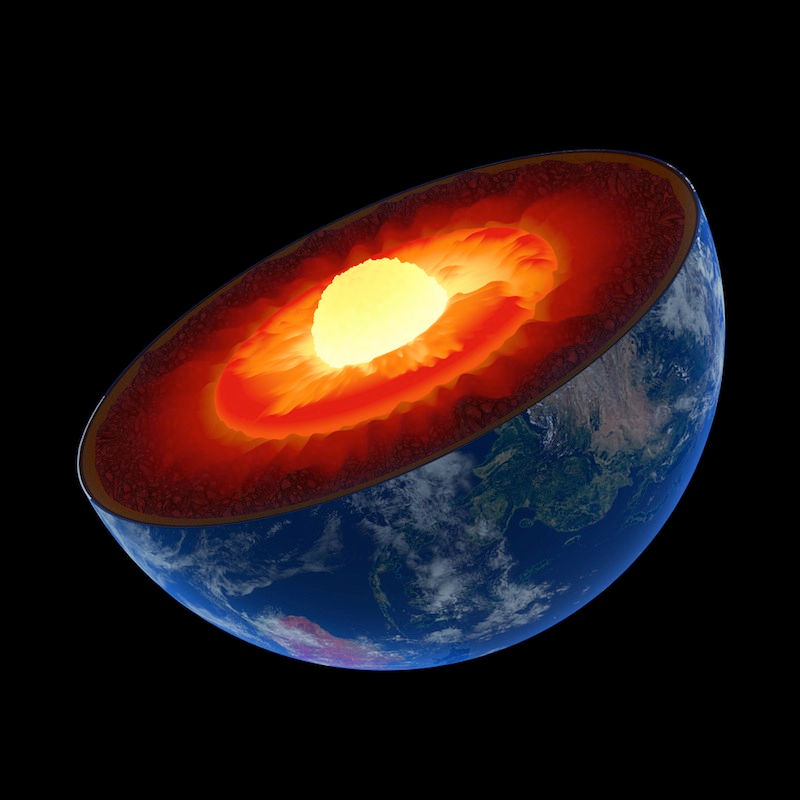
This layer contains the upper mantle and the crust.
a)
Mesosphere
b)
Asthenosphere
c)
Lithosphere
d)
Core
3.
The core is mostly made up mostly of which elements?
a)
Oxygen and Silicon
b)
Silicon and Magnesium
c)
Nickel and Iron
d)
Iron and Magnesium
4.
Which layer of the Earth is the only liquid layer?
a)
Outer Core
b)
Inner Core
c)
Mantle
d)
Lithosphere
5.
What are the two type of crust?
a)
Continental and Landforms
b)
Oceanic and Mountains
c)
Mountains and Landforms
d)
Oceanic and Continental
6.
Which layer(s) of the Earth make up the asthenosphere?
a)
Part of the upper mantle
b)
Crust, mantle, Core
c)
Crust and upper mantle
d)
Only the crust
7.
How are scientist able to estimate the thickness of each layer of the Earth?By studying __________
a)
radio waves
b)
sonar waves
c)
laser waves
d)
seismic waves
8.
Why is the inner core made of solid metal?
a)
Because it is so hot it turns from liquid to solid
b)
Because of the weight of the crust
c)
Because of it's temperature
d)
Because of the pressure of the other layers beating down on it
9.
Which layer is considered the thinnest layer?
a)
Mesosphere
b)
Core
c)
Mantle
d)
Crust
10.
This layer is divided into pieces called tectonic plates.
a)
Mesosphere
b)
Asthenosphere
c)
Mantle
d)
Lithosphere
11.
This is the plastic layer of the mantle on which pieces of the lithosphere move.
a)
Lithosphere
b)
Asthenosphere
c)
Mesosphere
d)
Crust
12.
What is the hottest layer?
a)
Crust
b)
Mantle
c)
Core
13.

Name this boundary
a)
Convergent
b)
Divergent
c)
Transform
d)
Sergent
14.

Name the boundary
a)
convergent
b)
transform
c)
divergent
d)
sergent
15.
Which of the following is where one plate slides under another plate?
a)
submarine zone
b)
divergence zone
c)
subduction zone
d)
lower zone
16.
Mountains form from....
a)
Plates sliding past one another
b)
collision of plates
c)
plates moving away from each other
d)
none of these
17.
Oceanic crust is.....
a)
Younger and less dense than continental crust
b)
Thinner, younger, and more dense than continental crust
c)
older, thicker, and less dense than continental crust
d)
Bigger and younger than continental crust
18.
Earth's plates are....
a)
Constantly moving and changing the face of the Earth
b)
Never moved
c)
Move seldom and very fast
d)
move when they feel like it
19.
Plate movement is caused by _____
a)
The rotation of the Earth
b)
Ocean tides
c)
Convection current in the mantle
d)
The moon's gravity
20.
What are mid-ocean ridges?
a)
A chain of underwater falls
b)
A chain of underwater volcanoes
c)
A chain of underwater mountains
d)
A chain of underwater rocks
21.
Plates moving apart would be...
a)
convergent
b)
divergent
c)
transform
22.

Which is subducted in an ocean-continental convergent boundary?
a)
continental plate
b)
oceanic plate
23.
What type of boundary creates a new seafloor?
a)
convergent continental to continental
b)
convergent ocean to continental
c)
convergent ocean to ocean
d)
divergent
24.
What was Wegener's hypothesis called?
a)
The Pangea
b)
Moving Continents
c)
The Continental Drift
d)
Techtonic Plates
25.
True or False : Sea-floor Spreading adds new material to the ocean floor?
a)
True
b)
False
26.
What is not a piece of evidence for continental drift?
a)
fossils
b)
rock formations
c)
fit of the continents
d)
these are all pieces of evidence
27.
The process of something growing by adding mass to itself because of gravity.
a)
Accretion
b)
Differentiation
c)
Submerging
d)
Diverging
28.
The process of layers forming due to different densities.
a)
Accretion
b)
Differentiation
c)
Submerging
d)
Diverging
29.
What are the causes of tsunami?
a)
Pressure in the atmosphere
b)
Rain
c)
Under water earthquake
30.
Which type of wave is the first to arrive after an earthquake occurs?
a)
P Wave
b)
Rayleigh Wave
c)
S Wave
d)
Shear Wave
31.
P Waves can move through which of the following?
a)
Gas
b)
Liquid
c)
Solid
d)
All of these
32.
S Waves can move through which of the following?
a)
Gas
b)
Liquid
c)
Solid
d)
All of these
33.
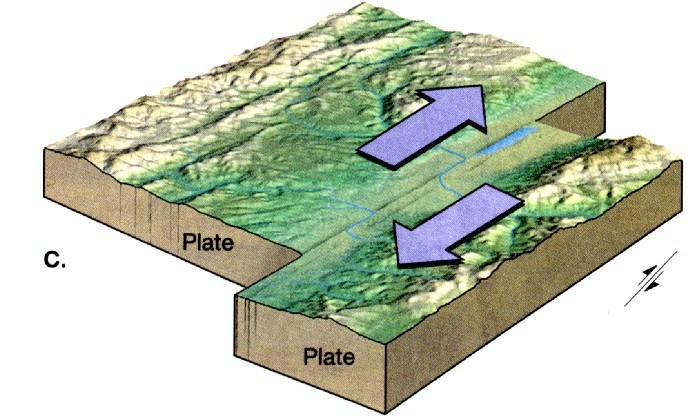
What type of plate boundary is this?
a)
Transform
b)
Convergent
c)
Divergent
d)
Plate
34.
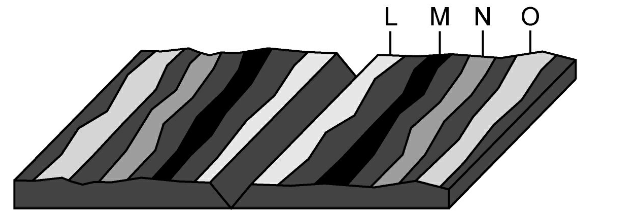
Where would the oldest rock be found?
a)
L
b)
M
c)
N
d)
O
35.
What is not a trait that increases as you move to the center of the earth?
a)
pressure
b)
density
c)
temperature
d)
thickness
100 %

