
Font size
S
M
L
XL
 Worksheets
Calculus Midterm Review
Total questions: 46
Worksheet time: 2hrs 33mins
Name
Class
Date
1.

a)
3
b)
1
c)
infinity
d)
negative infinity
2.

a)
-3
b)
1
c)
2
d)
infinity
3.

What is the limit?
a)
DNE
b)
Infinity
c)
6
d)
12
4.

a)
−1
b)
1
c)
∞
d)
−∞
5.

1
a)
4
b)
1/4
c)
0
d)
infinity
6.
Find the derivative of the given equation
f(x) = x4 + 4x3 - 2x2
f(x) = x4 + 4x3 - 2x2
a)
x3 + x2 - x
b)
4x3 + 12x2 + 4x
c)
4x + 12x - 4x
d)
4x3 + 12x2 - 4x
7.
Find the derivative of the given equation
f(x) = 1/x2
f(x) = 1/x2
a)
1/2x
b)
-2x
c)
2x
d)
-2x-3
8.

Which of the following best describes the continuity at x = 1?
a)
Continuous
b)
Removable Point Discontinuity
c)
Non-removable Infinite Discontinuity
d)
Non-removable Jump Discontinuity
9.
What is the derivative of ln(x)?
a)
xln(x)
b)
1/x
c)
ex
d)
ln(x+1)
10.
What is the derivative of sin(x)?
a)
-sin(x)
b)
-cos(x)
c)
cos(x)
d)
sin(x)
11.
What is the derivative of cos(x)?
a)
sin(x)
b)
-sin(x)
c)
cos(x)
d)
-cos(x)
12.
What is the derivative of tan(x)?
a)
-sec2(x)
b)
-csc2(x)
c)
sec2(x)
d)
csc2(x)
13.
What is the derivative of cot(x)?
a)
sec2(x)
b)
-sec2(x)
c)
csc2(x)
d)
-csc2(x)
14.
What is the derivative of sec(x)?
a)
sec(x)tan(x)
b)
csc(x)cot(x)
c)
-sec(x)tan(x)
d)
-csc(x)cot(x)
15.
What is the derivative of csc(x)?
a)
csc(x)cot(x)
b)
-csc(x)cot(x)
c)
-csc2(x)
d)
-cot2(x)
16.
What is the derivative of ex?
a)
xex-1
b)
xe
c)
ex
d)
ex-1
17.
Given f (x) = 5sinx + 3x3cosx, f '(x) =
a)
-5cosx − 3x3sinx + 9x2cosx
b)
5sinx − 3x3sinx + 9x2cosx
c)
5cosx − 3x3sinx + 9x2cosx
d)
5cosx + 3x3sinx + 9x2cosx
18.
Find the derivative of f(x) = (x6 + 4)5
a)
f '(x) = 5x5(x4 + 4)4
b)
f '(x) = 6x5(x6 + 4)4
c)
f '(x) = 30x5(x6 + 4)4
d)
f '(x) = 30x6(x6 + 4)4
19.

Find h'(3)
a)
-2
b)
0
c)
1
d)
3
20.
What is the derivative of y3 with respect to x?
a)
3y2
b)
3y2 (dy/dx)
c)
3x2
d)
3x2 (dx/dy)
21.
Find an equation of the tangent line to the graph of f(x) at the point (1, 100)
f(x) = (5x5 + 5)2
f(x) = (5x5 + 5)2
a)
y = 500x + 400
b)
y = 100x + 400
c)
y = -500 x - 400
d)
y = 500x - 400
22.
Derivative means the same thing as
a)
slope of the tangent line
b)
slope of the normal line
c)
exponent
d)
slope of the secant line
23.
If a function has a derivative that is negative, what does that tell you?
a)
The function is increasing
b)
The function is decreasing
c)
There is a max where it is negative
d)
There is a min where it is negative
24.

Identify the interval from the derivative graph where the function is concave up.
a)
(-1,1) & (3,4)
b)
(-3,-2)
c)
(-2,-1)
d)
(-3,-1) & (1,3)
25.
The concavity of a function is described by its _______________.
a)
first derivative
b)
second derivative
c)
third derivative
d)
expression
26.
The slope of a function is described by its ____________.
a)
first derivative
b)
second derivative
c)
third derivative
d)
expression
27.
For a function f(x), f'(-3) = 5 indicates f(x) is ___________ at x=-3.
a)
increasing
b)
decreasing
c)
concave up
d)
concave down
28.
For a function g(x), g''(3)=-8 indicates that g(x) is ____________ at x=3.
a)
increasing
b)
decreasing
c)
concave up
d)
concave down
29.
The function d(t)=2t represents the distance (in inches) of a car from a stop sign in terms of the amount of time (in seconds) since the car started to drive away from the stop sign. What is the average rate of change of the car from 0 to 5 seconds?
a)
6.2
b)
31
c)
-31
d)
-6.2
30.
When f'(x) changes from negative to positive, there is(are) ...
a)
a maximum.
b)
a minimum.
c)
no extrema.
31.
When f'(x) changes from positive to negative, there is(are) ...
a)
a maximum.
b)
a minimum.
c)
no extrema.
32.
Find the intervals of concavity for
f(x) = x2 + 2x + 1.
a)
concave up: (-∞,∞)
b)
concave down: (-∞,∞)
c)
concave up: (2, ∞)
concave down: (-∞,2)
d)
concave up: (-∞,2)
concave down: (2, ∞)
33.
Find the relative minimum values for f(x)=3x4-2x3-9x2
a)
-1
b)
0
c)
1.5
d)
-1 and 1.5
34.

Over what interval(s) is f(x) concave up? (Be careful this is a graph of f'!)
a)
(-∞, -3) ∪ (1, ∞)
b)
(-3, 1)
c)
(-∞,-3) U (1, ∞)
d)
(-5, 0)U(2, ∞)
35.
The acceleration function is the first derivative of...
a)
position
b)
velocity
c)
calculus
d)
particle motion
36.
If f'(x) = 0 what does that imply about the x value?
a)
It is a critical point, it is a possible max, min, or point of inflection.
b)
That the limit does not exist.
37.
Find the critical points of f(x) = 2x4- 4x2 + 1
a)
x= 0
b)
x = -1, 1
c)
x = -1, 0, 1
d)
no critical points
38.
What will be true at an inflection point? (select the best answer)
a)
f(x)=0
b)
f'(x)=0
c)
f''(x)=0
d)
The function is undefined
39.

At what x-value( s) does f( x) have a minimum? (Be careful this is a graph of f'!)
a)
x = -3
b)
x = 1
c)
x = 5
d)
x = -3 and x = 5
40.
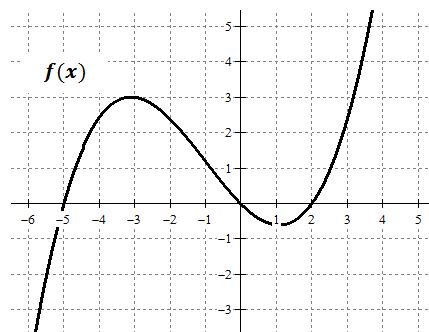
Over what interval(s) is f(x) decreasing?
a)
(-3, 1)
b)
(-∞, -5) ∪ (0, 2)
c)
(-∞, -3) ∪ (1, ∞)
d)
(-5, 0) ∪ (2, ∞)
41.
If (a,b) is a local maximum, then what will be true about f''(a)?
a)
It's positive
b)
It's negative
c)
It's zero
d)
Cannot be determined
42.
If (a,b) is a local minimum, then what will be true about f''(a)?
a)
It's postive
b)
It's negative
c)
It's zero
d)
Cannot be determined
43.
If f''(x) is negative, then f(x) is
a)
decreasing
b)
increasing
c)
concave down
d)
relative minimum
44.
If f"(x) is positive, then f(x) is
a)
increasing
b)
positive
c)
relative maximum
d)
concave up
45.
The distance d (measured in a number of feet) between Brianna and her house is modeled by the formula, d = t2+ 1 where t represents the number of seconds since Brianna started walking.
What was Brianna’s change in distance as her time walking increased from 2 to 7 seconds?
What was Brianna’s change in distance as her time walking increased from 2 to 7 seconds?
a)
50
b)
5
c)
45
d)
-45
46.

Given the following graph of f', the derivative of f. On what interval is f increasing?
a)
[-5,-1] U [3,4]
b)
[-3,1]
c)
[-1,3] U [4,5]
d)
x=-3 and x=1
Reset

