
 Worksheets
Chap. 6.1 & 6.2 (Chemistry) Review
Total questions: 30
Worksheet time: 17mins

Atoms of the same element that have different numbers of neutrons.
Isotope
Covalent Bond
Enzymes
Ionic Bonds

Pure substance formed when 2 or more different elements combine.
Compound
Isotope
Covalent Bond
Ionic Bond

What is the center of an atom called?
Neutron
Proton
Nucleus
Electron

Particles in an atom that are neutral and have no charge are
negatrons
electrons
neutrons
protons

The smallest particle of any particular type of matter is known by which of the following terms?
Compound
Atom
Chemical
Element
All matter is made of what?
energy
atoms
electrons
compounds
Ions are:
atoms with a positive or negative charge
atoms with no charge
atoms with ONLY a positive charge
atoms with ONLY a negative charge

What is an example of a physical change?
Rusting
Freezing
Food digestion
Burning toast

What is an example of a chemical change?
Unexpected color change
Gas emitted
Odor is created
All of the above

A covalent bond is formed as a result of
transferring electrons
sharing electrons
transferring protons
sharing protons
An example of a compound is:
Hydrogen (H)
Ammonia (NH3)
Carbon (C)
Lithium (Li)
The minimum amount of energy needed for reactants to form products in a chemical reaction is called:
Enzymes
Catalysts
Exothermic Reaction
Activation Energy
A substance that lowers the activation energy needed to start a chemical reaction.
Substrate
Enzyme
Ion
Muscle Power
The total number of atoms in a molecule of glucose, C6H12O6, is:
6
12
24
432
What is an atom?
smallest part of the universe
smallest part of a substance
smallest part of anything
smallest part of water
Protons:
negative charge, nucleus
positive charge, shells
positive charge, nucleus
neutral charge, nucleus
Neutrons:
no charge, shells
positive charge, nucleus
neutral, no charge, nucleus
negative charge, shells
Electrons:
no charge, nucleus
positive charge, nucleus
negative charge, shells
negative charge, nucleus
1st shell (energy level) holds how many electrons:
2
8
18
32
2nd shell (energy level) holds how many electrons:
2
8
18
32
True or False - An energy level has to be full before moving on to the next energy level?
true
false
What is a pure substance that cannot be broken down into any other substance by physical or chemical means. Ex: Gold, Silver, Oxygen, & Nitrogen
element
compound
mixture
salad

Who developed the modern day periodic table of elements?
Darwin
Shultz
Hooke
Mendeleev
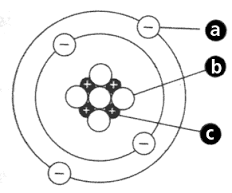
"B" and "C" in the image are found in the ______ of an atom.
electron cloud
Space
Nucleus
Outside
An attraction that occurs when molecules come close together causing positive and negative regions to pull on molecules and hold them together. (Example: geckos use this to help them when “hanging” around on a surface.)
Chemical Reactions
van der Waals Force
Enzyme
Catalyst
Isotope
These proteins are biological catalysts that speed up the rate of chemical reactions.
Enzyme
Catalyst
Substrate
Compound
Isotope
In the equation, what are the products of the reaction?
CH4 + 2O2 → CO2 + 2H2O
CH4 and CO2
CH4 and 2O2
CO2 and 2H2O
2O2 and 2H2O

What does a represent?
Proton
Neutron
Electron
What does b represent?
Proton
Neutron
Electron
What does c represent?
Proton
Neutron
Electron

