wayground logo

Free Printable Worksheets

Font size

S
M
L
XL
Worksheets

Advanced Genetics Review

Total questions: 40

Worksheet time: 1hrs 6mins
Name
Class
Date
1.
How many alleles (letters) do each person carry for a trait?
a)
1
b)
2
c)
3
d)
4
2.
How many alleles (letters) does a child get from each parent for each trait?
a)
1
b)
2
c)
3
d)
4
3.
Dominant alleles are represented by a:
a)
Male gene
b)
lowercase letter
c)
recessive trait
d)
capital letter
4.
Which of the following genotypes is heterozygous?
a)
Bb
b)
BB
c)
bb
d)
B
5.
In a pedigree, what shape represents a male?
a)
circle
b)
square
c)
triangle
d)
diamond
6.

What gender has an X and a Y chromosome?

a)

male

b)

female

c)

all of the above

7.
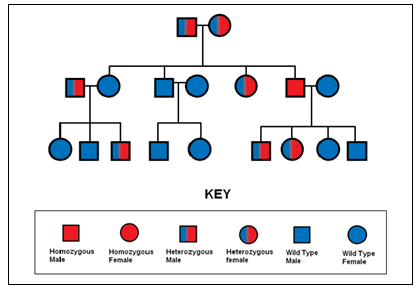
In the second generation-how many people are carriers of the trait?
a)
2
b)
3
c)
5
d)
6
8.
Why do all the daughters in Generation II carry the colorblind gene?
a)
Because mom passed on the gene.
b)
Because dad passed on the X chromosome.
c)
Because their brother has it.
d)
Because their brother gave it to them.
9.
Why does individual IV-7 have colorblindness?
a)
Because his mom is a carrier.
b)
Because his dad has it.
c)
Because his siblings have it.
d)
Because his uncle has it.
10.
What percentage of the offspring will have this recessive disease?
a)
0%
b)
25%
c)
50%
d)
75%
11.
What percentage of the female offspring will be a carrier for this recessive disease?
a)
0%
b)
50%
c)
100%
d)
25%
12.
Looking at this pedigree, how many female family members are carriers?
a)
1
b)
3
c)
10
d)
7
13.
Looking at this pedigree, how many family members have the disease?
a)
4
b)
7
c)
All
d)
None
14.
The visual representation of an individual's chromosomes is a 
a)
phenotype
b)
genotype
c)
karyotype
d)
stereotype
15.
Males are more likely to suffer from a sex-linked disease or disorder because
a)
males are the weaker sex
b)
males have less DNA
c)
males have 1 X chromosome, so the disorder is more likely to be expressed
16.
If a gene is found only on the X chromosome and not the Y chromosome, it is said to be 
a)
sex-linked trait
b)
polygenic trait
c)
codominant trait
d)
incomplete dominance trait
17.
Hemophilia is a recessive x-linked disorder.
Which genotype represents a female who is a carrier for hemophilia?
a)
XHXh
b)
XhXh
c)
XHXH
d)
XhY
18.
Hemophilia is a recessive x-linked disorder.
Which genotype represents a male with hemophilia?
a)
XHXh
b)
XhXh
c)
XHY
d)
XhY
19.
Which gender can be carriers of colorblindness and not have it?
a)
Just males
b)
Just females
c)
Both genders
20.

when one allele is not completely dominant over the other - blending of two traits

a)

Codominance

b)

Mendelian

c)

incomplete dominance

d)

none of these

21.

condition in which both alleles for a gene are expressed when present - both traits are visible

a)

Codominance

b)

Dominance

c)

Mendelian

d)

Incomplete dominance

22.

this image is an example of

a)

codominance

b)

Mendelian

c)

incomplete dominance

d)

multiple alleles

23.
There are multiple alleles for the ABO blood group.  Why are only two of these alleles present in any one individual? 
a)
Each parent contributes only one allele for the ABO blood group to the offspring.
b)
There are not enough nucleotides in a red blood cell to produce a third allele. 
c)
Each allele in the ABO group must be dominant or recessive
d)
Blood group alleles are not segregated during meiosis. 
24.
A red flowered plant (RR) breeds with a White flowered plant (WW). The gene for petal color in these plants expresses incomplete dominance.  What percentage of the offspring will have pink (RW) flowers?
a)
0%
b)
25%
c)
50%
d)
100%
25.
A homozygous dominant dog with brown fur is crossed with a heterozygous dog with brown fur. What are the percentages of the possible genotypes?
a)
100% BB
b)
75% BB and 25%Bb
c)
50 % BB and 50% Bb
d)
50% Bb and 50% bb
26.

A calico cat shows both the traits for orange fur and black fur. What kind of allele expression is this?

a)

Incomplete Dominance

b)

Codominance

c)

Mendelian

27.

A roan cow shows co-dominance in fur color (orange and white). What is the phenotype ratio expected if a roan cow and a roan steer mate together?

a)

4 Orange and White cows

b)

2 Orange cows and 2 White cows

c)

2 Orange cows and 2 Orange and White cow

d)

1 Orange cow, 2 Orange and White cows, and 1 White cow

28.

In some carnations, flower color exhibits codominance. When crosses, Red (R) and white (W) flowers make speckled flowers (RW) that show both colors.

Complete a cross between A speckled flower and a red flower. Find the phenotype ratio.

a)

2 red, 2 speckled, and 0 white

b)

4 red, 0 speckled, and 0 white

c)

0 red, 4 speckled, and 0 white

d)

0 red, 2 speckled, and 2 white

29.
Based off this punnett square, what fraction of the offspring will have wrinkled, yellow seeds?
a)
9/16
b)
3/16
c)
1/16
d)
16/16
30.
What gamete possibilities could come from this parent's genotype?
a)
AB, AB, aB, aB
b)
Ab, AB, Ab, ab
c)
Ab, Ab, Ab, Ab
d)
AB, aB, ab, aB
31.
What genotype is missing from this Punnett Square?
a)
RrYy
b)
RRYY
c)
rryy
d)
RrYY
32.

What goes in box 3

a)

Aabb

b)

AABB

c)

AAbb

d)

aaBb

33.
A cell will _____________________ in a hypertonic solution.
a)
swell
b)
shrink
c)
will not change
d)
will explode
34.
A cell will __________________ in a hypotonic solution.
a)
swell and perhaps burst (lyse)
b)
shrink
c)
the size of the cell will not change
d)
the size of the cell will change from large to small and from small to large
35.
During osmosis
a)
water moves from high to low concentration
b)
large or oddly shaped molecules move across a cell membrane
c)
water moves when energy is used
d)
proteins are built
36.
In the given scenario what will happen?  An egg is placed in pure water for 48 hours.
a)
The egg will gain water and swell.
b)
Water will move in and out of the cell equally, and the cell with neither shrink nor swell.
c)
The egg will lose water and shrink.
37.
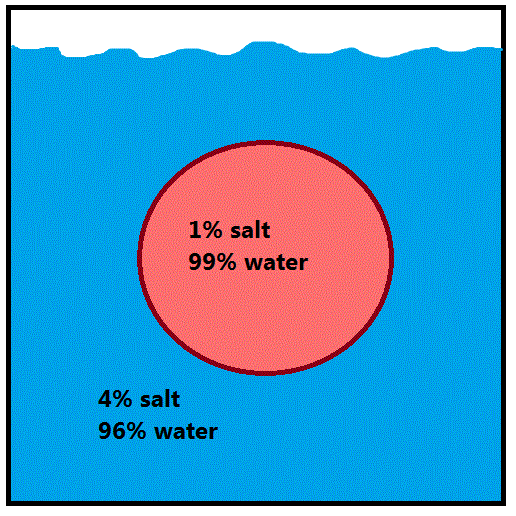
Where will the water go?
a)
Into the cell
b)
Out of the cell
c)
Equally in & out - it's isotonic
d)
There is no water
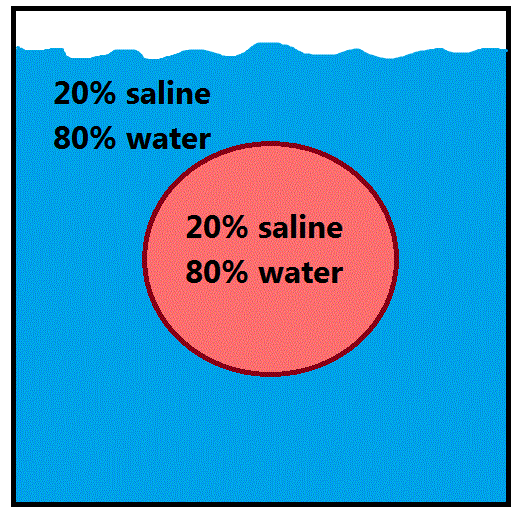
38.
A blood cell is placed into the jar, as seen. Where will the water go?
a)
Into the cell
b)
Out of the cell
c)
Equally in & out - it's isotonic
d)
The water is a lie
39.
What is the difference between active and passive transport?
a)
Active does not need energy and passive uses ATP (energy)
b)
Active uses ATP (energy) and passive does not need energy
c)
Active stores transport proteins and passive releases 
d)
Active uses hormones and passive does not 
40.
Osmosis is a form of ______________. 
a)
Passive Transport
b)
Active Transport