wayground logo

Free Printable Worksheets

NEW

Font size

S
M
L
XL
Worksheets

PSH: Final part 3

Total questions: 58

Worksheet time: 3hrs 6mins

Name
Class
Date
1.

When two equal forces act in opposite directions on an object, they are called ______________________.

a)

frictional force

b)

balanced force

c)

centripetal force

d)

gravitational force

2.

When an unbalanced force acts on an object, the force ______________________.

a)

changes the motion of the object

b)

is cancelled by another force

c)

does not change the motion of an object

d)

is equal to the weight of the object

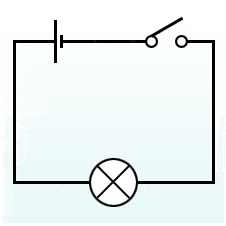
3.

The resistance of an object to any change in its motion is called ______________________.

a)

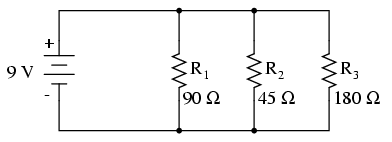
inertia

b)

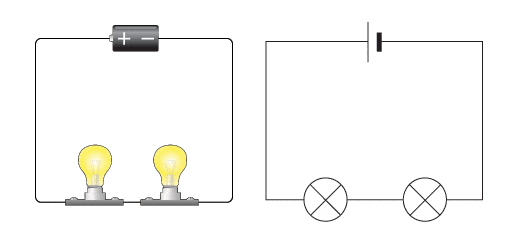
friction

c)

gravity

d)

weight

4.

According to Newton’s second law of motion, force is equal to mass times ______________________.

a)

inertia

b)

weight

c)

acceleration

d)

direction

5.
What law is best described by inertia?
a)
1st
b)
2nd
c)
3rd
6.

Acceleration is due to a force put on an objects mass.

a)

1st Law

b)

2nd Law

c)

3rd Law

7.
"For every action, there is an equal and opposite reaction."
a)
Newton's 1st Law
b)
Newton's 2nd Law
c)
Newton's 3rd Law
d)
Newton's 4th Law
8.
Force = Mass x Acceleration
a)
Newton's 1st Law
b)
Newton's 2nd Law
c)
Newton's 3rd Law
d)
Newton's 4th Law
9.
"An object in motion (or at rest) will to stay in motion (or at rest) until an outside force acts upon it."
a)
Newton's 1st Law
b)
Newton's 2nd Law
c)
Newton's 3rd Law
d)
Newton's 4th Law
10.
Any push or pull on an object.
a)
force
b)
velocity 
c)
inertia
d)
momentum
11.
The force that opposes motion between two surfaces in contact with each other.
a)
inertia
b)
friction
c)
momentum
d)
gravity
12.
A Newton is a unit of...
a)
force
b)
inertia
c)
acceleration
d)
velocity
13.
Gravity is increased with...
a)
greater mass & shorter distance
b)
greater mass & farther distance
c)
lower mass & shorter distance
d)
lower mass & farther distance
14.

John took 90 minutes to bicycle to his grandmother's house, a total of six kilometers. What was his speed (pay attention to units)?

a)

540 km/hr

b)

.066 km/hr

c)

4 km/hr

d)

9 km/hr

15.
How far has the red runner gone in 3 seconds?
a)
40 yards
b)
10 yards
c)
30 yards
d)
20 yards
16.
 Jermaine runs exactly 2 laps around a 400 meter track. What is the displacement?
a)
800 meters
b)
400  meters
c)
0 meters
d)
200 meters
17.
1.  How far will a train moving at 5.7 km/min go in 45 minutes?
a)
256.5 km
b)
0.12 km
c)
7.89 km
18.

Consider the position vs. time graph below for cyclists A and B.

Do the cyclists start at the same point?

a)

Yes

b)

No

19.

At t= 7s, which cyclist is ahead?

a)

A

b)

B

20.

The Flash runs 200 m/s. How long does it take him to run to Atlanta, 30,000 m away?

a)

150 seconds

b)

6000 seconds

c)

6,000,000 seconds

d)

0.000067 seconds

21.
Velocity is both ____ and _____. 
a)
speed , direction 
b)
direction, mass
c)
volume, density 
d)
direction, magnitude 
22.
initial v=5 m/s, final v=0 m/s, time is 20 seconds, how do you calculate the acceleration?
a)
(0-5)/20
b)
(5-0)/20
c)
5/20
d)
20/(5-0)
23.
A car accelerates from a standstill to 70 m/s in 10 seconds.  What is the acceleration?
a)
0.7m/s2
b)
7m/s2
c)
14m/s2
d)
none of the above
24.
The SI unit for acceleration is
a)
mph
b)
ft/sec2
c)
m/s2
25.
Which graph represents zero acceleration (constant velocity)?
a)
A
b)
B
c)
C
d)
D
26.
Mass is _________________________.
a)
the amount of matter in an object.
b)
the force of gravity on an object.
c)
both.
d)
neither.
27.
Weight is ________________________.
a)
the force of gravity on an object.
b)
the amount of matter in an object.
c)
neither.
d)
both.
28.
In physics, mass is measured in _____.
a)
grams
b)
newtons
c)
kilograms
d)
pounds
29.
In physics, the weight equation is _____________.
a)
Weight=Mass×Gravity
b)
Mass=Weight×Gravity
c)
Gravity=Mass×Weight
30.
You get in your spaceship and head on a trip to Mars.  As you leave Earth, your mass ______________.
a)
increases
b)
decreases
c)
remains the same
31.
You get in your spaceship and head on a trip to Pluto.  As you leave Earth, your weight ______________.
a)
increases
b)
decreases
c)
remains the same
32.
An object weighs 340 N.  What is its mass?
a)
340 kg
b)
340 N
c)
34 kg
d)
34 N
33.
If an object's mass =30 Kg on the Earth, what would be it's weight on Earth?
a)
3 kg
b)
300 kg
c)
3 N
d)
300 N
34.
On which planet would your mass be the greatest?
a)
Earth
b)
Jupiter
c)
Sun
d)
Your mass doesn't change on different planets.
35.

Pick the correct sentence.

a)

This circuit will work because it is a closed circuit.

b)

Energy will freely flow in this circuit.

c)

This circuit will not work because there is no energy source.

d)

This circuit will not work because there is no switch.

36.
In order for a circuit to work you need to have
a)
A voltage source
b)
A complete pathway with no breaks in the circuit
c)
A resistor
d)
A voltage source and a complete pathway with no breaks in the circuit
37.
This type of circuit only has one path for current to flow. 
a)
series
b)
parallel
c)
combination
d)
split
38.
This is an example of a _______ circuit
a)
open
b)
series
c)
parallel
d)
square
39.
this circuit is .....?
a)
open
b)
parallel
c)
closed
d)
The cutest little circuit evah!
40.
This is an example of a ______ circuit
a)
Series
b)
Parallel
c)
Open
d)
Dihexihedral
41.
What kind of circuit is this?
a)
Series
b)
Consecutive
c)
Parallel
d)
Training
42.
What kind of circuit is this?
a)
Series
b)
Consecutive
c)
Parallel
d)
Training
43.
wood is a _____?
a)
conductor
b)
insulator
44.
brass is a _____?
a)
insulator
b)
conductor
45.
A material in which electrons are not able to move easily 
a)
Circuit 
b)
Insulator 
c)
Resistance 
d)
Conductor
46.
This circuit has more than one loop. When one light goes out, the others stay on. 
a)
closed circuit
b)
series circuit
c)
parallel circuit
d)
open circuit
47.
How did Rutherford discover the proton?
a)
Cathode tube ray experiment
b)
Gold Foil Experiment
c)
Planetary Model
d)
Plum Pudding Model
48.
What scientist is best known for his "Plum Pudding" model of the atom?
a)
J.J. Tomson
b)
Ernest Rutherford
c)
John Dalton
d)
Democritus
49.
What is the net force
a)
10 N
b)
0 N
c)
25 N
d)
1 N
50.

What is the net force?

a)

400 N Up

b)

-400 N Down

c)

+400 N Down

d)

800 N Down

51.
Which way is the object moving?
a)
It is not or moving at a constant speed
b)
moving to the right
c)
moving to the left
d)
going up
52.
Friction is a force that acts in an ___________ direction of movement.
a)
similar
b)
opposite
c)
parallel
d)
west
53.
A type of friction that occurs when air pushes against a moving object causing it to negatively accelerate
a)
surface area
b)
air resistance
c)
descent velocity
d)
gravity 
54.
A type of friction that occurs when air pushes against a moving object causing it to negatively accelerate
a)
surface area
b)
air resistance
c)
descent velocity
d)
gravity 
55.
Which factor affects inertia of an object?
Factor manakah yang mempengaruhi inersia suatu objek? 
a)
Size
Saiz
b)
Distance
Jarak 
c)
Velocity
Halaju 
d)
Mass
Jisim 
56.
Objects with greater _________ also have greater inertia.
a)
speed
b)
mass
c)
temperature
d)
friction
57.
Because of inertia, a resting object will remain at ________.
a)
rest
b)
a constant speed
c)
school
d)
inertia 
58.
a force that opposes motion between any surfaces that are touching
a)
velocity
b)
friction
c)
inertia
d)
position