wayground logo

Free Printable Worksheets

NEW

Font size

S
M
L
XL
Worksheets

Atmosphere & Winds

Total questions: 50

Worksheet time: 39mins

Name
Class
Date
1.
What does the earth's atmosphere do?
a)
help to regulate the temperature on Earth
b)
Help UV rays to reach the Earth's surface
c)
Creates meteors in the sky
d)
Keep ocean waters cold
2.
What is the percentage of nitrogen in Earth's atmosphere?
a)
1%
b)
21%
c)
78%
d)
90%
3.
What is the percentage of oxygen in Earth's atmosphere?
a)
1%
b)
21%
c)
78%
d)
90%
4.
Where is the temperature the highest?
a)
1
b)
2
c)
3
d)
4
5.
Where is the air pressure the greatest?
a)
1
b)
2
c)
3
d)
4
6.
Where is the altitude the greatest?
a)
1
b)
2
c)
3
d)
4
7.
What is the hottest layer in the atmosphere?
a)
Ionosphere
b)
Stratosphere
c)
Thermosphere
d)
Mesosphere
8.
The lowest layer of the atmosphere, this is also where weather occurs.
a)
Mesosphere
b)
Stratosphere
c)
Troposphere
d)
Thermosphere
9.
The _____ protects us from the harmful UV rays of the sun.
a)
Troposphere
b)
Ozone Layer
c)
Exosphere
d)
Stratosphere
10.
The force of a column of air pressing down is called what?
a)
Air Mass
b)
Air Pressure
c)
Air
d)
Heavy
11.
What is the atmosphere made of?
a)
oxygen
b)
carbon dioxide
c)
mixture of gases
d)
water vapor
12.
The five layers of the atmosphere in order from the ground up
a)
stratosphere, troposphere, exosphere, mesosphere and thermosphere
b)
troposphere, mesosphere, thermosphere, exosphere and stratosphere
c)
thermosphere, exosphere, mesosphere, stratosphere and troposphere
d)
troposphere, stratosphere, mesosphere, thermosphere and exosphere
13.
The layer with the least amount of air
a)
troposphere
b)
stratosphere
c)
thermosphere
d)
exosphere
14.

Which word makes the statement true?

As altitude above Earth increases air pressure _______.

a)

Decreases

b)

Increases

15.

Which word makes the statement true?

The ______ helps protect Earth from too much ultra violet light.

a)

Mesosphere

b)

Stratosphere

16.

Which word makes the statement true?

Air pressure is measured by an instrument called a _______.

a)

Barometer

b)

Altimeter

c)

Psychrometer

d)

Anemometer

17.
What natural event results in sudden atmospheric change?
a)
Production of nitrogen gas by soil-living bacteria
b)
Production of carbon dioxide by decomposing organic matter
c)
Discharge of carbon dioxide and ash from an exploding volcano
18.

The direct transfer of energy by electromagnetic waves is called ________.

a)

radiation

b)

convection

c)

conduction

19.
The sun gives off ______________ which can cause sunburns.
a)
radiation
b)
infrared radiation
c)
ultraviolet radiation
d)
visible light
20.

Nearly all the energy in Earth's atmosphere comes from the sun and travels to Earth as ________________.

a)

electromagnetic waves

b)

convection

c)

conduction

d)

visible light

21.
True or False. Different wavelengths of radiation are absorbed by different layers in the atmosphere. 
a)
True
b)
False
22.
Dust-size particles and gases in the atmosphere disperse light in all directions which is a process called ___________. 
a)
atmosphere
b)
scattering
c)
visible light
23.
True or False. About 50% of the energy that reaches Earth's surface is absorbed by land and water and changed into heat. 
a)
True
b)
False
24.
The __________ keeps the Earth's atmosphere at a temperature that is comfortable for most living things. 
a)
greenhouse effect
b)
radiation
c)
Old Man Winter
25.

When gas, oil, and coal are burned, ___ is added to the atmosphere.

a)

Carbon Dioxide

b)

Oxygen

c)

Chlorofluorocarbon

d)

Hydrogen

26.

A gas that increases the greenhouse effect is ___.

a)

hydrogen

b)

carbon dioxide

c)

oxygen

d)

none of the above

27.

One cause of _____ may be deforestation.

a)

clouds

b)

thunderstorms

c)

precipitation

d)

global warming

28.
Winds are named for the direction they are blowing from?
a)
True
b)
False
29.
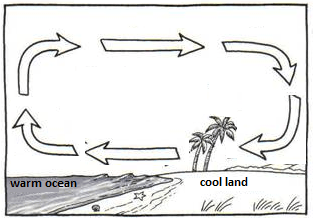
What kind of breeze is this and when would it form?
a)
Land breeze - daytime
b)
Land breeze - nighttime
c)
Sea breeze - daytime
d)
Sea breeze - nighttime
30.
Winds are created by differences in ______
a)
air temperature
b)
 air pressure 
c)
altitude
d)
humidity 
31.
Air always blows from 
a)
High pressure to low pressure
b)
 Hot air to cold air
c)
 low pressure to high pressure
d)
East to west
32.
Which diagram shows the formation of a land breeze?
a)
diagram Y
b)
diagram X
c)
neither 
d)
both
33.
Which diagram shows the formation of a sea breeze?
a)
diagram Y
b)
diagram X
c)
neither
d)
both
34.
Why do sea breezes occur during the day?
a)
Water heats up faster than land, so the air above water is warmer.
b)
Water cools off faster than land, so the air above land is cooler.
c)
Land heats up slower than water, so the air stays cooler during the day.
d)
Land heats up faster than water, so the air above land is warmer.
35.
Cold air exerts _____________ pressure than warm air.
a)
the same
b)
less
c)
more 
d)
impossible to tell
36.

What is the main source of energy for the water cycle

a)

Wind

b)

Water

c)

Sun

d)

Trees

37.

In Florida the weather is very sunny and has clear skies. What type of air pressure does Florida have right now?

a)

Low

b)

No air pressure

c)

High

d)

Altitude

38.

The wind belt which blows steadily toward the equator from the northeast in the northern hemisphere or the southeast in the southern hemisphere, especially at sea is the _____

a)

Prevailing Westerlies

b)

Prevailing Easterlies

c)

Trade Winds

d)

Jet Stream

39.

A large amount of air that has the same temperature and humidity is known as an ____

a)

Air Mass

b)

Front

c)

Cyclone

d)

Body of Air

40.

At the equator the lack of wind is know as the ______.

a)

Trade Winds

b)

Horse latitudes

c)

Prevailing westerlies

d)

Doldrums

41.

When air temperature is high, air pressure is ______

a)

high

b)

low

42.

Name the instrument/equipment

a)

wind vane

b)

barometer

c)

anemometer

d)

psycrometer

43.

Name the equipment/instrument

a)

barometer

b)

wind vane

c)

anemometer

d)

psycrometer

44.

The bending of the winds due to the rotation on the Earth is known as the ________________ effect.

a)

Dormitory

b)

Coriollis

c)

Gravitation

d)

Lebo

45.

In the Northern hemisphere the Coriolis effect causes the winds to bend/turn to the _____

a)

left; clockwise

b)

left; counter clockwise

c)

right; clockwise

d)

right; counter clockwise

46.

Meteors are destroyed in the _______________.

a)

troposhphere

b)

stratosphere

c)

mesosphere

d)

thermosphere

47.

The aurora borealis (dancing lights) are due the the ions in the ______

a)

troposphere

b)

stratosphere

c)

mesosphere

d)

thermosphere

48.

True / False: Human activity is the cause of global warming. We are releasing too much CO2 into the atmosphere that has lead to the Earth's temperature to rise.

a)

True

b)

False

49.

Temperatures are the equator are greater because sunlight strikes at

a)

directly

b)

less directly

50.

Long wavelengths with less frequency, carry ______________ energy

a)

high

b)

low