
 Worksheets
Chemical Reactions Twizz Review
Total questions: 55
Worksheet time: 1hrs 5mins
Name
Class
Date
1.
In an exothermic reaction, heat is ...
a)
taken in
b)
given out
2.
In an endothermic reaction, heat is ,,,
a)
taken in
b)
given out
3.
What type of reaction occurs in a hand warmer
a)
exothermic
b)
endothermic
4.
If a chemical reaction is EXOTHERMIC, the temperature would....
a)
Stay the same
b)
Increase
c)
Decrease
5.
What is a Chemical Reaction?
a)
When two liquids hit each other
b)
When a liquid has foam
c)
When two substances mix and produce new products
d)
When a reaction forms with soda and candy
6.
What type of reaction occurs between an element and a compound?
Zn + 2HCl --> ZnCl2 + H2
Zn + 2HCl --> ZnCl2 + H2
a)
Synthesis
b)
Decomposition
c)
Single Replacement
d)
Double Replacement
7.
What kind of reaction is this:
2H2 + O2 --> 2H2O
2H2 + O2 --> 2H2O
a)
Synthesis
b)
Decomposition
c)
Single Replacement
d)
Double Replacement
8.
What kind of reaction is this:
4Fe + 3O2 → 2Fe2O3
4Fe + 3O2 → 2Fe2O3
a)
Synthesis
b)
Decomposition
c)
Single Replacement
d)
Double Replacement
9.
What kind of reaction is this:
2H2O2 →2 H2O + O2
2H2O2 →2 H2O + O2
a)
Synthesis
b)
Decomposition
c)
Single Replacement
d)
Combustion
10.
What kind of reaction is this:
Fe + CuSO4 -> Cu + FeSO4
Fe + CuSO4 -> Cu + FeSO4
a)
Double Replacement
b)
Decompostion
c)
Single Replacement
d)
Combustion
11.
The reaction below is an example of?
AgNO3 + NaCl → AgCl + NaNO3
AgNO3 + NaCl → AgCl + NaNO3
a)
Single Replacement
b)
Double Replacement
c)
Decomposition
d)
Combustion
12.
What kind of reaction is this:
CaCO3 + Ag2SO4 → CaSO4 + Ag2CO3
CaCO3 + Ag2SO4 → CaSO4 + Ag2CO3
a)
Decomposition
b)
Single Replacement
c)
Double Replacement
d)
Combustion
13.
An element plus additional element reacts to form one product is an example of which type of chemical reaction?
a)
combustion
b)
decomposition
c)
synthesis
d)
single replacement
14.
Which type of reaction takes place in the presence of oxygen and produces carbon dioxide and water?
a)
double replacement
b)
decomposition
c)
combustion
d)
single replacement
15.
Which type of reaction can be recognized by the general pattern?
A + BC--> AC + B
A + BC--> AC + B
a)
Decomposition
b)
Combustion
c)
Single Replacement
d)
Double Replacement
16.
What type of reaction is illustrated below?
2HI --> H2 + I2
2HI --> H2 + I2
a)
synthesis
b)
decomposition
c)
single replacement
d)
double replacement
17.
Classify
Zn + H2S → ZnS + H2
Zn + H2S → ZnS + H2
a)
synthesis
b)
combustion
c)
single replacement
d)
double replacement
18.
Classify
FeS + HCl → H2S + FeCl2
FeS + HCl → H2S + FeCl2
a)
synthesis
b)
combustion
c)
single replacement
d)
double replacement
19.
Classify
Fe + O2 → Fe2O3
Fe + O2 → Fe2O3
a)
synthesis
b)
decomposition
c)
double replacement
d)
single replacement
20.
Which of the following general formulas represents a single-displacement reaction?
a)
AB → A + B
b)
A + B → AB
c)
A + BC → AC + B
d)
AB + CD → AD + CB
21.
The formula AB → A+B represents what type of chemical reaction?
a)
synthesis
b)
decomposition
c)
single displacement
d)
double replacement
22.
Which of the following examples shows that a chemical reaction has occurred?
a)
A rock breaks into smaller pieces when it is struck with a hammer.
b)
Rust forms on a hammer that has been left outside to long.
c)
A cup of water turns pink when a few drops of red food coloring are added.
d)
A solid is formed when heat is removed from a sample of water.
23.
A student places a piece of a potato into a container of hydrogen peroxide. One observation the student makes is that bubbles form around the potato. The presence of bubbles might indicate the formation of a new substance because bubbles -
a)
could show that a gas is forming
b)
always rise to the top of a liquid.
c)
are almost always perfectly spherical.
d)
usually burst after a few minutes.
24.
Hydrogen peroxide breaks down to form water and oxygen gas. Which observation is evidence that a chemical reaction has occurred?
a)
The mass of the solution remains the same.
b)
Phase changes are observed.
c)
The color of the solution remains clear.
d)
The temperature of the solution increases.
25.
A clear liquid from a flask is poured into another clear liquid in a beaker. Which of the following results of this procedure would indicate a new substance was formed?
a)
The level of the substance in the beaker is higher after the other liquid is added.
b)
A yellow solid forms and then settles to the bottom of the beaker.
c)
Small white crystals are left behind in the flask that held the first liquid.
26.
Which of the following is an example that includes evidence of a chemical reaction?
a)
A sample of zinc is placed in water and it settles to the bottom
b)
A solid block of ice is heated and it completely melts into a liquid.
c)
Sugar that is burned gives off an odor and turns brown and then black.
d)
A tomato is placed into a blender and chopped up into smaller pieces.
27.
Evidence of a chemical reactions is anything that shows -
a)
a new substance has formed
b)
a solid dissolved in a liquid
c)
interaction between 2 gases
d)
a change in the state of matter
28.
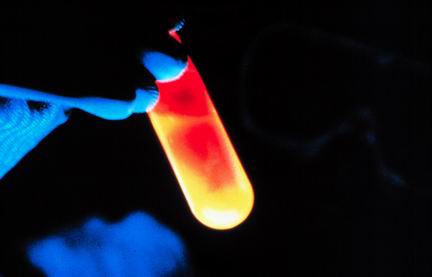
Which of the following is NOT evidence that that a chemical reaction has occurred?
a)
produces light/heat
b)
production of a gas
c)
formation of a precipitate
d)
melting
29.

For an investigation a student poured a blue solution of CuSO4 into a beaker. The student placed a shiny, silver-colored strip of zinc metal in the solution and observed the changes.
The student inferred that a chemical reaction occurred. What evidence supports this inference?
The student inferred that a chemical reaction occurred. What evidence supports this inference?
a)
A dark solid formed on the zinc metal.
b)
The zinc metal remained silver-colored and shiny
The zinc metal remained silver-colored and shiny
c)
The CuSO4 solution turned blue when the zinc metal was added.
d)
None of these
30.
How many atoms of carbon (C) are in C6H12O6?
a)
3
b)
6
c)
12
d)
24
31.
How many Sodium (Na) are in 6NaCl?
a)
1
b)
12
c)
6
32.
How many Aluminum are in Al2O3?
a)
3
b)
2
c)
5
33.
How many O's are in Al₂(SO₄)₃
a)
4
b)
12
c)
7
d)
24
34.
Which of the following shows the correct way to balance the chemical equation?
Fe + O2 -> Fe2O3
Fe + O2 -> Fe2O3
a)
4Fe + 3O2 -> 2Fe2O3
b)
2 Fe + 3O2 -> Fe2O6
c)
4 Fe + O6 -> 2Fe2O3
d)
None of the options are correctly balanced.
35.
Which of the following reactions is balanced?
a)
2CH4 + O2 -> CO2 + H2O
b)
CH4 + 2O2 -> CO2 + H2O
c)
CH4 + 2O2 -> CO2 + 2H2O
d)
None of the chemical equations are balanced.
36.
Balance this equation...
HgO --> Hg + O2
HgO --> Hg + O2
a)
It is balanced
b)
2HgO --> Hg + O2
c)
2HgO --> 2Hg + O2
d)
I don't know...Oh well!
37.
How many HCl molecules do you need to balance this equation?
Mg + __HCl ---> MgCl2 + H2
Mg + __HCl ---> MgCl2 + H2
a)
1
b)
2
c)
3
d)
4
38.
Balance this equation.
_CH4 + _O2 --> _CO2 + _H2O
_CH4 + _O2 --> _CO2 + _H2O
a)
1,2,1,1
b)
2,1,2,1
c)
1,2,1,2
d)
0,2,0,2
39.
Which coefficients balance this equation:
NH3 + O2 ----> NO + H2O
NH3 + O2 ----> NO + H2O
a)
2,3,5,6
b)
5,5,4,6
c)
4,6,4,5
d)
4,5,4,6
40.
In a reaction A + B ----> C, reactant A has 5g and product C has 9g. How many grams does reactant B should have?
a)
4g
b)
5g
c)
9g
d)
14g
41.
What is the law of conservation of mass?
a)
The amount of matter changes when reacted or changed.
b)
The mass of all reactants are changed during a physical or chemical change
c)
The mass of the reactants equals the mass of the products
d)
The mass of the products is different than the mass of the reactants.
42.
Students react baking soda & vinegar.
Which of the following would provide the evidence that the number of atoms present before a chemical reaction is equal to the number of atoms present after the chemical reaction?
Which of the following would provide the evidence that the number of atoms present before a chemical reaction is equal to the number of atoms present after the chemical reaction?
a)
The mass of the plastic bag, baking soda, and vinegar before the reaction was equal to the mass after the reaction.
b)
Bubbles were produced during the reaction, which meant that a gas was being produced.
c)
The plastic bag did not change in any way, indicating that it was not involved in the reaction.
d)
The mass of the baking soda was exactly equal to the mass of the vinegar used to create the chemical reaction.
43.
The total amount of matter (atoms) before and after a chemical reaction remains the same.
a)
True
b)
False
44.
What is the activation energy?
a)
The energy of the products
b)
The energy of the reactants
c)
The minimum energy needed by the reactants to form the products.
d)
The energy lost in the reaction
45.

What kind of reaction is this?
a)
Endothermic
b)
Exothermic
c)
Cannot be determined
46.
Which side is the arrow in a reactant?
a)
top
b)
right
c)
left
d)
bottom
47.
Which side is the arrow in a product?
a)
top
b)
right
c)
left
d)
bottom
48.
What is a coefficient?
a)
the larger number in the front of the chemical formula
b)
the smaller number below the chemical symbol
49.
What is a subscript?
a)
the larger number in the front of the chemical formula
b)
the smaller number below the chemical symbol
50.
What is rate of reaction?
a)
How fast a reaction is
b)
How big a reaction is
c)
How loud a reaction is
d)
How much gas a reaction produces
51.
What does a catalyst do?
a)
Stabilises a reaction
b)
Increases the rate of reaction
c)
Cools the reaction down
d)
Increases the concentration of the reaction
52.
This helps to speed up a reaction but does not take part in the chemical reaction.
a)
coeffiecents
b)
reactants
c)
catalyst
d)
combustion
53.
Reactants + Energy ----> _________
a)
Atoms
b)
Molecules
c)
Products
d)
Energy
54.
Increased surface area ______ reaction rate.
a)
Increases
b)
Decreases
55.
Increase in temperature of the reactants can do one of the following
a)
Slow collision frequency
b)
Allow less effective collision between the particles
c)
Cause particles to lose speed
d)
Increase collision between the particles thus increasing the rate.
100 %

