
 Worksheets
Week 1
Total questions: 20
Worksheet time: 15mins
Name
Class
Date
1.
Describes the arrangement of the cell membrane as flexible, bendable, and made of many parts.
a)
The Fluid Mosaic Model
b)
The Major Mobility Model
c)
The Crazy Cell Model
d)
The Maze Model
2.
___________ allow cells to recognize each other.
a)
Carbohydrates
b)
Proteins
c)
Phospholipids
d)
Cholesterol
3.
The cell membrane is selectively permeable, which means...
a)
All materials can enter and leave the cell
b)
Certain things can enter while others cannot
c)
The cell manually sorts through all materials
d)
Only certain cells can interact with the cell.
4.
What structure acts like a doorway allowing larger and more polar molecules through the membrane?
a)
carbohydrates
b)
proteins
c)
hydrophilic heads
d)
lipids
5.

Hydrophobic region of the cell membrane?
a)
E
b)
B
c)
C
d)
A
6.
What is a phospholipid made out of?
a)
Plasma, Membrane fluid, and Glucose
b)
Carbohydrates, Proteins, and cholesterol
c)
Ribosomes, Glycerol, and Plasma
d)
Glycerol, Two fatty acids, and a phosphate group
7.
What is NOT TRUE about the cell membrane
a)
It controls what enters and leaves the cell
b)
Semipermeable
c)
Phospholipid bilayer
d)
Contains digestive enzymes
8.
Phospholipid heads are...
a)
Hydrophobic
b)
Hydrophilic
9.
What forms the channels and pumps in the phospholipid bilayer?
a)
Carbohydrates
b)
Proteins
c)
Hydrophilic heads
d)
Lipids
10.

Part of the plasma membrane responsible for cell recognition...
a)
C
b)
E
c)
B
d)
D
11.

In the following diagram of the cell membrane, name the structure labeled 'B'.
a)
Transport protein
b)
Phospholipid bilayer
c)
Cholesterol
d)
Glycoprotein
12.
What is diffusion?
a)
when molecules move from a low concentration to a high concentration
b)
when molecules move from a high concentration to a low concentration.
c)
no movement
d)
molecules move everywhere
13.

Where is there a high concentration of water?
a)
in the flower
b)
cannot be determined by picture.
c)
in the vase
d)
in the leaves
14.

Osmosis
a)
diffusion of water molecules through a semi-permeable mebrane from an area of low concentration to an area of high concentration
b)
the diffusion of particles from an area of high concentration to an area of low concentration
c)
diffusion of water molecules through a semi-permeable membrane from an area of high concentration to an area of low concentration
d)
the diffusion of particles from an area of low concentration to an area of high concentration
15.
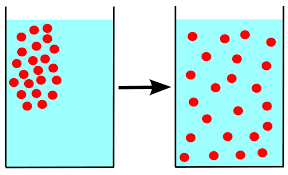
The picture below is an example of _________________.
a)
osmosis
b)
isotonic
c)
diffusion
d)
active transport
16.
Osmosis is the movement of _____ across a membrane.
a)
food
b)
energy
c)
oxygen
d)
water
17.

Equilibrium?
a)
a large amount of substance on side of the cell and a small amount on the other side
b)
a small amount of substance on side of the cell and a large amount on the otherside
c)
equal amount of substance on either side of the membrane
d)
no particles on either side of the a cell membrane
18.
In the given scenario what will happen to the organism: salt is poured onto eggplant.
a)
Water will move out of the eggplant cells and the cells will shrink.
b)
Water will move out of the eggplant cells and the cells will swell.
c)
Water will move into the eggplant cells and the cells will swell.
19.
In the given scenario what will happen? An egg is placed in pure water for 48 hours.
a)
The egg will gain water and swell.
b)
Water will move in and out of the cell equally, and the cell with neither shrink nor swell.
c)
The egg will lose water and shrink.
20.
An animal cell placed in a hypertonic (salty) solution will
a)
Shrink
b)
Swell
c)
Stay the same
100 %

