
 Worksheets
S347 Enzyme Review
Total questions: 48
Worksheet time: 41mins
How do enzymes speed up chemical reaction?
Increasing activation energy
Decreasing activation energy
Increasing deactivation energy
Decreasing deactivation energy
What is a substance called if it speeds up a chemical reaction?
reusable
catalyst
specific
fragile
Each enzyme only has 1 substrate that will fit its active site. What is this called?
reusablility
denaturation
specificity
fragility
With what 3 letters do enzymes typically end?
-ose
-ase
-ese
-tic
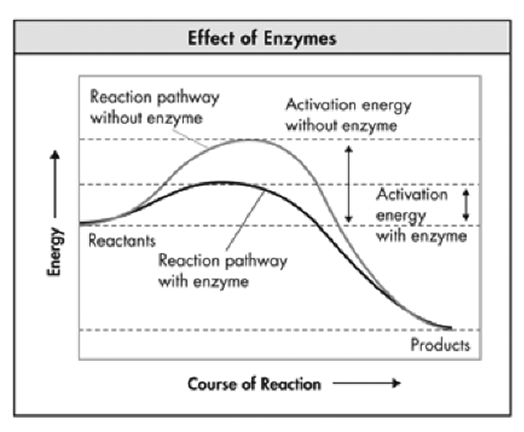
The graph shows how enzymes affect reactions in cells. Which statement best summarizes the information shown in the graph?
Enzymes increase the energy of the reactants.
Enzymes decrease the energy level of the products.
Enzyme decrease the activation energy of the reaction.
Enzymes reverse the direction of the reaction.
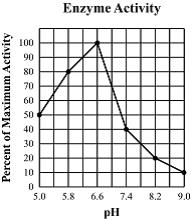
Which of the following conclusions can be drawn from this graph?
The optimum pH of the enzyme is 6.6.
The optimum pH of the enzyme is 5.8
The enzyme’s activity increases as pH increases 5.0 to 9.0
The enzyme’s activity is greater around pH of 8.0 .
Any substance that is acted upon by an enzyme is called a(n)?
Coenzyme
Substrate
Vitamin
Polypeptide
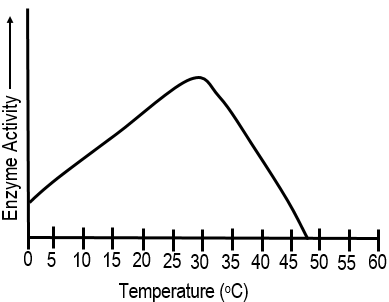
Based on the graph, what is the optimal temperature for this enzyme?
15oC
40oC
30oC
35oC
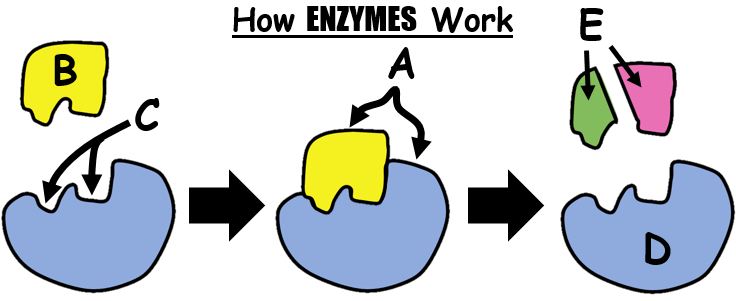
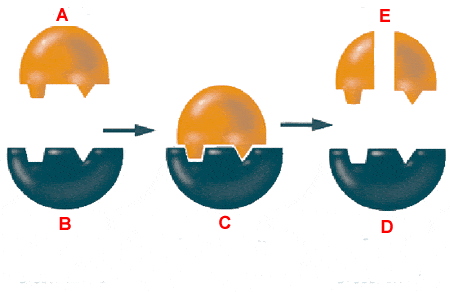
In the diagram, what is letter A?
product
substrate
enzyme-substrate complex
active site
Enzymes are...
nucleic acids
proteins
lipids
carbohydrates
An enzyme speeds up a chemical reaction in the cell but can only be used once. True or False?
true
false
What happens when enzymes are heated to a high temperature?
The enzymes die.
The shapes of the enzyme are altered denature
The enzymes' amino acid sequence changes.
The enzymes remain the same
Which of these is NOT true?
Enzymes can denature (change shape) when the temperature gets too high.
Enzymes can only be used once in a chemical reaction.
Extreme pH can denature enzymes.
Enzymes speed up chemical reactions.
Which of these is most likely an enzyme?
Sucrose
Galactose
Fructose
Amylase
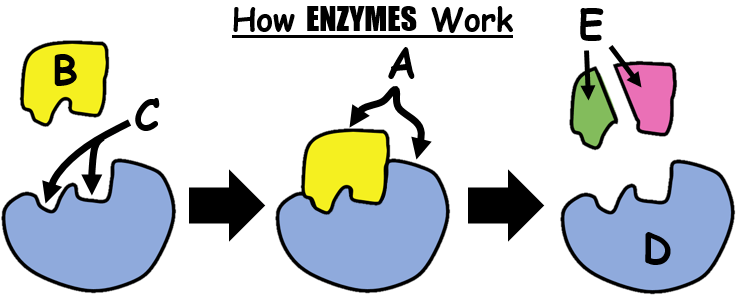
Letter D...
active site
enzyme
substrate
products
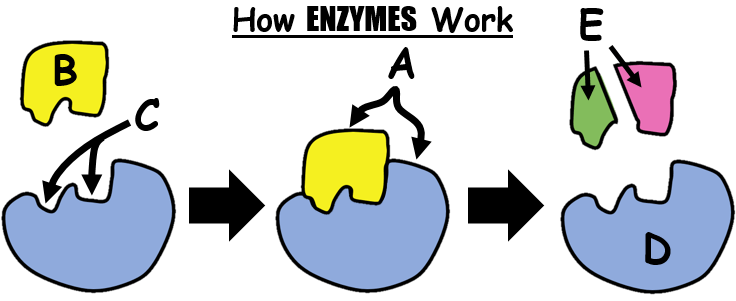
Letter B...
active site
enzyme
substrate
products
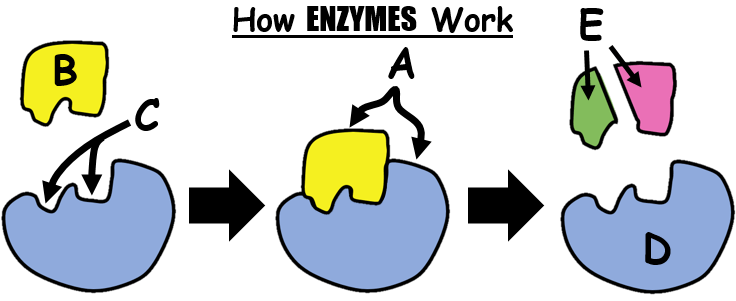
Letter C...
active site
enzymes
substrate
products
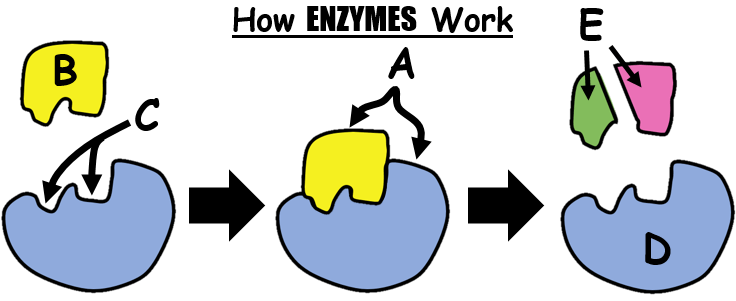
Letter E...
active site
enzyme
substrate
products
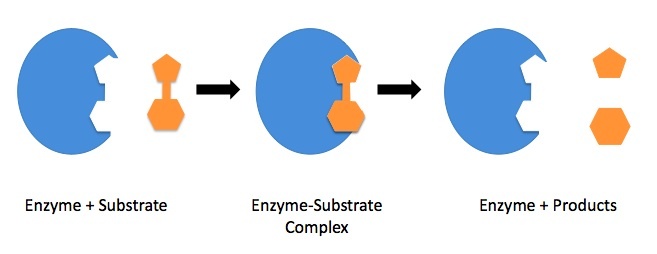
This reaction shows a(n) ____________ reaction
Catabolic
Anabolic
Dehydration Synthesis
Halogenation
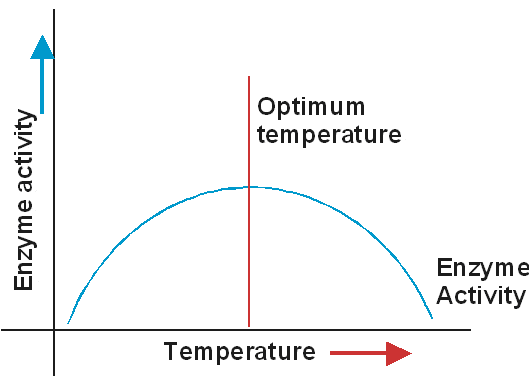
At high temperatures enzyme activity declines because of:
The enzyme denatures
Decreased Kinetic Motion
Increased H-Bonding
Dissociation of Ionic Compounds
what stop/slows enzymatic reactions by binding to the allosteric site of the enzyme?
noncompetative inhibitor
competative inhibitors
coenzymes
cofactors
what reduces the productivity of enzymes by blocking substrates from entering active sites?
noncompetative inhibitor
competative inhibitors
coenzymes
cofactors

How do non-competitive inhibitors affect enzymes?
It binds to the active site, blocking the substrate
It changes the shape of the enzyme
It increases the activation energy
It decreases the activation energy

How do competitive inhibitors affect enzymes?
It binds to the active site, blocking the substrate
It changes the shape of the enzyme
It increases the activation energy
It decreases the activation energy
When a molecule can occupy the same active site as the substrate, a situation called __________________ can result
Competitive lnhibition
Allosteric Regulation
Non-Competitive Inhibition
Feedback Inhibition

Based on the graph, which of the following could be used to increase the reaction rate beyond point C?
Increase the amount of substrate
Add more water
Increase the temperature
Decrease enzyme concentration
Endergonic reactions require:
an input of energy
a release of energy
do not change energy
Which type of reaction releases free energy into a system?
Endergonic
Nonspontaneous
Synthesis
Exergonic
The break down of larger molecules into small one.
metabolism
catabolism
anabolism
oxidation
sum of all chemical reactions
chemosynthesis
cellular respiration
metabolism
photosynthesis

What type of reaction is occurring in this graph?
endergonic
exergonic
unable to determine

Use the diagram to answer the question. Between which parts of the molecule must the bonds be broken to form an ADP molecule?
A and B
A and C
B and C
C and D
Energy is released from ATP when
a phosphate group is added
adenine bonds to ribose
ATP is exposed to sunlight
a phosphate group is removed
Which of the following is an example of potential rather than kinetic energy?
the flight of an insect foraging for food
the muscle contractions of a person mowing grass
water rushing over Niagara Falls
the bonds in a molecule of glucose
Succinate dehydrogenase catalyzes the conversion of succinate to fumarate. The reaction is inhibited by malonic acid, which resembles succinate but cannot be acted upon by succinate dehydrogenase. Increasing the ratio of succinate to malonic acid reduces the inhibitory effect of malonic acid. What is malonic acid's role with respect to succinate dehydrogenase?
It is a competitive inhibitor.
It is an allosteric regulator.
It is able to bind to succinate.
It blocks the binding of fumarate.
The place, other than the active site, where activators and inhibitors bind to an enzyme is called the ________ site.
competitive
allosteric
alterior
rate

If a process is spontaneous, what can be said about the Gibbs Free Energy of the process?
ΔG is negative
ΔG is positive
ΔG is zero

Where is the most easily accessible energy stored in an ATP molecule?
between the 1st and 2nd phosphate groups
between the adenine and ribose groups
between the 2nd and 3rd phosphate groups
between the ribose and the 1st phosphate groups
Where on an enzyme does the substrate bind?
active site
allosteric site
C-terminus
N-terminus
Which environmental conditions can cause denaturation of the enzyme?
slight increase in temperature
extreme increase in temperature
decrease in temperature
extreme increase in temperature and pH changes
Describe why an increase in temperature increases the rate of the reaction.
increase in temperature increases the speed/kinetic energy of particles
increase in temperature activates more enzyme to increase the rate
increase in temperature results in increase in substrate available
increase in temperature allows for a tighter fit in the active site
What is the process of an endergonic reaction being fueled by an exergonic reaction called?
second law of thermodynamics
energy coupling
first law of thermodynamics
endergonic/exergonic switch
A --> B + C
Anabolic
Catabolic
A + B --> C
Anabolic
Catabolic
A + B --> AB + Energy
This is what type of reaction?
exergonic
endergonic

