Wayground logo

Free Printable Worksheets

Font size

S
M
L
XL
Worksheets

DIA #4 Review cellular respiration and carbon cycle

Total questions: 45

Worksheet time: 37mins

Name
Class
Date
1.
All living things do which of the following?
a)

Chemosynthesis

b)

Cellular Respiration

c)

photosynthesis

d)

all of the answers

2.
What is one of the reactants of cellular respiration?
a)
energy
b)
glucose
c)
carbon dioxide
d)
water
3.
What are the products of aerobic respiration?
a)
Glucose and oxygen
b)
Carbon dioxide and water
c)
Lactic acid
d)
Carbon monoxide
4.
In which way are photosynthesis and cellular respiration different?
a)

Cellular respiration stores ATP, while photosynthesis releases ATP.

b)

Cellular respiration produces oxygen, while photosynthesis uses oxygen.

c)

Photosynthesis releases energy, while cellular respiration stores energy.

d)

Photosynthesis uses carbon dioxide, while cellular respiration produces carbon dioxide.

5.
What is the correct equation for cellular respiration?
a)
6O2 + C6H12O6 -> 6CO2 + 6H2O + Energy
b)
6O2 + C6H12O6 + Energy -> 6CO2 + 6H2O
c)
6CO2 + 6H2O -> 6O2 + C6H12O6 + Energy
d)
6CO2 + 6H2O + Energy -> 6O2 + C6H12O6
6.
Cellular Respiration's goal is to
a)
make water
b)
make ATP
c)
make glucose
d)
make  oxygen
7.
What is cellular respiration?
a)
the breakdown of glucose  to release ATP
b)
the breakdown of glucose to release NADH
c)
the breakdown of glucose to release FADH
d)
the breakdown of glucose to release carbon
8.
Where does aerobic respiration occur?
a)
glucose molecule
b)
mitochondria
c)
cytoplasm
d)
chloroplast
9.
Which is not a waste product of cellular respiration?
a)
Water
b)
Heat
c)
Carbon Dioxide
d)
Oxygen
10.
What are the two reactants of cellular respiration?
a)
C6H12O6 & 6CO2
b)
6 CO2 & 6H2O
c)
C6H12O6 & 6O2
d)
6CO2 & 6O2
11.
When humans burn fossil fuels, most of the carbon quickly enters the                       as carbon dioxide.
a)

Water

b)

Atmosphere

c)

Sun

d)

ground

12.
Which one of these does not add CO2 to the atmosphere?
a)
cooking with gas
b)
planting trees
c)
burning wood
d)
riding in a bus
13.
Combustion is another word for _______________.
a)
a train
b)
a bus
c)
a dog
d)
burning
14.
What does not produce carbon dioxide?
a)
Photosynthesis
b)
Burning Fossil Fuels
c)
Animal respiration
d)
Plants decaying
15.
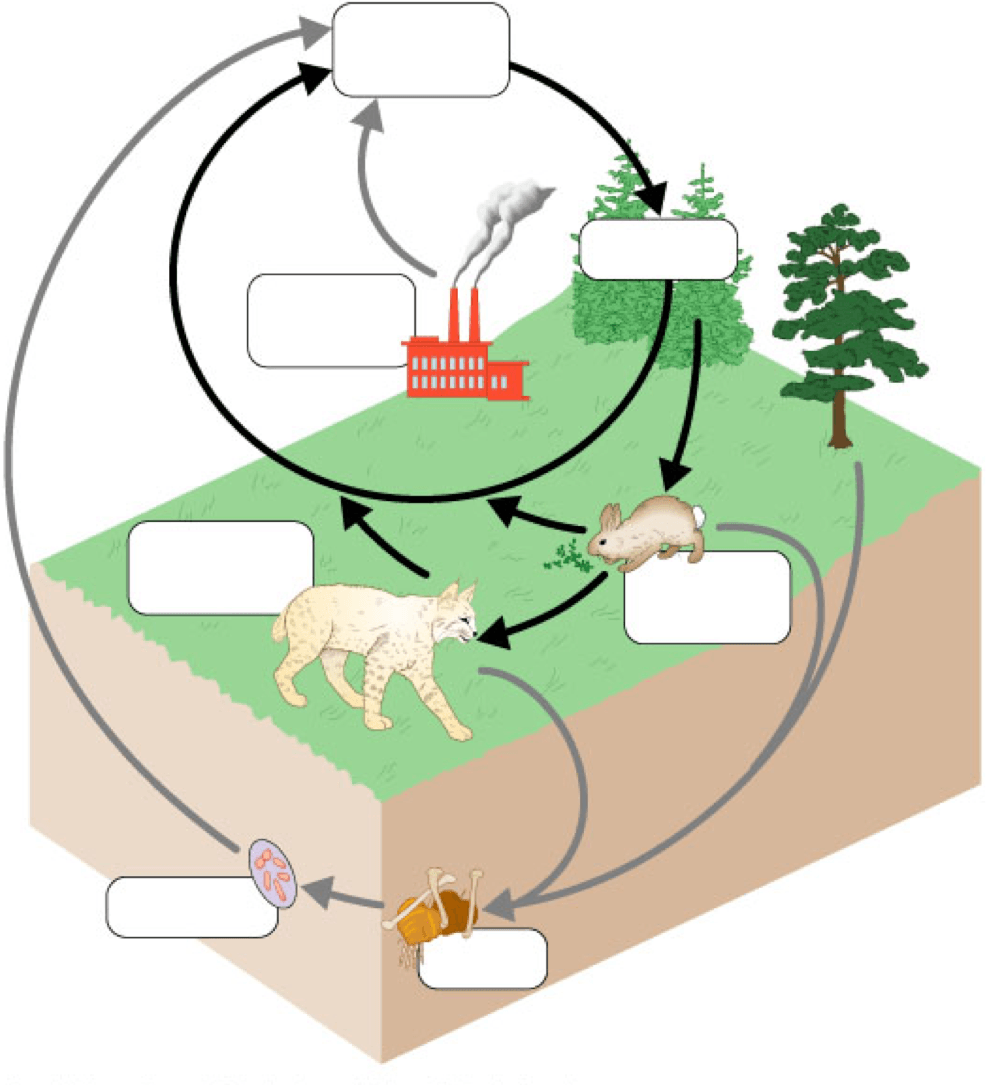
How do living organisms return carbon to the atmosphere in the carbon cycle?
a)
respiration and photosynthesis
b)
 decomposition and respiration
16.
In the carbon cycle, producers take in the gas __
a)
carbon dioxide
b)
oxygen
c)
nitrogen
d)
carbon monoxide
17.
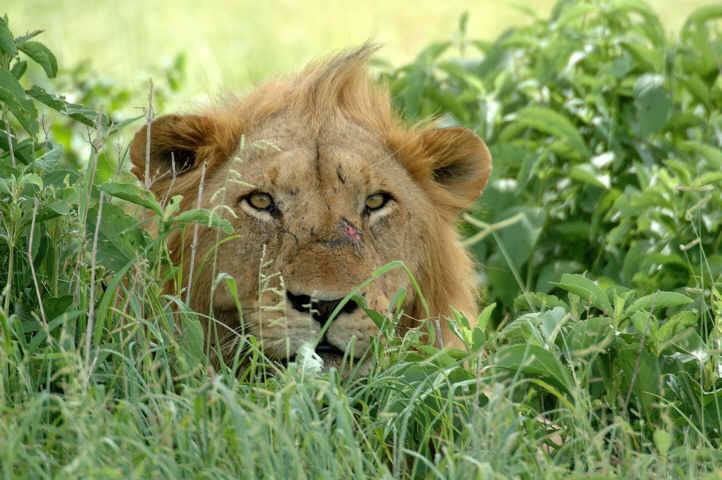
How does the carbon in grass become part of a lion?
a)
The lion eats the grass
b)
Carbon from grass doesn't end up in a lion. 
c)
The carbon ends up in the lion's food chain. 
d)
The lion breathes in carbon given out by the plant
18.
In what process is Carbon transformed into chemical energy?
a)
Photosynthesis
b)

The law of conservation of mass

c)

Weathering

d)

Mitosis

19.
oxygen is a gas produced by _ and used by  _ 
a)
plants and animals 
b)
photosynthesis and carbon dioxide 
c)
animals and plants 
d)
carbon dioxide and photosynthesis
20.
All of the carbon in existence is continually recycled in the carbon cycle
a)
True
b)
False
21.
Which of the following removes carbon from the atmosphere?
a)
Combustion
b)
Respiration
c)
Photosynthesis
d)
Death
22.
If the plant population decreased, the amount of carbon would _________.
a)
Stay the same
b)
Increase
c)
Decrease
23.
Why is the ocean important to the carbon cycle?
a)
It keeps sediment containing carbon underwater for millions of years
b)
The ocean gives out more carbon then it takes in (increases global warming)
c)
The ocean isn't important to the carbon cycle.
24.
Carbon can be found in...?
a)
The atmosphere
b)
Inside of the Earth
c)
Fossil fuels
d)
All of the above!
25.

What element is present in all living things?

a)

water

b)

carbon

c)

helium

d)

methane

26.
Fossil Fuels are also be known as 
a)
Renewable resources
b)
Non Renewable resources 
27.
In the carbon cycle, producers take in the gas __
a)
carbon dioxide
b)
oxygen
c)
nitrogen
d)
carbon monoxide
28.
Humans and animals release carbon dioxide into the air during photosynthesis  
a)
True                     
b)
 False
29.
What does Carbon Dioxide trap in our atmosphere that is causing Global Climate Change?
   
a)
water
b)
Minerals
c)
Oxygen
d)
Heat 
30.
The formation of fossil fuels is a process that takes millions of years and starts with energy from the sun. The sun contributes to the formation of fossil fuels by - 
a)
heating up the Earth's core where fossil fuels form
b)
generating winds so humans use less fossil fuels
c)
give energy to the living things that become fossil fuels 
d)
giving off heat, similar to burning fossil fuels
31.
Which of the following adds to the greenhouse effect and global warming?
a)
the conservation of national forests
b)
decreasing the amount of air pollution that is created by cars and buses
c)
the lessening of carbon emissions into the air
d)
the burning of too much fossil fuels
32.

Which is a true statement?

a)

Humans depend on oxygen, plants depend on carbon dioxide

b)

Plants produce carbon dioxide

c)

Humans depend on carbon dioxide, plants depend on oxygen

d)

Humans don't depend on plants for the air they need

33.
In a reaction A + B ----> C,  reactant A has 5g and product  C has 9g. How many grams does reactant B should have? 
a)
4g
b)
5g
c)
9g
d)
14g
34.
If a reaction starts with a total 75g of reactants it should produce 
a)
a total of 40g of products
b)
a total of 75g of products
c)
a total of 180 g of products
d)
None of the above
35.

One group of students read a reading passage in silence and one group of students read the passage with the TV on in the background. They both took a comprehension test to see what they understood from the passage and the results were compared. Identify the dependent variable.

a)

reading in silence or with the TV on

b)

results of reading comprehension test

c)

There isn't one.

36.

According to the graph, which statement is true?

a)

Fewer students received C's than F's.

b)

About 3 times as many students received A's than F's.

c)

There are about 70 students in the 7th grade class.

d)

More students received C's than F's.

37.

What happened to the temperature between the hours of 3:00-4:00?

a)

The temperature increased by 5 degrees.

b)

The temperature declined by 5 degrees.

c)

There was no change in the temperature.

d)

A snowstorm is going to hit this town.

38.

Which of the following is the label for the independent variable.

a)

Money Collected

b)

Raising Money

c)

Boxes Sold

d)

None of the above

39.

Which compound does NOT contain carbon atoms?

a)

carbon dioxide

b)

ammonium

c)

calcium carbonate

d)

methane

40.
When humans burn fossil fuels, most of the carbon quickly enters the                       as carbon dioxide.
a)
Water
b)
Atmosphere
c)
Sun
d)

Ground

41.
Which one of these does not add CO2 to the atmosphere?
a)
cooking with gas
b)
planting trees
c)
burning wood
d)
riding in a bus
42.
How do living organisms return carbon to the atmosphere in the carbon cycle?
a)
respiration and photosynthesis
b)
 decomposition and respiration
43.
How does the carbon in grass become part of a lion?
a)
The lion eats the grass
b)
Carbon from grass doesn't end up in a lion. 
c)
The carbon ends up in the lion's food chain. 
d)
The lion breathes in carbon given out by the plant
44.
All of the carbon in existence is continually recycled in the carbon cycle
a)
True
b)
False
45.

Which is a true statement?

a)

Humans depend on oxygen, plants depend on carbon dioxide

b)

Plants produce carbon dioxide

c)

Humans depend on carbon dioxide, plants depend on oxygen

d)

Humans don't depend on plants for the air they need