wayground logo

Free Printable Worksheets

NEW

Font size

S
M
L
XL
Worksheets

Earth's Changing Climate

Total questions: 62

Worksheet time: 1hrs 22mins

Name
Class
Date
1.
Located at the leading edge of a temperature drop off. Bring heavy thunderstorms, rain, and hail. Cool, fair weather is likely to follow.  
a)
Warm Front
b)
Cold Front
c)
Occluded Front
d)
Stationary Front 
2.
Where the warm and cold air meet and stall, clouds and fog form, and it may rain or snow.  It could bring many days of clouds and precipitation.  
a)
Warm Front
b)
Cold Front
c)
Occluded Front 
d)
Stationary Front 
3.
When a cold front overtakes a warm front, the temperature drops as the warm air mass is cut off from the ground and pushed upward.  It can bring strong winds and heavy precipitation. 
a)
Warm Front
b)
Cold Front
c)
Occluded Front
d)
Stationary Front 
4.
This is the symbol for a... 
a)
Cold Front
b)
Warm Front
c)
Stationary Front
d)
Occluded Front 
5.
This is the symbol for a... 
a)
Occluded Front
b)
Stationary Front
c)
Warm Front
d)
Cold Front 
6.
This is the symbol for a... 
a)
Stationary Front
b)
Occluded Front
c)
Cold Front
d)
Warm Front
7.
This is the symbol for a... 
a)
Stationary Front
b)
Occluded Front
c)
Cold Front
d)
Warm Front 
8.
Identify the type of front that is shown in the image.
a)
Occluded Front
b)
Cold Front
c)
Stationary Front
d)
Warm Front
9.
Identify the type of front that is shown in the image.
a)
Occluded Front
b)
Cold Front
c)
Stationary Front
d)
Warm Front
10.
Identify the type of front that is shown in the image.
a)
Occluded Front 
b)
Cold Front
c)
Stationary Front
d)
Warm Front
11.
Identify the type of front that is shown in the image.
a)
Occluded Front
b)
Cold Front
c)
Stationary Front
d)
Warm Front
12.
Humidity is the...
a)
Amount of Water Vapor in the Air
b)
Amount of Wind in the Air
c)
Amount of Precipitation in the Air
d)
Amount of Pressure in the Air
13.
________________ are made of water vapor that condenses in the troposphere.
a)
dew
b)
clouds
c)
evaporation
d)
transpiration
14.
Because the earth is spinning on its axis, the global winds appear to curve. This is known as the __________ ________.
a)
Coriolis Effect
b)
Greenhouse Effect
c)
Climate Effect
d)
Atmosphere Effect
15.
What kind of weather is usually associated with a low pressure system?
a)
Sunny weather
b)
Precipitation (rain, snow, etc.)
16.
What kind of weather is usually associated with a high pressure system?
a)
Sunny weather
b)
Precipitation (rain, snow, etc.)
17.
In what direction do winds always blow?
a)
From areas of high pressure to areas of low pressure
b)
From areas of low pressure to areas of high pressure
18.
A(n) _____ is a large body of air that has properties similar to the part of Earth's surface over which it depends.
a)
tornado
b)
pressure system
c)
front
d)
air mass
19.
When two air masses meet, there is a _____, or boundary.
a)
thunderstorm
b)
watch
c)
front
d)
cloud
20.
What part of the illustration shows Evaporation? 
a)
1
b)
2
c)
3
d)
4
21.
Which number illustrates Condensation?
a)
1
b)
2
c)
3
d)
4
22.
What does this symbol on a weather map indicate? 
a)
High pressure system
b)
Low pressure system
c)
Cold front
d)
Warm front
23.
Hot air (RISES / FALLS) __________.
a)
RISES
b)
FALLS
24.
Cold air (RISES/ FALLS)  _________.
a)
RISES
b)
FALLS
25.
Precipitation happens when clouds of water droplets are too ______________.
a)
cold
b)
light
c)
heavy
d)
hot
26.
What is the weather conditions in an area over a long period of time?
a)
climate
b)
temperature
c)
elevation
d)
precipitation
27.
What is climate?
a)
 What's going on with the atmosphere at any particular time
b)
The type of weather that occurs during a particular season
c)
An area's pattern of weather over a long period of time
d)
How much sunshine an area gets 
28.
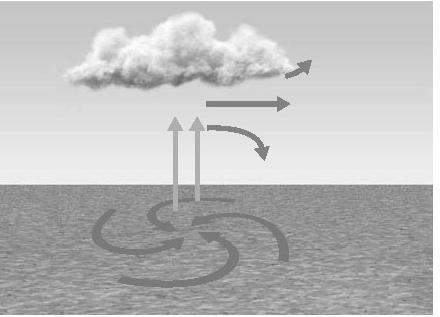
Which type of pressure system is pictured?
a)
high
b)
low
c)
medium
d)
none
29.
What type of weather would you expect with the pressure system pictured?
a)
clear
b)
cloudy
c)
severe storms
d)
hot
30.
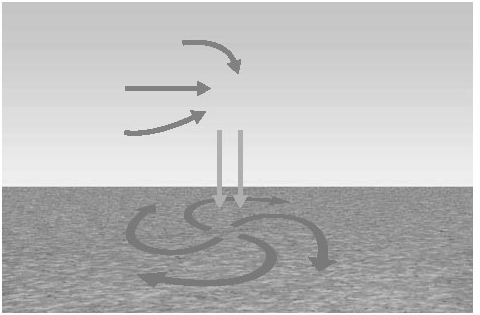
Which type of pressure system is pictured?
a)
high
b)
low
c)
medium
d)
none
31.
What type of weather would you expect from the pressure system pictured?
a)
clear
b)
cloudy
c)
hot
d)
stormy
32.
Cold air traveling south from Canada is:
a)
continental tropical
b)
continental polar
c)
maritime tropical
d)
maritime polar
33.
Warm air moving upwards from the Gulf of Mexico is:
a)
continental tropical
b)
continental polar
c)
maritime tropical
d)
maritime polar
34.
Warm air mass that does not carry water:
a)
continental tropical
b)
continental polar
c)
maritime tropical
d)
maritime polar
35.
Cold air mass that is carrying water is:
a)
continental tropical
b)
continental polar
c)
maritime tropical
d)
maritime polar
36.
In _________ pressure systems, air sinks:
a)
high
b)
low
c)
medium
d)
none
37.
In _______ pressure systems, air rises
a)
high
b)
low
c)
medium
d)
none
38.
Which term describes a circulation of air or water that is caused by uneven heating?
a)
convection current
b)
conduction current
c)
radiation current
d)
emission current
39.
Which statement describe parts of the water cycle and how clouds form? 1. Water evaporates from the earth's surface as it changes from a liquid to a gas. 2. Water vapor rises with rising, warm air. 3. At higher altitudes, where temperatures are cool, vapor (along with dust particles) condenses into drops of water that form clouds. 4. Low-pressure conditions also help clouds form. 
a)
1 and 2
b)
1, 2, 4
c)
1 and 3
d)
all of the above
40.
Earth would be too cold to support life without _____________________.
a)
global warming
b)
the greenhouse effect
c)
tropics
d)
seasons
41.
____________ air rises because it is ____________dense.
a)
Cool, Less
b)
Warm, Less
c)
Cold, More
d)
Warm, More
42.
The weight of air as it presses down on Earth's surface
a)
front
b)
air pressure
c)
air mass
d)
evaporation
43.
What can cause global warming?
a)
melting ice in Antarctica.
b)
riding a bike.
c)
too much carbon dioxide in the atmosphere
d)
unusual weather patterns near the South Pole
44.
What causes warm air to rise during a convection current?
a)
the warm air is more dense
b)
the warm air has very tightly packed molecules
c)
the warm air molecules are further apart and less dense
d)
no molecules exist in warm air
45.
Differences in air temperature and air pressure due to uneven heating of the Earth creates?
a)
atmosphere
b)
sunlight
c)
gravity
d)
wind
46.
Earth is unevenly heated due to its?
a)
oceans and moon
b)
tilt and shape
c)
gravity and clouds
d)
climate and weather
47.
Differences in water temperature in the ocean create currents because warm water ______ and cold water ______.
a)
sinks and sinks
b)
sinks and rises
c)
rises and sinks
d)
rises ad rises
48.
It is a cold, but sunny day.  There are almost no clouds.
What type of system is associated with the weather described above?
a)
low pressure system
b)
none of these
c)
Circulatory system
d)
high pressure system
49.
Convection currents, which affect weather and climate, are created by
a)
slow, constant tectonic movement
b)
mining of the seafloor
c)
erosion of ocean beaches
d)
the uneven heating of the Earth
50.
Why does too much carbon dioxide in the atmosphere cause climate change?
a)
It cools down our planet.
b)
It blocks out UV rays.
c)
It traps heat and warms up our planet.
d)
It lets sunlight escape.
51.

Which gas of the Earth's atmosphere is classified as a greenhouse gas?

a)

Nitrogen

b)

Carbon Dioxide

c)

Oxygen

52.
These are all important greenhouse gases.
a)
Oxygen, hydrogen and nitrogen
b)
Carbon dioxide, helium and clouds
c)
Carbon dioxide, water vapour and methane
d)
Methane, ethane and hydrogen
53.
Greenhouse gases are mostly absorbing this type of radiation.
a)
shortwave
b)
longwave
c)
ultra-violet
d)
blue
54.
What has the highest albedo?
a)
the oceans
b)
 glacial ice
c)
the ground
d)
roads
55.
Albedo can best be described as...
a)
the temperature at the equator
b)
the amount of solar radiation absorbed
c)
the amount of solar radiation reflected
d)
the air pressure during El Nino
56.
Melting ice caps will cause the poles to have a ____________ albedo.
a)
higher
b)
lower
c)
same
57.
Currently, about 10% of Earth is covered with ice year-round. If this ice melts, what could happen to Earth’s temperature?
a)
Increase
b)
Decrease
c)
Remain the Same
d)
Not enough information 
58.

If you want to keep your house cool all year, should you design the house roof to have a high or a low albedo?

a)

High

b)

Low

59.

Which of the following statements about heat is true?

a)

Heat flows from a warmer object to a cooler one until both are at the same temperature

b)

Heat flows from warmer object to a cooler one until the cold one is warm and the warm one is cool

c)

Cold moves out of the cold object and into the warm one.

60.

Which statement best describes what happens in conduction?

a)

Molecules in the hot object bump into colder molecules speeding them up

b)

Faster moving molecules spread out and become less dense so they rise carrying heat with them

c)

Hot objects give off invisible rays of light called infrared

61.

Which statement best describes what happens in convection?

a)

Hot, fast-moving molecules bump into colder, slower molecules speeding them up

b)

Hot, fast-moving molecules spread out, become less dense and rise carrying heat with them

c)

Invisible light called infrared is given off by hot objects. It travels through empty space and heats up objects when it strikes them.

62.

Which statement best describes what happens in radiation?

a)

Hot molecules spread out and become less dense which causes them to rise carrying heat with them.

b)

Hot objects give off invisible rays of light (infrared) which travel through empty space until they are absorbed by another object.

c)

Hot fast-moving molecules bump into cold, slow molecules speeding them up