wayground logo

Free Printable Worksheets

Font size

S
M
L
XL
Worksheets

Plate Tectonics Review

Total questions: 37

Worksheet time: 42mins

Name
Class
Date
1.

What type of boundary is pictured?

a)

divergent, rift valley

b)

divergent, sea floor spreading

c)

convergent, mid- ocean ridge

d)

convergent, rift valley

2.

What type of convergent boundary is pictured?

a)

convergent- oceanic & continental

b)

convergent- subduction zone

c)

convergent- continental & continental

d)

convergent- sea floor spreading

3.

Identify this geologic feature

a)

sea floor spreading from divergent boundary

b)

rift valley from convergent boundary

c)

subduction zone from convergent boundary

d)

crust destroyed from transform boundary

4.

Which letter represents the asthenosphere/mantle?

a)

A

b)

B

c)

C

d)

D

5.

Which of the following creates new crust?

a)
b)
c)
6.
The Great Rift Valley in Africa and the Mid-Atlantic Ridge were both created by this type of plate boundary. 
a)
divergent
b)
convergent
c)
transform
d)
subduction
7.
What drives tectonic plate movement? 
a)
gravity
b)
coriolis effect
c)
convection currents
d)
the earth's magnetic core
8.
Earthquakes and volcanoes are most likely found in which locations? 
a)
at plate boundaries
b)
in oceans
c)
in the middle of continents
d)
in the middle of plates
9.
When one plate slides underneath another, it ____ and the magma _____. 
a)
hardens; sinks
b)
melts; sinks
c)
hardens; rises
d)
melts; rises
10.
When an oceanic plate and a continental plate collide, which one will subduct? 
a)
oceanic
b)
continental
c)
neither
d)
both
11.
Two tectonic plates collide at a ___ plate boundary.
a)
convergent
b)
divergent
c)
transform
d)
transformer
12.
According to Wegener's hypothesis of continental drift, 
a)
Earth's surface is made up of seven major landmasses
b)
the continents DO NOT move
c)
Earth is slowly cooling and shrinking
d)
the continents were once joined together in a single landmass
13.
Most geologists rejected Alfred Wegener's idea of continental drift because...
a)
it did not agree with their current theory
b)
Wegener was interested in what Earth was like millions of years ago
c)
Wegener used several different types of evidence to support his hypothesis
d)
Wegener could not identify the force that moved the continents
14.
In Seafloor Spreading, molten material rises from the mantle and erupts or flows out 
a)
along the edges of all the continents
b)
along mid-ocean ridges
c)
in the deep ocean trenches
d)
in the north and south poles
15.
The geological theory that states that pieces of Earth's lithosphere are in constant, slow motion is the theory of
a)
subduction
b)
plate tectonics
c)
evolution
d)
seafloor spreading
16.
The process by which the ocean floor sinks beneath a deep ocean trench and back into the mantle is known as
a)
convection
b)
continental drift
c)
subduction
d)
conduction
17.
A place where two plates slide past each other, moving in opposite directions, is known as a
a)
transform boundary
b)
divergent boundary
c)
convergent boundary
d)
rift valley
18.
A rift valley forms at a 
a)
convergent plate boundary
b)
divergent plate boundary
c)
transform boundary
d)
deep ocean trench
19.
Who is the person credited with developing the theory of continental drift?
a)
Harry Hess
b)
Galileo
c)
Alfred Wegener
d)
Newton
20.
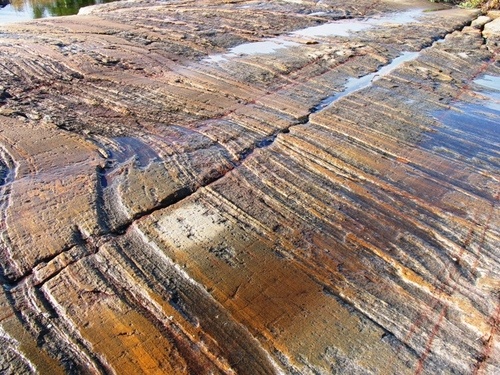
This is a picture of glacier scars found in Africa.  What are these evidence for?
a)
Africa has always been near the equator
b)
Africa was once in an area of the Earth that had a very cold climate
c)
The continents have not moved
d)
sea floor spreading
21.

According to the continental drift hypothesis, the presence of similar fossils in South America and Africa supports which scientific idea?

a)

Animals easily and frequently travel from Africa to South America.

b)

Species of animals probably traveled between continents on natural rafts (such as trees destroyed in tsunamis).

c)

Land bridges once existed that connected the continents.

d)

South America and Africa were once connected together.

22.
The thinnest layer of the Earth is the ___________.
a)
mantle
b)
crust
c)
core
23.
What is the thickest layer of the Earth?
a)
the crust
b)
the mantle
c)
the outer core
d)
the inner core
24.

What is the inner core made of?

a)

steel

b)

liquid iron

c)

aluminum

d)

solid iron

25.
Why is the inner core solid?
a)
its unknown
b)
what it's made of
c)
the pressure
d)
it is colder than the outer core
26.
What layer is a semisolid and acts like a plastic?
a)
Lithosphere
b)
Mantle
c)
Asthenosphere
d)
crust
27.
Which layer of Earth is made up of tectonic plates?
a)
outer core
b)
inner core
c)
asthenosphere
d)
lithosphere
28.

Which of the following DOES NOT describe the crust of the earth?

a)

it is thickest and least dense under the ocean

b)

it is thickest and least dense under the continents

c)

the continental crust is made up of mostly granite

d)

the oceanic crust is made up of mostly basalt

29.

Label the diagram.

30.

Reorder the following from LEAST DENSE to MOST DENSE.

a)

continental crust

b)

oceanic crust

c)

mantle

d)

outer core

e)

inner core

1)
2)
3)
4)
5)
31.

Draw what happens during SUBDUCTION. You may use arrows to show your thinking.

32.

Match the following plate boundaries.

a)

convergent (2 continental plates)

1.

mountain building

b)

convergent (plates are different densities)

2.

subduction

c)

divergent on land

3.

rift valley

d)

divergent (oceanic plates)

4.

sea-floor spreading

e)

transform

5.

faults

33.

The theory of ​ (a)   was what eventually explained HOW ​ (b)   was possible.

Choose from the below words
Plate Tectonics
continental drift
34.

Drag the labels to show where you would find the YOUNGEST oceanic crust and the OLDEST oceanic crust.

35.

Match the following to describe the 2 types of crust.

a)

oceanic crust description

1.

thinnest, more dense

b)

What the oceanic crust is made out of

2.

basalt

c)

continental crust description

3.

thicker and less dense

d)

What the continental crust is made out of

4.

granite

36.

Label the diagram.

37.

New crust is created at ​ (a)   plate boundaries while older crust is subducted at ​ (b)   plate boundaries.

Choose from the below words
divergent
convergent