
 Worksheets
Earth Science Review
Total questions: 40
Worksheet time: 3hrs 18mins
Which of the following natural resources are nonrenewable?
Water
Animals
Natural gas
Wind
Which of these is renewable?
Water
Oil
Coal
Minerals
The natural resource is any thing comes from ..................................
ground
nature
land
Which object is a natural resource?


Which thing is a natural resource?


Water, Air , Soil , Rocks , Animals and plants are .......................
Man-made resources.
Natural resources.
In what kind of rock can fossils be found?
Sedimentary Rocks
Igneous Rocks
Metamorphic Rocks
Granite
What are the 3 main fossil fuels?
Coal, Oil, and Gasoline
Coal, Oil, and Natural Gas
Electricity, Gasoline, Petroleum
Coal, Oil, Non-renewable Resources
What changes buried organic matter into fossil fuels?
Industrial Pollution
Ocean Currents
Volcanic Activity
Heat and Pressure

Which layer formed first?
Rock Layer W
Rock Layer X
Rock Layer Y
Rock Layer Z
Which of the following is not a type of fossil fuel?
Coal
Light
Petroleum
Natural Gas
Why do we depend on fossil fuels?
Electricity, transportation, and heating
Food
Sunlight
Growing, building muscle, calcium
Layers of rock formed when sediment is deposited and then compacted and cemented over time.
Sedimentary Rock
Igneous Rock
Metamorphic Rock
How long does it take fossil fuels to form?
Millions of years
24 hours
about a week or so
10 seconds
What are the 2 key things that were needed to form fossil fuels?
Dinosaurs and Ice
Heat and Pressure
Water and Sugar
Chicken and Rice
Which statement is related to climate?
The temperature has never dropped below 0°C in April.
The barometric pressure is high today
The sky is dark and cloudy.
There is a severe thunderstorm warning for the Dallas area.
Which statement below best describes weather?
Weather is the average temperature of an area over several years.
Weather is recorded yearly.
Weather changes and is recorded daily.
Weather cannot be predicted.
What is the difference between weather and climate?
Weather is measured over a period of years, and climate changes daily
Weather changes daily and can be predicted, but climate cannot ever be predicted.
Weather cannot be predicted, but climate is certain.
Weather conditions describe the daily atmospheric conditions, and climate is the average weather of an area measured over many years.
An area's _______________ is the weather conditions over a long period of time.
weather
climate
precipitation
temperature
Rain, sleet, snow, and hail are all examples of ________________.
Climate
Precipitation
Temperature
Weather
When temperature, cloud cover, wind speed, and precipitation are being measured over a short period of time, we are describing the _____________.
temperature
outside
climate
weather
Temperatures in the Artic are usually below freezing year round.
weather
climate
Winds are currently blowing from the North in Denver, Colorado.
weather
climate
Which statement below describes climate?
It’s hot outside.
It's normally warm outside.
It’s raining outside.
It’s cold and snowing outside.
Meteorologists forecast this.
Climate
Weather

What climate does a desert have?
Tropical
Polar
Arid/Dry
Temperate
an imaginary line that circles Earth halfway between the North and South Poles
typical
atmosphere
equator
climate
Breakdown of Rock into smaller pieces from the effects of water, wind , or ice?
Erosion
Weathering
Deposition
Climate
The movement of soil and rock by wind, water, ice, or natural forces?
Erosion
Weathering
Deposition
Climate
Feature on the surface of Earth such as a mountain, hill, dune, ocean, or river.
Runoff
Weather
Fossil
Landform
The build up of land by the settlement of sediments and soil in a new location.
Weathering
Erosion
Deposition
River

The photograph shows a canyon in northern Arizona. Which of these best describes how this canyon was most likely formed?
Floods eroded the sandstone away from the canyon walls
Glaciers eroded the canyon rock as they melted and moved.
Ice wedged into cracks in the rock and weathered the canyon walls
Wind blew large rocks that smashed against the canyon walls.

What land form is this?
valley
plain
volcano
mountain
What role does the Sun play in the water cycle?
The Sun splits the water molecules and they disappear
The Sun causes clouds to form and they accumulate
The Sun is not part of the water cycle
The Sun causes water to change form and move by heating it up
What is the energy source for the water cycle?
the sun
the earth
water
the moon
Which of these is an example of precipitation?
snow
air
clouds
vapor

What is it called when plants give off water vapor as a waste product?
condensation
evaporation
sublimation
transpiration
Lakes, rivers, and oceans are examples of ___________________, or a buildup that occurs over time.
evaporation
condensation
precipitation
accumulation
When water vapor travels to the clouds, the gas cools and changes into a liquid. This process is known as ______________________.
evaporation
condensation
precipitation
accumulation
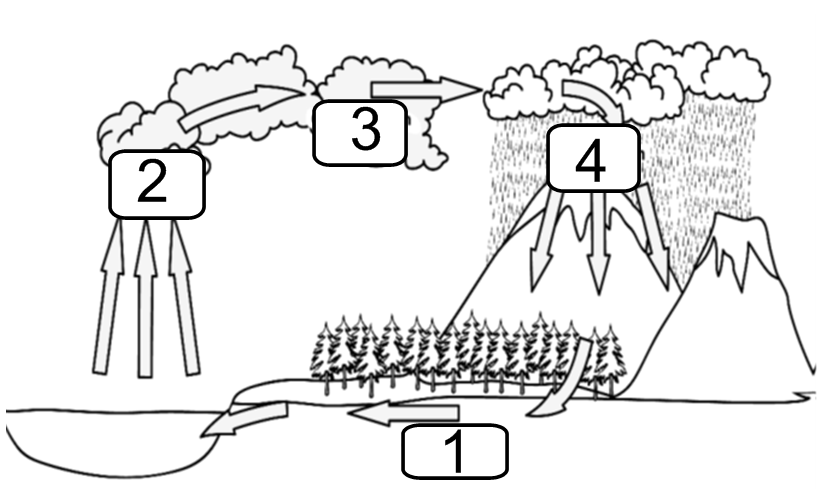
Which stage does the #2 show in the diagram?
condensation
evaporation
precipitation
run off

