wayground logo

Free Printable Worksheets

NEW

Font size

S
M
L
XL
Worksheets

Static Electricity and Parts of a Circuit Review

Total questions: 48

Worksheet time: 9mins

Name
Class
Date
1.
Wood is a(n) _____.
a)
conductor
b)
insulator
2.
Water is a(n) ______.
a)
conductor
b)
insulator
3.
A material in which electrons are not able to move easily is a(n) ______________________.
a)
circuit 
b)
insulator 
c)
resistance 
d)
conductor
4.

When there is a path for electrons to move through and the light turns on, the circuit is ______________.

a)

closed

b)

open

5.
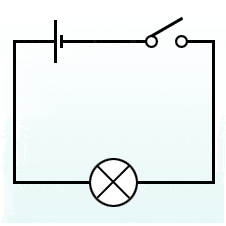
This circuit is _________.
a)
open
b)
parallel
c)
closed
d)
The cutest little circuit evah!
6.
When all parts of the circuit are connected it is a(n) ___________ circuit. 
a)
open
b)
closed
7.
When you flip a light switch on and off you are closing and opening a circuit.
a)
true
b)
false
8.
A circuit is a pathway through which electricity flows.
a)
true
b)
false
9.
A circuit must be closed for electrons to travel.
a)
true
b)
false
10.

A conductor allows electrons to flow through it.

a)

true

b)

false

11.
What is a switch's function in a circuit?
a)
to make the current hotter or colder
b)
to turn on and off the flow of current
c)
it is the pathway through which current flows
d)
to add more power to the circuit
12.
Silver is a(n) __________.
a)
insulator
b)
conductor
13.
In which of these circuits will the light bulb turn on?
a)
A
b)
B
c)
C
d)
D
14.

Lightning is a discharge of static electricity.

a)

true

b)

false

15.
A switch can change an open circuit into a(n) _______________.
a)
closed circuit
b)
electrical circuit
c)
parallel circuit
d)
series circuit
16.
Which component supplies the power (energy) to a circuit?
a)
Battery
b)
Wire
c)
Light Bulb
d)
Light Sensor
17.
In which of these circuits will the motor turn on?
a)
A
b)
B
c)
A & B
d)
D
18.
Pick the correct sentence.
a)
This circuit will work because it is a closed circuit.
b)
Energy will freely flow in this circuit.
c)
This circuit will not work because there is no energy source.
d)
This circuit will not work because there is no switch.
19.
Which statement is true?
a)
The light bulb will light up because the circuit is complete.
b)
The light bulb will light up because the circuit is broken.
c)
The light bulb will not light up because the circuit is complete.
d)
The light bulb will not light up because the  circuit is broken.
20.
When you charge a balloon by rubbing it on your hair this is an example of what method of charging?
a)
Friction
b)
Conduction
c)
Grounding
d)
Induction
21.
Neutral atoms contain equal numbers of positive __ and negative __.
a)
Electrons and Protons
b)
Protons and Electrons
c)
Neutrons and Electrons 
d)
Protons and Neutrons
22.
Transferring a charge without touching is ___
a)
conduction
b)
induction
c)
grounding 
d)
Newtons 3rd law
23.
In a neutral atom ___.
a)
protons = neutrons
b)
electrons = neutrons
c)
protons = electrons
d)
neutrons = protons = electrons
24.

If a charged rod touches a conductor, the conductor will be charged by what method?

a)

Friction

b)

Conduction

c)

Induction

d)

Convection

25.
What do you call the process of charging a conductor by bringing it near another charged object?
a)
induction
b)
polarization
c)
neutralization
d)
conduction
26.
Two like charges
a)
 neutralize each other.
b)
repel each other. 
c)
must be neutrons. 
d)
attract each other.
27.

A positively charged object contains _____.

a)

no protons

b)

more protons than electrons

c)

only electrons

d)

more electrons than protons

28.

Which of the following particles are present in the nucleus of an atom?

a)

Electrons only

b)

Neutrons only

c)

Electrons and protons

d)

Protons and neutrons

29.

Two students are trying to decide whether or not Object A is charged. They perform the following two tests:


Test 1: They bring Object A near a positively charged tape and observe repulsion.

Test 2: They bring Object A near a negatively charged tape and observe attraction.

These two tests lead to the conclusion that Object A is _____.

a)

charged negatively

b)

charged positively

c)

electrically neutral

d)

charged, but with an unknown type of charge

30.

What types of charges attract?

a)

Positive and Positive

b)

Neutral and Neutral

c)

Negative and Neutral

d)

Positive and Negative

31.

The build-up of electric charges on an object is called

a)

static electricity.

b)

electric discharge.

c)

resistance.

d)

a circuit.

32.

Electric charges that are alike _______ each other.

a)

attract

b)

repel

33.
If a substance has a higher number of electrons than protons on its surface, what type of charge does it have?
a)
A positive charge.
b)
A negative charge.
c)
A neutral charge
d)
No charge at all
34.

Which of the following is caused because of static electricity?

a)

a stove getting hot when it is turned on

b)

a magnet being attracted to a refrigerator

c)

a lightning strike during a storm

d)

a light bulb coming on when a switch is turned on

35.

To make a neutral object positive, you must add protons.

a)

True

b)

False

36.

To make a neutral atom negative, you must remove protons.

a)

True

b)

False

37.
Plastic is an example of _______.
a)
an insulator
b)
a conductor
38.
A metal spoon is an example of _____.
a)
a conductor
b)
an insulator
39.

Materials that tightly hold onto electrons are considered

a)

good conductors.

b)

good insulators.

c)

good anti-static agents.

d)

useful for storing spare change.

40.

Materials that easily lose or accept electrons are considered

a)

good conductors.

b)

good insulators.

c)

good anti-static agents.

d)

good for storing spare change.

41.
Removing a static charge by providing a path to the ground is called __.
a)
electric transfer
b)
grounding
c)
switching
d)
seperation
42.
Transferring a charge without touching is ___
a)
conduction
b)
induction
c)
grounding 
d)
Newtons 3rd law
43.

Lightning rods are insulators that provide a pathway to the ground.

a)

true

b)

false

44.

If you increase the voltage in a circuit, but keep the resistance the same, the current

a)

will increase or go faster.

b)

will decrease or go slower.

c)

will stay the same.

d)

will increase but the bulbs will burn dimmer.

45.

If you increase the resistance, and keep the voltage the same, the current will

a)

will increase or go faster.

b)

will decrease or go slower.

c)

will stay the same.

d)

will increase but the bulbs will burn dimmer.

46.

Electrons flow from from the negative end of a battery, through the circuit, toward the positive end of the battery.

a)

true

b)

false

47.

Current flows from from the positive end of a battery, through the circuit, toward the negative end of the battery.

a)

true

b)

false

48.

The movement of electrons is

a)

static electricity.

b)

electricity or current

c)

resistance.

d)

caused by the Force.