wayground logo

Free Printable Worksheets

Font size

S
M
L
XL
Worksheets

Midterm Review

Total questions: 206

Worksheet time: 9hrs 24mins

Name
Class
Date
1.
Does this graph in the back have maximum or minimum value?
a)
maximum
b)
minimum
c)
neither
d)
both
2.
Name the x-intercept(s)?
a)
0
b)
4
c)
2
d)
0 and 4
3.
Which of the following is a zero of x(x + 4)(x - 2)
a)
0
b)
4
c)
-2
d)
1
4.
Where is the graph increasing?
a)
(-∞, -2.55) U (2.55, ∞)
b)
(0, ∞)
c)
(-2.55, 0) U (2.55, ∞)
d)
(-6.25, 36)
5.
What are all the x-intercepts?
a)
(-2.55, 0), (2.55, 0)
b)
(-3,0), (-2,0), (2,0), (3,0)
c)
(0, 36)
d)
(-∞,∞)
6.
What is the relative max?
a)
(0, 36)
b)
(-2.55, -6.55), (2.55, -6.55)
c)
(-∞, ∞)
d)
None
7.
What is the relative min?
a)
(0, 36)
b)
(-2.55, -6.55), (2.55, -6.55)
c)
(-∞, ∞)
d)
None
8.
What is the end behavior as x → +∞, f(x)→ ?
a)
-∞
b)
9.
What is the end behavior as x → -∞ f(x)→ ?
a)
-∞
b)
10.
When is this function increasing?
a)
-2.5 < x < 2.5
b)
0 < x < 5
c)
0 < x < 55
d)
-5 < x < 0
11.
Where is the function decreasing?
a)
y≤2
b)
y≥2
c)
y≤4
d)
y≥4
12.
For what intervals of x is f(x) positive?
a)
x<-2 and x>2
b)
-2<x<2
c)
x≤-2 and x≥2
d)
x≥-4
13.
For what intervals of x is f(x) negative?
a)
-2<x<2
b)
-2≤x≤2
c)
x<-2 and x>2
d)
x≤-4
14.
y = -x2
a)
down and down
b)
down and up
c)
up and down
d)
up and up
15.
y = 6 - 8x7
a)
down and down
b)
down and up
c)
up and down
d)
up and up
16.
y = 8x2 - 5x8 + 3x7-10x5
a)
down and down
b)
down and up
c)
up and down
d)
up and up
17.
How many extrema (maxes and mins) are in the picture?
a)
2
b)
3
c)
4
d)
5
18.
Fill in the blank:  The maximum number of turning points is ____ less than the degree of the polynomial.
a)
0
b)
1
c)
2
d)
3
19.
What is the maximum number of turning for the function f(x) = 8x3-27
a)
0
b)
1
c)
2
d)
3
20.
Determine the domain of the graph.
a)
(1, +∞)
b)
[1, +∞)
c)
(2, +∞)
d)
[2, +∞)
21.
Which point is an example of a y-intercept?
a)
(3,4)
b)
(-2,8)
c)
(0,4)
d)
(5,0)
22.
What is the domain of this function in interval notation?
a)
(1, infinity)
b)
[1, infinity)
c)
(2, infinity)
d)
[2, infinity)
23.
What is the range of this function in interval notation?
a)
(1, infinity)
b)
[1, infinity)
c)
(2, infinity)
d)
[2, infinity)
24.
What is the interval of increase of this function?
a)
(1, infinity)
b)
None
c)
(2, infinity)
d)
All real numbers
25.
What is the interval of increase of this function?
a)
(1, infinity)
b)
None
c)
(2, infinity)
d)
All real numbers
26.
What is the interval of decrease of this function?
a)
(1, infinity)
b)
None
c)
(2, infinity)
d)
All real numbers
27.
What is the minimum of this function?
a)
(2, 1)
b)
None
c)
(1, 2)
d)
Infinity
28.
What is the maximum of this function?
a)
(2, 1)
b)
None
c)
(1, 2)
d)
[2, 1]
29.
What is the vertex of the graph?
a)
(2, 4)
b)
(3, -1)
c)
(0, 8)
d)
(4, 2)
30.
What piece of information does c identify in the following equation?
y=ax2+bx+c
a)
Zeroes
b)
Axis of Symmetry
c)
Direction
d)
y-intercept
31.
What direction is the following equation opening?
y=-3x2-7x+8
a)
Concave Up
b)
Concave Down
32.
What is the
y-intercept of 
f(x)=-2x2 + 4x - 6
a)
(0, 6)
b)
(0, -6)
c)
(6, 0)
d)
(-6, 0)
33.
What is the axis of symmetry?
a)
x = - 4
b)
x = - 2
c)
x = 0
d)
x = 4
34.
Match the possible equation to the graph.
a)
y = 2x2 - 5
b)
y = -x2 - 5
c)
y = 3x2 +5
d)
y = 5x2
35.
What form is the equation in?
y = 2x2-8x+7
a)
Standard
b)
Vertex
c)
Factored
d)
None of These
36.
What is the axis of symmetry for the following equation?
y=4x2-8x+9
a)
x=-8
b)
x=1
c)
x=-1
d)
x=2
37.
Find the vertex of 
f(x) = -x- 4x + 12
a)
(-2, 16)
b)
(2, 0)
c)
(2, 4)
d)
(-2, 4)
38.
Find the y-intercept of
f(x) = 2x2-2x + 1

a)
2
b)
-2
c)
1
d)
-1
39.
Does
y = -4x2
have a maximum or minimum value?

a)
maximum
b)
minimum
40.
When a basketball is shot, it forms an arc (also known as a parabola). When the basketball reaches it's highest point, what is that point called?
a)
Minimum value
b)
Slope
c)
Maximum value
d)
A parabola
41.
Which form is the equation
y = -3(x-5)2+7 in?
a)
Standard
b)
Vertex
c)
Factored
d)
None of These
42.
What is the vertex of the quadratic function: y=1/2(x-3)2+8?
a)
(3,8)
b)
(-3,-8)
c)
(-3,8)
d)
(3,-8)
43.
Joe Mauer hits a fly ball.  You can track the height of the ball using the equation:   h(t) = -16t2 + 140t + 2  
What was the starting
                        height of the ball?                                                                                      
a)
-16 feet
b)
140 feet
c)
2 feet
d)
0 feet
44.
If the graph of a quadratic does not intercept the x-axis at any point, then it has:
a)
1 Real Solution
b)
2 Real Solutions
c)
Half a Solution
d)
No Real Solution
45.
Describe the discriminant.
a)
Two Real Solutions
b)
One Real Solution
c)
Two Imaginary Solutions
d)
I don't know
46.
A quadratic function has zeros -7 and 9.
What are the linear factors of the function?
a)
(x+7) (x-9)
b)
(x-7) (x+9)
c)
(-7,0) (9,0)
d)
(0,-7) (0,9)
47.
Which transformation transforms the graph of
f(x) = x2 to the graph of
g(x) = (x + 4)2?
a)
a vertical translation 4 units up
b)
a vertical translation 4 units down
c)
a horizontal translation 4 units to the left
d)
a horizontal translation 4 units to the right
48.
Which of the following best describes at the zeros?
a)
The dolphins are at the surface of the water.
b)
The dolphins are at the furthest distance from the water.
c)
The dolphins are increasing their distance from the water.
d)
The dolphins are under water.
49.
Ed hits a shot off the tee that has a height modeled by the function f(t) = -16t2 + 112t.  What is the height of the ball after 1 second?
a)
0 ft
b)
160 ft
c)
96 ft
d)
112 ft
50.
A soccer ball is kicked from the ground with an initial upward velocity of 90 feet per second. The equation h=-16t+ 90t gives the height h of the ball after t seconds.
What is the maximum height of the ball?
a)
126.56 ft
b)
5.625 sec
c)
2.81 sec
d)
90 ft
51.

Based on the table, which function can best be used to model this situation?

a)

h(t) = 99t2 + 858

b)

h(t) = -4.9t2 + 295t + 0.6

c)

h(t) = -4.9t2 + 295t + 2

d)

h(t) = 99t2 + 1,470.3

52.

Estimate the amount of time in seconds it took for the projectile to reach the ground.

a)

60 seconds

b)

10 seconds

c)

85 seconds

d)

175 seconds

53.

Based on the table, what was the maximum height of the projectile?

a)

4, 440 feet

b)

30 feet

c)

3, 940 feet

d)

35 feet

54.

A toy rocket is launched vertically upward from ground level with an initial velocity of 128 feet per second. The function

h(t) = -16t2 +128t represents the projectile of the rocket.

What is the maximum height of the rocket?

a)

4 ft

b)

256 ft

c)

0 ft

d)

4 seconds

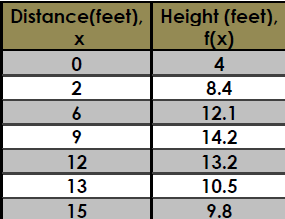
55.

What is the vertex of the following quadratic function from the following data?

a)

(3, -4)

b)

(2, 1)

c)

(0, 5)

d)

(5, 1)

56.

At a high school track and field meet an athlete was given 3 throws at shot put. What was the maximum height of the shot put at throw #3?

a)

12 feet

b)

20 feet

c)

16 feet

d)

4 feet

57.

The graph shows the projectile of a rocket. What does the zero of the graph represent?

a)

The amount of time it took the rocket to land on the ground.

b)

The maximum height of the rocket.

c)

The amount of time it took the rocket to reach its maximum height.

d)

The height of the rocket before it was launched.

58.
A parabola has a vertex at (-3,2).
Where is the axis of symmetry?
a)
y = -2
b)
x = 3
c)
x = -3
d)
y = 2
59.
What is the range of  y= (x + 5)2 - 8
(hint: make a sketch first)
a)
y ≥ -5
b)
y ≥ 5
c)
y ≥ 8
d)
y ≥ -8
60.

Which function’s graph has a vertex at (3, 5) and contains the point (5, 13)?

a)
b)
c)
d)
61.

Which quadratic function in vertex form can be represented by the graph that has a vertex at (-8, -5) and passes through the point (-13, 5)?

a)
b)
c)
d)
62.

Which function’s graph has a vertex at (-1, 7) and contains the point (3, -25)?

a)
b)
c)
d)
63.
(2x + 5y - z) + (-6x - 4y + 7z)
a)
-4x +6y + 6z
b)
4x + y + 6z
c)
-4x - y + 6z
d)
-4x + y + 6z
64.
(3x + 4y - 3z) - (2x - 6y + 7z)
a)
x + 10y - 10z
b)
-x +10y - 10z
c)
x -10y - 10z
d)
-x -10y - 10z
65.
(4x3-5x2+3x)+(-2x3-x2+6x)
a)
2x3-6x2-9x
b)
2x3+6x2+9x
c)
-2x3-6x2+9x
d)
2x3-6x2+9x
66.
(5x- 4x- 2x2 + x - 19) - (x+ 5x3 + 8x2 + x + 5)
a)
4x- 9x- 10x- 24
b)
4x- 9x3 - 10x- 2x - 24
c)
4x4 - 9x3 - 10x2 + 2x - 24
d)
-4x4 - 9x3 - 10x2 - 24
67.
(x+5)2
a)
x2+25
b)
2x+10
c)
x2+10x+25
d)
12x
68.
(2x + 1)(x - 3)
a)
-3x - 3
b)
2x2 + 5x - 3
c)
2x2 - 5x - 3
d)
2x2 - 5x +3
69.
(2x + 3)(x2 + 4x + 1)
a)
2x3 + 10x2 + 14x + 4 
b)
2x3 + 11x2 + 14x + 3 
c)
-2x3 - 11x2 + 14x + 5 
d)
x3 - 11x2 + 14x + 3 
70.
Classify by degree of polynomial:
3x3 – 6x
a)
Constant
b)
Linear
c)
Quadratic
d)
Cubic
71.
Classify by number of terms:
2x – 9
a)
Monomial
b)
Binomial
c)
Trinomial
d)
4-Term Polynomial
72.
Classify by degree of polynomial:
2x – 9
a)
Constant
b)
Linear
c)
Quadratic
d)
Cubic
73.
Classify by number of terms:
3x2 – 8x + 1
a)
Monomial
b)
Binomial
c)
Trinomial
d)
4-Term Polynomial
74.

How many zeros of the polynomial represented by the given curve

a)

1

b)

2

c)

3

d)

4

75.
f(x)=(x+4)(x-3)(x-2)
List the zeros for this function.
a)
x=-4, x=3, x=-2
b)
x=-4, x=3, x=2
c)
x=-4, x=3, x=2
d)
x=4, x=3, x=2
76.
Write the cubic polynomial in factored form with 
zeros -1, 1, and 4
a)
(x + 1) (x - 1) (x - 4)
b)
x3 - 4x2 - x + 4
c)
(x + 1) (x - 1) (x + 4)
d)
x3 - 4x2 - x - 4
77.

The remainder when 3x4 - 2x2 +5 is divided by x+1

a)

-6

b)

6

c)

8

d)

-8

78.

If g(x) is a factor of the polynomial p(x), the remainder when p(x) is divided by g(x) is

a)

0

b)

1

c)

2

d)

3

79.
If one zero of the quadratic polynomial x2 + 3x + k is 2, then the value of k is
a)
10
b)
–10
c)
5
d)
– 5
80.

The graphs below represent functions defined by polynomials. For which function are the zeros of the polynomials 2 and −3?

a)
b)
c)
d)
81.

Based on the graph below, which expression is a

possible factorization of p(x)?

a)

(x+3)(x−2)(x−4)

b)

(x−3)(x+2)(x+4)

c)

(x+3)(x−5)(x−2)(x−4)

d)

(x−3)(x+5)(x+2)(x+4)

82.
(2u-4v)2
a)
4u2-8uv+16v2
b)
4u2-16uv+16v2
c)
4u2-16v2
d)
4u2+8uv+16v2
83.
8r3 + 16r2
a)
4r2(2r + 4)
b)
8r2(r + 2)
c)
8(r3 + r2)
d)
4(r3 + 2r2)
84.
Factor
x-16x + 48
a)
(x - 12)(x - 4)
b)
(x + 6)(x - 8)
c)
(x + 12)(x - 4)
d)
(x -16)(x - 3)
85.
Factor:
x2 - 9
a)
(x + 3)(x - 3)
b)
(x + 3)2
c)
(x - 3)2
d)
(x+3)(x+3)
86.
Factor completely: 3x² - 7x + 2
a)
(x - 1) (3x + 2)
b)
(x - 2) (3x -1)
c)
(x - 1) (3x - 2)
d)
(x + 2) (3x + 1)
87.
Factor Completely: 2x² + x - 6
a)
(x + 2) (2x -3)
b)
(x - 6) (2x + 1)
c)
(x + 1) (2x - 6)
d)
(x - 2) (2x + 3)
88.
Factorly Completely: 2x² - 7x + 6
a)
(x -1)(2x - 6)
b)
(x - 3) (2x - 2)
c)
(x - 2) (2x - 3)
d)
(x - 6) (2x - 1)
89.
Factor Completely: 4x² - 20x + 25
a)
(4x - 25) (x -1)
b)
(2x + 5) (2x - 5)
c)
(2x - 5)²
d)
(4x - 5) (x - 5)
90.
For synthetic division, what would be the number in the left hand box?
a)
0
b)
1
c)
2
d)
3
91.
Divide using synthetic division 
(2x³ + 4x² - 5) by (x + 3).
a)
2x² + 2x - 4  R(-12)
b)
2x² - 2x + 6  R(-23)
c)
2x² - 2x + 8  R(-20)
d)
2x² - 4x + 1  R0
92.
Is (x-3) a factor of
(x- 3x+ 2x + 2)?
a)
Yes
b)
No
93.
What is the remainder R when the polynomial p(x) is divided by (x-5)?
p(x) = x- 5x+ 2x - 10
a)
0
b)
2x-10
c)
-2x-10
d)
2x+10
94.
What is the degree of the following polynomial?
3x4 + 4x + 1
a)
1
b)
2
c)
3
d)
4
95.
What is the remainder of  (3x3 -5x2 -4x +1) ÷ (x + 3)?
a)
-25
b)
25
c)
113
d)
-113
96.
What is the quotient of this division problem?
a)
x+2
b)
x2-6x-16
c)
x-4
d)
-24
97.
16x-56x + 49
a)
(4x + 7)2
b)
(4x - 7)2
c)
(8x + 7)2
d)
Not a Perfect Square Trinomial
98.

Fully Factor the Following

16x2+25

a)

(4x+5)(4x-5)

b)

(4x-5)(4x+5)

c)

(4x +5i)(4x - 5i)

d)

(4x+5)2

99.

9x2 - 49y6

a)

( 3x + 7y3) (3x + 7y3)

b)

( 3x - 7y3) (3x + 7y3)

c)

( 3x - 7y3) (3x - 7y3)

d)

(3x - 7y3)(3x + 21xy +7y3)

100.

Factor

4x2 + 64

a)

4(x2 + 16)

b)

4(x - 4)(x + 4)

c)

4(x2 + 8)

d)

4(x + 4i)(x -4i)

101.
Factor: 8x3 - 1
a)
(2x - 1)(4x2 + 2x + 1)
b)
(2x + 1)(4x2 - 2x + 1)
c)
(2x - 1)(4x2 - 2x - 1)
d)
(2x + 1)(4x2 +2x + 1)
102.

Factor Completely 4x2 - 64y2

a)

( 2x - 8y) (2 x + 8y)

b)

4( x + 4iy) (x - 4iy)

c)

( 2x - 8y) (2 x - 8y)

d)

4(x + 4y)(x - 4y)

103.

What technique should you use to factor 27a3-729?

a)

GCF

b)

DOTS

c)

DOTC

d)

GCF & DOTC

104.

Factor completely:

2x3 + 128

a)

2(x3 + 64)

b)

(x + 4)(x2 - 4x + 16)

c)

2(x - 4)(x2 + 4x + 16)

d)

2(x + 4)(x2 - 4x + 16)

105.
Write this polynomial in standard form
7 - 2x + 6
a)
-2x + 13
b)
-2x - 1
c)
2x - 13
d)
2x + 1
106.
4x2 + 8x - 7 is classified as a...
a)
Monomial
b)
Binomial
c)
Trinomial
d)
Cubic
107.
This polynomial:  3x- 4x4 + 7x3 - 1 + 5x ,written in standard form would be
a)
3x- 4x4 + 7x3 - 1 + 5x
b)
- 4x4 + 7x3 + 3x2 + 5x - 1 
c)
- 1 + 5x + 3x+ 7x- 4x4
d)
7x3+ 5x - 4x4+ 3x2 - 1
108.
The leading coefficient of this polynomial                      - 4x4 + 7x3 + 3x+ 5x - 1 is...
a)
-4
b)
-1
c)
4
d)
7
109.
The leading coefficient of this polynomial                      - 4x4 + 7x3 + 3x+ 5x - 1 is...
a)
-4
b)
-1
c)
4
d)
7
110.
What is the degree of this polynomial?  7x - 4x5 + 3x4 - 6x2
a)
1
b)
2
c)
4
d)
5
111.
The number in front of the variable is called the.... 
a)
exponent
b)
base
c)
coefficient
d)
fronter
112.
What is the constant in the polynomial x2-2x+5?
a)
1
b)
2
c)
5
d)
0
113.
What is the leading coefficient in the polynomial x2-2x+5?
a)
1
b)
2
c)
5
d)
0
114.
Simplify this expression.
a)
-5x10
b)
4x+ 18x6
c)
-6x+ 16x2
d)
4x- 9x2
115.
What is the degree of the function graphed here?
a)
2
b)
3
c)
4
d)
5
116.
What is the degree of the above polynomial graph?
a)
3
b)
4
c)
5
d)
6
117.
Is the leading coefficient positive or negative
a)
positive
b)
negative
118.
What is the smallest possible degree of the function
a)
1st
b)
3rd
c)
4th
d)
5th
119.
How many real solutions does the function have?
a)
0
b)
1
c)
2
d)
3
120.
Which function is graphed?
a)
(x - 4)(x + 2)(x - 8)=0
b)
(x - 4)(x - 2)(x + 8)=0
c)
(x - 4)(x + 2)(x + 8)=0
d)
(x + 4)(x + 2)(x + 8)=0
121.
What is the degree and end behaviors of the function behind this text? (As x−>∞, as x−>-∞, as usual...)
a)
2; ∞,-∞
b)
3; ∞,∞
c)
4; ∞,∞
d)
6; ∞,∞
122.
What is the degree of the polynomial function
P(x)=3x4-7x2-2x7-x+4?
a)
4
b)
7
c)
2
d)
1
123.
In the above graph complete the following end behavior:
As x --> -∞, f(x) --> ____
As x --> +∞, f(x) --> ____
a)
-∞
-∞
b)
+∞
-∞
c)
-∞
+∞
d)
+∞
+∞
124.
The polynomial is...
a)
Odd degree, positive leading coefficient.
b)
Odd degree, negative leading coefficient.
c)
Even degree, positive leading coefficient.
d)
Even degree, negative leading coefficient.
125.
a)
A.
b)
B.
c)
C.
d)
D.
126.
a)
(1, 4)
b)
(0, 2)
c)
(-1, 0)
d)
(2, 0)
127.
a)
(0, 4)
b)
(2, 0)
c)
(0, 2)
d)
(-1, 0)
128.
a)
y =  _(x + 2)(x - 1)2
b)
y = -(x - 2)(x + 1)2
c)
y = (x - 2)(x + 1)2
d)
y = -x3
129.
a)
y = -x4 + 5x3 + 2
b)
y = -x3
c)
y = x3 - 3x - 2
d)
y = -x3 + 3x + 2
130.
Describe the end behavior of
f(x) = -5x4 - 2x2 + 8
a)
Left side: Rises  
 Right side: Rises
b)
Left Side:  Rises
Right side: Falls
c)
Left side: Falls
Right side: Rises
d)
Left side: Falls
Right side: Falls
131.
Describe the end behavior of
f(x) = 2x2 + 6x5 + 10x
a)
Left side:  Rises
Right side: Rises
b)
Left side: Falls
Right side: Rises
c)
Left side:Rises
Right side: Falls
d)
Left side: Falls
Right side: Falls
132.
Match the graph to the function
a)
f(x) = -x⁴-x³+5x²-6
b)
f(x) = x⁴+3x²-3x+1
c)
f(x) = -x³+2x²-x-6
d)
f(x) = x⁴+x³+5x²-6
133.
Match the graph to the function
a)
f(x) = -2x⁶+9x²
b)
f(x) = x⁴+x³-5x²-6
c)
f(x) = -½x⁴+1
d)
f(x) = -x²+3x
134.
What is the degree?
a)
Positive
b)
Negative
c)
Odd
d)
Even
135.
What is the degree?
a)
Positive
b)
Negative
c)
Odd
d)
Even
136.
What is the leading coefficient?
a)
Positive 
b)
Negative
c)
Odd 
d)
Even
137.
What is the leading coefficient?
a)
Positive
b)
Negative
c)
Odd
d)
Even
138.
What is the degree of the polynomial:
f(x) = 3x2 + 4x - 5
a)
Degree 2  (quadratic)
b)
Degree 3 (cubic)
c)
Degree 4 (quartic)
d)
Degree 5 (quintic)
139.
What is the degree of the polynomial:
f(x) = -5x4 - 3x + 2
a)
Degree 2 (quadratic)
b)
Degree 3 (cubic)
c)
Degree 4 (quartic)
d)
Degree 5 (quintic)
140.
What is the leading coefficient for the polynomial f(x) = -3x2 - 5x - 4
a)
The leading coefficient is 2
b)
The leading coefficient is -3
c)
The leading coefficient is -4
d)
The leading coefficient is -5
141.
a)
y=-(x+1)(x-2)(x-4)
b)
y=(x+1)2(x-3)(x-1)3
c)
y = 3x3 – 2x + 1
d)
y=(x+1)3(x-3)(x-1)2
142.
f(x)=(x+4)(x-3)(x-2)
List the zeros for this function.
a)
x= -4, x=3, x= -2
b)
x= -4, x=3, x=2
c)
x= -4, x=3, x=2
d)
x=4, x= -3, x= -2
143.
a)
Even Degree
- Leading Coeff.
b)
Even Degree
+ Leading Coeff.
c)
Odd Degree
- Leading Coeff.
d)
Odd Degree
+ Leading Coeff.
144.
a)
Even Degree
- Leading Coeff.
b)
Even Degree
+ Leading Coeff.
c)
Odd Degree
- Leading Coeff.
d)
Odd Degree
+ Leading Coeff.
145.
a)
Even Degree
- Leading Coeff.
b)
Even Degree
+ Leading Coeff.
c)
Odd Degree
- Leading Coeff.
d)
Odd Degree
+ Leading Coeff.
146.
f(x) = 4x- 3x + 2
a)
Even Degree
- Leading Coeff.
b)
Even Degree
+ Leading Coeff.
c)
Odd Degree
- Leading Coeff.
d)
Odd Degree
+ Leading Coeff.
147.
f(x) = (x-4)2(x+1)
a)
Even Degree
- Leading Coeff.
b)
Even Degree
+ Leading Coeff.
c)
Odd Degree
- Leading Coeff.
d)
Odd Degree
+ Leading Coeff.
148.
f(x)=-2x4+9x-11
a)
Even Degree
- Leading Coeff.
b)
Even Degree
+ Leading Coeff.
c)
Odd Degree
- Leading Coeff.
d)
Odd Degree
+ Leading Coeff.
149.
The function f(x)=2x6-3x4+2x-10 could...
a)
have 6 real zeros.
b)
have 6 turns.
c)
have 4 real zeros and 3 imaginary zeros.
d)
have ends that point in opposite directions.
150.
Which equation will vertically compress the quadratic parent function?
a)
y = 2x2
b)
y = 1/2x2
c)
y = (2x)2
d)
y = (1/2x)2
151.
a)
horizontal shift to the right 4 and vertical shift down 2
b)
horizontal shift to the left 4 and vertical shift up 2
c)
horizontal shift to the right 4 and vertical shift up 2
d)
horizontal shift to the left 4 and vertical shift down 2
152.
Name the parent function.
a)
linear
b)
quadratic
c)
absolute value
d)
cubic
153.
The blue is f(x)=|x|, red must be:
a)
g(x)=|x+2|
b)
g(x)=|x|+2
c)
g(x)=|x-2|
d)
g(x)=|x|-2
154.
Match the equation to its description.
a)
Right 2 and up 2
b)
Left 2 and up 2
c)
Right 2 and down 2
d)
Left 2 and down 2
155.
there is a vertical asymptote
a)
when the denominator equals zero
b)
when the degree of the numerator is exactly one more than the denominator
c)
when there is a common factor in the numerator and denominator
d)
when the degree of the numerator is the same as the denominator
156.
You determine if the graph has a horizontal asymptote by
a)
setting the denominator equal to zero and solving
b)
comparing the degree of the numerator and denominator
c)
dividing the numerator and denominator
d)
determining if the numerator and denominator have a common factor.
157.
Find the Vertical Asymptotes
a)
x= 0, -2
b)
x= 2
c)
x= -3, 2
d)
x = -3,1
158.

Find the vertical asymptote(s).

a)

x = 3 and x = -7

b)

x = 3

c)

x = -7

d)

x = -4

159.
What is the Horizontal Asymptote?
a)
None
b)
y= 0
c)
y= 1
d)
y= 5/4
160.
What are the asymptotes
a)
x=1, x= 2, y =1, y= 2
b)
x= 2, x=-2, y = 1
c)
x=2 y =-1
d)
x=1 y =2, y =-2
161.
What are the asymptotes?
a)
x=-2 and y=-1
b)
x=-2 and y=1
c)
x=2 and y=1
d)
x=2 and y = -1
162.
Where do Vertical Asymptotes come from in a Rational Functions? Do you set the factors of the numerator or denominator = 0?
a)
Numerator
b)
Denominator
163.
For the function {(0,1), (1,-3), (2,-4), (-4,1)}, write the domain and range.
a)
D: {1, -3, -4,}
R: {0, 1, 2, -4}
b)
D: {-4, 0, 1, 2}
R:{-4, -3, 1}
c)
D: {0, 1, 2, 3, 4}
R:{1, -3, -4}
d)
D: {0, 1, 2, -4}
R: {1, -3, -4, 1}
164.
There is a relative maximum at:
a)
x = -1
b)
x = 3
c)
x = -0.5
d)
x = 1.5
165.
What is the smallest possible degree of the function
a)
1st
b)
3rd
c)
4th
d)
5th
166.
The function is increasing from:
a)
[ -3.5, -2.5]
b)
[-2.5, -1]
167.
Is the function increasing or decreasing from [-1, 1]
a)
increasing
b)
decreasing
168.
Is there a zero at x = 1?
a)
yes
b)
no
169.
Give the x-coordinates where a zero occurs
a)
between 3 & -3
b)
between -2 & -1
c)
between -1 & 0
d)
between 3 & 4
170.
Find the quadratic equation for the relationship of the horizontal distance and the height of the ball.
a)
-18x2 + 2.11x + 4.21
b)
-.06x2 +1.06x + 7.9
c)
-6x2 +1.06x + 79
d)
-.12x2 + 2.11x + 4.22
171.
Find the vertical asymptote.
   x2-2x-8
__________
    3x-2
a)
y=2/3
b)
x=3/2
c)
x= 2/3
d)
x=1/3
172.
Which asymptote(s) are determined by looking only at the denominator?
a)
vertical
b)
horizontal
c)
both
d)
none
173.
What are the asymptotes of the following function:
y =            x
                _________
                  2x - 6
a)
y = 1/2, x = 3
b)
y = 2, x = 6
c)
y = 1/2, x = 6
d)
y = 2, x = 3
174.
Find the horizontal asymptote.
4x-16
_________
x2-16
a)
y=16
b)
y=4
c)
y=0
d)
none
175.
What is the vertical asymptote? 
a)
x = 2
b)
x = 7
c)
x = -2
d)
x = 5
176.
What is the horizontal asymptote? 
a)
x = 2
b)
x = 7
c)
y = 2
d)
y = 7
177.
Describe all transformations from the rational parent function g(x)=1/x to the given function f(x)
a)
Shift right 5 and shift up 7
b)
Shift left 7 and shift up 5
c)
Reflect over the x-axis, shift up 7
d)
Shift left 5 and shift up 7
178.
State the Domain and Range.
a)
D:  x ≠ 5 , and  R:  y ≠ 7
b)
D:  x ≠ -5 , and  R:  y ≠ 7
c)
D:  x ≠ 5 , and  R:  y ≠ -7
d)
D:  x ≠ 7 , and  R:  y ≠ 5
179.
What is the domain? 
a)
x≠ -5,5
b)
x≠ -5,4
c)
x≠ -4,5
d)
x≠ -4,-5
180.
What is the domain?
a)
D: x ≠ 0
b)
D: x ≠ 3
c)
D: x ≠ 1
181.
Which asymptote(s) are determined by looking only at the denominator?
a)
vertical
b)
horizontal
c)
both
d)
none
182.

Select all that apply to this function.

a)

Vertical Stretch

b)

Vertical Compression

c)

Vertical Reflection

d)

Horizontal Translation

e)

Vertical Translation

183.

The horizontal asymptote equals zero when:

a)

the degree of the numerator and denominator are equal

b)

the degree of the numerator is less than the degree of the denominator

c)

the degree of the numerator is greater than the degree of the denominator

d)

the numerator equals zero

184.

Add

a)

18

b)

6x

c)

3xy

d)

6xy

185.

Add

a)
b)
c)
d)
186.

Add

a)

A

b)

B

c)

C

d)

D

187.

Add

a)

A.

b)

B.

c)

C.

d)

D.

188.

Add

a)

A.

b)

B.

c)

C.

d)

D.

189.

Subtract

a)
b)
c)
d)
190.

Subtract

a)

n / 2m

b)

n / 3m

c)

(m2 + 4n2) / 12m

d)

n / 4m

191.

Multiply

a)

4(x+3)/(x+2),

b)

(x+2)/4(x+1)

c)

(x+2)/4(x+3),

d)

4(x+1)/(x+2),

192.

Multiply

a)

5a-25/ (a-5)(a+9)

b)

5/(a+9)

c)

5a-25/ (a+9)

d)

1/(a+9)

193.

Multiply

a)

A

b)

B

c)

C

d)

D

194.

Divide

a)

1/6

b)

x+10/ 6x+60

c)

x+8/ 6x+60

d)

(x+10)(x+8)/ 6x+60

195.

Divide

a)

1/6

b)

x+10/ 6x+60

c)

x+8/ 6x+60

d)

(x+10)(x+8)/ 6x+60

196.

Divide

a)

A

b)

B

c)

C

d)

D

197.
Simplify 
a)
A.(x+7)/(x-4)
b)
B.-3/4
c)
C.(x+3)/(x+4)
d)
D.(x+3)/(x-4)
198.
Multiply and Simplify
a)
(n-10)/8n+56
b)
(n-10)(n+7)/8n+56
c)
(n-10)/8
d)
(n+10)/8
199.
Solve
a)
x = 6, -3
b)
x = 6
c)
x = -6, 3
d)
no solution
200.
Solve
a)
x = -3
b)
x = -3, 5
c)
x = 3, 5
d)
no solution
201.
Solve
a)
x = 5/3
b)
x = -5/3
c)
x = 3/5
d)
no solution
202.
Solve for x
a)
6
b)
17/5
c)
19/2
d)
- 6
203.
Solve for x
a)
5
b)
4/5
c)
1
d)
- 4
204.
Solve for x
a)
5/3, 1
b)
- 5, 1
c)
5, 2/3
d)
5, 1
205.
Solve for n
a)
- 2, - 1
b)
- 5, - 1
c)
- 2
d)
- 2, - 2/3
206.
a)

A

b)

B

c)

C

d)

D