
 Worksheets
RANDOM REVISION
Total questions: 202
Worksheet time: 5hrs 0mins
y = 4x+1
3x + 2y = 13
-2x + 5y = -1
4x - 2y = -6

x2 + 6x = 5
Write the following quadratic expression in completed square form...
x2 + 4x + 10
(x + 4)2 + 6
(x + 2)2 + 6
(x + 4)2 - 6
(x + 2)2 - 6

Solve
(2,3) and (3,-15)
(-3,-15) and (4,-8)
(-3,15) and (8,4)
(-8,4) and (-4,10)
Factorise:
3x2−3x−363(x−3)(x+4)
(x−4)(x−3)
(x−4)(x+3)
3(x−4)(x+3)
Find the discriminant for
3x2−3x+3−27
-27
27
-9
Factorise x3+1 can be factorised in the form of (x+1)(f(x)) .
What is f(x)
x2+x−1
x2−x+1
(2x−1)2
(x+1)2
f(x) = (x+1)(x-4)(x+2)
f(x) = (x-2)(x+3)2
f(x) = -x(x+1)(x-3)

Solve the system.
x=3, y=−2, z=4
x=2, y=−3, z=1
x=−3, y=2, z=−1
x=3, y=−2, z=1

Check whether the long division is correct and hence, state whether
x+2 is one of the factor for 2x3−3x2+4x+5long division incorrect,undefined is not a factor
long division incorrect,undefined is a factor
long division correct,undefined is not a factor
long division correct,undefined is a factor
Factorise 2x3+18x2−24x−40 if x+1 is one of its factors
(x+1)(x+10)(x−2)
2(x+1)(x+10)(x−2)
(2x−1)(x+10)(x−2)
(x+1)(x−10)(x+2)
Find the point of intersection between y=4x+1 and y=2x+2
(−21, −1)
(81, 23)
(−81,21 )
(21, 3)
Which of these quadratic expressions has a non zero discriminant?
x2+x+1
x2+2x+1
x2+4x+4
x2−6x+9

Given a quadratic equation (a−3)x2+2ax+3=0 .
Choose which of these statements is TRUE.
II and III
I, III and IV
II, III and IV
I and III
Determine the roots of the polynomial f(x)=−(x+1)(x+4)(2x+2)
1, 4, 2
1, 4, 1
-1, -4, -2
-1, -4, -1
Which of the following is the equation of a circle with a center at (-1,3) and a radius of 4?
(x-1)2+(y+3)2=4
(x-1)2+(y+3)2=16
(x+1)2+(y-3)2=4
(x+1)2+(y-3)2=16
Which circle has a center at (-3,-6) and passes through the point (-4,8)?
(x-3)2+(y-6)2=197
(x+3)2+(y+6)2=197
(x-3)2+(y-6)2=32
(x+3)2+(y+6)2=32

(x+7)2+(y−4)2=81
(x+7)2+(y−4)2=324
(x−7)2+(y+4)2=324
(x−7)2+(y+4)2=81

(x+4)2+(y+13)2=16
(x-4)2+(y-13)2=16
(x-4)2+(y-13)2=64
(x-4)2+(y-13)2=256
Which of the following graphs represents this circle equation (x−4)2+(y+2)2=36


Which of the following graphs represents this circle equation -- x2 + (y−6)2 = 25
Determine the equation of the circle in standard form:
x² + y² + 4x + 6y - 36 = 0
(x + 2)2 + (y + 3)2 = 49
(x + 2)2 + (y + 3)2 = 13
(x - 2)2 + (y - 3)2 = 49
(x - 2)2 + (y - 3)2 = 13
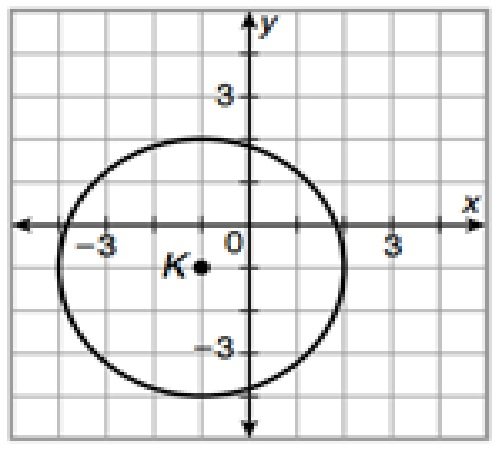
If x2−4x+y2+6y+4=0 is a general equation of a circle , choose the WRONG statement about this circle.
Its centre lies in the 4th quadrant of the Cartesian plane
The area of the circle is 9π unit2
The circle intercept x axis once
The circle intercept y axis once
The general equation of a circle is given by x2+12x+y2+8y−48=0 .
What is the coordinate of its centre?
(6, 4)
(−6, −4)
(12, 8)
(−12, −8)
The general equation of a circle is given by x2+12x+y2+8y−48=0 .
What is the length of its diameter?
10
20
48
5

If the radius of the circle is 7, which statement is WRONG about the circle?
centre at (-7, 7)
it has y intercept at 7
in general equation, the value of c is -49
in standard equation, the value of h is equal the value of k

The distance across the circle, through its center
Radius
Tangent
Circumferene
Diameter
A circle passes through 3 points (−3 , 4) , (4 , 5) and (1 , −4).
Find its standard equation of the circle.
(x−1)2+(y−1)2=25
(x+1)2+(y+1)2=25
x2+y2−2x−2y−23=0
x2+y2+2x+2y−23=0
A circle (x+b)2+(y+2b)2=b2 is tangent with y axis with distance 1 unit.
Given that b is a positive integer, what is the standard equation of the circle?
(x+1)2+(y+2)2=1
(x+2)2+(y+4)2=4
(x−1)2+(y−2)2=1
(x−2)2+(y−4)2=4
A circle passes through 3 points (3,2),(6,3) and (0,3)
Find the radius of the circle.
5
25
9
3
If a circle is tangent to both axes, which of these statement is TRUE?
the centre is (r, r) , if the circle is on the first quadrant
the centre is (−r,− r) , if the circle is on the 2nd quadrant
the centre is (−r, r) , if the circle is on the 4th quadrant
the centre is (r, −r) , if the circle is on the 3rd quadrant
What is the area of the circle?
9π unit
81π unit
6π unit
3π unit
Given a circle with a center at (2,-3) and a radius of 3.
Which is the correct statement about the circle?
the centre is on the first quadrant of the Cartesian plane
the circle is tangent to the x axis
the circle is tangent to the y axis
the standard equation is (x-2)2+(y-3)2=9
-|−2r − 1| = 11
3| −8x| + 8 = 80


r ≥ -6?

Solve:
3x + 2 < -7 or -4x + 5 < 1
All real numbers
x < -3 and x > 1
x < -3 or x < 1
x < -3 or x > 1
Which of the following would result in NO SOLUTION?
x < 1 or x > 5
x > 1 or x < 5
x < 1 and x > 5
x > 1 and x < 5
Solve and give the final solution set:
5x + 1 < 21 OR 3x + 2 > -1
All real numbers
-1 < x < 4
No solution
x > 4 or x < -1
5 < x + 3
6x+10>5x-12
-3≤2x-1≤7
4x-2<-10 or 5x+2>12
|3x+9|<6
|4x-8|≥12

x3≥2
0<x≤23
0≤x≤23
x≥23
x≤23

A
B
C
D
Which is the equivalent of xy−7 ?
y−7x
y7x
(xy)−7
xy71
log39 + log327
Write in index form.
log232 = 5
2-5 = 32
232 = 5
25 = 32
325 = 2
Which is equivalent to log7 32 ?
2log7 31
log73−log72
log72−log73
log73log72
log8−log2+2logw
logw24
log6w2
log4w2
logw26

Solve for x
x = 8
x = 4
x = 256
x = 32
√32
2√45 - 5√45 + 9√16
1. If a and b are positive integers, which of the following is/are correct?
I.a2+b2=a+b
II.a2b2=ab
III.2a2b×6a3b=2a2b3a
II only
III only
II and III only
I, II and III
The conjugate surd of (3−2) is
2−3
3−2
3+2
3−2
(5−4)(5+4)=
5−4
5+4
52−42
52+42
1+6−2 Rationalize the following:
−21+6
−5−2+26
−626
−26
Simplify,
(z3yx) × (x2yz)
z4 y2 x3
6 zyx
3z 2y 3x
z2 ÷ x


Which of the following is considered as rationalising the denominator of 5+43−2 ?
5+43−2×5−43−2
5+43−2×5+45+4
5+43−2×4−54−5
5+43−2×5−45−4


Can the operation be performed?
Yes
No


Determine the dimension of the new matrix if both of these matrices are being multiplied.
Can't multiply them
4 x 2
3 x 3
4 x 3

What is A23
14
4
1
3
What must be true in order to ADD two matrices?
They must be square.
The dimensions must be the same.
The determinant can't equal 0.
The column of the 1st matrix must equal the row of the 2nd matrix

What do w, x, y and z equal in this matrix equation?
w = 13, x = 4, y = 7, z = 23
w = 13, x = -4, y = 11, z = 23
w = 13, x = 4, y = 11, z = 23
w = 13, x = 4, y = 11, z = 17

Find the inverse of the matrix.


No Inverse Exists

Find the values of x and y.
x=25, y=1
x=21, y=3
x=213, y=1
x=27, y=−1

Find the value of n
-10
-8
6
10


What is the value of cofactor for matrix M on the third row, first column
16
-16
2
-2

By using properties of determinant, what is the determinant of matrix B
0
1
-1
2
What is the value of minor for matrix M on the second row, third column
2
-2
3
-3
Is matrix M singular?
No
Yes
Does matrix B has an inverse?
No
Yes
A circle passes through 3 points; (2,1), (0,5) and (-1, 2).
Which of the followings is the system of linear equations to solve for the value of g, f, and c?


Which of the following statements is FALSE for a singular matrix?
Its determinant equal 0
It does not have an inverse
They are inverse of itself
Matrices that have zero row or zero column

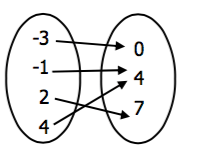

g(x) = x - 2
Find g(f(-10))
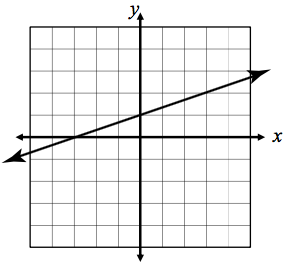
What type of function does this graph represent? State its gradient.
LInear Function, increasing
LInear Function, decreasing
Constant Function, increasing
Constant Function, increasing

Which of the following is the incorrect statement about this function?
*the graph is sketched according to scale
It has y intercept at -3
The range for this function is (−3, ∞)
This is a quadratic function with positive a
The discriminant of this function is greater than 0

The function represented by the blue line and the function represented by the orange line are inverse of each other.
The inverse has been reflected over which line?
y = x
y =1
y = 0
y = x + 1

Df−1=[0, ∞), Rf−1=(−∞,1 ]
Df−1=(−∞,1 ] , Rf−1=[0, ∞)
Df−1=(−∞,1 ] , Rf−1=(−∞,∞)
Df−1=(−∞,∞) , Rf−1=(−∞,1 ]
What is the range for a linear function f(x)=5−3x, −2≤x<4 ?
(−7, 11]
[11, −7)
(−7, 11)
[11, −7]
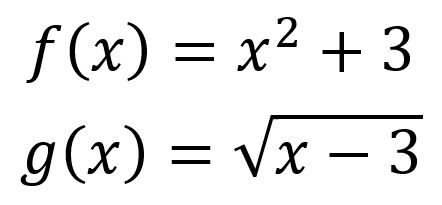
How must the domain of f(x) be restricted so that g(x) can become its inverse?
x ≤ 0
x ≥ 0
x ≤ 3
x ≥ 3
Does f(x)=(x+1)2+3 has inverse?
No
Yes

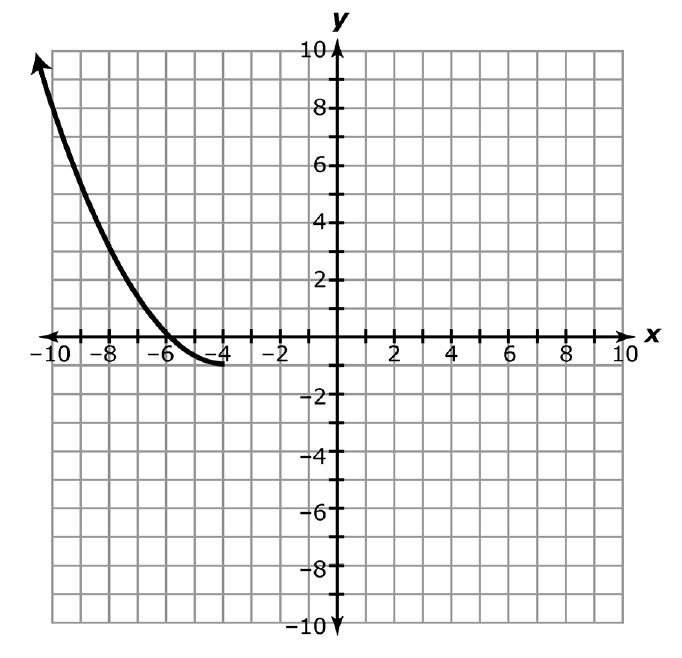
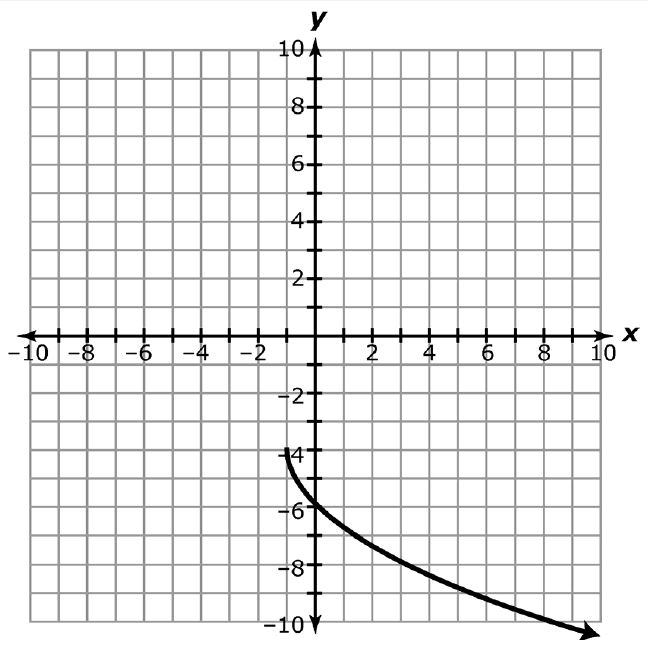
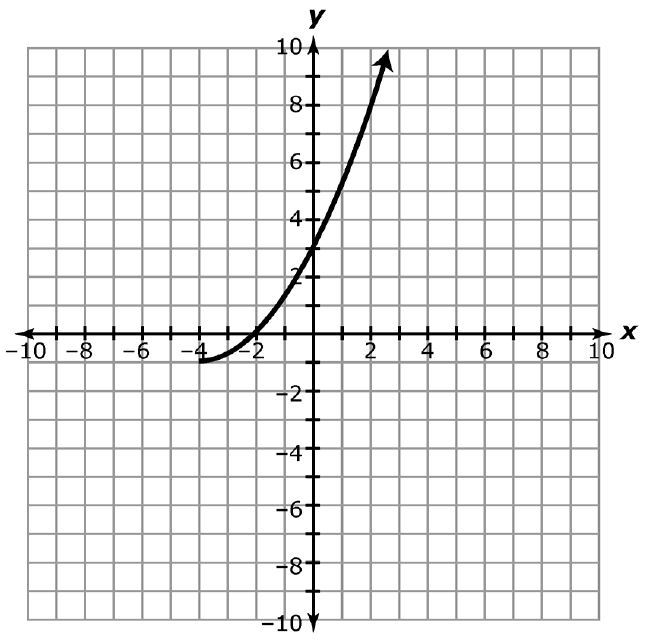
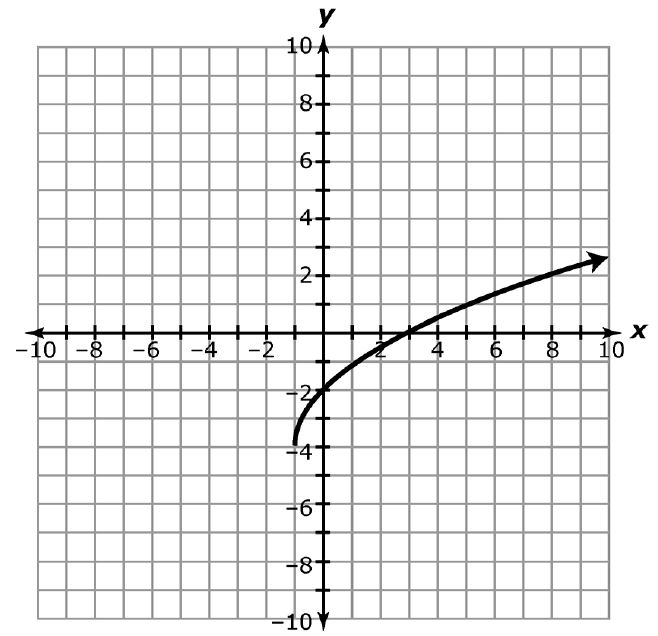

This graph represent a quadratic function.
Which of these functions is the possible function?
*the graph is sketched not according to scale
y=−2x2+1
y=−(x−2)2+1
y=(x−2)2+1
y=−(x+2)2+1

Which of the following is the possible function for this graph?
*graph is accurately sketched to scale
y = -2x3 + x + 3
y = (x - 2)(x + 1)(x + 3)
y = (x + 2)(x - 1)(x - 3)
y = -2x2 + x + 3

Which of the following is NOT the possible function for the graph?
*graph is not accurately sketched to scale
(x+2)2(x−1)
(x+2)2(1−x)
(x−3)(x+2)2
(x−2)(x+3)2
Given fg(x)=11−8x and g(x)=5−4x .
Find f(x)f(x)=2x+1
f(x)=4x−9
f(x)=1−2x
f(x)=4x+9
Does the function f(x)=8−x3 has an inverse?
Yes
No

Which of the statement is CORRECT regarding f(x)=x+1 ?
III and IV only
I, III and IV
II and III only
II, III and IV

The illustrated graph is a surd function.
Which of the statement is INCORRECT?
The starting point is at (2,-3)
It has domain (−∞, 2]
It has range [−3,7)
The graph has intercepts on both axis
Choose the INCORRECT statement about a function.
A function need to have one-to-one or many-to-one relation.
A function need to have one-to-one or one-to-many relation.
A function that has inverse has to be one-to-one relation
There are 2 tests to determine one-to-one relation
Given gh(x)=− x+41+2x and g(x)=x−1 .
Find h(x)
h(x)= x+43−x
h(x)= x+43x−3
h(x)= x+43+x
h(x)= x+43x+3

Which of the following graphs represents y = −1 − x2?
A
B
C
D

Which of the following graphs represents
y = x3 + 4?
A
B
C
D

Which of the following is the function of the graph?
y = 2x3 + 8
y = 2x3 − 8
y = −2x3 − 8
y = −2x3 + 8

This is one of the methods to prove a function is a one to one function.
Verify whether this is the correct way to show it.
Yes
No
Which is the correct graph for the function f(x)=4−x+1 ?


Which graph shows the inverse of the graph above?
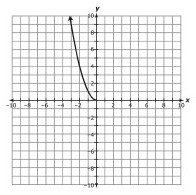
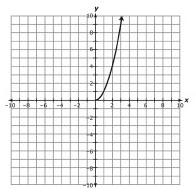
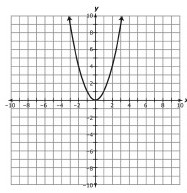
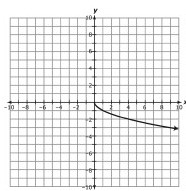


Which of the following functions has itself as inverse?
f(x)=1+x1−x
f(x)=1+x
f(x)=x3−1
f(x)=1−x2
An inverse for quadratic function generally doesn't exist.
What can we do to make the inverse exist?
Limiting its range to only positive values
Limiting its domain to half
Reflect its negative axis
Multiply the function with negative
In completing the square for a quadratic ax2+bx+c , which of the following is NOT one of the steps?
the value of a must be 1
use +(2b)2−(2b)2
factorise using A2+2AB+B2=(A+B)2
make the quadratic equal 0
Which is the correct factorisation of a cubic function f(x)=−2x3−4x2+10x+12 ?
f(x)=−2(x+1)(x−2)(x+3)
f(x)=(x+1)(x−2)(x+3)
f(x)=−(x+1)(x−2)(x+3)
f(x)=2(x+1)(x−2)(x+3)
Which is the correct factorisation of a cubic function f(x)=3x3+27x2+72x+48 ?
f(x)=3(x+1)(x+4)2
f(x)=(x+1)(x+4)2
f(x)=3(x+1)2(x+4)
f(x)=(x+1)2(x+4)
If a horizontal line touched a graph more than once, what can we say about the function?
The inverse of the function doesn't exist
The function is a one to one function
The function is a linear function
The inverse of the function is itself
Given a function f(x)=x3+2x2−5x−6 .
Find its zeros.
−3,−1,2
x=−3, x=−1, x=2
(x+3), (x+1), (x−2)
(x+3)(x+1)(x−2)

Which of the following statement is INCORRECT regarding the graph?
*pink = f(x)
*purple = g(x)
f(x) and g(x) are inverse of each other
Domain for f(x) is equal to the range of g(x)
Both functions are one to one functions
Range of f(x) is (−∞,∞)
GIven f(x)=x2+4 and g(x)=x−9 . Find the value of x if fg(x)=gf(x)
x = 5
x=−51
x = -5
x=51
If there is a function f(x) such that f2(x)=x , which of the following statement is FALSE?
f(x) is inverse of itself
f13(x)=f(x)
f20(x)=f(x)
f8(f(x))=f(x)
Which of these is the test for one to one function?
*you can choose more than one
Horizontal Line Test
Algebraic method
Vertical Line Test
Arrow Test
Solve:
2x2 + 5x ≥ 12
[-4, 1.5]
(−∞, -4) U (1.5, ∞)
(−∞, -4] U [1.5, ∞)
no solution
Solve: 5x - 10x2 < 0
(0, ½)
[0, ½]
(−∞, 0) U (½, ∞)
(- ½ , 0)
Determine the solution of the given quadratic inequality.
x<−2 or x>23
−2<x<23
Determine the solution of the given quadratic inequality.
x≤−11 or x≥−311
−11≤x≤−311
8∣x∣+32>0
no solution
all numbers
x>2, x<−2
x=±2
Solve the quadratic inequality:
x2−4x−5≤0
−1≤x≤5
−5≤x≤1
x≥5 OR x≤−1
x≤−5 OR x≥1
Solve the quadratic inequality:
x2+3x−28≥0
x≥4 OR x≤−7
x≥7 OR x≤−4
−4≤x≤7
−7≤x≤4
Solve the quadratic inequality:
x2−49≥0
x≤−7 OR x≥7
x≥−7 OR x≥7
−7≤x≤7
x≥−7 AND x≥7

(-2,2)
(−∞, −2)∪(2, ∞)
[-2,2]
(∞, −2)∪(2, −∞)
Solve for x:
x+23x−7>1
(−2, 29)
(−∞,−2)∪(29, ∞)
(−∞,−2)∪(37, ∞)
(−2, 37)
Solve the rational inequality and state your solution in interval notation.
x−3−x≥0
(0, +∞)
[0, 3)
(−∞, 0)∪(3, +∞)
(−∞, 0]∪[3, +∞)
(-2,2)
(−∞, −2)∪(2, ∞)
[-2,2]
(∞, −2)∪(2, −∞)
Do we need to check the answer for ∣1−x∣=2x−5 ?
Yes
No
Solve ∣1−x∣=2x−5
x=2, x=4
x=-2, x=-4
x=2
x=4
Do we need to check the answer for ∣∣x2+2x−4∣∣=4 ?
Yes
No
Solve ∣5−6x∣>7
3−1≤x≤2
x≤−2 or x≥31
x<−3 or x>21
x<3−1 or x>2
State the solution set of ∣7−3x∣≤2x+5
{x: x≤−2 or x≥51}
{x: x∈R}
{x: 52≤x≤12}
Solve ∣3x+1∣≥x−4
{x: x≤2−5 or x≥43}
{x: −25≤x≤43}
{x: x∈(−∞, ∞)}

Find the inverse of the matrix


Based on previous calculation, find the values of x, y and z.
x=3, y=-1, z=-15
x=1, y=-3, z=21
x=3, y=-1, z=15
x=3, y=1, z=-15

Find the determinant for matrix A
3
-5
9
-1
If ∣A∣=3 and ∣B∣=−5 , find the determinant for matrix AB
-15
-2
-10
-5

2a
-a
-2a
a

2a
-a
-2a
a

2a
-a
-2a
a

27a
3a
27a3
9a3
If matrix AB were compatible to be multiplied, which of these statements is WRONG?
The number of columns of matrix A is equal to the number of rows of matrix B
The number of rows of matrix A is equal to the number of columns of matrix B
The dimension of matrix AB is (number of rows matrix A) by (number of columns matrix B)
∣A∣∣B∣=∣AB∣
If AB=4I , find B−1
41A
−41A
4A
−4A
Which of the following statements is TRUE for a singular matrix?
Its determinant greater than 0
It does not have an inverse
They are inverse of itself
Its determinant less than 0


Classify the matrix
Square matrix, Diagonal matrix
Triangular matrix, Diagonal matrix
Square matrix, Identity matrix
Square matrix, triangular matrix
A is a (4x33) matrix
B is a (33x1) matrix
What are the dimensions of the product of A times B?
If two rows of a matrix A are identical, then det(A)
Zero
A positive number
One
Can not say
Which of the following is a diagonal matrix?


Which of the following is NOT a singular matrix?

AB=C
What is the inverse for matrix A?


What is the value of k?
9
5
-9
-5
If matrix A+B were compatible to be added, which of these statements is CORRECT?
A+B=B+A
Matrix A and B will also be compatible to be multiplied
∣A∣=∣B∣
∣A∣+∣B∣=∣A+B∣

A
B
C
D

A
B
C
D
Simplify 2x5y224x3y7
x212y5
y224x5
12x2y5
24
When
2xy2(6y)21
(24x3y5)21
2xy12x3y4
2x2y(12x2y4)21
Rationalize 3+25+2
715+22
715−22
Which of these is the WRONG rule of surds?
ax+bx=(a+b)x
a+b=a+b
a×b=ab
ba=ba
Rationalize the denominator. Simplify the answer. 3 − 75 − 21
23 +7
−23+7
23− 7
103 −27
Simplify 3n−1×9n−13n×9n+1 .
3
27
81
243
Given log5 (4x − 7) = log5 (x + 5).
Find the value of x.
3
4
7
12

A
B
C
D
Rationalise 2+11+2−11
−22
22
3+2
3+22
Solve
x−3=24
5
6
7
Solve
31−x=x+3-15, 0
-15
0
no solutions
In order to solve
31−x=x+3 , do you need to do recheck?Yes
No

Solve for x.
4log3−2log6log6−3log3
4log3−2log6log6+3log3
4log3−3log32log6+log6
no solution
2log4x=log43+log4(x+6)
Solve this equation
x=6
x=6, x=−3
x=−18
no solutions
Solve
ln14+ln(2−x)=lnx+ln(x−11)
4
4 and -7
-7
no solutions
Solve
log8 x−log8(x−1)=1
78
No Solution
−647
655
Solve for x: 9x=60
1.748
x = 6.667
x = 0.537
x = 1.863
125x⋅252x+1=(51)x+6
Solve.
−618
-1
1
618
Solve 4(x−21)−9(2(x−2))+1=0
(You can choose more than 1 answer)
2
21
4
-1
In order to solve
x−3=2 , do we need to do recheck?No
Yes

