
 Worksheets
Quadratics and Factoring Practice
Total questions: 205
Worksheet time: 11hrs 46mins
Which of the following is Standard Form?
y=ax2+bx+c
y=a(x−p)(x−q)
y=a(x−h)2+k
Which of the following is Vertex Form?
y=ax2+bx+c
y=a(x−p)(x−q)
y=a(x−h)2+k
Which of the following is Factored Form?
y=ax2+bx+c
y=a(x−p)(x−q)
y=a(x−h)2+k
Convert to Vertex Form:
f(x) = x2 +8x +14
f(x) = (x - 4)2 + 2
f(x) = (x - 4)2 - 2
f(x) = (x + 4)2 + 2
f(x) = (x + 4)2 - 2
Convert to standard form:
f(x) = x2+3x-18
(x-6)(x+3)
(x+6)(x+3)
(x+6)(x-3)
(x-6)(x-3)
Convert to Standard Form:
f(x) = (x+7)(x-3)
f(x) = x2 +10x +21
f(x) = x2 -10x -21
f(x) = x2 +4x -21
f(x) = x2 +4x +21
Convert to standard form: y=(x+5)2−15
y=x2+10
y=x2+10x +10
y=x2+25
y=x2+10x+25
Convert to standard form: y=−2(x−3)2+6
y=−2x2+12x−12
y=−2x2+6x+15
y=−2x2+12x−18
y = −2x2−12
Convert to Factored Form:
3a2 + 4a + 1
(7a-10)(a-8)
Not factorable
(3a+1)(a+1)
(3a-1)(a-1)
Convert to Factored Form:
x2 - 10x + 24
(x - 6)(x - 4)
(x + 6)(x + 4)
(x - 12)(x + 2)
(x - 8)(x - 3)
Determine the vertex of the parabola y=5(x-2)2–7
(5, -7)
(-2, -7)
(2, -7)
(-7, -2)
f(x)=2x2 + 4x + 6
What are the x-intercepts for the function?
f(x) = (x + 7)(x + 5)
(7 , 0) and (5 , 0)
(0 , 7) and (0 , 5)
(-7 , 0) and (-5 , 0)
(7 , 0) and (5 , 0)

Which of the following is Standard Form?
y=ax2+bx+c
y=a(x−p)(x−q)
y=a(x−h)2+k
Which of the following is Vertex Form?
y=ax2+bx+c
y=a(x−p)(x−q)
y=a(x−h)2+k
What is an equation of a parabola with the vertex of (3,−4) ?
y=−21(x+3)2−4
y=2(x−3)2+4
y=23(x−3)2−4
y=(x+3)2+4
What is an equation of a parabola with the vertex of (−2,−4) ?
y=−(x+2)2−4
y=23(x−2)2+4
y=23(x−2)2−4
y=(x+2)2+4
What is an equation of a parabola with the vertex of (4,9) ?
y=−54(x+4)2−9
y=43(x−4)2+9
y=−25(x−4)2−9
y=(x+4)2+9
Which of the following is Intercept (Factored) Form?
y=ax2+bx+c
y=a(x−p)(x−q)
y=a(x−h)2+k
What is an equation of a quadratic with x-intercepts at (−1,0) and (−10,0)
y=−2(x+1)(x−10)
y=31(x+1)(x+10)
y=−101(x−1)(x+10)
y=3(x−1)(x−10)
What is an equation of a quadratic with x-intercepts at (4,0) and (−5,0)
y=−31(x+4)(x−5)
y=4(x+4)(x+5)
y=−54(x−4)(x+5)
y=3(x−4)(x−5)
What is an equation of a quadratic with x-intercepts at (7,0) and (11,0)
y=−31(x+7)(x−11)
y=−(x+7)(x+11)
y=52(x−7)(x+11)
y=23(x−7)(x−11)
y=−32(x−4)2+10 What is the vertex of the parabola with the equation
(4,10)
(−4,10)
(4,−10)
(−4,−10)
y=5(x+3)2−2 What is the vertex of the parabola with the equation
(3,2)
(−3,2)
(3,−2)
(−3,−2)
y=−35(x−1)2 What is the vertex of the parabola with the equation
(1,0)
(−1,0)
y=8(x−2)(x+3) What are the zeros (x-intercepts) of the equation
(2,0) and (3,0)
(−2,0) and (3,0)
(2,0) and (−3,0)
(−2,0) and (−3,0)
y=−32(x+1)(x+3) What are the zeros (x-intercepts) of the equation
(1,0) and (3,0)
(−1,0) and (3,0)
(1,0) and (−3,0)
(−1,0) and (−3,0)
y=41(x+5)(x−6) What are the zeros (x-intercepts) of the equation
(5,0) and (6,0)
(−5,0) and (6,0)
(5,0) and (−6,0)
(−5,0) and (−6,0)
What do we call the graph of a quadratic function?
parabola
linear
cubic
sinusoidal
Which of the following is an example of a quadratic function?


Which of the following equations matches vertex form of a quadratic?
y = a(x + h)2 - k
What is the "formula" for finding the axis of symmetry?
y=ax2+bx+c
x=2a−b
y=mx+b
x=2a−b±b2−4ac

Define X-intercept
The highest or lowest point on the graph
Where the parabola touches or intersects the x-axis
Where the parabola touches or intersects the y-axis
A line that divides the graph into two equal parts. i.e. cuts the graph in half

What are the x-intercepts on the graph?
Check all that apply.
(0, −3)
(1, −4)
(−1, 0)
(3, 0)
(1, 0)

Define Y-intercept
Where the parabola touches or intersects the x-axis, also called the x-intercept
The lowest y-value on the graph
The highest y-value on the graph
Where the parabola touches or intersects the y-axis

When a parabola opens downward the vertex is
a minimum
a maximum
a vertex
a parabola

What is the significance of the ordered pair (2, -4) to the graph?
It is the vertex
It is an x-intercept
It is the y-intercept
It is the axis of symmetry

The axis of symmetry line passes through which point?
y-intercept
any random point
vertex
x-intercept

A parabola has a vertex at (5, -3).
Where is the axis of symmetry?
y = -3
x = -3
x = 5
(5, -3)

Use the graph to determine the solutions.
(Hint: locate the x-intercepts)
-1 and -3
1 and -3
1 and 3
- 4
What is the y-intercept of this graph?
It is the vertex
(0, -2)
(5, 0)
( -1, 0)

What are the coordinates of the vertex?
(0, −5)
(1, 0)
(3, 4)
(5, 0)

What is the range of the function?
[3, ∞)
(−∞, 3]
(−∞, ∞)
[−1, 5]
[3, ∞)
(−∞, 3]
(−∞, ∞)
[−1, 5]

[−3, ∞)
[−1, ∞)
(−∞, ∞)
(−∞, −1]
What is another word for x-intercepts?

three

Which of the statements about the graph is FALSE?
The vertex is a maximum
There are two zeros at
(-3, 0) and (3, 0)
The y-intercept is (0, 18)
The range is
[18, ∞)
What is the significance of the ordered pair (0, -2) to the graph?
It is the vertex
It is an x-intercept
It is the y-intercept
It is the axis of symmetry
What is the significance of the ordered pair (2, -4) to the graph?
It is the vertex
It is an x-intercept
It is the y-intercept
It is the axis of symmetry
A quadratic function can have how many x-intercepts? Choose all that apply:
None
One
Two
Three
Which is the mirror point of (0, −3) ?
(Hint, where would it be reflected over the axis of symmetry?)
(0, −3)
(1, −4)
(−1, 0)
(3, 0)
(2, −3)
Which is the mirror point of the y-intercept?
(0, −5)
(1, 0)
(−5, 0)
(5, 0)
(6, −5)
Which description best fits the transformation of f(x)=x2 into f(x) =(x-5)2+3 ?
Opens up, shifts to the right 5, and shifts up 3
Is narrow, shifts left 5 and up 3
Shifts right 5 and down 3
Opens down and shifts up 3
What are the transformations of the function: f(x)=(x−3)2−5
Right 3
UP 5
Right 3
Down 5
Left 3
Up 5
Left 3
Down 5
What is the vertex of the function:
f(x)=51(x−9)2+8
(−9,8)
(9,8)
(51,9)
(−51,−9)
What is the vertex of the function:
f(x)=−4(x−1)2
(4,−1)
(−4,1)
(−1,0)
(1,0)
What is the axis of symmetry of the function:
f(x)=31(x−4)2−5
x=−5
x=4
x=−4
x=5
f(x)=4(x-2)2 + 3
open up or down?
f(x)=4(x-2)2 + 3

Which equation is graphed above?
y=−(x−1)2+4
y=(x−1)2+4
y=−(x−4)2+1
y=(x−4)2+1
Find the factors of:
x2+7x+12
(a)
How many terms does it have?
Is there a GCF?
What strategy should I use?
Why do I have to learn this?!?!?!
8r3 - 16r2
4r2(2r - 4)
8r2(r - 2)
8(r3 - r2)
4(r3 - 2r2)
7r3−8r2+42r−48
(r2+6)(7r+8)
(r2+6)(7r−8)
(r2+6)(r2+8)
(r2+6)(7r+6)
x3−5x2+5x−25
(x2−5)(x−5)
(x2+5)(x−5)
(x2+5)(x+5)
(x2−1)(x−25)
Factor by grouping: x3+7x2−2x−14
(x2−2)(x−7)
(x2+2)(x−7)
(x2+2)(x+7)
(x2−2)(x+7)
What is the greatest common factor of 14 and 35?
2
7
8
5
What does GCF mean?
Great Cookie Fever
Greatest Common Factor
Greatest Common Multiple
Greatest Compared Factor
What are the factors of 24?
2, 4, 6, 8, 12
1, 2, 3, 4, 6, 8, 10, 12, 24
1, 2, 3, 4, 5, 6, 7, 12, 24
12, 24, 3, 4, 2, 8, 6, 1
x2 + 5x - 24
Factor k2−2k−24
(k−4)(k+6)
(k+4)(k+6)
(k+6)(k−1)
(k+4)(k−6)
x4−81
(x2−9)(x2+9)
(x2+9)(x−3)(x+3)
(x4−9)(x4+9)
(x2−9)(x2−9)
Factor:
64 - 27a3
(4-3a)(9a2+12a+16)
(3a-4)(3a2+12a+16)
(4-3a)(3a2+12a+16)
(4-3a)3
Factor:
x3 - 343
(x + 7) (x2 - 7x + 49)
(x2 + 1) (x - 343)
(x - 7) (x2 + 7x + 49)
(x2 - 343) (x + 1)
Factor:
2x3 + 128
2(x3 + 64)
(x + 4)(x2 - 4x + 16)
2(x - 4)(x2 + 4x + 16)
2(x + 4)(x2 - 4x + 16)
Factor:
4x2 - 25
(2x + 5) (2x - 5)
(2x - 5)2
(2x + 5)2
2x + 5(2x - 5)
x2 + 7x - 30
3x2 - 9x -120
Factor:
25x2 - 36y2
5x + 6y(5x - 6y)
(5x + 6y) (5x - 6y)
(5x + 6y)2
(5x - 6y)2
Factor:
3x2−75y2
3(x−5y)(x+5y)
3(x2−25y2)
(x2−25y2)
3(x2−5y2)(x2−5y2)
x2 + 7x - 30
a2 - a - 12
r2 -16r + 60
x2 -16x + 48
3a2 + 4a + 1
2n2 + 13n + 15
3v2 - 4v - 7
3x2 + 18x +15
Hint: Factor GCF first.
5x2-15x+10

Question 1
A
B
C
D

Question 2
A
B
C
D

Question 3
A
B
C
D

Question 4
A
B
C
D

Question 5
A
B
C
D

Question 6
A
B
C
D

Question 7
A
B
C
D

Question 8
A
B
C
D

Question 9
A
B
C
D

Question 10
A
B
C
D

Question 11
A
B
C
D

Question 12
A
B
C
D

Question 13
A
B
C
D

Question 14
A
B
C
D

Question 15
A
B
C
D

Question 16
A
B
C
D

Question 17
A
B
C
D

Question 18
A
B
C
D
(a + b)(a - b)
(a + b)(a - b)
(a + b)(a + b)
(a - b)(a - b)
-64 + x2
-100 + 49m2
What is the vertex for the following quadratic?
f(x)=−3(x+1)2−5
(a)
What is the vertex for the following quadratic?
f(x)=x2−4
(a)
What is the vertex for the following quadratic?
f(x)=−2(x−5)2
(a)
What is the vertex for the following quadratic?
f(x)=(x−4)2−4
(a)
What is the vertex for the following quadratic?
f(x)=(x−5)2+2
(a)
What is the vertex for the following quadratic
f(x)=−x2+8x−15
(a)
What is the vertex for the following quadratic (no spaces in your answer)
f(x)=−x2+7x−12
(a)
What is the vertex for the following quadratic (no spaces in your answer)
f(x)=x2−3x−4
(a)
What is the vertex for the following quadratic (no spaces in your answer)
f(x)=−(x−5)(x−1)
(a)
What is the vertex for the following quadratic (no spaces in your answer)
f(x)=−(x+29)2+41
(a)
What is the vertex for the following quadratic (no spaces in your answer)
f(x)=−(x+2)(x+1)
(a)
What is the vertex for the following quadratic (no spaces in your answer)
f(x)=−31(x+6)(x+4)
(a)
Which form best describes the quadratics?
f(x)=(x−2)(x+1)
Factored Form
Vertex Form
Standard Form
None of the Above
Which form best describes the quadratics?
f(x)=−21(x+2)2−3
Factored Form
Vertex Form
Standard Form
None of the Above
Which form best describes the quadratics?
f(x)=12(x−3)2
Factored Form
Vertex Form
Standard Form
None of the Above
Which form best describes the quadratics?
f(x)=−3x2+2x−12
Factored Form
Vertex Form
Standard Form
None of the Above
Which form best describes the quadratics?
f(x)=(x−2)(x+10)
Factored Form
Vertex Form
Standard Form
None of the Above

Identify the vertex.
(5, 2)
(5, -2)
(-5, 2)
(-5, -2)
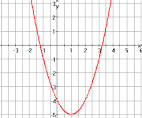
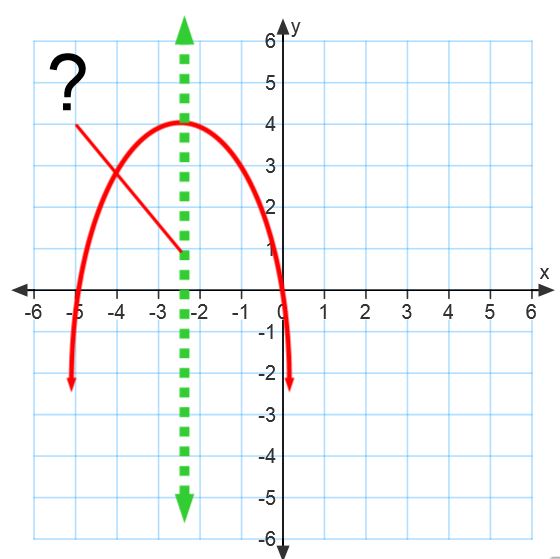
Which equation is graphed above?
y=−(x−1)2+4
y=(x−1)2+4
y=−(x−4)2+1
y=(x−4)2+1
f(x) = x2 + 12x - 2
written in vertex form?
f(x) = x2 - 8x + 1
written in vertex form?
Convert f(x) = 4x2 - 32x + 2 to vertex form.
f(x) = 4(x + 4)2 - 62
f(x) = 4(x - 4)2 - 62
f(x) = 4(x - 8)2 - 62
f(x) = 4(x + 8)2 - 62
f(x)=4(x-2)2 + 3
open up or down?
What is the axis of symmetry for the quadratic
f(x)=−x2−4x−4
Don't forget to write as an equation. No spaces in your answer.
(a)
What is the axis of symmetry for the quadratic
f(x)=2x2−2x−4
Don't forget to write as an equation. No spaces in your answer. Round to the nearest tenths when applicable.
(a)
What is the axis of symmetry for the quadratic
f(x)=−(x+4)2+1
Don't forget to write as an equation. No spaces in your answer.
(a)
What is the axis of symmetry for the quadratic
f(x)=−(x+4)(x+3)
Don't forget to write as an equation. No spaces in your answer. Round to the nearest tenths when applicable.
(a)
What is the axis of symmetry for the quadratic
f(x)=−2(x+5)2−1
Don't forget to write as an equation. No spaces in your answer.
(a)
What is the axis of symmetry for the quadratic
f(x)=41(x−1)(x+1)
Don't forget to write as an equation. No spaces in your answer.
(a)
What is the y-intercept for the quadratic
f(x)=2x2−2x−4
Don't forget to write as an ordered pair. No spaces in your answer.
(a)
What is the y-intercept for the quadratic
f(x)=41(x−1)(x+1)
Don't forget to write as a coordinate pair. No spaces in your answer. Round to the nearest tenths when applicable.
(a)
What is the y-intercept for the quadratic
f(x)=−(x+4)2+1
Don't forget to write as a coordinate pair. No spaces in your answer.
(a)
What are the x-intercepts for the quadratic?
f(x)=−x2+2x+24
(0,0) and (2,0)
(6,0) and (-4,0)
None
(-4.2,0) and (-1.8,0)
What are the x-intercepts for the quadratic?
f(x)=31(x+9)2−31
(-10,0) and (-8,0)
(10,0) and (8,0)
None
(-11.4,0) and (-8.6,0)
What are the x-intercepts for the quadratic?
f(x)=31(x+9)2−31
(-10,0) and (-8,0)
(10,0) and (8,0)
None
(-11.4,0) and (-8.6,0)
What are the x-intercepts for the quadratic?
f(x)=31(x−8)(x+3)
(8,0) and (-3,0)
(3,0) and (-8,0)
None
(-12.5,0) and (-9.2,0)
What is the domain for the follow quadratic?
f(x)=−x2+6x−15
(−∞,∞)
(∞,−∞)
(3,∞)
(−∞,3)
What is the range for the follow quadratic?
f(x)=−x2+6x−15
(−∞,∞)
(∞,−∞)
(−6,∞)
(−∞,−6)
What is the domain for the follow quadratic?
f(x)=2(x+2)2−5
(−∞,∞)
(∞,−∞)
(2,∞)
(−∞,−2)
What is the range for the follow quadratic?
f(x)=2(x+2)2−5
(−∞,∞)
(∞,−∞)
(−5,∞)
(−∞,−5)

y = (x - 2)2 + 2
y = (x + 2)2 + 2
y = (x - 2)2 - 2
y = -(x - 2)2 + 2


Which equations matches the graph above?
h(x)= (x+1)2−4
h(x)=−(x+1)2−4
h(x)=(x+4)2−1
h(x)=−(x+4)2+1

What is the vertex of the graph?
(0.13)
(3,4)
f(x)=−(x−4)2+1
Choose the correct graph of the equation.


Which equation matches the graph above?
r(x)=−(x+4)2−1
r(x)=(x+4)2−1
r(x)=−(x−4)2+1
r(x)=(x−4)2+1

Which equation matches the graph?
f(x)=(x−1)2+4
f(x)=(x+4)2−1
f(x)=−(x−1)2+4
f(x)=−(x+4)2−1
y = ax2 + bx + c
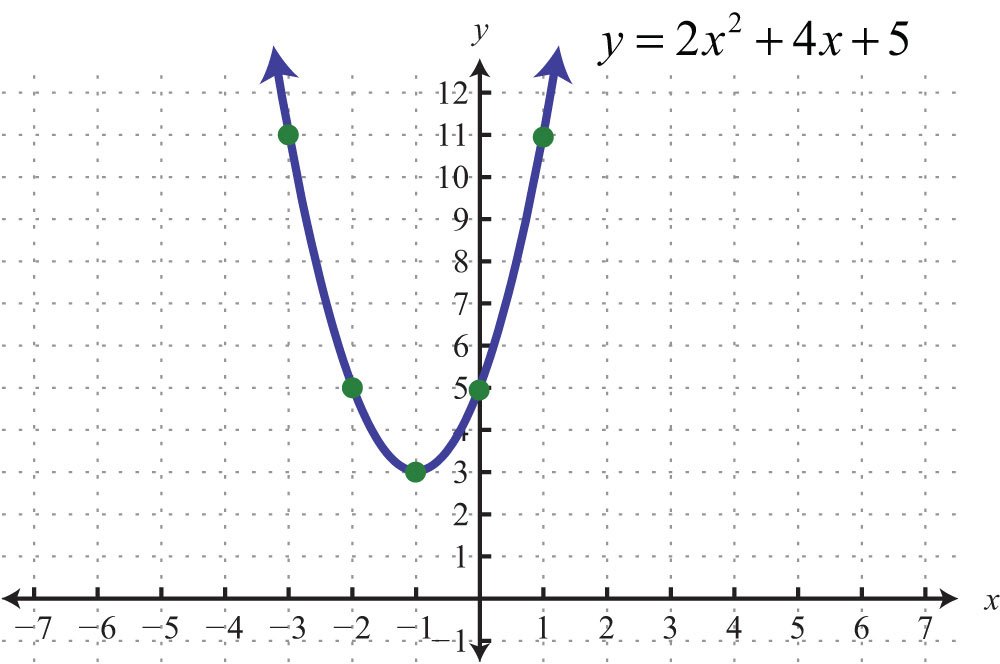
f(x) = x2 - 8x + 15.
y = 3x2 - 6x + 4
Y = -3x2 +7x - 2
f(x) = x2- 8x + 15.
What is the "formula" for finding the axis of symmetry?
y=ax2+bx+c
x=2a−b
y=mx+b
x=2a−b±b2−4ac
f(x)=x2+18
b= (a)

When a parabola opens "down" the vertex is known as a (a) .

When a parabola opens "up" the vertex is known as the (a) .
Given the equation y=x2−2x−3, find the VERTEX.
(4, −3)
(1,−4)
(−2, 6)
(1, −5)

