

wayground logo

Free Printable Worksheets

Font size

S
M
L
XL
Worksheets

Economics Final

Total questions: 144

Worksheet time: 2hrs 56mins

Name
Class
Date
1.
What function of money the picture represents? 
a)
Medium of Exchange
b)
Store of Value
c)
Unit of Account
d)
Stable 
2.
What function of money the picture represents?
a)
Medium of Exchange
b)
Store of Value
c)
Unit of Account
d)
Durable 
3.
What is NOT a characteristic of money? 
a)
Divisible
b)
Portable
c)
Acceptable
d)
Accessible
4.
The Federal Reserve System is responsible for which of the following:
a)
Controlling the ability of banks to lend money
b)
Ensuring the gold standard
c)
Ensuring the fiat standard
d)
Reserving judges for the Supreme Court
5.

Which of the following is NOT a function of money?

a)

Store of value

b)

Unit of account

c)

Medium of exchange

d)

Exchange of debt

6.

This type of money does not have any intrinsic value and does not represent an asset in a vault.

a)

Commodity money

b)

Representative money

c)

Fiat money

7.

This type of money is considered legal tender and gets its value from the people's faith in the government.

a)

Commodity money

b)

Representative money

c)

Fiat money

8.
What term fits this definition: Currency plus bank current deposits from the private non-bank sector
a)
Central bank
b)
Financial innovation
c)
N1
d)
M1
e)
M2
9.
Which is not a function of the reserve bank
a)
Provide loans to property buyers
b)
advise the government on financial action
c)
control over currency and gold
d)
dictate the interest rates other banks offer
10.

Where did the name 'greenback' come from?

a)

Reference to the animal used for barter in earlier trade

b)

The color of ink used on the back side of one of the earliest currencies in the U.S.

c)

A term for the football team from Green Bay

d)

A person who is new to trade

11.

What is a fiat currency?

a)

Currency backed by a gold standard

b)

A currency used to purchase a car

c)

A currency backed by a physical commodity

d)

A currency that is declared a currency by the government, although not backed by a physical commodity

12.

This program was set up to assure the public that the funds they deposited in member banks would be insured by the federal government if the bank failed. The original amount secured was $2,500.

a)

National Industrial Recovery Act (NIRA)

b)

Agricultural Adjustment Act (AAA)

c)

Federal Deposit Insurance Corporation (FDIC)

d)

Social Security Act

13.
What new deal program insures bank deposits & helped to stop bank failures?
a)
SEC
b)
FDIC
c)
AAA
d)
TVA
14.
The Fed keeps a certain amount of money out of circulation. This is referred to as....
a)
Reserve requirement
b)
Emergency Fund
c)
Stockpile
d)
Hoard
15.
A system that requires financial institutions to set aside a fraction of their deposits in the form of reserves.
a)
Legal Reserves
b)
Reserve Requirement
c)
fractional reserve system
d)
member bank reserve
16.

Based on the Required Reserves that Reserve Ratio must be

a)

5%

b)

10%

c)

20%

d)

19%

e)

none of the above

17.
What does FOMC stand for?
a)
Mission impossible
b)
Federal Open Market Committee
c)
Your mom's open Market Committee
d)
Federal Reserve Committee
18.
How many members is the Board of Governors made up of?
a)
4
b)
5
c)
6
d)
7
19.
__________ are checking accounts are sometimes referred to as this because the funds can be converted to currency on demand and given to the person to whom the check is made payable 
a)
Loanable Funds market
b)
Demand Deposit
c)
Money Supply
d)
Bank Reserve
20.
Which is not one of the 6 major responsibilities of the Fed.
a)
Vote for the President
b)
Supply the economy with paper money
c)
Control the money supply
d)
Hold bank reserves
21.
The tools and strategies used to stabilize the economy
a)
Fiscal policy
b)
Monetary policy
c)
Tight Money
d)
Easy Money
22.
The Federal Reserve uses ______ to regulate the economy.
a)
Monetary Policy
b)
Fiscal Policy
23.
The interest rate the Fed charges commercial banks for loans
a)
Fed Fund Rate
b)
Reserve Requirement Rate
c)
Discount Rate
d)
I.O.U Rate
24.

Which of the following is not an entity of the Federal Reserve System?

a)

Federal Reserve Banks

b)

The FDIC

c)

The Board of Governors

d)

The Federal Open Market Committee

25.
Buying bonds
a)
increases money supply
b)
decreases money supply
26.
Selling bonds
a)
increases money supply
b)
decreases money supply
27.
Low reserve requirements 
a)
lower the money supply
b)
increase the money supply
28.
Discount Rate is the fee that 
a)
the member bank must pay the district bank for a loan
b)
you and I must pay our bank for a loan
c)
the district bank pays the national bank for a loan
d)
the FED pays FOMC for services
29.
The tools and strategies used to stabilize the economy
a)
Fiscal policy
b)
Monetary policy
c)
Tight Money
d)
Easy Money
30.
The goal of monetary policy is to 
a)
sell bonds
b)
reduce unemployment
c)
seek price stability
d)
red and blue
31.
The Federal Reserve uses ______ to regulate the economy.
a)
Monetary Policy
b)
Fiscal Policy
32.
The interest rate the Fed charges commercial banks for loans
a)
Fed Fund Rate
b)
Reserve Requirement Rate
c)
Discount Rate
d)
I.O.U Rate
33.
All of the following are responsibilities of the Federal Reserve System EXCEPT
a)
maintain the value of currency
b)
regulate banks
c)
print money
d)
manage the amount of money in supply in the economy
34.
Opportunity Cost is best defined as
a)
The best rejected alternative you give up when making a decision 
b)
The price you pay to purchase something 
c)
The benefit you gain by making a decision 
d)
The amount of debt you take on by making a decision 
35.
The four types of economic systems are: 
a)
Traditional, Command, Mixed, & Market
b)
Traditional, Command, Combined, & Market
c)
Communism, Capitalism, Free Market, and Macroeconomics
d)
Microeconomics, Macroeconomics, Individual, and Traditional.
36.
Which of the following is NOT one of the three basic questions of economics when looking at economic systems? 
a)
What goods should be produced ?
b)
What is the price of the goods? 
c)
How should the goods be produced? 
d)
Who gets to consume the goods? 
37.

A share of value of a company which can be bought, sold, or traded as an investment

a)

Stocks

b)

401K Plans

c)

S & P 500

d)

The NASDAQ Composite

38.

the largest exchange in the U.S., located in the New York City

a)

NASDAQ

b)

AMEX

c)

S & P 500

d)

NYSE

39.

An index of 500 stocks chosen for market size, liquidity and industry grouping, among other factors. The S & P 500 is designed to be a leading indicator of the U.S. equities and is meant to reflect the risk/return characteristics of the large cap universe

a)

NYSE

b)

The James and Tuttle 500

c)

AMEX

d)

S & P 500

40.

A market capitalization weighted index of the more than 3,000 common equities listed on the Nasdaq stock exchange. The types of securities in the index include American depositary receipts, common stocks, real estates investment trusts (REITs) and tracking stocks. The index includes all NASDAQ listed stocks that are not derivatives, preferred shares, funds, exchange-traded funds (ETFs) or Debentures.

a)

DJIA

b)

NYSE

c)

The NASDAQ Composite

d)

AMEX

41.

DJIA

a)

A market capitalization weighted index of the more than 3,000 common

equities listed on the Nasdaq stock exchange. The types of securities in the

index include American depositary receipts, common stocks, real estates

investment trusts (REITs) and tracking stocks. The index includes all NASDAQ

listed stocks that are not derivatives, preferred shares, funds,

exchange-traded funds (ETFs) or Debentures.

b)

An index of 500 stocks chosen for market size, liquidity and industry

grouping, among other factors. The S & P 500 is designed to be a leading

indicator of the U.S. equities and is meant to reflect the risk/return

characteristics of the large cap universe

c)

Shares in a company whose earnings are expected to grow at an above-average rate relative to the market

d)

The Dow jones Industrial Average is a price weighted index of 30 significant stocks traded on the New York Stock Exchange and the Nasdaq. The DIJA was invented by Charles Dow back in 1896.

42.
The oldest and most prestigious market in the United States where the most secure corporations trade
a)
New York Stock Exchange
b)
National Association of Securities Dealers Automated Quotation
c)
Standard and Poors 500
d)
Dow Jones Industrial Average
43.
What is GDP?
a)
The market value of the goods and services produced by a Country's economy and compare it to other countries
b)
 Grand Opening Procedure
c)
Germany Departing Poland 
d)
The grossness of a country an compare it by other countries
44.

Which economic system is based off of "laissez-faire economics"?

a)

Communism

b)

Socialism

c)

Capitalism

45.
Adam Smith's call for the restricting of government in the economy is called...
a)
The invisible hand
b)
Laissez Faire
c)
Consumer sovereignty 
d)
Competition
46.
What is the invisible hand?
a)
The self-regulating nature of the market place
b)
Self-interest motivating the market place
c)
Competition being the regulating force in the market place
d)
The equal distribution of wealth
47.

Factory

a)

Entrepreneurship

b)

Capital

c)

Labor

d)

production

48.
All the things we sacrifice to obtain another?
a)
Trade-Offs
b)
Opportunity Cost
c)
Scarcity
d)
Factors of Production
49.

How are trade-offs and opportunity costs different?

a)

The opportunity cost is the most desirable trade-off.

b)

A trade-off is the most expensive opportunity cost.

c)

A trade-off can be put on a decision-making grid, but an opportunity cost cannot.

d)

It's more important to be aware of the trade-off when deciding something.

50.

Butter and oil are considered:

a)

immaterial goods

b)

free goods

c)

durable goods

d)

non-durable goods

51.
Contradiction between the high value of nonessential items and low value of essential items. 
a)
Paradox of Value 
b)
Utility 
c)
Wealth
d)
Durable Good
52.
Things that you buy that last a long time are called________________
a)
durable goods
b)
non-durable goods
c)
opportunity cost
d)
job
53.
The profits and losses are shared between a few owners in this type of business.
a)
Company
b)
Social Enterprise
c)
Partnership
d)
Sole Proprietorship
54.
This type of business is considered a separate legal entity in the eyes of the law.  It is owned by shareholders.
a)
Cooperative
b)
Company
c)
Partnership
d)
Sole Proprietorship
55.
Which of the following is not an advantage of a sole proprietorship?
a)
Easy to start
b)
Owner is their own boss
c)
Owner has unlimited liability
d)
Owner receives all the profits
56.
One advantage of a partnership is that there are more sources of capital available than in a sole proprietorship.
a)
True
b)
False
57.
-General Partner provides business skill/talent
-Silent Partner provides capital
-Silent Partner enjoys limited input
a)
Partnership
b)
Limited Liability Company
c)
Sole Trader
d)
Joint Venture
58.
-Owned by a single owner
-No separation between owner and business
-Unlimited personal liability
a)
Corporation
b)
Limited Liability Company
c)
Partnership
d)
Sole Proprietorship
59.
-Publicly traded company
-Governed by Board of Directors
-CEO, COO, CFO
-Stocks sold to raise capital
a)
Corporation
b)
Limited Liability Company
c)
Partnership
d)
Cooperative
60.
-Two or more owners
-Unlimited Personal Liability
-No separation between owners and business
a)
Limited Partnership
b)
Corporation
c)
Cooperative
d)
Partnership
61.
-General Partner provides business skill/talent
-Silent Partner provides capital
-Silent Partner enjoys limited personal liability
a)
Partnership
b)
Limited Liability Company
c)
Limited Partnership
d)
Joint Venture
62.
In a Limited Partnership, the limited partner is also known as the:
a)
Financier 
b)
Monopolist
c)
Venture Capitalist
d)
Silent Partner
63.

Disadvantages for this type of business include: owner pays for everything, hard to get money to start from the bank, owner might lack skills & unlimited liability.

a)

Sole Proprietorship

b)

Partnership

c)

Corporation

d)

Limited liability company

64.

Advantages of this business include: easier to get money from the bank to start, share skills and share risks.

a)

Sole Proprietorship

b)

Partnership

c)

Corporation

d)

Limited liability company

65.
This type of business is owned by many people called stockholders.
a)
Sole Proprietorship
b)
Partnership
c)
Corporation
d)
Franchise
66.

a business combination merging more than three businesses that produce unrelated products of services

a)

merger

b)

horizontal merger

c)

conglomerate

d)

multinational corporation

67.

A ____ combines firms that operate at different stages in the production of a good.

a)

conglomerate

b)

vertical merger

c)

horizontal merger

d)

cooperative

68.

A legal entity formed to carry out a "non-for-profit" mission is a

a)

cooperative

b)

nonprofit organization

c)

conglomerate

d)

franchise

69.

The biggest advantage of a "corporation" business structure is

a)

expensive startup costs

b)

low monetary rewards

c)

different tax treatment

d)

limited liability for the stockholders

70.

What business structure is the easiest to start?

a)

partnership

b)

sole proprietorship

c)

partnership

d)

corporation

71.

Which market structure has only one seller and they control the overall market and options for consumers.

a)

monopoly

b)

perfect competition

c)

the purge

d)

oligopoly

72.

Which of these markets usually offers the lowest prices for consumers?

a)

oligopoly

b)

monopoly

c)

command economy

d)

perfect competition

73.
Which of the following is a disadvantage of a sole proprietorship?
a)
Business expansion decisions are easy to accomplish.
b)
It may be difficult to raise enough capital to begin business.
c)
Sole proprietors are their own bosses.
d)
The proprietor owns the assets and runs the business.
74.
What is the simplest form of business organization?
a)
limited ownership
b)
corporation
c)
partnership
d)
sole proprietorship
75.
Why are sole proprietorships so common?
a)
They require no registration and can be as simple as one person selling a product.
b)
They have very low start-up costs, including a small registration fee.
c)
They value individualism over cooperation and group dynamics.
d)
The government has encouraged people in the past 50 years to start their own businesses.
76.
What are bonds?
a)
Spies
b)
written statements that the borrower will repay the principal (amount of money borrowed) at some time in the future
c)
investors who own stock
d)
Men of mystery
77.
What is double-taxation?
a)
Being taxed double the income tax of a partnership
b)
Tax on a business plus its shareholders' income
c)
Tax people have to pay for existence of corporations
78.
What must be obtained from a state government prior to creating a corporation?
a)
Stock certificate
b)
Proxy
c)
Charter
d)
Capital funds
79.
The Income Statement lists a businesses:
a)
Assets and Expenses
b)
Owner's Equity and Revenue
c)
Revenue, cost of goods and Expenses
d)
Expenses and Net Assets
80.
Net Profit is:
a)
Assets less Liabilities
b)
Gross Profit less Expenses
c)
Revenue less Liabilities
d)
Liabilities less Assets
81.
Net Income:
a)
Decreases equity
b)
Represents the amount of assets stockholders put into a business
c)
Equals assets minus liabilities
d)
Is the excess of revenues over expenses
82.
lists and summarizes income and expense transactions that have taken place over a specific period of time, usually a month or a year
a)
mortgage
b)
income and expense statement
c)
net income
d)
savings
83.

In a cash flow statement depreciation is deducted from profit because it is a non cash expense

a)

False

b)

True

84.

A cash flow is useful for

a)

Informing the business about its profits

b)

Helping the business see where cash shortages may occur

c)

Seeing the flow of cash from the business to the bank

d)

Choosing the best method of finance to expand the business

85.
Occurs when a firm acquires former suppliers or customers
a)
Horizontal Merger
b)
Vertical Merger
c)
Product Extension Merger
d)
Market Extension Merger
86.
The acquisition of a former competitor
a)
Vertical Merger
b)
Horizontal Merger
c)
Market Extension Merger
d)
Conglomerate Merger
87.

What is the business consolidation that occurs between firms that operate in the same industry?

a)

Non-profit Organization

b)

Conglomerates

c)

Horizontal Merger

d)

Vertical Mergers

88.

What is a private business organization that is owned and controlled by the people who use its products, supplies or services.

a)

a Together Project

b)

Joint Venture

c)

Cooperative

d)

An Agreement to Work Together

89.

A ______________ is a type of business formed for the purpose of some positive or altruistic task or outcome.

a)

corporation

b)

sole partnership

c)

non-profit

90.

The type of business owned by stockholders and run by a Board of Directors is a

a)

sole proprietorship

b)

multinational vertical merger

c)

corporation

91.

A multinational corporation only has one facility.

a)

TRUE

b)

FALSE

92.

What is a multinational corporation?

a)

corporations that operate in more than country but are based in one country

b)

corporations that operate in one country only

c)

corporations that have global income of more than $1 billion

d)

corporations that only operate in countries outside of the country they are based in

93.

This describes the combining of companies involved in different steps of the production process.

a)

vertical merger

b)

horizontal merger

c)

reserved merger

d)

general merger

94.
Goodwill Industries help poor and homeless people with the money raised by selling donated products in their stores.  How is Goodwill classified?
a)
combination product and service
b)
For-profit
c)
Non-profit
d)
Service
95.
Why does no one firm dominate in a perfect competition?
a)
No firm wants to
b)
Each firm sells to different people
c)
Each firm produces so little of the total supply that they cannot influence prices
d)
One firm will eventually dominate and make it a monopoly
96.
Factors that make it difficult for new firms to enter a market are called
a)
Barriers to entry
b)
Factors of production
c)
Limited supply
d)
Monopolistic Outlook
97.

What are Identical Products?

a)

Any factor that makes it difficult for a new firm to enter a market

b)

A market structure that does not meet the conditions of perfect competition

c)

Products that are different in every way

d)

No differences between the products sold by different suppliers
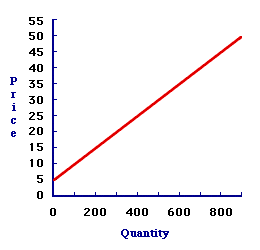
98.

How do produces create informed buyers?

a)

Products that are different in every way

b)

Any factor that makes it difficult for a new firm to enter a market

c)

The market provides the buyer with full information about the product’s features and price

d)

No differences between the products sold by different suppliers
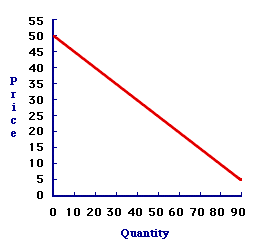
99.
The airline industry is most likely in the market structure called
a)
perfect competition
b)
oligopoly
c)
monopolistic competition
d)
monopoly
100.
Price fixing and collusion often occur in this type of market structure
a)
monopoly
b)
oligipoly
c)
perfect competition
d)
monopolistic competition
101.
In this market structure there are many buyers and sellers with identical products
a)
perfect competition
b)
monopolistic competition
c)
monopoly
d)
oligopoly
102.
This market structure can act like a monopoly when the firms all set prices the same
a)
Monopoly
b)
Monopolistic Competition
c)
Perfect Competitio
d)
Oligopoly 
103.
AT&T, Verizon, and T-Mobile are an example of a(n)
a)
Monopoly
b)
Oligopoly
104.
When companies that form on oligopoly cooperate together to set or fix prices at a given level, they are engaging in
a)
Monopoly
b)
Vertical Integration
c)
Collusion
d)
Rationing
105.
Point at which supply and demand come together
a)
price ceiling
b)
excess demand
c)
equilibrium
d)
disequilibrium
106.
In which market structure is there the MOST competition?
a)
Monopoly
b)
Oligopoly
c)
Monopolistic Competition
d)
Perfect Competition
107.
The post office or fire department is an example of a _______________ monopoly.
a)
Technological
b)
Government
c)
Geographic
d)
Natural
108.
What does this curve represent?
a)
demand
b)
supply
c)
equilibrium
d)
shortage
109.
What does this curve represent?
a)
supply
b)
equilibrium
c)
demand
d)
surplus
110.
A government payment made to a business is a
a)
tax
b)
regulation
c)
subsidy
d)
resource
111.
The following is a factor that will not cause the demand curve to shift:
a)
Advertising
b)
Population
c)
Price
d)
Consumer expectations
112.
A change in quantity demanded is shown
a)
at various points on the demand curve
b)
with a new demand curve drawn above or below the original demand curve
c)
with a vertical line
113.
A table that lists the quantity of a good that a single person will buy at each price in a market.
a)
demand schedule
b)
market demand schedule
c)
elasticity chart
d)
supply and demand graph
114.
Generally speaking, the lower the price, the greater the quantity demand.
a)
True
b)
False
115.
If sandals suddenly became very popular, what would happen to the market for basketball shoes? This would cause the ___________ curve for basketball shoes to shift ____________.
a)
demand.........right
b)
demand.........left
c)
supply.......right
d)
supply....... left
116.
For the law of supply, as price rises, what happens to quantity supplied?
a)
it goes up
b)
it goes down
c)
it stays the same
d)
it is not effected
117.
For the law of demand, as price rises, what happens to quantity demanded?
a)
it goes up
b)
it goes down
c)
it stays the same
d)
it is not effected
118.
Elastic or Inelastic?
a)
Elastic
b)
Inelastic
119.
Elastic or Inelastic
a)
Elastic
b)
Inelastic
120.
The diagram represents a
a)
increase in demand
b)
decrease in demand
121.

The law of demand states?

a)

As price decreases quantity demanded increases

b)

As price decreases quantity demanded decreases

c)

As price increases quantity demanded increases

d)

As price increases quantity demanded remains unchanged

122.

A change in the quantity demanded occurs when?

a)

consumers decide to purchase a greater or lesser quantity of a product due to A CHANGE IN PRICE!!!!

b)

consumers decide to purchase a greater or lesser quantity of a product due to a change in incomes

c)

consumers decide to purchase a greater or lesser quantity of a product due to a change in tastes

d)

consumers decide to purchase a greater or lesser quantity of a product due to a change in expectations

123.

The cause of a change in the quantity demanded is?

a)

A change in taste

b)

A change in habits

c)

A change in diapers

d)

A change in price

124.

Graphically, a change in the quantity demanded is represented by?

a)

Shift of the entire demand curve to the left

b)

Shift of the entire demand curve to the right

c)

From one point to another point along the same demand curve

d)

From X to Y axis on the same supply curve

125.

Peanut butter and jelly are what types of goods

a)

substitutes

b)

complements

c)

yummy

d)

yucky

126.

2 products that you use together are?

a)

substitutes

b)

complements

c)

ying and yangs

d)

coke and pepsi

127.

items that you can use to replace another product are

a)

substitutes

b)

complements

c)

merit goods

d)

private goods

128.

Which of the following measures the responsiveness of producers to a price change?

a)

Marginal cost

b)

Elasticity of supply

c)

Equilibrium

129.
A change in demand is shown
a)
along the demand curve
b)
with a new demand curve above or below the original demand curve
c)
without a demand graph
d)
with a totally vertical line
130.
The demand for a good is _____ when a small change in price causes a large change in the quantity demanded.
a)
elastic
b)
inelastic
c)
related
d)
substituted
131.
Demand for a product is said to be _______ when a change in price causes very little change in quantity demanded.
a)
elastic 
b)
inelastic
c)
related
d)
rigid
132.
What is created when prices are too low?
a)
surplus
b)
shortage
c)
equilibrium price
d)
subsidy
133.
If the supply and demand curves intersect at a price of $20 then any price above that would result in a(n):
a)
shortage.
b)
equilibrium.
c)
increase in demand.
d)
surplus.
134.

If the cost of inputs increases

a)

quantity demanded decreases

b)

demand decreases

c)

quantity supplied decreases

d)

supply decreases

135.

Advertising

a)

Changes consumer expecatations

b)

lowers the cost of inputs

c)

changes producer expectations

d)

changes consumer taste and preferences

136.

If the number of producers in a market increases

a)

quantity demanded increases

b)

demand increases

c)

quantity supplied increases

d)

supply increases

137.

If the number of producers in a market increases

a)

quantity demanded increases

b)

demand increases

c)

quantity supplied increases

d)

supply increases

138.

If technology makes things easier to produce then supply will

a)

increase

b)

decrease

c)

stay the same

d)

move along the supply curve

139.

If a producer expects the price to increase

a)

supply will increase in the short run

b)

supply will decrease in the long run

c)

demand will decrease in the short run

d)

supply will decrease in the short run
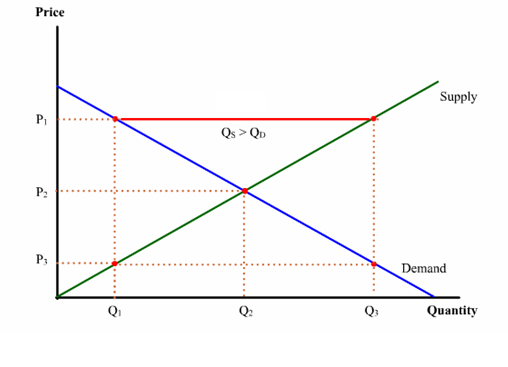
140.
What is the supply with a price floor of $60?
a)
50
b)
100
c)
150
d)
200
141.
What does this graph show?
a)
Shortage
b)
Surplus
c)
Supply Table
d)
Equilibrium
142.
4. The minimum wage is an example of a government price control.
a)
True
b)
False
143.
3. Price floors and price ceilings prevent items from obtaining their equilibrium price.
a)
True
b)
False
144.
A ___ ___ keeps prices form going any higher and causes a ___.
a)
price ceiling; shortage
b)
price ceiling; surplus
c)
price floor; shortage
d)
price floor; surplus
