
 Worksheets
Meiosis
Total questions: 40
Worksheet time: 34mins
Name
Class
Date
1.
The cells produced via meiosis are called:
a)
sex cells
b)
somatic cells
c)
body cells
d)
skin cells
2.
Unlike mitosis, meiosis in male mammals results in the formation of
a)
one haploid gamete
b)
three diploid gametes
c)
four diploid gametes
d)
four haploid gametes
3.
If the Diploid number of Carrots is 18, the haploid number is
a)
18
b)
9
c)
27
d)
36
4.
If a body cell in a butterfly contains 24 chromosomes, a butterfly egg would contain
a)
3
b)
6
c)
12
d)
24
5.
The chromosomes that pair up during meiosis, are called __________ chromosomes.
a)
homozygous
b)
asexual
c)
homologous
d)
genes
6.

Identify the phase.
a)
Metaphase I
b)
Metaphase II
c)
Prophase I
d)
Anaphase II
7.
How many daughter cells are produced from meiosis ?
a)
10
b)
6
c)
4
d)
2
8.
Name the growth phase of the cell cycle for both Mitosis and Meiosis.
a)
metaphase
b)
telophase
c)
interphase
d)
anaophase
9.
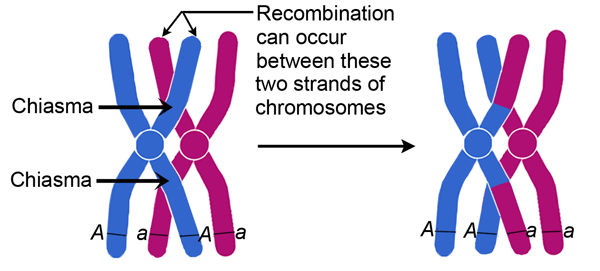
This image shows chromosomes during Prophase 1. Which of the following correctly describes the process shown?
a)
segregation of sister chromatids
b)
condensation and segregation of alleles
c)
mutationin which the DNA content of the gene is altered
d)
crossing - over in which alleles are exchanged
10.
Why do we need meiosis?
a)
To double the number of chromosomes going into sex cells
b)
To halve the number of chromosomes going into sex cells
c)
To triple the number of chromosomes going into sex cells
d)
To not change the number of chromosomes going into sex cells
11.
A human zygote should have _____ chromosomes inside.
a)
46
b)
23
c)
92
d)
64
12.
products of meiosis are genetically
a)
different
b)
identical
13.

This picture shows which process?
a)
mitosis
b)
meiosis
c)
the cell cycle
14.
Human eggs and sperm are _____, and each has ____ chromosomes.
a)
diploid, 23
b)
diploid, 46
c)
haploid, 23
d)
haploid, 46
15.
How are your chromosomes inherited?
a)
most of your chromosomes from your mother
b)
most of your chromosomes from your father
c)
a random number of chromosomes from each parent
d)
half your chromosomes from your mother and half from your father.
16.
Creates sperm and eggs
a)
Mitosis
b)
Meiosis
17.
Crossing over occurs during prophase I
a)
Mitosis
b)
Meiosis
18.
Two identical cells are produced
a)
Mitosis
b)
Meiosis
19.
Four gamete cells are formed
a)
Mitosis
b)
Meiosis
20.
Occurs in Somatic cells
a)
Mitosis
b)
Meiosis
21.
Creates haploid cells
a)
Mitosis
b)
Meiosis
22.
Creates diploid cells
a)
Mitosis
b)
Meiosis
23.
Occurs in skin, liver, and heart cells
a)
Mitosis
b)
Meiosis
24.
An organism has 20 chromosomes in its skin cell. How many chromosomes are in its gamete cells?
a)
20
b)
10
c)
40
d)
15
25.
What is the process that occurs during meiosis that causes genetic variation?
a)
cytokinesis
b)
prophase I
c)
crossing-over
d)
genetic mutations
26.
Which of the following statements are true?
a)
Meiosis cells divide once while mitosis cells divide twice
b)
Meiosis parent cell is diploid while mitosis parent cell is haploid
c)
Meiosis produces four haploid cells while mitosis produces two diploid cells
d)
Meiosis produces genetically identical cells while mitosis produces genetically different cells
27.
What is the haploid number for humans?
a)
46
b)
23
c)
10
d)
52
28.

Meiosis produces different types of cells than mitosis. If there was a "meiosis club," all of these cells could be included EXCEPT
(Which cell type is not produced in meiosis?)
(Which cell type is not produced in meiosis?)
a)
gametes
b)
body cells
c)
sperm cells
d)
egg cells
29.

In meiosis, crossing over occurs in prophase 1. What is the significance of this event?
a)
This process ensures that chromosomes are evenly divided into daughter cells.
b)
This process can lead to genetic variation in daughter cells.
c)
This process can create gaps in the chromosome DNA for RNA to bind.
d)
This process allows for spindles to connect to the chromosomes in order to pull chromosomes apart.
30.

Mitosis is useful for the creation of new cells which is important for all of the following EXCEPT
a)
organism growth.
b)
repair of damage.
c)
replacement of worn out cells.
d)
generation of gametes.
31.

Meiosis makes sperm and egg cells. In humans, sperm and egg cells each have _____ chromosomes. Therefore a fertilized human egg cell (sperm and egg cell combined) would create a cell with _____ chromosomes.
a)
23, 46
b)
46, 23
c)
2, 4
d)
50, 100
32.

What phase is shown in the picture?
a)
anaphase 1
b)
anaphase 2
c)
metaphase 1
d)
telophase 1
33.

What phase is shown here?
a)
Prophase II
b)
Metaphase I
c)
Metaphase II
d)
Anaphase I
34.

What phase is shown here?
a)
Metaphase II
b)
Telophase I
c)
Telophase II
d)
Metaphase I
35.

What phase is shown here?
a)
Anaphase I
b)
Prophase I
c)
Metaphase II
d)
Metaphase I
36.

What phases is shown here?
a)
Prophase II
b)
Prophase I
c)
Anaphase II
d)
Interphase I
37.

What phase is shown here?
a)
Telophase II
b)
Anaphase II
c)
Metaphase I
d)
Interphase I
38.

What phase is shown here?
a)
Telophase I
b)
Metaphase II
c)
Telophase II
d)
Anaphase I
39.

What phase is this?
a)
Interphase II
b)
Prophase I
c)
Metaphase I
d)
Anaphase II
40.
How do the formation of male and female human gametes differ?
a)
Only one male gamete is viable at the end of meiosis
b)
Only one female gamete is viable at the end of meiosis
c)
Female gametes are much larger than male gametes
d)
Female gametes are motile and move with flagellum
100 %

