wayground logo

Free Printable Worksheets

Font size

S
M
L
XL
Worksheets

ECG Interpretation & Analysis Test

Total questions: 40

Worksheet time: 23mins

Name
Class
Date
1.
The p-wave correlates with which event?
a)
atrium contraction /signals moving from SA node to AV node
b)
ventricle contraction
c)
ventricle repolarization
d)
both atrial and ventricle contraction
2.
The place where the electrical current starts and is considered the heart's pacemaker:
a)
Sino-atrial node 
b)
right atrium
c)
atria-ventricular node 
d)
left ventricle
3.
The QRS-wave correlates with which event?
a)
atrium contraction /signals moving from SA node to AV node
b)
ventricle contraction
c)
ventricle repolarization
d)
both atrial and ventricle contraction
4.

If there is a flat P wave which structures in the heart are damaged?

a)

SA/AV node

b)

Bicuspid valve

c)

Bundle of His

d)

Purkinje fibers

5.
Which letter(s) indicates the health of the atria?
a)
QRS
b)
P-Q wave
c)
P wave only 
d)
T wave
6.
Which letter(s) indicates the health of the ventricles?
a)
T-wave  
b)
S-T waves
c)
R wave 
d)
QRS
7.
Which letter(s) indicates that the ventricles are relaxing? 
a)
P-wave
b)
S-T Waves
c)
QRS 
d)
T-wave
8.
If the R wave is irregular, which chamber is enlarged with blood? 
a)
Ventricles 
b)
Atria 
c)
Vena cava 
d)
Aorta 
9.

What is damaged within the heart to cause the R wave to be irregular & the ventricles enlarged?

a)

AV node

b)

Semi Lunar valves

c)

Coronary arteries

d)

AV Valves

10.
An electrocardiogram measures what?
a)
The amount of pressure exerted on blood vessels.
b)
The electrical activity of the heart.
c)
How many times the heart contracts over time.
d)
The body's temperature caused by friction of blood in vessel.
11.
An EKG is actually
a)
A ratio
b)
An equation
c)
A time frame
d)
A graph 
12.
What are the semilunar valves called?
a)
right atrium and right ventricle
b)
pulmonic valve and aortic valve
c)
tricuspid and mitral valve
d)
superior vena cava and inferior vena cava
13.
What are the four characteristics of cardiac cells?
a)
automaticity, excitability, conductivity, and controllability
b)
conductivity, transitivity, automaticity, and excitability
c)
excitability, conductivity, automaticity, and contractility
d)
contracility, automaticity, transitivity, and excitability 
14.
The ability of a cell to transmit an electrical impulse to another cardiac cell is
a)
automaticity
b)
conductivity
c)
excitability
d)
contractility 
15.
When a cell is dully depolarized and attempts to return to its resting state is called
a)
depolarization
b)
polarized
c)
repolarization
d)
excitability 
16.
How many impulses does the SA node generates per minute?
a)
30-40
b)
40-60
c)
60-100
d)
100-120
17.
What pacemaker has a firing rate of 40-60 times per minute?
a)
Purkinje fibers
b)
SA node
c)
Bundle of His
d)
AV node
18.
When there is no electrical activity occurring or electrical activity is too weak to measure, this is called
a)
isoelectric waveform
b)
lead
c)
plane
d)
interval
19.
On the horizontal axis of the ECG strip, each small block equals to how may seconds?
a)
0.02
b)
0.01
c)
0.40
d)
0.04
20.
What consists of five waveforms labeled with the letters P, Q, R, S, and T?
a)
interval
b)
complex
c)
lead
d)
artifact
21.
This tracks the atrial impulse from the atria through the AV node, bundle of His, and right and left bundle branches.
a)
PR interval
b)
QRS complex
c)
P wave
d)
Q wave
22.
This represents the end of ventricular conduction or depolarization and the beginning of ventricular recovery or repolarization.
a)
P wave
b)
PR interval
c)
ST Segment
d)
QR interval
23.
What waveform represents ventricular recovery or repolarization?
a)
P wave
b)
QT interval
c)
ST segment
d)
T wave
24.
This measures ventricular depolarization and repolarization.
a)
QT interval
b)
ST segment
c)
P wave
d)
T wave
25.
What is the easiest way to calculate heart rate especially if the rhythm is irregular?
a)
1500 method
b)
sequence method
c)
10 times method (6-second interval)
d)
5 times method
26.
This is characterized by a sinus rate below 60 beats/minute and a regular rhythm.
a)
sinus tachycardia
b)
sinus arrhythmia
c)
sinus bradycardia
d)
sinus arrest
27.
What causes sinus arrest?
a)
lack of electrical activity in the atrium
b)
lack of electrical activity in the ventricles
c)
sinus tachycardia
d)
sinus bradycardia
28.

Which of the following is NOT a common use for ECG

a)

Diagnosis of heart disease or condition

b)

During surgery

c)

For administering electrical shock

d)

For cardiac monitoring

29.

The ECG tracing procedure must be done with accuracy because (choose all that apply)

a)

the tracing provides information about the patient's heart

b)

it is used to make decisions about the patients care

c)

if inaccurate, wrong decisions about the patients care could occur

d)

none of the above

30.

Which heart beats per minute below are considered normal

a)

72

b)

60

c)

102

d)

80

31.

SA node transmits an impulse initiating the heartbeat

a)

True

b)

False

32.

SA node signal causes atrial contraction

a)

True

b)

False

33.

AV node is in the lower portion of the right atria

a)

True

b)

False

34.

Bundle HIS transmits the impulses from the atria to the ventricles

a)

True

b)

False

35.

Purkinje Fibers distribute impulses throughout the ventricles

a)

True

b)

False

36.

Which wave form is not always seen on the ECG

a)

T

b)

P

c)

QRS

d)

U

37.

Which is NOT an indication to perform an ECG

a)

to evaluate the flow of electricity through the heart

b)

to evaluate the pumping of the heart

c)

to evaluate for electrolyte imbalance

d)

to evaluate pulmonary function

38.

What is the standard paper speed

a)

25mm/sec

b)

50mm/sec

c)

.25mm/sec

d)

.50mm/sec

39.

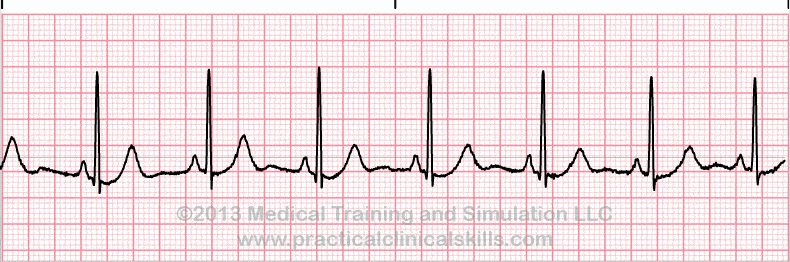
What is the ECG showing

a)

Atrial Fibrillation

b)

Ventricular Fibrillation

c)

Asystole

d)

Premature Ventricular Contraction

e)

Heart Block

40.

What is the ECG showing

a)

Atrial Fibrillation

b)

Ventricular Fibrillation

c)

normal

d)

Premature Ventricular Contraction

e)

Heart Block