wayground logo

Free Printable Worksheets

NEW

Font size

S
M
L
XL
Worksheets

Earth & Space Review

Total questions: 59

Worksheet time: 1hrs 12mins
Name
Class
Date
1.
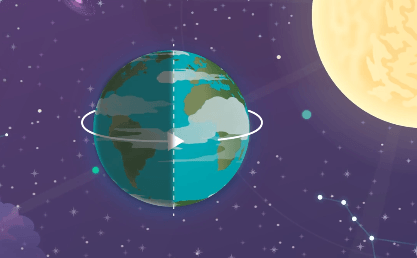
The Earth is rotating on its axis, creating _____
a)
the 12 months
b)
the years
c)
the seasons
d)
day and night
2.
What looks to be the motion of the Sun in the sky is really caused by the motion of _____
a)
the Earth
b)
the stars
c)
the planets
d)
the Earth's axis
3.
The spinning movement of the Earth about its axis is called the Earth's _____
a)
revolution
b)
rotation
c)
precession
d)
orbit
4.
When the part of the world that you're living in is leaning towards the Sun, its _____
a)
winter
b)
spring
c)
summer
d)
fall
5.
When the part of the world that you're living in is leaning away from the Sun, its _____
a)
winter
b)
spring
c)
summer
d)
autumn
6.
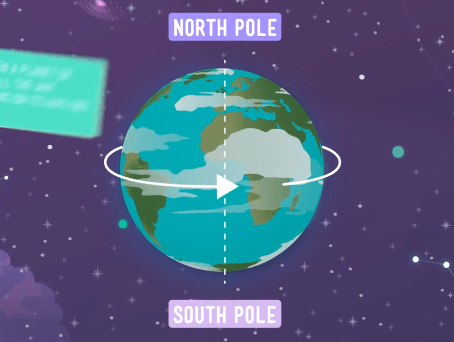
The invisible line that passes through the North Pole and the South Pole is called Earth's ____
a)
axis
b)
equator
c)
ecliptic
d)
prime meridian
7.
The earth is tilted on its _____
a)
line
b)
equator
c)
axis
d)
core
8.
The earth rotates every
a)
24 hours
b)
15 hours
c)
365 days
d)
hour
9.
What does the tilt of the earth cause?
a)
heating
b)
Seasons
c)
Atmosphere
d)
Years
10.
How many times does earth rotate in one year?
a)
365
b)
2
c)
97
d)
120
11.
What causes day and night cycles?
a)
mars
b)
seasons
c)
earths rotation
d)
moon phases
12.
7. The reason we have seasons is because we get closer and farther to the sun.
a)
True
b)
False
13.

How long does it take the Earth to rotate on its axis?

a)

1 hour

b)

1 day

c)

1 week

d)

1 year

14.

The length of an Earth day is determined by the time required for approximately one

a)

Sun revolution

b)

Earth rotation

c)

Earth revolution

d)

Sun rotation

15.
What looks to be the motion of the Sun in the sky is really caused by the motion of _____
a)
the Earth
b)
the stars
c)
the planets
d)
the Earth's axis
16.
Spinning of Earth on its axis.
a)
Rotation
b)
Revolution
17.

What path does the sun take as it moves through the sky?

a)

East to West

b)

North to South

c)

South to North

d)

West to East

18.
Weathering is the process of....
a)
Breaking down rock into smaller and smaller pieces of sediment.
b)
The movement of sediment
c)
Placing sediment into a new location.
d)
None of the above
19.
What is the process of sedimentary rock formation?
a)
Sediments are laid in a new location and layers build up over time. Pressure and cementation pack the layers together.
b)
Sediments are laid in a new location and layers build up over time. Pressure and heat pack the layers together.
c)
Rocks are formed out of lava
d)
Rocks are formed from other rocks.
20.
What must be present for Fossil Fuels to form?
a)
Bones and Sediment
b)
Dead Organisms and Layers of Sediment
c)
Dead Organisms, Layers of Sediment, and Heat & Pressure over time
d)
Bones, Layers of Sediment, and Heat & Pressure over time
21.
Some students made a model to show one of the first steps in the formation of sedimentary rock.  The students pour 2 cm of light-colored sand into a clear plastic box.  Then they add 1 cm of gravel.  Finally, they pour 2 cm of dark-colored sand on top of the gravel.  Which characteristic of sedimentary rock does this model best show?
a)
Sedimentary rock is made of layers.
b)
Sedimentary rock is cemented bits of rock.
c)
Sedimentary rock is often limestone.
d)
Sedimentary rock is common in Texas.
22.
What land form is this?
a)
plain
b)
valley
c)
mountain
d)
canyon
23.
What land form is this?
a)
valley
b)
canyon
c)
plain
d)
mountain
24.
What land form is this?
a)
valley
b)
canyon
c)
mountain
d)
plain
25.
Flood water pounding against a canyon wall and wearing it down
a)
Weathering
b)
Erosion
c)
Deposition
26.
Rain washing away soil from a hillside
a)
Weathering
b)
Erosion
c)
Deposition
27.
Layers of sediment forming at the bottom of the ocean floor
a)
Weathering
b)
Erosion
c)
Deposition
28.
Waves dropping sand on the beach
a)
Weathering 
b)
Erosion
c)
Deposition
29.
Caves being formed by acid rain dissolving underground limestone
a)
Weathering
b)
Erosion
c)
Deposition
30.
Deltas forming at the mouths of rivers
a)
Weathering
b)
Erosion
c)
Deposition
31.
Water getting into cracks, freezing, and breaking the rocks or pavement apart
a)
Weathering
b)
Erosion
c)
Deposition
32.
Wind blowing sand from one location to another
a)
Weathering
b)
Erosion
c)
Deposition
33.
A delta forms where the river meets the ocean because the ocean-
a)
A. makes the river slow down and deposit sediments. 
b)
B. contains salt water and the river contains fresh water. 
c)
C. is usually much older that the water in the river. 
d)
D. has powerful currents that weathers the rocks on the shore. 
34.
Students used a fan to blow piles of sand. This best models which of the following natural processes that create changes to the land? 
a)
A. Weathering of rocks to make soil. 
b)
B. Deposition of sediments to form deltas. 
c)
C. Formation and movement of dunes. 
d)
D. Carving out plains creating canyons. 
35.

Glaciers are masses of ice that move slowly on land. Which of these features was most likely formed by a glacier?

a)

a wide valley

b)

a deep ocean

c)

a lava flow

d)

a mountain range

36.

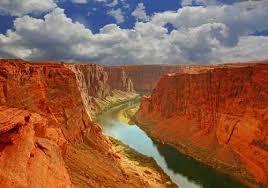
Which of these was the major reason that this canyon was formed?

a)

movement of wind

b)

underground hot springs

c)

movement of water

d)

movement of ice

37.

Which of the following are fossil fuels?

a)

coal

b)

oil

c)

natural gas

d)

petroleum

e)

all of them

38.

Which of the following was needed in order for coal to form?

a)

sea organisms

b)

plants

c)

sunlight

d)

animals

39.

Which of the following was needed for oil to form?

a)

sea organisms

b)

plants

c)

sunlight

d)

trees

40.

Which of the following was needed for natural gas to form?

a)

sea organisms

b)

plants

c)

sunlight

d)

trees

41.

What is weathering?

a)

Rock breaking into sediments

b)

Sediments moving

c)

Sediments being dropped

d)

Sediments forming new rocks

42.

What is erosion?

a)

Rock breaking into sediments

b)

Sediments moving

c)

Sediments being dropped

d)

Sediments forming new rocks

43.

What is deposition?

a)

Rock breaking into sediments

b)

Sediments moving

c)

Sediments being dropped

d)

Sediments forming new rocks

44.

What is compaction?

a)

Sediments being pressed together

b)

Sediments moving

c)

Sediments being dropped

d)

Sediments forming new rocks

45.

What is cementation?

a)

Sediments being pressed together

b)

Sediments moving

c)

Sediments being dropped

d)

Sediments sticking together & forming new rocks

46.
How are Sedimentary Rocks formed?
a)
Cooling and Hardening
b)
Heat and Pressure
c)
Compacting and Cementing
d)
Melting
47.
Where can the oldest layer be found?
a)
The top layer
b)
The middle layer
c)
They are all the same age
d)
The bottom layer
48.
In what kind of rock can fossils be found?
a)
Sedimentary Rocks
b)
Igneous Rocks
c)
Metamorphic Rocks
d)
Granite
49.
What are the 3 main fossil fuels?
a)
Coal, Oil, and Gasoline
b)
Coal, Oil, and Natural Gas
c)
Electricity, Gasoline, Petroleum
d)
Coal, Oil, Non-renewable Resources
50.
Fossil Fuels formed over long periods of time after particles in water settled to the sea floor and formed marine mud.  What kinds of particles needed to be present in the marine mud in order for fossil fuels to form.
a)
Mostly sand and a few small bits of wood
b)
Mostly decaying organisms
c)
Mostly lava and a few sedimentary rocks
d)
Mostly metal minerals
51.
Coal often forms where once there was swamps.  What characteristic of swamps is important to the formation of coal?
a)
High Temperature
b)
Abundant Plant Life
c)
Frequent Rains
d)
Reptile Predators
52.
What changes buried organic matter into fossil fuels?
a)
Industrial Pollution
b)
Ocean Currents
c)
Volcanic Activity
d)
Heat and Pressure
53.
Which layer formed first?
a)
Rock Layer W
b)
Rock Layer X
c)
Rock Layer Y
d)
Rock Layer Z
54.
Snow, sleet, hail, and rain are all examples of  ________________. 
a)
evaporation
b)
condensation
c)
accumulation
d)
precipitation
55.
What is it called when water is formed from a liquid to a water vapor?
a)
EVAPORATION
b)
PRECIPITATION
c)
TRANSPIRATION
56.
What is it called when plants give off water vapor as a waste product?
a)
condensation
b)
evaporation
c)
sublimation
d)
transpiration
57.
When water _________, dew forms.
a)
Melts
b)
Evaporates
c)
Condenses
d)
Precipitates
58.
When water condenses, the water vapor in the air gets ___________ and changes back into liquid.
a)
cold
b)
hot
c)
warm
d)
solid
59.
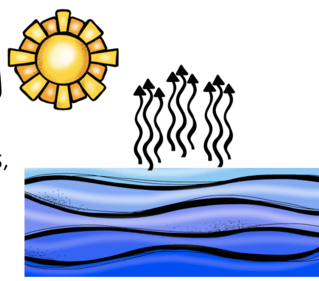
Evaporation happens when the sun ___________ water and turns it into vapor.
a)
cools
b)
heats up
c)
freezes
d)
lights up