wayground logo

Free Printable Worksheets

NEW

Font size

S
M
L
XL
Worksheets

Chem Reactions

Total questions: 66

Worksheet time: 1hrs 18mins
Name
Class
Date
1.
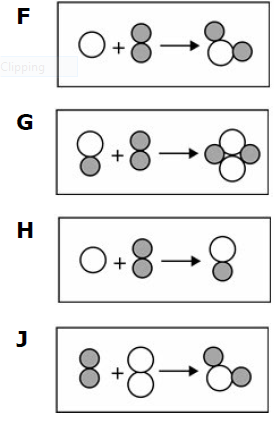
Which of the following models best demonstrates a balanced chemical equation?
a)
F
b)
G
c)
H
d)
J
2.
For an investigation a student poured a blue solution of CuSO4 into a beaker. The student placed a shiny, silver-colored strip of zinc metal in the solution and observed the changes.
The student inferred that a chemical reaction occurred. What evidence supports this inference?
a)
A dark solid formed on the zinc metal.
b)

The zinc metal remained silver-colored and shiny
c)
The CuSO4 solution turned blue when the zinc metal was added.
d)
None of these
3.
Which of the following equations demonstrates an actual chemical reaction that forms a new substance?
a)
A
b)
B
c)
C
d)
D
4.
Which of these formulas contain equal numbers of nitrogen atoms?
a)
Formulas I and III
b)
Formulas I and IV
c)
Formulas II and III
d)
Formulas I, II, and V
5.
The reactants are on the left side of the chemical equation.
a)
True
b)
False
6.
Two clear colorless solutions were combined.
The student observed that the temperature changed from 25 •C to 23 •C when the solutions were combined and that a white substance rapidly formed and settled to the bottom of the container. What most likely happened to produce these results?

a)
One of the original compounds came out of solution
b)
The solutions reacted chemically
c)
Some of the water froze into ice crystals
d)
Rapid evaporation of water occurred, leaving a solid
7.
The equation below represents a chemical reaction that occurs in living cells. How many atoms are represented in the reactants of this equation?
a)
6
6
b)
12
12
c)
24
24
d)
36
36
8.
In which of these compounds are there twice as many oxygen atoms as hydrogen atoms?
a)
H3PO4
b)
H2SO4
c)
HCIO3
d)
H20
9.

How many atoms in all are in a molecule of serotonin?

C10H12N2O

a)
22
b)
24
c)
25
d)
4
10.
Coal contains carbon and other elements. Carbon dioxide forms when coal burns in the presence of oxygen. Which of these is the best evidence that a chemical reaction occurs when coal burns?
a)
The shape of the coal changes
b)
Oxygen is present
c)
A new substance is produced
d)
Coal is made up of more than one element
11.
All of the following reactions are correctly balanced except-
a)
A
b)
B
c)
C
d)
D
12.
What is the mass of H2O in the reaction above?
a)
70.01
b)
24.11
c)
21.44
d)
48.22
13.
A scientist performed four investigations using eight different liquids. In each investigation, the scientist combined two of the liquids under a fume hood and recorded observations in the table below.In which investigation is it least likely that the liquids reacted chemically?
a)
1
b)
2
c)
3
d)
4
14.

In a ___________change, a substance changes into a different substance.

a)

Physical

b)

Chemical

15.

Which of these is NOT a sign that a chemical change has occurred?

a)

A loss of transparency

b)

An unexpected color change

c)

A temperature change

d)

The formation of a precipitate

16.

The Law of Conservation of Mass states

a)

that matter exists in all states and reacts the same

b)

that matter can only be changed into new substances by introducing a catalyst

c)

that matter exists in the same state throughout any chemical change

d)

that matter cannot be created or destroyed and that the mass of the products must equal the mass of the reactants

17.

How many Al atoms are in this compound? 4Al2O3

a)

2

b)

8

c)

6

d)

4

18.

a copper penny turning greenish after a few years.

a)

Physical change

b)

Chemical change

19.

An gel ice pack getting cold after you put it in the freezer for an hour.

a)

Chemical change

b)

Physical change

20.

Which of the following IS a physical change?

a)

Getting a haircut

b)

Rusty metal

c)

sour milk

d)

A compound

21.

Change in the identity of a substance. New

substance is formed, can’t be reversed

a)

chemical reaction

b)

physical change

c)

chemical change

d)

physical reaction

22.

When you change the physical properties of

something but don’t change what it is. Can be reversed

a)

physical reaction

b)

chemical reaction

c)

chemical change

d)

physical change

23.

Atoms in the reactants combine in new and different ways to form the molecules of the products

a)

balanced equation

b)

chemical reaction

c)

chemical change

d)

catalyst

24.

Atoms and molecules that interact with each

other

a)

reactants

b)

products

c)

balanced equation

d)

catalyst

25.

Atoms and molecules produced in a chemical

reaction

a)

reactants

b)

products

c)

balanced equation

d)

catalyst

26.

Atoms in the reactants are the same as atoms in

the products

a)

reactants

b)

products

c)

balanced equation

d)

catalyst

27.

Matter is not created or destroyed – only

changes form

a)

law of conservation of matter

b)

law of conservation of measurement

c)

law of conservation of energy

d)

law of conservation of mass

28.

The mass of what you end up with is always the

same as the mass you started with

a)

law of conservation of matter

b)

law of conservation of measurement

c)

law of conservation of energy

d)

law of conservation of mass

29.

Speeds up the rate of a reaction

a)

catalyst (which are enzymes)

b)

endothermic

c)

exothermic

d)

chemical

30.

Absorbs heat during a chemical reaction,

substance seems cooler

a)

catalyst

b)

endothermic

c)

exothermic

d)

chemical

31.

Releases heat during a chemical reaction,

substance seems warmer

a)

catalyst

b)

endothermic

c)

exothermic

d)

chemical

32.
The symbol for a substance dissolved in water is
a)
(s)
b)
(l)
c)
(g)
d)
(aq)
33.
An ending substance that is made during a chemical reaction is called
a)
Reactant
b)
Product
c)
Atom
d)
Molecule
34.
How many F atoms are in this compound?
6MgF2 
a)
2
b)
6
c)
8
d)
12
35.
The starting substances of a chemical reaction is called
a)
products
b)
substances
c)
reactants
36.
The number of atoms on one side of a chemical equation is equal to
a)
a molecule of a substance
b)
the amount of gas released during a chemical reaction
c)
the number of atoms on the other side of a chemical equation
d)
all of the matter that exists in the universe
37.
The arrow in a chemical reaction is known as
a)
yield/produce
b)
mixture
c)
energy
d)
equals
38.
How many hydrogen atoms are in this chemical formula: 
a)
4 hydrogen atoms
b)
1 hydrogen atom
c)
2 hydrogen atoms
d)
3 hydrogen atoms
39.
How many O's are in Al₂(SO₄)₃
a)
4
b)
12
c)
7
d)
24
40.
How many Magnesium are in 10MgCl2?
a)
10
b)
5
c)
20
d)
1
41.
What is the left part of a chemical equation called?
H2 + O → H2O
a)
Reactants
b)
Products 
c)
Yields 
d)
Chemical Equation 
42.
What is the right part of a chemical equation called?
H2 + O H2O
a)
Reactants
b)
Products 
c)
Yields 
d)
Chemical Equation 
43.
This is used to represent the number of each atom being represented. 
a)
A Exponent
b)
The Coefficient
c)
A Molecule
d)
The Subscript
44.
A group of atoms bonded together. 
a)
A Molecule
b)
The Coefficient
c)
The Subscript
d)
An Atom Party
45.
This appears on the left side of a chemical formula, and represents how many molecules there are. 
a)
An Atom
b)
The Subscript
c)
A Molecule
d)
The Coefficient
46.
How many oxygen atoms are in this chemical formula?
a)
7 oxygen atoms
b)
4 oxygen atoms
c)
3 oxygen atoms
d)
1 oxygen atoms
47.
How many oxygen atoms are in this chemical formula?
a)
6 oxygen atoms
b)
2 oxygen atoms
c)
3 oxygen atoms
d)
4 oxygen atoms
48.
The one or two letters used to represent elements 
a)
Yield sign
b)
Coefficient
c)
Symbol
d)
Subscript
49.
Which type of reaction will feel cold?
a)
exothermic
b)
exergonic
c)
endothermic
d)
none of these
50.
When mixing to unknown substances the mixture begins to colder. Is this evidence of a chemical reaction?
a)
YES
b)
NO
51.
Which statement explains the Law of Conservation of Matter?
a)
In a chemical reaction, matter can only be destroyed.
b)
In a chemical reaction, matter can only be created.
c)
Matter can neither be created nor destroyed in a chemical reaction.
d)
Matter can be created or destroyed in a chemical reaction.
52.
What type of chemical reaction releases energy in the form of heat?
a)
endothermic
b)
exothermic
c)
subthermic
d)
geothermic
53.
Is this balanced?
Al + O2 → 2Al2O3
a)
Yes
b)
No
54.
Is this balanced?
2HgO → 2Hg + O2
a)
Yes
b)
No
55.
What is the right part of a chemical equation called?
H2 + O H2O
a)
Reactants
b)
Products 
c)
Yields 
d)
Chemical Equation 
56.
What is the left part of a chemical equation called?
H2 + O → H2O
a)
Reactants
b)
Products 
c)
Yields 
d)
Chemical Equation 
57.
You know you a chemical reaction has occurred if 
a)
there is a precipitate.
b)
there is a color change.
c)
there is a temperature change.
d)
All of these answers are evidence.
58.
One of the signs of a chemical reaction taking place is:
a)
Bubbles are produced 
b)
Reactants are not combining
c)
Products are not forming
d)
Color is not changing
59.
Which of the following describes a precipitate?
a)
a liquid forms when a block of metal is heated
b)
a solid forms when one liquid is poured into another
c)
a gas forms when a solid is placed in a liquid
d)
bubbles form when an acid is poured on a rock
60.
Which is NOT an indication of a chemical change?
a)
temperature change
b)
formation of a precipitate
c)
shape change
d)
production of light
61.
A clear liquid from a flask is poured into another clear liquid in a beaker. Which of the following results of this procedure would indicate a new substance was formed?
a)
The level of the substance in the beaker is higher after the other liquid is added.
b)
A yellow solid forms and then settles to the bottom of the beaker.
c)
Small white crystals are left behind in the flask that held the first liquid.
d)
The mass of the combined liquids is greater than either original liquid.
62.
Which of the following is an example that includes evidence of a chemical reaction?
a)
A sample of zinc is placed in water and it settles to the bottom
b)
A solid block of ice is heated and it completely melts into a liquid. 
c)
Sugar that is burned gives off an odor and turns brown and then black.
d)
A tomato is placed into a blender and chopped up into smaller pieces.
63.
Four students performed four different investigations by combining different substances. Which of the observations is most indicative of a chemical reaction?
a)
investigation 1
b)
investigation 2
c)
investigation 3
d)
investigation 4
64.
A student places a piece of a potato into a container of hydrogen peroxide. One observation the student makes is that bubbles form around the potato. The presence of bubbles might indicate the formation of a new substance because bubbles - 
a)
could show that a gas is forming.
b)
always rise to the top of a liquid. 
c)
are almost always perfectly spherical.
d)
usually burst after a few minutes.
65.
In a container, a solid consisting of clear crystals is combined with a blue liquid and the following observations are obtained: How many of the listed observations indicate a new substance was formed?
a)
1
b)
2
c)
3
d)
4
66.
What type of change do we see in when we melt ice?
a)
Physical Change
b)
Chemical Change